answer.
Ask question
Login Signup
Ask question
All categories
  • English
  • Mathematics
  • Social Studies
  • Business
  • History
  • Health
  • Geography
  • Biology
  • Physics
  • Chemistry
  • Computers and Technology
  • Arts
  • World Languages
  • Spanish
  • French
  • German
  • Advanced Placement (AP)
  • SAT
  • Medicine
  • Law
  • Engineering
gulaghasi [49]
2 years ago
4

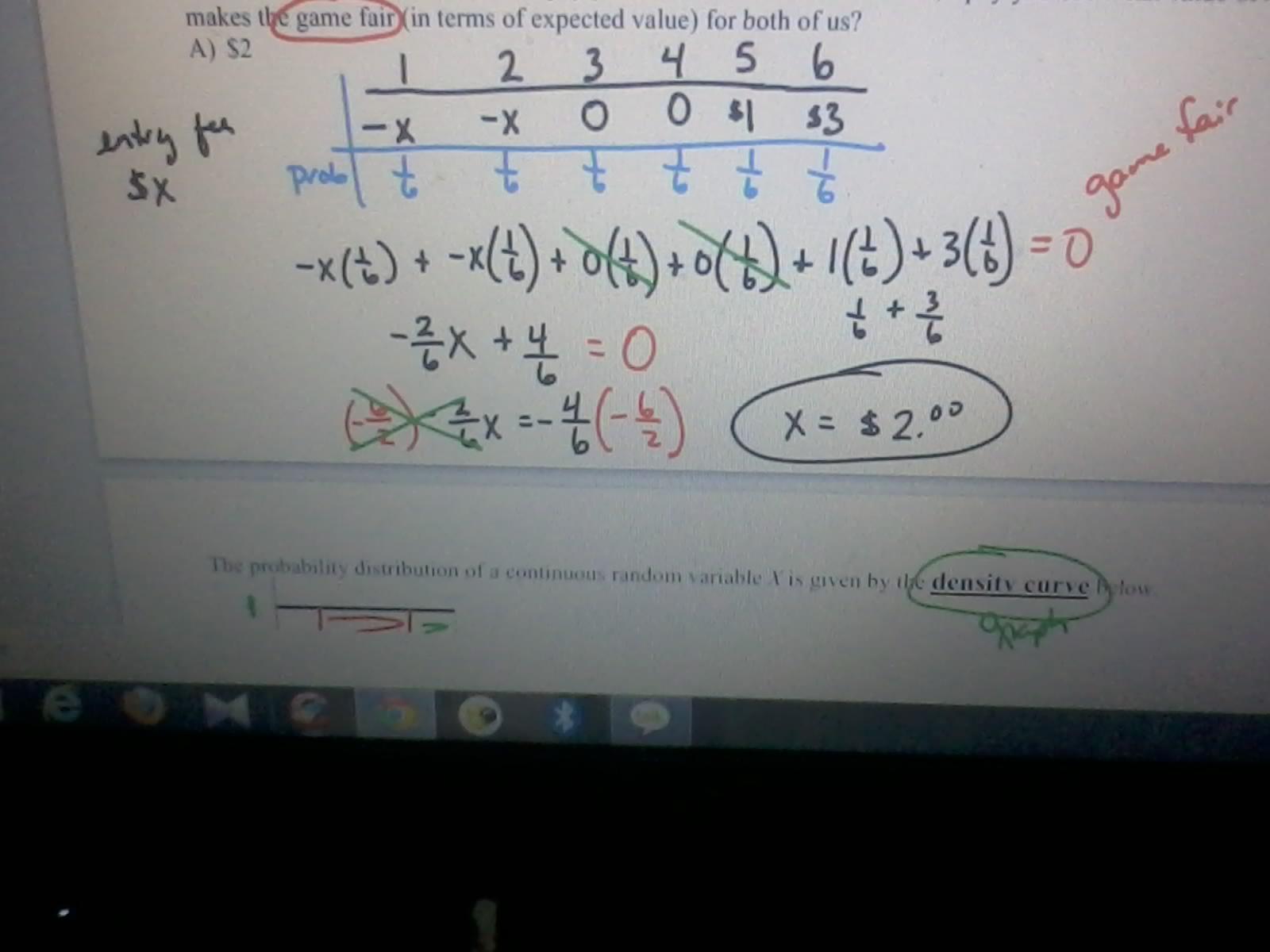
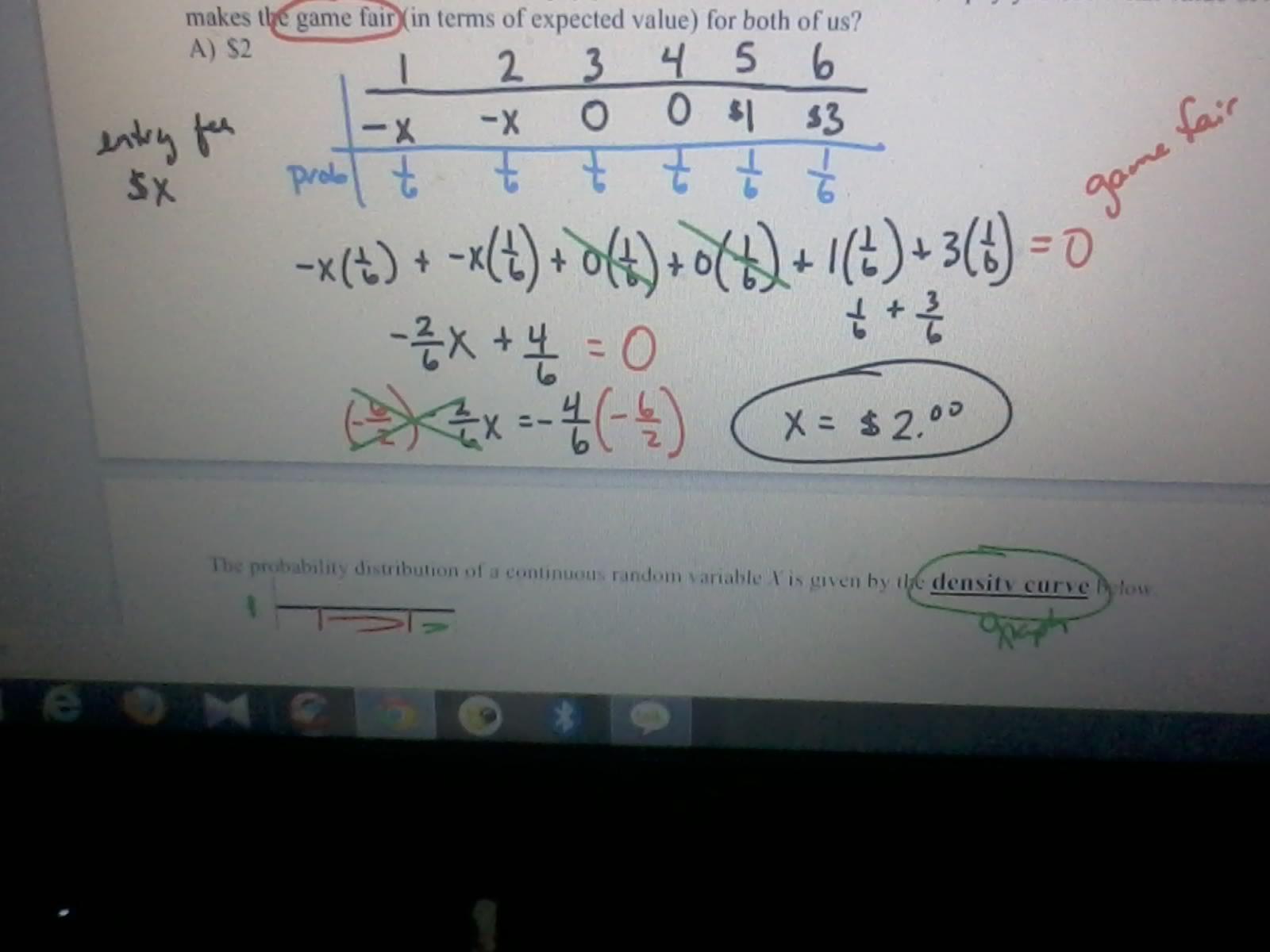
Consider the following game. You pay me an entry fee of x dollars, then I roll a fair die. If the die shows a number less than 3

, I pay you nothing; if the die shows a 3 or 4, I give you back your entry fee of x dollars; if the die shows a 5, I will pay you $1; and if the die shows a 6, I pay you $3. What value of x makes the game fair (in terms of expected value) for both of us

Business
1 answer:
Lapatulllka [165]2 years ago
6 0

Answer

The answer and procedures of the exercise are attached in the following archives.

Step-by-step explanation:

You will find the procedures, formulas or necessary explanations in the archive attached below. If you have any question ask and I will aclare your doubts kindly.  

You might be interested in
In most instances, who is in the best position to perform the function of appraising an employee's performance? someone from the
natka813 [3]
The answer would be:
the employees supervisor.

Hope this helps
3 0
2 years ago
Your Green Investment Tips subscription is about to expire. You plan to subscribe to the magazine for the rest of your life, and
pentagon [3]

Answer:

The answer is a. 14.33.

Explanation:

We apply the net present value (NPV) methodology to approach the two options.

+ The lifetime subscription's npv = $(850)

+ The annual subscription's npv = - 85 - [ 85/6% * [ 1 - 1.06^(-n) ], with n is the number of years the subscriber still lives.

To make a lifetime subscription a better buy, the NPV of this option should be higher than the NPV of annual subscription or:

85 + [ 85/6% * [ 1 - 1.06^(-n) ] > 850 <=> 1 - 1.06^(-n) > 0.54 <=> 1.06^(-n) < 0.46 <=> -n < -13.33 <=> n > 13.33.

So, the subscriber should live more than 14.33 years ( 13.33 + 1 years for another next year subscription) to make the lifetime subscription a better choice.

So, a is the correct choice.

4 0
2 years ago
Exercise 10-3 Sell or process further LO P2 Cobe Company has already manufactured 28,000 units of Product A at a cost of $28 per
kozerog [31]

Answer:

The company should process the units further.

Explanation:

Base on the scenario been described in the question, we can be able to use the method to prepare an analysis that shows whether the 28,000 units of Product A should be processed further or not.

Sell as is Process

further

Sale as is (28,000 units x $25.00) $700,000

Process further (5,600 units x $105) + (11,200 x $70) $1,372,000

Cost to process further (420,000)

Incremental income (loss) $700,000 $952,000

The company should process the units further

7 0
2 years ago
​greg, a​ landscaper, is planning on opening his own landscaping company. he currently earns​ $40,000 per year working for his u
Oxana [17]

Answer:

The total economic cost is $40,500 per year

Explanation:

The total economic cost per year is equal to the sum of:

* The opportunity cost relating to sacrificing the current work Greg is working on which is equal to his yearly salary of : $40,00.

* The opportunity cost relating to sacrificing the interest income earned on $10,000 saving, which he is now used for purchasing equipment, which is calculated as: 10,000 * current rate of savings = 10,000* 5% = $500 ( total cost of equipment is not included because e could sell the equipment for what he​ paid later on).

=> So, total economic cost per year is $40,000 + $500 = $40,500.

5 0
2 years ago
Show the total cost expression and calculate the EOQ for an item with holding cost rate 18%, unit cost $8.00, annual demand of 4
torisob [31]

Answer:

Total cost = Total ordering cost + Total holding cost

Total cost = DCo     + QH

                     Q              2

Where

D = Annual demand

Co = Ordering cost per order

Q = EOQ

H = Holding cost per item per annum

D = 40,000 units

Co = $48

H = 18% x $8.00 = $1.44

EOQ = √2DCo

                H

EOQ = √2 x 40,000 x $48

                     $1.44

EOQ = 1,633 units

Explanation:

EOQ equals 2 multiplied by annual demand and ordering cost divided by holding cost per item per annum. The holding cost per item per annum is calculated as holding cost rate multiplied by unit cost.
7 0
2 years ago
Other questions:
  • Oscar's dog house has a profit margin of 5.6 percent, a return on assets of 12.5 percent, and an equity multiplier of 1.49. what
    14·1 answer
  • Bechtel, a construction and engineering firm, has a contract with the indian government to expand the airport in new delhi. bech
    12·1 answer
  • David is preparing a report to show the percentage increase in population in the United States in The Last 5 Years which feature
    8·1 answer
  • Campbell Soup uses electronic networks to improve the efficiency of outbound logistics. These networks also helped Campbell Soup
    11·1 answer
  • "North Shore Community College reimburses faculty members $.535 cents per mile to go to a workshop. Professor Wales submitted he
    14·1 answer
  • Yvette Bradbury is an account representative at Commerce Savings Bank, earning $45,600 annually, paid semimonthly. She contribut
    10·1 answer
  • Your answer is incorrect. Try again. Blossom Corp. had total variable costs of $219,600, total fixed costs of $126,750, and tota
    7·1 answer
  • Presented below are two independent situations. a. George Gershwin Co. sold $2,000,000 of 10%, 10-year bonds at 104 on January 1
    9·2 answers
  • Bethany works for FastFashion Inc. which has set the same sales target for all employees in their 550 stores across the globe. T
    6·1 answer
  • Each of the following quality control policies and procedures is typical of ones that can be found in public accounting firms’ s
    8·1 answer
Add answer
Login
Not registered? Fast signup
Signup
Login Signup
Ask question!
