answer.
Ask question
Login Signup
Ask question
All categories
  • English
  • Mathematics
  • Social Studies
  • Business
  • History
  • Health
  • Geography
  • Biology
  • Physics
  • Chemistry
  • Computers and Technology
  • Arts
  • World Languages
  • Spanish
  • French
  • German
  • Advanced Placement (AP)
  • SAT
  • Medicine
  • Law
  • Engineering
Mekhanik [1.2K]
2 years ago
12

Describe the characteristics of the phospholipid bilayer that permit small hydrophobic lipid molecules to pass directly across t

he membrane.
Biology
1 answer:
Ipatiy [6.2K]2 years ago
6 0

Explanation:

The phospholipid bilayer forms the outermost layer of cells called the plasma membrane of the cell.

The phospholipids are arranged in the bilayer with the globular head composed of glycerol and the phosphate on the outer side (hydrophilic) and the hydrophobic carbon chain in the inner side.

The hydrophobic molecule present in the layer provides a characteristic feature to the membrane that is known as selective permeability. The selective permeability allows the non-polar or uncharged molecule to pass through the membrane and not the large polar molecules.

This is because the non-polar molecules can interact with the hydrophobic portion (tails) which could allow the molecules to pass through the membrane but the polar molecules are repelled by the hydrophobic protein so require special channels.

You might be interested in
A biologist at World University used Procedure IV to conduct an additional study and found the sequence following below. Using y
Nady [450]

Answer:

Valine-Leucine-Proline-Lysine-Histidine

Explanation:

The central dogma of biology is the process by which DNA is used to synthesize RNA and subsequently amino acid sequence (PROTEIN). The processes of transcription and translation is used in gene expression. Transcription is the process whereby the information encoded in a DNA molecule is used to synthesize a mRNA molecule. Transcription is catalyzed by RNA polymerase enzyme, which uses complementary base pairing rule i.e Adenine(A)-Thymine(T), Guanine(G)-Cytosine(C) pairing.

N.B: Thymine is replaced by Uracil in the mRNA

For the above DNA sequence: CAC GAC GGA TTC GTA, the mRNA sequence will be: GUG CUG CCU AAG CAU

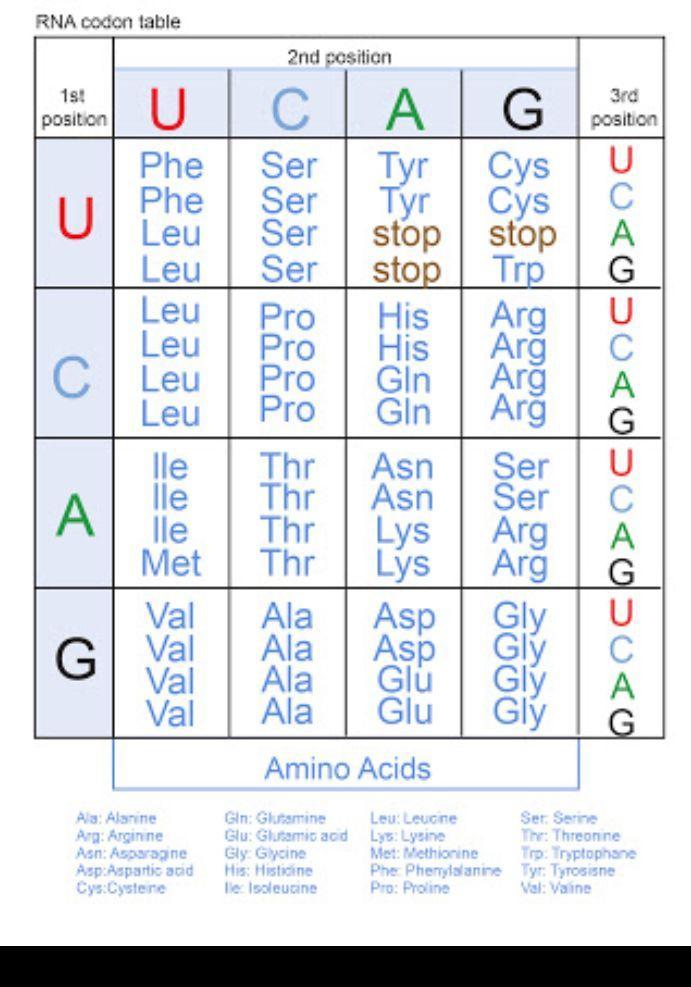
Translation is the second process of gene expression which involves the synthesis of an amino acid sequence from an mRNA molecule. The mRNA is read in a group of three nucleotides called CODON. Each codon specifies an amino acid (see attached image for genetic code)

Based on the attached genetic code, an mRNA sequence: GUG CUG CCU AAG CAU will encode an amino acid sequence: Valine(Val) - Leucine (Leu) -Proline (Pro) -Lysine (Lys) - Histidine (His).

GUG specifies Valine amino acid

CUG specifies Leucine amino acid

CCU specifies Proline amino acid

AAG specifies Lysine amino acid

CAU specifies Histidine amino acid

5 0
2 years ago
Choose the statements below that are true. Cells are the smallest unit of life. Cells are important to the structure and functio
Irina-Kira [14]

Cells are the smallest unit of life. This is true.

Cells are important to the structure and function of living things. This is true.

All organisms are made of multiple cells. This is false, because there are many single celled organisms like bacteria.

Cells come in different shapes and sizes. This is true, as there are cells with a variety of shape and size (round shaped cocci and the elongated and flat bacillus). There are cells from squid's nervous system, called the neurons, that are comparatively very large in size than the vast majority of the other cells.

6 0
2 years ago
Read 2 more answers
According to the Focus on Neuroscience box titled, "Mirror Neurons; Imitation in the Brain?", recent findings reveal that specif
Len [333]

Answer:

c

Explanation:

7 0
2 years ago
I started out as magma down in the earths
erastovalidia [21]
Lava is the next step after magma if it reaches the surface 


8 0
2 years ago
Read 2 more answers
Use the model here to describe the transfer of matter and flow of energy from one trophic level to another within an ecosystem.
Brrunno [24]

Answer:

A)Biomass is transferred from one organism to another when one organism consumes another organism. When a predator organism eats the prey organism, the molecules on the food are broken down by the digestive system into smaller molecules. These smaller molecules like lipids, amino acids, glucose are used by the organism for various purposes.

B) Energy that is not transferred from one organism to another is either used up by the organism for various purposes. Most of the energy is lost into the environment in the form of heat.

c) There are typically fewer organisms at the top of the trophic levels because energy keeps on declining at each trophic levels so the number of consumers which it can satisfy also decreases.

d) Only 10% of the energy passes from one trophic level to another. The rest is usually lost in the form of heat. For example, if there was 100%  energy in the producers, only 10% would pass to the primary consumers. The secondary consumers will receive 1%.


6 0
2 years ago
Other questions:
  • What element is the most abundant in the earth's crust?
    5·1 answer
  • 3. Which of the following is a characteristic that could be applied to both living and nonliving things? (1 point)
    11·1 answer
  • A chromosome contains ____
    14·1 answer
  • Which unit of measurement is used in the metric system?
    7·2 answers
  • A scientist is using relative dating to determine the age of a fossil that she discovered.
    9·2 answers
  • Many foods must be refrigerated to prevent spoiling (microbial growth). Explain why honey (which is ∼82% carbohydrate by weight)
    7·1 answer
  • Why aren’t your cells poisoned to death even though they create toxins?
    13·1 answer
  • Show how selection, genetic drift, gene flow, and mutation relate to genetic variation. Match the words in the left column to th
    14·1 answer
  • Which of the following would most likely mark the beginning of a new era?
    8·2 answers
  • How do animals that live in the tundra survive? *
    7·1 answer
Add answer
Login
Not registered? Fast signup
Signup
Login Signup
Ask question!