answer.
Ask question
Login Signup
Ask question
All categories
  • English
  • Mathematics
  • Social Studies
  • Business
  • History
  • Health
  • Geography
  • Biology
  • Physics
  • Chemistry
  • Computers and Technology
  • Arts
  • World Languages
  • Spanish
  • French
  • German
  • Advanced Placement (AP)
  • SAT
  • Medicine
  • Law
  • Engineering
GenaCL600 [577]
2 years ago
9

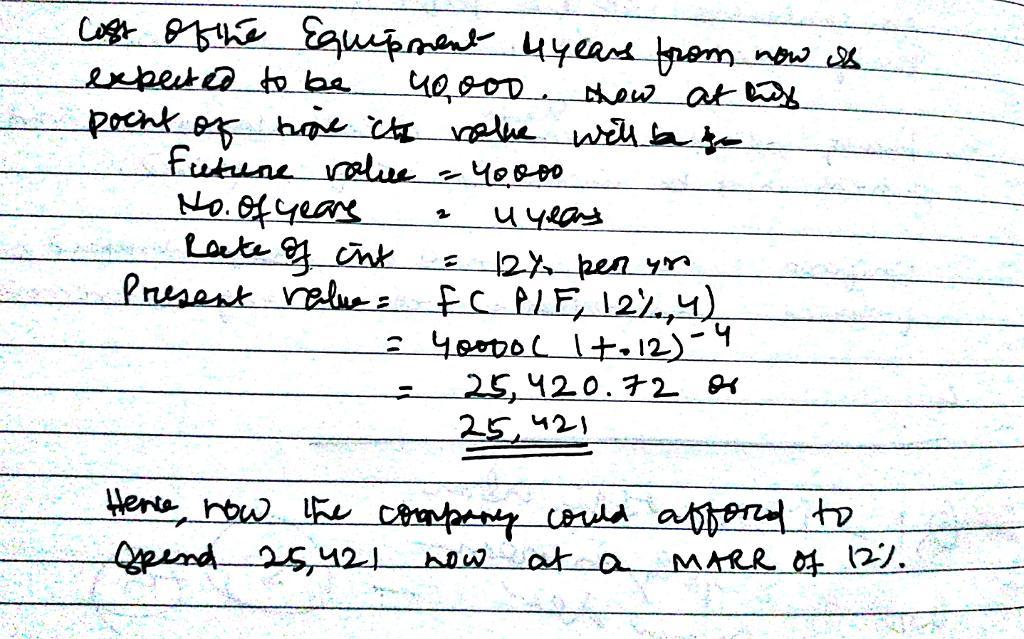
10. A maker of micromechanical systems can reduce product recalls by 10% with the installation of new packaging equipment. If th

e cost of the new equipment is expected to be $40,000 four years from now, how much could the company afford to spend now (instead of 4 years from now) at a minimum attractive rate of return of 12% per year?

Engineering
1 answer:
trapecia [35]2 years ago
5 0

Answer:

See explaination

Explanation:

Please kindly check attachment for the step by step solution of the given problem.

You might be interested in
If the current on your power supply exceeds 500 mA it can damage the supply. Suppose the supply is set for 37 V. What is the sma
lilavasa [31]

Answer:

74 Ω

Explanation:

Data provided in the question:

Maximum value of the current that can be provided = 500 mA

= 500 × 10⁻³ A  

Applied voltage set for the system = 37 V

Now,  

The smallest resistance that can be measured    

= [ Applied voltage ] ÷ [ Maximum current that can be applied ]

= 37 ÷ (  500 × 10⁻³ )

= 74 Ω

4 0
2 years ago
Water at 200C flows through a pipe of 10 mm diameter pipe at 1 m/s. Is the flow Turbulent ? a. Yes b. No
Degger [83]

Answer:

Yes, the flow is turbulent.

Explanation:

Reynolds number gives the nature of flow. If he Reynolds number is less than 2000 then the flow is laminar else turbulent.

Given:

Diameter of pipe is 10mm.

Velocity of the pipe is 1m/s.

Temperature of water is 200°C.

The kinematic viscosity at temperature 200°C is 1.557\times10^{-7}m2/s.

Calculation:

Step1

Expression for Reynolds number is given as follows:

Re=\frac{vd}{\nu}

Here, v is velocity, \nu is kinematic viscosity, d is diameter and Re is Reynolds number.

Substitute the values in the above equation as follows:

Re=\frac{vd}{\nu}

Re=\frac{1\times(10mm)(\frac{1m}{1000mm})}{1.557\times10^{-7}}

Re=64226.07579

Thus, the Reynolds number is 64226.07579. This is greater than 2000.

Hence, the given flow is turbulent flow.

5 0
2 years ago
Which of the following is NOT true about hydraulic valves? A. Directional control valves determine the path of a fluid in a give
Lelechka [254]

Answer: Option D is not true of hydraulic valves. A hydraulic valve is a device that can change the opening degree of liquid flow path

Explanation:

The pilot check valve allows flow of liquid in one direction and blocks flow in the opposite direction

5 0
2 years ago
A three-point bending test was performed on an aluminum oxide specimen having a circular cross section of radius 3.5 mm (0.14 in
RideAnS [48]

To resolve this problem we have,

R=3.5mm\\F_f1=950N\\L_1=50mm\\b=12mm\\L_2=40mm

F_{f2} is unknown.

With these dates we can calculate the Flexural strenght of the specimen,

\sigma{fs}=\frac{F_{f1}L}{\pi R^3}\\\sigma{fs}=\frac{(950)(50*10^{-3})}{\pi 3.5*10^{-3}}\\\sigma{fs}=352.65Mpa

After that, we can calculate the flexural strenght for the square cross section using the previously value.

\sigma{fs}=\frac{F_{f2}L}{\pi R^3}\\(352.65*10^6)=\frac{3Ff(40*10^{-3})}{2(12*10^{-10})}\\F_{f2}=\frac{352.65*10^6}{34722.22}\\F_{f2}=10156.32N\\F_{f2}=10.2kN

6 0
2 years ago
The extruder head in a fused- deposition modeling setup has a diameter of 1.25 mm (0.05 in) and produces layers that are 0.25mm
Angelina_Jolie [31]

Answer:

The time taken will be "1 hour 51 min". The further explanation is given below.

Explanation:

The given values are:

Number of required layers:

= \frac{38}{0.25}

= 152 \ layers

Diameter (d):

= 1.25 mm

Velocity (v):

= 40 mm/s

Now,

The area of one layer will be:

= 38\times 38 \ mm^2

= 1444 \ mm^2

The area covered every \second will be:

= d\times v

= 1.25\times 40

= 50 \ mm^2

The time required to deposit one layer will be:

= \frac{1444}{50}

= 28.88 \ sec

The time required for one layer will be:

= 15 \ sec

∴ Total times required for one layer will be:

= 15+28.88

= 43.88 \ sec

So,

Number of layers = 152

Therefore,

Total time will be:

= 152\times 43.88

= 6669.76 \ sec

= 1 \ hour \ 51 \ min

6 0
2 years ago
Other questions:
  • A 0.2-m^3 rigid tank equipped with a pressure regulator contains steam at 2MPa and 320C. The steam in the tank is now heated. Th
    9·1 answer
  • A long aluminum wire of diameter 3 mm is extruded at a temperature of 280°C. The wire is subjected to cross air flow at 20°C at
    9·1 answer
  • Your roommate wants to learn about organizational chart. You can tell her that these charts can tell you all of these about an o
    10·1 answer
  • A 0.9% solution of NaCl is considered isotonic to mammalian cells. what molar concentration is this?
    10·1 answer
  • A signalized intersection approach has an upgrade of 4%. The total width of the cross street at this intersection is 60 feet. Th
    15·1 answer
  • 5 kg of steam contained within a piston-cylinder assembly undergoes an expansion from state 1, where the specific internal energ
    7·1 answer
  • A negative pressure respirator brings fresh air to you through a hose<br>A) True<br>B)False​
    15·2 answers
  • The following passage contains a fragment. Select the correct revision. Presley took the exuberance of gospel and added the freq
    7·1 answer
  • The procedure for determining the presence of Non-Condensable Gasses in refrigerant contained in an external recovery tank utili
    5·2 answers
  • Anytime scaffolds are assembled or __________, a competent person must oversee the operation.
    15·2 answers
Add answer
Login
Not registered? Fast signup
Signup
Login Signup
Ask question!