answer.
Ask question
Login Signup
Ask question
All categories
  • English
  • Mathematics
  • Social Studies
  • Business
  • History
  • Health
  • Geography
  • Biology
  • Physics
  • Chemistry
  • Computers and Technology
  • Arts
  • World Languages
  • Spanish
  • French
  • German
  • Advanced Placement (AP)
  • SAT
  • Medicine
  • Law
  • Engineering
den301095 [7]
2 years ago
5

A manager for a factory farm is ordering corn. Each animal eats 2.3 kg of corn per day. Considering all the inputs associated wi

th growing corn in an industrialized manner (fertilizers, pesticides, machinery, etc.) it takes 2 liters of oil to produce 10 grams of corn. How much oil is used to grow the corn for a one week supply of corn for the 3000 animals the manager must feed?
Biology
2 answers:
jok3333 [9.3K]2 years ago
6 0

Answer: 9,666,000 Liters of Oil

(asterisk is multiply. underscore is divide)

Explanation:

3000 animals * 2300 g * 2 liters oil * 7days ____________________________________

1 animal * 10 grams * 1 day

asambeis [7]2 years ago
5 0

Answer:

each animal eats 2.3g of corn per day

Explanation:

You might be interested in
Of the following items listed below, which is the best description for why skeletal muscle stores glycogen? Of the following ite
mars1129 [50]

Answer:

Skeletal muscle stores glycogen because it is a heavy consumer of energy.

Explanation:

Skeletal fiber contractions are based on different physiological and biochemical phenomena that happen in every cell and that need an amount of energy to occur. During muscle contraction, <em>myosin binds to the uncovered actin-binding sites, producing littles power strokes that, continuously, lead to muscle contraction</em>. To make this process possible, the muscle needs energy.  

Glycogen is a very important energetic reserve polysaccharide for animals. It is stored in the liver and muscles, and when the organism needs energy it degrades glycogen into glucose, which is an available form for the metabolism.  In the liver,<em> glycogen</em> is used to maintain constant levels of <em>blood glucose</em>. While in muscles, glycogen plays an important role in the glucose storage as a source of energy, needed and used only for contraction.

During muscle contraction, ATP molecules obtained from glucose are split to ADP and inorganic phosphate.

3 0
2 years ago
In a flowering plant, tall (T) is dominant to short (t), and blue flowers (B) is dominant to white flowers (b). A tall plant wit
Bumek [7]
<h3>Answer: </h3><h3 />

25%

<h3>Explanation:</h3>

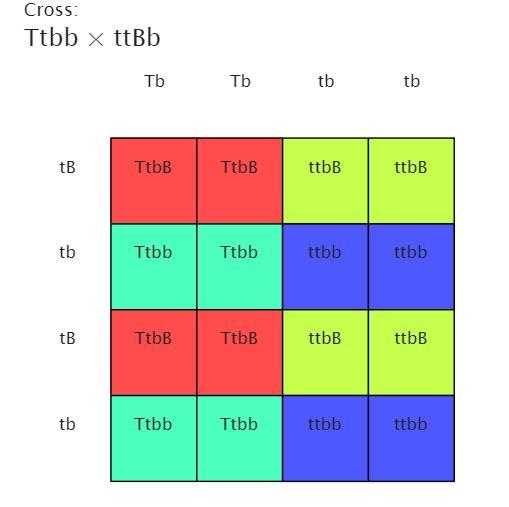
Following a cross between <u>Ttbb</u> and <u>ttBb</u>, the resulting offspring would be:

TtbB , TtbB , Ttbb , Ttbb , ttbB , ttbB , ttbb , ttbb , TtbB , TtbB , Ttbb , Ttbb , ttbB , ttbB , ttbb , ttbb

To have a clearer idea, see the attached image.

Of the 16 possible combinations from this dihybrid cross, there will be:

4 tall plants with blue flowers

4 tall plants with white flowers

4 short plants with blue flowers

4 short plants with white flowers

There are 4 possible genotypic recombinations that would yield short plants with white flowers out of a possible 16, so the chance that the offspring will be short with white flowers would be 4/16 which is 1/4 or 25%

<h3>Hope this helps</h3>

6 0
2 years ago
The data above represent the results of three different crosses involving the inheritance of a gene that determines whether a ce
prohojiy [21]

Answer:

The statement that best explains the mechanisms of inheritance of gene "The allele for blue is an X-linked dominant allele because there are no blue male offspring in cross 2."

Explanation:

The mechanism for inheritance of gene is the condition, in which the mutation when happens in one allele and cause the effect in the relevant phenotype. Similar inheritance will also be seen when the mutated allele will produce new type of the protein which will have deletorious effect on the normal function of the cell. In case of the single gene, autosomal dominant, autosomal recessive, X-linked dominant, X- linked recessive and mitochondrial are modes of inheritance.

4 0
2 years ago
Quiz: sensation and perception select the best answer to each question. our perception of the brightness of a color is affected
zmey [24]

Our perception of the brightness of a color is affected mainly by: the amplitude of light waves.

Night and peripheral vision depend mainly on rods, while daylight and acute vision depend mainly on cones.

The amount of light entering the eye is regulated by changes in the size of the pupil.

If you project a red, a green, and a blue light into space, the point at which the three lights cross will lead to the perception of white light.

eric has been wearing red welding goggles for the past 30 minutes. Based on the opponent-process theory of color vision, when Eric takes off the red goggles, he should expect that objects will temporarily appear to be green.


3 0
2 years ago
In mammoths, assume that spotted skin (S) is dominant over non-spotted skin (s) and that wooly hair (W) is dominant over non-woo
lisabon 2012 [21]

Answer:

Genotypic and Phenotypic ratios → 1:1:1:1

  • 25% of the progeny is expected to be SsWw, exhibiting spotted skin and wooly hair, SsWw
  • 25% of the progeny is expected to be Ssww, exhibiting spotted skin and non-wooly hair, Ssww
  • 25% of the progeny is expected to be ssWw, exhibiting non- spotted skin and wooly hair, ssWw
  • 25% of the progeny is expected to be ssww, exhibiting non-spotted skin and non-wooly hair, ssww

Explanation:

<u>Available data</u>:

  • spotted skin (S) is dominant over non-spotted skin (s)
  • wooly hair (W) is dominant over non-wooly hair (w)
  • Cross: heterozygous spotted, non-wooly mammoth with a heterozygous wooly-haired, non-spotted mammoth.

Parentals) Ssww   x   ssWw

Gametes) Sw, Sw, sw, sw

                 sW, sW, sw, sw

Punnett square)     Sw            Sw           sw           sw

                  sW      SsWw      SsWw      ssWw     ssWw

                  sW      SsWw      SsWw      ssWw     ssWw

                  sw      Ssww       Ssww       ssww      ssww

                  sw      Ssww       Ssww       ssww      ssww

F1) 4/16 = 1/4 = 25% of the progeny is expected to be SsWw, exhibiting spotted skin and wooly hair

    4/16 = 1/4 = 25% of the progeny is expected to be Ssww, exhibiting spotted skin and non-wooly hair

    4/16 = 1/4 = 25% of the progeny is expected to be ssWw, exhibiting non- spotted skin and wooly hair

    4/16 = 1/4 = 25% of the progeny is expected to be ssww, exhibiting non-spotted skin and non-wooly hair.

Genotypic and Phenotypic ratios → 1:1:1:1

7 0
2 years ago
Other questions:
  • Saki went on vacation and was fortunate enough to get to see the aurora australis. What solar activity did she observe? solar fl
    14·2 answers
  • The vascular cambium _____.
    15·1 answer
  • Check all the ways listed below that ensure accurate reading of volume from a graduated pipette. tapping the base of the pipette
    15·2 answers
  • state one reason why a glucose molecule is more likely than a sucrose molecule to diffuse through an artificial membrane
    6·2 answers
  • Which neurotransmitters is a dissolved gas?
    11·1 answer
  • The proximal end of the radius illustrates the relationship of form and function. The cup-like surface of the radial head articu
    9·1 answer
  • Your roommate tells you that because she has no time to eat healthy foods, she is taking megadoses of vitamins. You warn her tha
    15·2 answers
  • Which of the following statements concerning ribosomes is true?
    13·1 answer
  • Which details from the text reflect the cultural context of the historical period in which Marco Polo wrote his travelogue? Chec
    13·2 answers
  • Which type of biological macromolecule depends most upon its three-dimensional shape to function properly?
    14·1 answer
Add answer
Login
Not registered? Fast signup
Signup
Login Signup
Ask question!