answer.
Ask question
Login Signup
Ask question
All categories
  • English
  • Mathematics
  • Social Studies
  • Business
  • History
  • Health
  • Geography
  • Biology
  • Physics
  • Chemistry
  • Computers and Technology
  • Arts
  • World Languages
  • Spanish
  • French
  • German
  • Advanced Placement (AP)
  • SAT
  • Medicine
  • Law
  • Engineering
Natali5045456 [20]
2 years ago
15

Finance, or financial management, requires the knowledge and precise use of the language of the field. Match the terms relating

to the basic terminology and concepts of the time value of money on the left with the descriptions of the terms on the right. Read each description carefully and type the letter of the description in the Answer column next to the correct term. These are not necessarily complete definitions, but there is only one possible answer for each term.
Discounting:A. Concept that maintains that the owner of a cash flow will value it differently, depending on when it occur.
Time value of money terms:B. The amount towhich an ndividual cash flow or series of cash payments or receipt ewill grow over a period of time when earning interest at a given rate of interest.
Amortized loan:C. A type of security that is frequently used in mortgages and requres that the loan payment contain both interest and loan principal.
Ordinary annulty:D. An interest rate that reflects the return required by a lender and paid by a borrower, expressed as a percentage of the principal borrowed.
Annual percentage rate:E. A series of equal cash flows that occur at the end of each of the equally rate spaced intervals (such as daily, monthly, quarterly, and so on)
Annuity due: F. A table that reports the results of the disaggregation of each payment on an amortized loan, such as a mortgage, into its interest and loan repayment components.
Perpetuity:G. A process that involves calc lating the current value of a future cash flow or series of cash flows based on a certain interest rate Future value:H. A rate that represents the return on an investor's best available alternative investment of equal risk.
Amortization schdule:I. A series of equal (constant) cash flows (receipts or payments) that are schedule expected to continue forever
Opportunity cost of funds:J. A series of equal cash flows that occur at the beginning of each of the equaly spaced intervas (such as daily, monthly, quarterly, and so on)
Time value of money calculations can be solved using a mathernatical equation, a financial calculator, or a spreadsheet. Which of the following equations can be used to solve for the present alue of an annuity due?
A. PMT x (1-(1/ (1 + r)/r) x (1 +r)
B. PMT x (1-(1/ (1 + r)n]}
C. PMT/r
D. PMT x{[(1+r)n-1]/r*(1+r)
Business
1 answer:
Ierofanga [76]2 years ago
6 0

Answer:

1. Time value of money.

2. Future value.

3. Amortized loan.

4. Annual percentage rate.

5. Annuity due.

6. Amortization schedule.

7. Discounting.

8. Opportunity cost of funds.

9. Perpetuity.

10. Ordinary annuity.

11. A

Explanation:

1. <u>Time value of money</u>: concept that maintains that the owner of a cash flow will value it differently, depending on when it occur.

2. <u>Future value</u>: the amount to which an individual cash flow or series of cash payments or receipt will grow over a period of time when earning interest at a given rate of interest.

3. <u>Amortized loan</u>: a type of security that is frequently used in mortgages and requires that the loan payment contain both interest and loan principal.

4. <u>Annual percentage rate</u>: an interest rate that reflects the return required by a lender and paid by a borrower, expressed as a percentage of the principal borrowed.

5. <u>Annuity due</u>: A series of equal cash flows that occur at the end of each of the equally rate spaced intervals (such as daily, monthly, quarterly, and so on)

6. <u>Amortization schedule</u>: a table that reports the results of the disaggregation of each payment on an amortized loan, such as a mortgage, into its interest and loan repayment components.

7. <u>Discounting</u>: a process that involves calculating the current value of a future cash flow or series of cash flows based on a certain interest rate.

8. <u>Opportunity cost of funds</u>: a rate that represents the return on an investor's best available alternative investment of equal risk.

9. <u>Perpetuity</u>: a series of equal (constant) cash flows (receipts or payments) that are schedule expected to continue forever.

10. <u>Ordinary annuity</u>: a series of equal cash flows that occur at the beginning of each of the equally spaced intervals (such as daily, monthly, quarterly, and so on).

11. PMT x (1-(1/ (1 + r)/r) x (1 +r): an equation that can be used to solve for the present value of an annuity due. It is known as Present Value of an Annuity.


You might be interested in
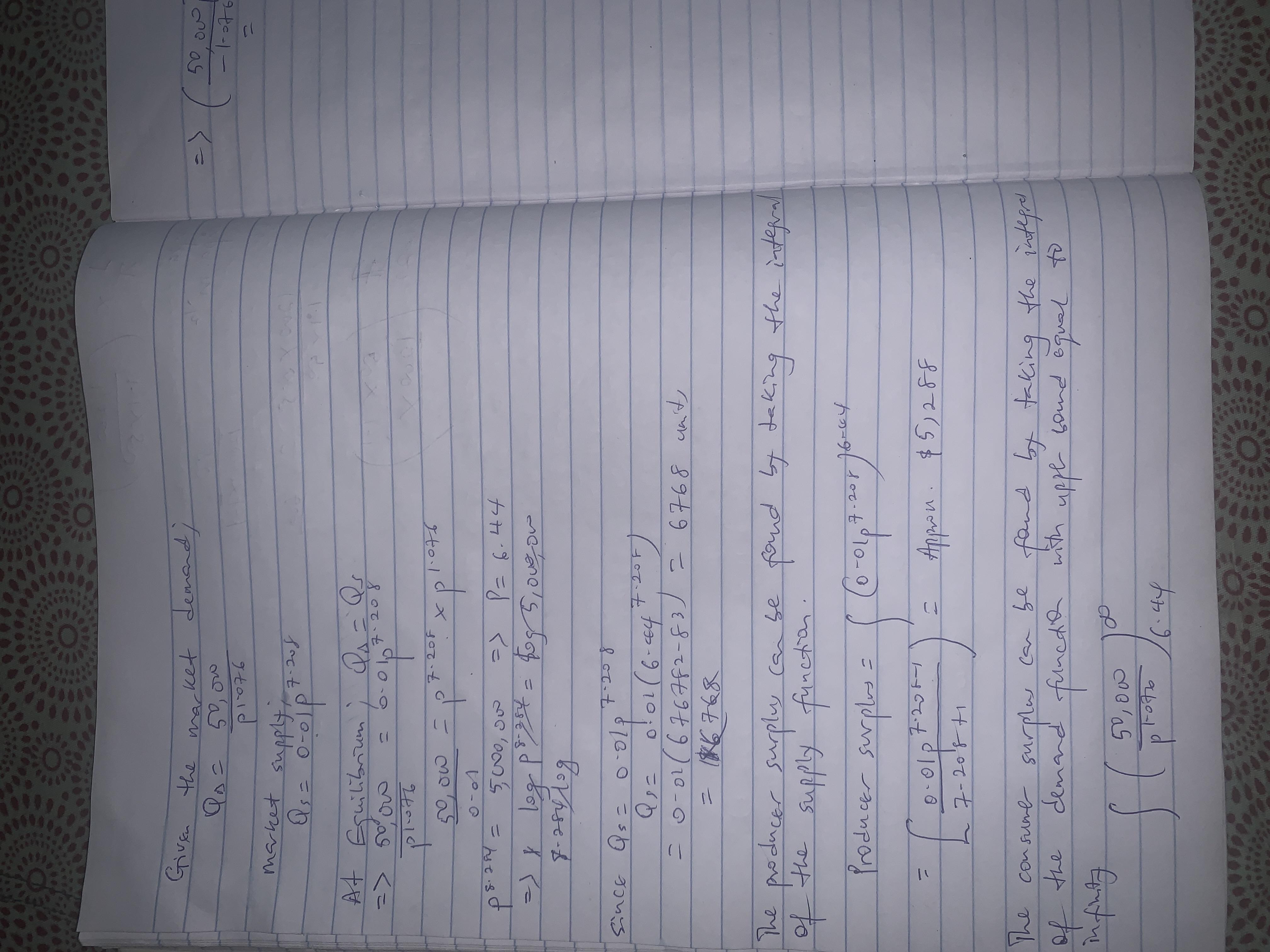
Suppose that the market demand for 32-oz. wide mouth Nalgene bottles is Q = 50,000p^-1.076, where Q is the quantity of bottles p
Natasha_Volkova [10]

Answer:

Equilibrium price and quantity

$6.44 and 6768

Consumer surplus

$571,081

Producer Surplus

$5,288

Explanation:

In this question, we are asked to calculate equilibrium price and quantity, consumer surplus and producer surplus.

Please check attachment for complete solution and step by step explanation

4 0
2 years ago
Dwight Donovan, the president of Benson Enterprises, is considering two investment opportunities. Because of limited resources,
alexandr402 [8]

Answer:

- Net present value of each project:

Project A:$37,193

Project B:$4,629

=> Project A should be chosen based on NPV approach as its NPV is higher.

- Internal rate of return of each project:

Project A: 20%

Project B: 12%

=>Project A should be chosen based on IRR approach as its IRR is higher

Explanation:

- Net present value calculation:

NPV for Project A: -111,000 + (37,116/0.08) x [1-1.08^(-5)] = $37,193

NPV for Project B: -43,000 + (11,929/0.08) x [1-1.08^(-5)] = $4,629.

- Internal rate of return approach;

IRR is the discount rate that bring NPV of project's cash flows to 0. Thus:

IRR for project A: -111,000 + (37,116/IRR) x [1-(1+IRR)^(-5)] = 0 <=> IRR = 20%

IRR for project B: -43,000 + (11,929/IRR) x [1-(1+IRR)^(-5)] = 0 <=> IRR = 12%

6 0
2 years ago
A leader high in initiating structure is most likely to​ ________.
olya-2409 [2.1K]

A leader who is high in initiating structure is most likely to engage to the following;

<span>·         </span>When it comes to deadlines, the leader most likely emphasizes the meeting of this deadlines

<span>·         </span>The leader is likely to expect from its workers the standards of their performance to be maintained

7 0
2 years ago
Show the total cost expression and calculate the EOQ for an item with holding cost rate 18%, unit cost $8.00, annual demand of 4
torisob [31]

Answer:

Total cost = Total ordering cost + Total holding cost

Total cost = DCo     + QH

                     Q              2

Where

D = Annual demand

Co = Ordering cost per order

Q = EOQ

H = Holding cost per item per annum

D = 40,000 units

Co = $48

H = 18% x $8.00 = $1.44

EOQ = √2DCo

                H

EOQ = √2 x 40,000 x $48

                     $1.44

EOQ = 1,633 units

Explanation:

EOQ equals 2 multiplied by annual demand and ordering cost divided by holding cost per item per annum. The holding cost per item per annum is calculated as holding cost rate multiplied by unit cost.

7 0
2 years ago
In a manufacturing company as many as 100 labourers are working in the production department.
snow_tiger [21]

Answer:

On one hand, the principle of management which is being ignored in this case is that of Unity of Command.

Explanation:

The principle of Unity of Command stipulates all staff or employee, for sakes of clarity and avoidance of confusion, an abiguity, should take instructions from only one boss or line manager.

On the other hand, the principle of management that is being followed in the above case is that of Taylors Functional Foremanship.

The practice of this technique requires that planning and execution be seperated according to areas of specialisation. Specialisation is the primary logic or argument in the Taylors Functional Foremanship principle. Taylors advocates that each foreman needs to be highly proficient, possess special know-how and be capable of directing the staff with high exuberance and tact.

Cheers!

8 0
2 years ago
Other questions:
  • Which best compares and contrasts Business Financial Management and Insurance Services?
    9·2 answers
  • Of each dollar a consumer spends on food how much does the farmer receive?
    7·1 answer
  • If a company's actual results for revenues, net profits, eps, and roe turn out to be worse than projected, then it is usually be
    6·2 answers
  • Three critical activities occur during group socialization that affect the productivity of teams, and they are:
    10·1 answer
  • "A storm damaged Mr. Smith’s roof, allowing rainwater to leak into the house. Mold began to grow. It cost $5200 to repair the ro
    15·1 answer
  • One of the workers in Henry's department submitted his two weeks' notice so Henry needs to hire a replacement. The HR department
    14·1 answer
  • Four years ago, Ship Express purchased a mailing machine at a cost of $218,000. This equipment is currently valued at $97,400 on
    5·2 answers
  • Over the course of 50 years, Dexter grew his company to eight package shipping stores. With his retirement approaching and the i
    13·1 answer
  • Which best describes the facilities involved in the Healthcare cluster?
    8·2 answers
  • Adrian's Premium Boxing Service subcontracts with a chocolate manufacturer to box premium chocolates for their mail order catalo
    13·1 answer
Add answer
Login
Not registered? Fast signup
Signup
Login Signup
Ask question!