answer.
Ask question
Login Signup
Ask question
All categories
  • English
  • Mathematics
  • Social Studies
  • Business
  • History
  • Health
  • Geography
  • Biology
  • Physics
  • Chemistry
  • Computers and Technology
  • Arts
  • World Languages
  • Spanish
  • French
  • German
  • Advanced Placement (AP)
  • SAT
  • Medicine
  • Law
  • Engineering
levacccp [35]
2 years ago
3

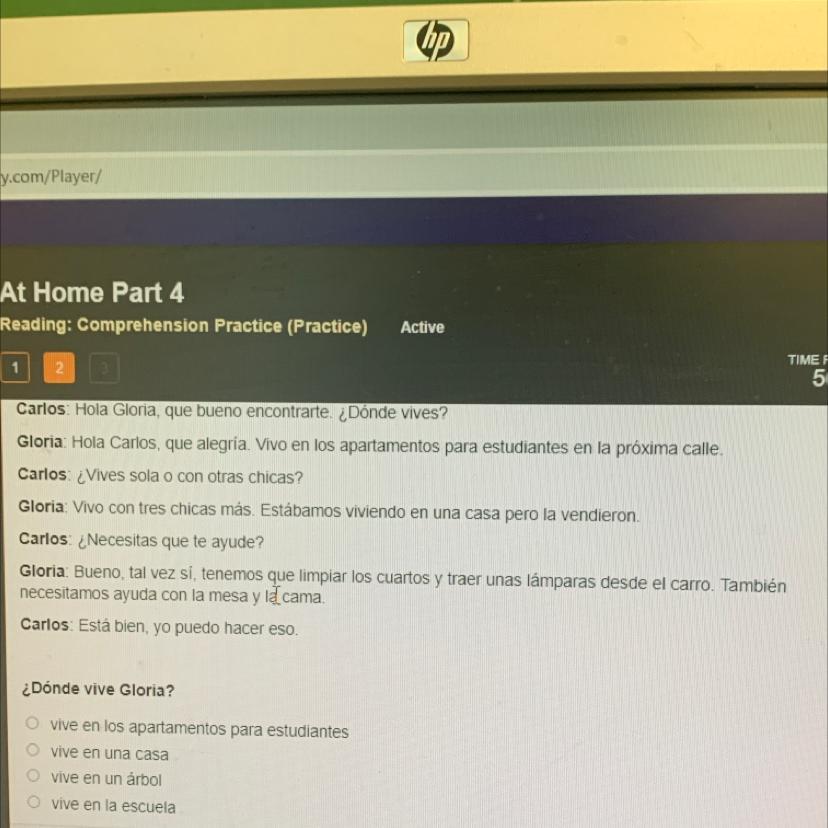
Carlos: Hola Gloria, que bueno encontrarte. ¿Dónde vives?

Spanish
2 answers:
mixas84 [53]2 years ago
7 0

Answer:

A. ( vive en los departamentos para estudiantes)

Explanation:

Diano4ka-milaya [45]2 years ago
3 0

Answer:

A

Explanation:

She said she lives in the student apartments, which means apartamentos para estudiantes in english

You might be interested in
Which word correctly completes this sentence? La _________ de la playa se genera por la erosión de rocas. A. marea B. arena C. b
frutty [35]

Answer:

A

Explanation:

la playa is the beach. use process of elimination. "ola" mean "be". "brisa" means "breeze". "arena" has no spanish translation.

6 0
2 years ago
Read 2 more answers
¿Qué oración dice en español: "It's their store"?<br> Es sus tienda.<br> Es su tienda.
Scilla [17]
Both say “it’s their store” it just depends whether you are talking about one or more people. Su is usually he/she but it can mean they/it if you are being non-gender specific. Personally I would go for Es sus tienda but I’m not a native Spanish speaker so I could be wrong
4 0
2 years ago
Read 2 more answers
5 - ¡Qué diferencia!Fill in the blanks Activity Instructions Fill in the blanks with the preterite or the imperfect of the indic
irina [24]

Answer:

1. llegué

2. vivimos

3. conocimos

4. teníamos

5. vimos

6. podíamos

7. conectó

8. miramos

9. caminábamos

10. dijo

Explanation:

* The imperfect past tense of the indicative is a frequent tense in Romance languages. It describes an action or state in the past whose time limits are not relevant, that is, a grammatical time of the past with a grammatical aspect. It is used in Spanish to express courses of past actions whose beginning and end are not specified.

* The preterite tense is used to talk about actions that took place in the past and has no relation to the present.

The past perfect simple or past tense is formed based on the root of the verb (infinitive minus -ar, -er, or -ir) and adding the following disinherities:

      * Verbs of the first conjugation (ending in -ar): -é, -aste, -ó, -amos, asteis, -aron

      * Verbs of the second and third conjugation (ending in -er or -ir): -í, -iste, -ió, -imos, -isteis, -ieron

8 0
2 years ago
Select the correct answer.
iren2701 [21]

Answer: D. Invento

Explanation:

7 0
2 years ago
Read 2 more answers
1. Se afeita después de cepillarse los dientes.
Delicious77 [7]

Answer:

what is the question friend?

7 0
2 years ago
Read 2 more answers
Other questions:
  • Select the formal command you would use to invite teacher to an event.
    11·2 answers
  • Ana ¿(1) es esto? ¿(2) dinero gastaste en ese vestido de fiesta? ¿A (3) tienda fuiste? A la más costosa, como siempre. (4) veces
    12·2 answers
  • vender — ¿Qué vendes tú? — Vendo libros en la librería. leer Question 1 with 1 blank— ¿Qué tú, Ana? Question 2 with 1 blank— un
    15·1 answer
  • 4 - ¿Qué pasa aquí?Multiple choice Activity Audio InstructionsListen and select the phrase that best completes each sentence bas
    6·2 answers
  • 1. How much does a typical mochila cost in your community?
    8·2 answers
  • ¿Cuál de las siguientes razones NO ayudó a Pizarro con su conquista de Perú?
    10·2 answers
  • After Potosi ran out of silver, what industry did Bolivia use to make up the difference?
    15·1 answer
  • How much area does El Gigante Blanco cover?
    13·1 answer
  • Question 10
    7·1 answer
  • Describe what these people are doing or feeling using an expression with tener.
    14·2 answers
Add answer
Login
Not registered? Fast signup
Signup
Login Signup
Ask question!