answer.
Ask question
Login Signup
Ask question
All categories
  • English
  • Mathematics
  • Social Studies
  • Business
  • History
  • Health
  • Geography
  • Biology
  • Physics
  • Chemistry
  • Computers and Technology
  • Arts
  • World Languages
  • Spanish
  • French
  • German
  • Advanced Placement (AP)
  • SAT
  • Medicine
  • Law
  • Engineering
kolezko [41]
2 years ago
5

Using the seismic reading received at Station 1 only, an observer would be able to determine

Geography
1 answer:
hoa [83]2 years ago
3 0

Answer

<u>Neither the distance nor the direction of the epicenter from station 1</u>

Explanation

A single seismic reading received at station 1 only will tell the observer that the ground shook at that location and the intensity. Without other data  and information, the observer cannot make any other meaningful conclusions. A minimum of three seismograph stations are required before an observer can determine/ conclude meaningful results.

You might be interested in
Arrange the jumbled letters eoatlpbr ktnerwo psiragch​
Mariana [72]
1. portable 2. network 3. graphics
6 0
2 years ago
Read 2 more answers
Which of the following events would be considered a migration push factor ?
stealth61 [152]

Answer:

Pull factors “pull” people to a new home and include things like better opportunities. The reasons people migrate are usually economic, political, cultural, or environmental.

5 0
2 years ago
Which diagram most accurately explains changes in media over time?
ludmilkaskok [199]

Answer:

O A.

Explanation:

8 0
2 years ago
Read 2 more answers
5. How fast did the shoes travel? (4 points) a. From where the shoes spilled (48°N, 161°W) to where they first made landfall (49
Leto [7]

Answer:

a) d = 35.0143 Km

t = 188 days

v = 7.76*10⁻³ Km/h

b) d = 28.6356 Km

t = 2165 days

v = 5.51*10-4 Km/h

Explanation:

a. From where the shoes spilled (48°N, 161°W) to where they first made landfall (49°N, 126°W), how many kilometers did they travel?  

We can use the equation

d = √(∆N²+∆W²)

⇒   d = √((49-48)²+(126-161)²) = 35.0143 Km

How many days did they take to travel that distance? (You can use November 30 as the date found).  

From May 27, 1990 to November 30, 1990 we have

t = 5 days + (30 days/month)*(3 months) + (31 days/month)*(3 months) = 188 days

⇒   t = 188 days = (188 days)*(24 hours/day) = 4512 hours

What was their rate of travel in kilometers per hour?  

We use the equation

v = d/t   ⇒   v =  35.0143 Km/ 4512 h

⇒   v = 7.76*10⁻³ Km/h

b. From where the shoes spilled (48°N, 161°W) to where they were found in 1996 (54°N, 133°W), how many kilometers did they travel?  

We can use the equation

d = √(∆N²+∆W²)

⇒   d = √((54-48)²+(133-161)²) = 28.6356 Km

How many days did they take to travel that distance (use April 30 as the date found)?  

From May 27, 1990 to April 30, 1996 we have

t = 5 days + (30 days/month)*(4 months) + (31 days/month)*(6 months) + 29 days + (365 days/ year)*(4 years)+ (366 days/ year)*(1 year)= 2165 days

⇒   t = 2165 days = (2165 days)*(24 hours/day) = 51960 hours

What was their rate of travel in kilometers per hour?

We use the equation

v = d/t   ⇒   v =  28.6356 Km/ 51960 h

⇒   v = 5.51*10-4 Km/h

7 0
2 years ago
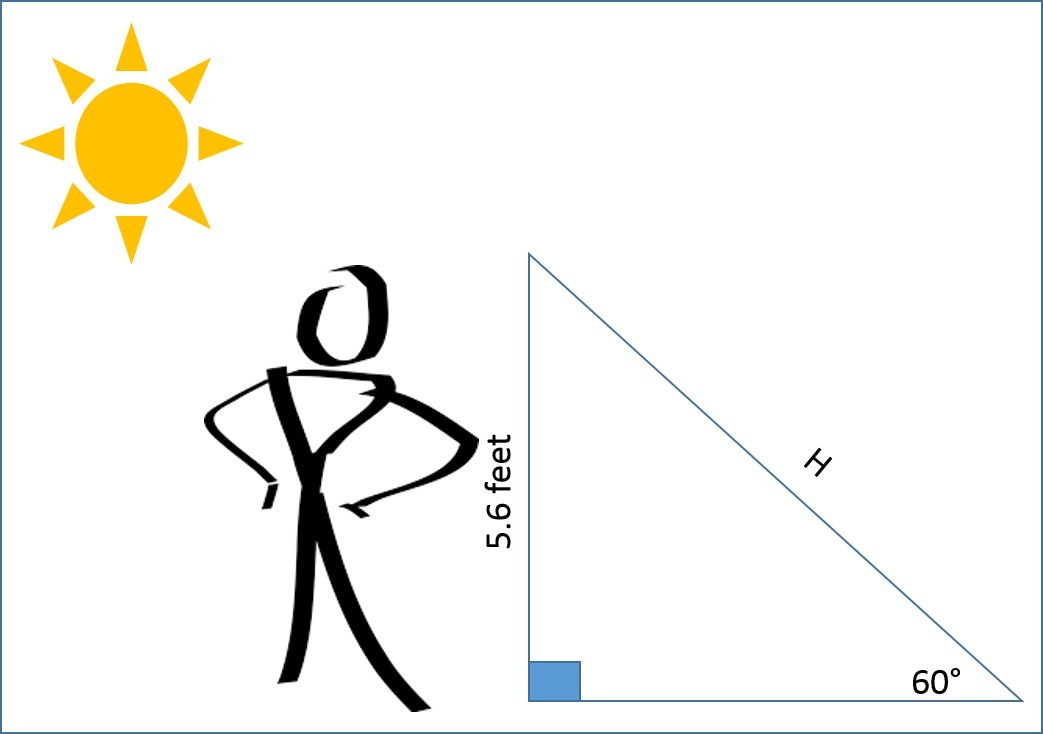
Adam, who is 5'6" tall, notices his shadow on the sidewalk. If the angle of elevation from the tip of the shadow to the sun is 6
german
<h2>Answer:</h2>

This problem can be solved using trigonomtry, assuming that the figure formed by Adam's shadow and Adam himself is a Right Triangle (as shown in the figure attached).


According to this,  the distance from the tip of the shadow to the top of Adam's head is the hypotenuse H of the triangle, and we already know Adam's height and the angle of elevation. So, the trigonometric function that best works in this case is sine:


sen(angle)=\frac{Oppositeleg}{hypotenuse}  


Where the opposite leg is the side of the triangle that is opposite to the 60\º angle.

In this especific case:


sen(60\º)=\frac{5.6feet}{H}     (1)


In order to know the value of the hypotenuse we have to find  H from equation (1):

H=\frac{5.6feet}{sen(60\º)}


H=6.4663 feet


Rounding:

H=6.46 feet>>>>>This is the distance from the tip of the shadow to the top of Adam's head


8 0
2 years ago
Read 2 more answers
Other questions:
  • What influences both chemical weathering and mechanical weathering?
    7·1 answer
  • What region of the united states is beef and hog production prevalent
    5·1 answer
  • Compare and contrast the dry climate type with the tropical climate type. Consider such characteristics as temperature, precipit
    5·2 answers
  • In the early 2000s, there were thick kelp forests in the Pacific Ocean. Kelp is a photosynthetic brown algae that can grow very
    10·1 answer
  • According to the graph above, what percentage of the world practices the five major religions? A. 87.52% B. 85.68% C. 73.66% D.
    8·2 answers
  • Scientists collaborate a lot. The Web of Science tells you who all the coauthors are. Search on Dr. A (Type "Anandakrishnan S" i
    6·1 answer
  • Analyze the map below and answer the question that follows. A map of Africa titled Climate Map of Africa. A key shows 4 main cli
    13·2 answers
  • What is the significance of understanding the characteristics of the earth?
    15·1 answer
  • Most Cuban people work in service industries. Which of the following industries is not a common service in Cuba?
    10·2 answers
  • Which of the following geographic concepts can be identified using information evident in the image?
    15·1 answer
Add answer
Login
Not registered? Fast signup
Signup
Login Signup
Ask question!