answer.
Ask question
Login Signup
Ask question
All categories
  • English
  • Mathematics
  • Social Studies
  • Business
  • History
  • Health
  • Geography
  • Biology
  • Physics
  • Chemistry
  • Computers and Technology
  • Arts
  • World Languages
  • Spanish
  • French
  • German
  • Advanced Placement (AP)
  • SAT
  • Medicine
  • Law
  • Engineering
Viefleur [7K]
2 years ago
14

An organism that feeds upon primary consumers is known as a _______.

Biology
2 answers:
Alex777 [14]2 years ago
8 0

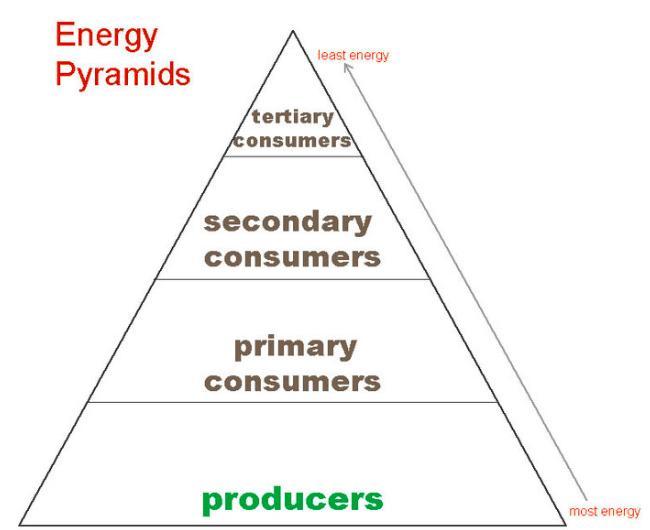
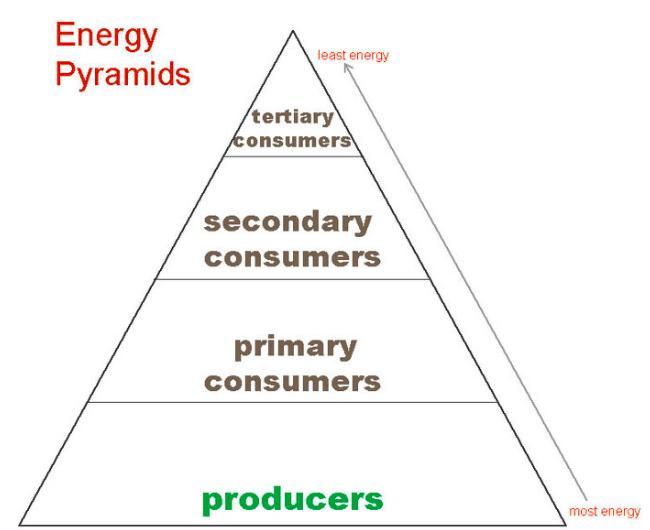
***see attached pic***

In the energy pyramid for any given ecosystem, the most energy available is at the bottom and the least energy available is at the top.

At the bottom of the energy pyramid are the producers (plants and other photosynthetic organisms). The first group of organisms that consume the producers are called the primary consumers (herbivores). The next group of consumers are the secondary consumers, and then the tertiary consumers and quaternary consumers.

Correct Answer: B

inessss [21]2 years ago
4 0

Answer:

B. Secondary Consumer

Explanation:

`Secondary consumers are organisms that eat primary consumers for energy.

You might be interested in
ASAP What is a photosynthetic pigment? What is a photosynthetic pigment? A. An oxygen based compound that captures light energy.
Vlad1618 [11]

I think the answer is A.

3 0
2 years ago
Read 2 more answers
Complete the following analogy regarding cell division.
Georgia [21]
Reproduction of a cell from an existing cell
4 0
2 years ago
A month after peter came in and was diagnosed with wnv, the physician at the urgent care facility noticed the presentation of si
Alex777 [14]
<span>West Nile virus is mostly spread through infected mosquitoes, which is likely how these other patients were infected. Other possible but unlikely ways include blood transfusions and organ transplants, so the physician would likely be able to track down whether Peter donated any blood during his recent hospital visits.</span>
8 0
2 years ago
Read 2 more answers
Which of these is a characteristic of index fossils?
algol13

Answer:

c is the right answer

Explanation:

3 0
2 years ago
How would a scientist have made the distinction between a unicellular and a multicellular organism in the 17th century(1600s), t
Drupady [299]

Using a microscope

Explanation:

A microscope is a scientific device used for magnifying and studying very tiny features.

It was invented by Anton Von Leeuwenhoek in the 17th century.

  • A unicellular organism is an organism made up of a single cell.
  • A multi-cellular organism is made up of several cells.
  • A cell is a very small microscopic structure.
  • It is usually described as the fundamental unit of life.
  • Due to its small size, the naked eyes cannot see it
  • The invention of the microscope opened up the world of cells.
  • Since they have been around for a long time, distinction of cells would have been made possible at those times using a microscope.

learn more:

Microscope brainly.com/question/4065308

#learnwithBrainly
5 0
2 years ago
Other questions:
  • Heat and cold treatment of food products is practiced since time immemorial for food preservation. How does it prevent food spoi
    6·1 answer
  • The range of cells receiving copied content is called the ____ area. select one:
    13·1 answer
  • Arrange the processes of the water cycle in the correct order, starting with the heat from the sun
    10·2 answers
  • Why is the interdependence of the worms and plants an example of commensalism?
    11·2 answers
  • The concept of reaction range proposes that ____ establish(es) boundaries, whereas ____ determines where a person falls within t
    15·1 answer
  • Which person’s function in a school is similar to the central nervous system’s role in a human body?
    9·2 answers
  • A student reads the article "Autoimmune Diseases Stopped in Mice" and claims that this research will revolutionize
    8·2 answers
  • During strenuous exercise, anaerobic conditions can result if the cardiovascular system cannot supply oxygen fast enough to meet
    7·1 answer
  • How are histone modification enzymes (such as HATs) and chromatin remodeling complexes recruited to unmodified chromatin, and ho
    5·1 answer
  • Special lymphatic vessels, called lacteals, absorb dietary __________ that are not absorbed by the blood capillaries.
    10·1 answer
Add answer
Login
Not registered? Fast signup
Signup
Login Signup
Ask question!