answer.
Ask question
Login Signup
Ask question
All categories
  • English
  • Mathematics
  • Social Studies
  • Business
  • History
  • Health
  • Geography
  • Biology
  • Physics
  • Chemistry
  • Computers and Technology
  • Arts
  • World Languages
  • Spanish
  • French
  • German
  • Advanced Placement (AP)
  • SAT
  • Medicine
  • Law
  • Engineering
Tems11 [23]
2 years ago
6

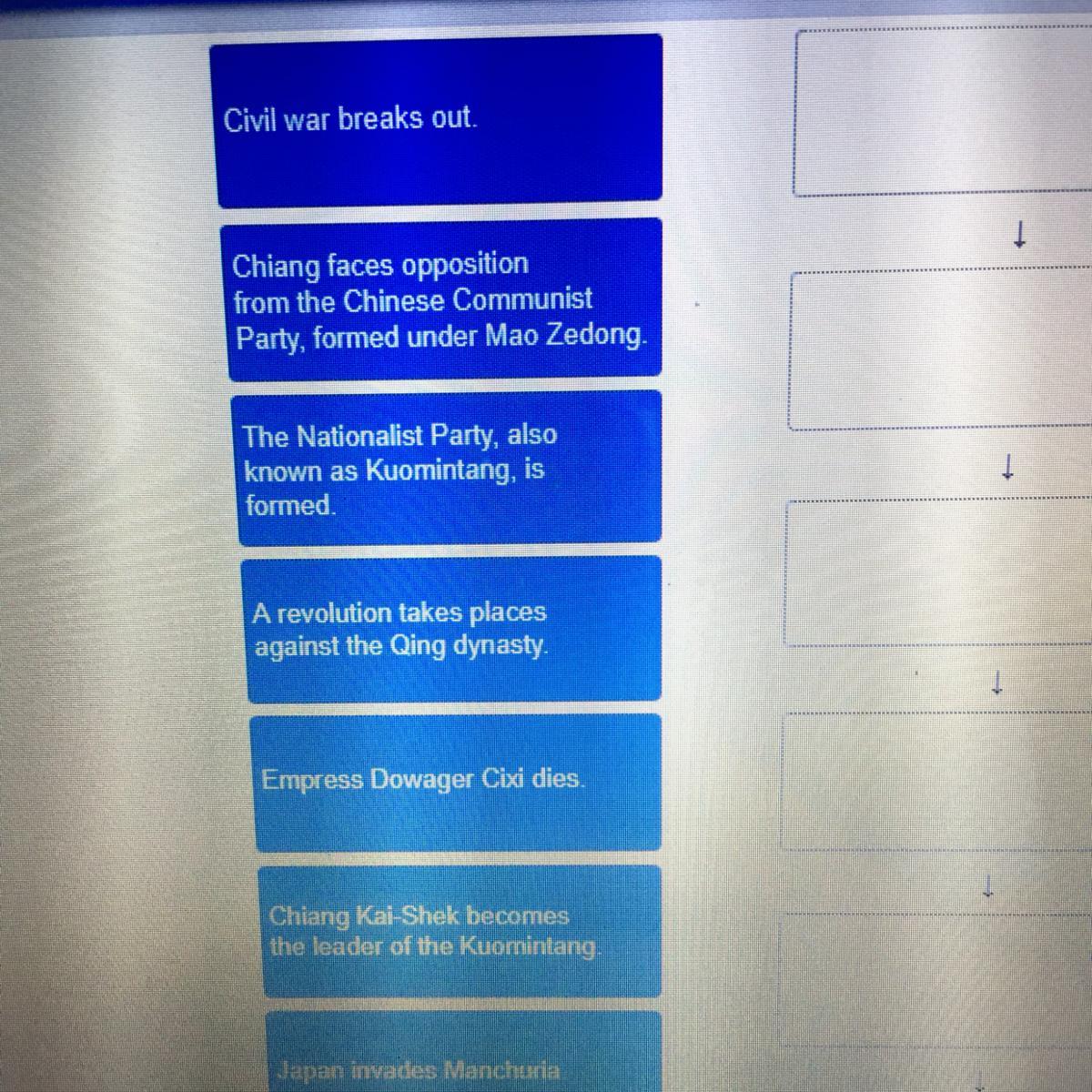
Arrange the following events in china in chronological order.

History
2 answers:
My name is Ann [436]2 years ago
7 0

Answer:

E- empress dowager cixi dies

D- a revolution takes places against the Qing dynasty

C- the nationalist party, also known as Kuomintang, is formed

F-Chiang Kai-shel becomes the leader of the Kuomintang

B-Chiangmai faces opposition from the Chinese communist party, formed under Mao Zedong

G-Japan invades Manchuria A-civil war breaks out

hope this helps mark me brainliest

Explanation:

brilliants [131]2 years ago
3 0

Answer:

1- Empress Dowager Cixi dies

2- A revolution takes places against the Qing dynasty.

3- The Nationalist Party, also known as Kuomintang, is formed.

4- Chiang faces opposition from the Chinese Communist Party, formed under Mao Zedong.

5- Chiang Kai-Shek becomes the leader of the Kuomintang.

6- Civil War breaks out.

7- Japan invades Manchuria.

Explanation:

1- Empress Dowager Cixi died in 1908, a day after his nephew Emperor Guangxu, having installed on the throne Puyi, a nephew-grandson of his who would be the last emperor of China.

2- The Xinhai Revolution was a revolution that overthrew China's last imperial dynasty (the Qing Dynasty) and established the Republic of China, in October 1911.

3- The Kuomintang is a Chinese nationalist political party of the Republic of China founded after the Xinhai Revolution of 1911.

4- The formal foundation of the Communist Party of China was held at a meeting in Shanghai on July 1, 1921. A few days later, on July 23, the 1st National Congress of the Chinese Communist Party was inaugurated, also in Shanghai. There were 12 delegates, including Mao Zedong, who approved the statutes of the new Party, which began to oppose the Kuomintang.

5- When Sun Yat-sen died in 1925, the KMT's political leadership fell on Wang Jingwei and Hu Hanmin, respectively leaders of the party's left and right. The real power, however, was in the hands of Chiang Kai-shek, who, as superintendent of the Whampoa Military Academy, was almost in complete control of the military. Chiang assumed effective leadership of the KMT on July 6, 1926.

6- The Chinese Civil War, which lasted from August 1927 to October 1949, was the conflict that took place in China between the Kuomintang (or Chinese Nationalist Party) and the Chinese Communist Party.

The war ended in 1949 with an unofficial cessation of hostilities between the sides, with the mainland China (including Hainan Island) finally being under communist control, where the new regime of the People's Republic of China was proclaimed, while the nationalists managed to maintain control over the island territories of Taiwan, Penghu and several coastal islands of Fujian province, territories in which the regime of the Republic of China has been maintained until now.

7- The Japanese invasion of Manchuria began on September 19, 1931, immediately after the Mukden Incident. The Japanese occupation of Manchuria lasted until the end of World War II and would lead to the founding of the puppet state of Manchukuo.
You might be interested in
Which of the following BEST describes the difference between the Departments of Defense and Homeland Security? A. The Department
lara31 [8.8K]
Hello,

Here is your answer:

The proper answer to this question is option A "The Department of Defense is mainly responsible for protecting US borders, while the Department of Homeland Security manages military operations abroad".

Your answer is A!

If you need anymore help feel free to ask me!

Hope this helps!
3 0
2 years ago
6. Anong lugar ang naging tanyag at sentro ng kalakalan sa bansa noong pre-kolonyal?
Vitek1552 [10]
D Manila hope it helps
7 0
2 years ago
Why was the government's decision to raise bread prices such a crucial cause of the French Revolution?
natali 33 [55]
I believe the correct answer is <span>C. Bread was a staple food item in French households, and the lack of it probably pushed the already starving citizens over the edge.
</span>
3 0
2 years ago
Read 2 more answers
Which of the following types of attendants are represented in this mosaic?
irina [24]
I think you forgot to add some detail but based on my research, the correct answer to this question is "soldiers." This is the type of attendants represented in this mosaic. Thank you for posting your question. I hope that this answer helped you. Let me know if you need more help. 
8 0
2 years ago
Read 2 more answers
Which natural resource led to terrible suffering for the people of the Congo Free State, who were forced to extract it for their
WITCHER [35]
Yo it's Rubber, so the answer would be A
3 0
2 years ago
Other questions:
  • One way in which filial piety in Confucian China and citizenship in ancient Athens are similar is that both (1) emphasized dutie
    8·2 answers
  • Which of the following best describes the Bush administration's approach to the problem of the growing federal budget deficit?:
    10·2 answers
  • Which statement most accurately answers why the Europeans in the Caribbean felt the need to bring in enslaved Africans as labore
    7·1 answer
  • All of the following happened following the Armenians’ pledge of support for Turkish enemies EXCEPT:
    15·2 answers
  • How were political cartoons used to stir up anti-british sentiment among the colonists?
    7·1 answer
  • Which of these describes how African traditions were incorporated into the many new churches that freedmen organized after the C
    7·2 answers
  • 1.) Bones, tools, weapons, and pottery are examples of:
    13·2 answers
  • Although American artists were an ocean apart from Europe, some visited and many adopted the artistic styles of the faraway cont
    12·1 answer
  • The mercantile system motivated European countries to explore new lands hoping to do what?
    11·2 answers
  • Hunter - gatherer societies developed all of the following aspects of culture except ____
    11·1 answer
Add answer
Login
Not registered? Fast signup
Signup
Login Signup
Ask question!
