answer.
Ask question
Login Signup
Ask question
All categories
  • English
  • Mathematics
  • Social Studies
  • Business
  • History
  • Health
  • Geography
  • Biology
  • Physics
  • Chemistry
  • Computers and Technology
  • Arts
  • World Languages
  • Spanish
  • French
  • German
  • Advanced Placement (AP)
  • SAT
  • Medicine
  • Law
  • Engineering
Leto [7]
2 years ago
13

Explain how a crime lab could use paper chromatography to determine if lipstick found at a crime scene matched the lipstick of a

suspect.

Biology
1 answer:
FromTheMoon [43]2 years ago
7 0

Explanation:

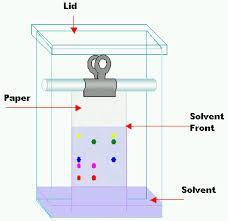
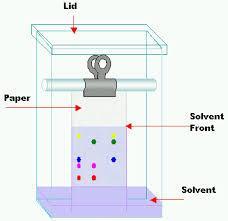
The lipstick from the crime would be crushed and dissolved in an appropriate liquid solvent. The lipstick would then be placed in one of the ink spots on the starting / base line of the paper. Another spot would be created for the lipstick with which it is being compared with.

The paper chromatogram would then be placed vertically on a solvent that acts as the mobile phase. After some time, when the solvent reaches the solvent front  of the paper chromatography, by capillary action, the chromatogram can be removed and left to dry.

Bands will have appeared on the chromatography paper formed from the different components of the lipstick. The bands of the lipstick from the crime scene and that with which it is being compared to are observed. If the bands are all aligned, horizontally, then this means it is a complete match. The lipstick must have been the same used at the crime scene.

Learn More:

For more on paper chromatography check out;

brainly.com/question/13232854

brainly.com/question/364792

#LearnWithBrainly

You might be interested in
Suppose you're studying levels of job stress and measures of job efficiency in a nursing home. Which one of the following statem
Mariulka [41]
D-As stress levels increase, job efficiency increases is the correct answer.
6 0
2 years ago
A mutation is made once in every nucleotides copies
dimaraw [331]

Explanation:

A mutation is made once in every <u>10 billion</u> nucleotides copied.

During the process of cell division, spontaneous changes within the genome can arise. These mutations are errors occur when copies of the DNA within the cell are made; mutations may range from small changes called single nucleotide polymorphisms, to large scale deletions, and additions which span multiple genes.


Further Explanation:


During reproduction other events, such as crossing over during mitosis and meiosis, mutations lead to increases in genetic variation. This variation refers to the genetic characteristics present within a species. Mutations may be either beneficial or deleterious; they are maintained within cells, as they form new traits called alleles. Beneficial mutations may confer traits that increase the fitness of a species, along with ensuring survival by conferring a protective advantage- these phenotypic differences between organisms are called adaptations.


Sequences of DNA make up genes which can have different forms called alleles. DNA, which makes up the genotype, is transcribed into mRNA and later translated into amino acids which are linked together by rRNA to form proteins which make up the phenotype of an organism. Mutations in DNA sequences affect the corresponding mRNA and thus the protein encoded.


Learn more about mutations at brainly.com/question/4602376

Learn more about DNA and RNA at brainly.com/question/2416343?source=aid8411316

#LearnWithBrainly

5 0
2 years ago
Approximately 60% of human genes are also found in fruit flies. About 97.5% of human genes are also found in mice. What does thi
zysi [14]
The answer would be option D :)
5 0
2 years ago
In this lab, the three flocks of birds changed in numbers between generation 1 and generation 3. Why? Check all reasons. The amo
anyanavicka [17]

Working in a lab means working under controlled environment. If in the generation 1 and generation 3, the number of bird’s increases or decreases in number, the possible conditions for this would

- The amount of food increased or decreased

- If a flock’s beak type made it easier to pick up the available food, the flock grows and vice versa

Justification: if the beak type for generation 1 makes the food intake easier, it will grow which ultimately decreases the food for the generation 3 which has un-supportive beak type.
9 0
2 years ago
Read 2 more answers
Please I Need help <br> Which of these does the photograph show?
FrozenT [24]

Answer:

B

Explanation:

6 0
2 years ago
Read 2 more answers
Other questions:
  • Which of the following properties of carbon give it particular importance to life?
    7·2 answers
  • Which statement best describes cancer cells
    9·2 answers
  • Staci has antibody a in her blood with no rh antibody. what blood type does she have?
    12·1 answer
  • Brainliest!!! Photosynthesis occurs and extra food is stored in which plant tissue? A)Vascular B)Dermal C)Ground D)Xylem
    15·1 answer
  • Producers, like this plant, take in oxygen and release carbon dioxide during __________________ , just like animals and other li
    10·1 answer
  • A scientist is observing a worm that was found inside a host. The worm that's an outer body that is smooth and soft. Which worm
    5·2 answers
  • Joan uses a model to show how wood burns at the level of atoms and molecules. Her model tracks 840 carbon atoms that make up a s
    13·1 answer
  • Review the graph that represents the whole class data. Compare the food energy in the saltine and pretzel with that of the pecan
    6·2 answers
  • Sweet yellow tomatoes with a pear shape bring a high price per basket to growers. Pear shape, yellow color, and terminal flower
    14·1 answer
  • Complete the sentences by matching the names of trees to the appropriate blanks. to do this, drag the names on the left into the
    10·1 answer
Add answer
Login
Not registered? Fast signup
Signup
Login Signup
Ask question!
