answer.
Ask question
Login Signup
Ask question
All categories
  • English
  • Mathematics
  • Social Studies
  • Business
  • History
  • Health
  • Geography
  • Biology
  • Physics
  • Chemistry
  • Computers and Technology
  • Arts
  • World Languages
  • Spanish
  • French
  • German
  • Advanced Placement (AP)
  • SAT
  • Medicine
  • Law
  • Engineering
chubhunter [2.5K]
2 years ago
14

The mismatch repair system recognizes mismatched base pairs, removes a portion of the DNA strand containing the error, and then

resynthesizes the missing DNA using the correct sequence as a template. But what if the mismatch repair system instead removed a piece of the DNA strand that contained the correct sequence? What would replication of this improperly repaired sequence produce?
A. two DNA molecules that are missing one nucleotide pair

B. two DNA molecules bearing the same mutation

C. two DNA molecules with a gap where the correct sequence was excised

D. one DNA molecule with a mutation and one DNA molecule with a mismatch

E. two DNA molecules with different mutations
Biology
1 answer:
Naya [18.7K]2 years ago
4 0

Answer:

B) two DNA molecules bearing the same mutation

Explanation:

The mismatch repair system is the biological system of proofreading the DNA strands which takes place after the DNA replication. The system works by recognizing the mispaired bases which could have added due to the insertion, deletion or any replicative error. The mismatched pair removes the wrong bases and then DNA ligases join the DNA.

If the repair system mistakenly removes the DNA with correct sequence then the DNA replication process would form the two DNA strands with the same type of mutation as the DNA replication forms the complementary strands from the two strands of the parent DNA.

Thus, Option-B is the correct answer.

You might be interested in
Put the steps of the carbon cycle in order using step 1 as your starting point. step 1: carbon dioxide is taken in by plants dur
aev [14]

Put the steps of the carbon cycle in order using Step 1 as your starting point. Step 1: Carbon dioxide is taken in by plants during photosynthesis.

The cycle repeats when the carbon stored in the atmosphere as carbon dioxide gas is taken in.  step four

The animal releases the carbon dioxide back into the atmosphere during respiration.  step three

The animal eats a plant and uses its carbohydrates for energy.  step two


6 0
2 years ago
Read 2 more answers
A Xw+m+Xwm female was mated to a XwmY male. Out of 1000 total F1 progeny there were 230 flies that were otherwise wild type with
deff fn [24]
In order to calculate the distance between two alleles/genes that are found in the same chromosome, we need to know how often crossing-over happened (recombination frequency). We know from the text that white eyes were linked to miniature wings and that wild type eyes were linked to wild type wings, so any phenotype that's contrary to these parent combinations are a result of crossing-over. We know then that 230 flies + 240 flies were a result of such recombination. To calculate the recombination frequency we only need to divide these flies (total of recombinant flies) by the total of flies in the offspring and turn it into percentage.
\frac{230+240}{1000}=0.47
0.47*100%=47%
47 map units is the distance between the genes <span>for eye color and wing length.</span>
7 0
2 years ago
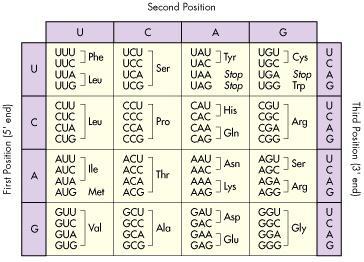
The genetic code links groups of nucleotides in an mRNA to amino acids in a protein. Which of the following peptide chains will
sergey [27]
C. Met-Thr-Met
UAG forms the chain Stop

8 0
2 years ago
Heavy rains and mudslides cause a river to change course, isolating two groups of lizards from one another. If they remain isola
Stells [14]

If they remain isolated for a long period of time, the two groups will probably diverge genetically, and may result in speciation.

Genetic divergence is the process whereby two groups of the same ancestral species acquire autonomous genetic changes through time, usually after the groups have been separated reproductively for some period of time.

Speciation is an evolutionary process whereby populations develop to become different species.

3 0
2 years ago
Which food molecule (monosaccharide, polysaccharide, lipid, or protein) would you eat if...
torisob [31]
<span>You needed a quick boost of energy - MONOSACCHARIDE

You wanted to grow strong nails, you haven't eaten in days - PROTEIN

You wanted to grow healthy hair - PROTEIN

You had a race tomorrow afternoon - POLYSACCHARIDE 

You were getting ready for hibernation - LIPIDS

You wanted to get bigger muscles - PROTEIN 

Your meal will be in a week - LIPIDS

CARBOHYDRATES include monosaccharide and polysaccharides. They provide immediate energy boost or short term energy storage for animals as well as long term energy storage for plants. 

PROTEIN s</span>peeds up chemical reactions by lowering activation energy. It is used to form bones and build muscles. It is m<span>ade up of an amino group, a carboxyl group, and an R group.

LIPIDS can be saturated or unsaturated fatty acids. They are not soluble in water however they provide long-term energy storage for animals. </span>
7 0
2 years ago
Other questions:
  • Why can bacteria recognize a human gene and then produce a human protein
    5·2 answers
  • Which component is more medial: the right lung or the tracheal bifurcation?
    10·1 answer
  • Muscle cells contain numerous __________ to serve their high demand for atp.
    8·1 answer
  • _____ is secreted by the _____ and acts to emulsify _____ in the lumen of the _____. _____ is secreted by the _____ and acts to
    10·2 answers
  • Many foods must be refrigerated to prevent spoiling (microbial growth). Explain why honey (which is ∼82% carbohydrate by weight)
    7·1 answer
  • Which of the following describes tight junctions?
    8·2 answers
  • Rewrite the following sentence to make it true.<br><br>Geologists subdivide periods into eras​
    11·1 answer
  • The body prefers to use fat or carbohydrate for energy, but when total energy or carbohydrate intake is low, protein may be used
    7·1 answer
  • Compare and contrast light microscopes, scanning electron microscopes, and transmission electron microscopes. Sort each statemen
    11·1 answer
  • Which most clearly shows evolutionary relationships between species?
    14·1 answer
Add answer
Login
Not registered? Fast signup
Signup
Login Signup
Ask question!