answer.
Ask question
Login Signup
Ask question
All categories
  • English
  • Mathematics
  • Social Studies
  • Business
  • History
  • Health
  • Geography
  • Biology
  • Physics
  • Chemistry
  • Computers and Technology
  • Arts
  • World Languages
  • Spanish
  • French
  • German
  • Advanced Placement (AP)
  • SAT
  • Medicine
  • Law
  • Engineering
Zolol [24]
2 years ago
8

If the fictitious country of Islandia puts all of its production resources into fish, it can produce 60 units of fish. If it put

s all of its production resources into coconuts, it can produce 30 units of coconuts. If the fictitious country of Mountania puts all of its production resources into fish, it can produce 15 units of fish. If it puts all of its production resources into coconuts, it can produce 45 units of coconuts. Assume that both countries have constant cost functions for both products. nstructions: Round your answers to 2 decimal places. a. What is the opportunity cost of producing 1 unit of fish in Islandia? unit(s) of coconuts b. What is the opportunity cost of producing 1 unit of coconuts in Islandia? unit(s) of fisih c. What is the opportunity cost of producing 1 unit of fish in Mountania? unit(s) of coconuts d. What is the opportunity cost of producing 1 unit of coconuts in Mountania? unitis) of fish e. (Click to select)has a comparative advantage in the production of fish. ck to select) has a comparative advantage in the production of coconuts. f. What will be the terms of trade for fish? Betweena andunits) of coconuts . What will be the terms of trade for coconuts? and?
Business
1 answer:
Setler79 [48]2 years ago
5 0

Answer:

1.5 unit of Coconut and 0.66 unit of fish. Mountania gets 0.66 fish per 1.5 unit of coconut it gives to Islandia.

Explanation:

a. What is the opportunity cost of producing 1 unit of fish in Islandia? unit(s) of coconuts.

it can produce 60 units of fish or 30 units of coconuts

Therefore 1 unit of fish has opportunity cost of 30 coconuts/60 fish = 0.5 unit of coconuts.

b. What is the opportunity cost of producing 1 unit of coconuts in Islandia? unit(s) of fish  

it can produce 60 units of fish or 30 units of coconuts

Therefore 1 unit of coconut has opportunity cost of 60 fish/30 coconut = 2 unit of fish.

c. What is the opportunity cost of producing 1 unit of fish in Mountania? unit(s) of coconuts  

it can produce 15 units of fish or 45 units of coconuts.

Therefore 1 unit of fish has opportunity cost of 45 coconuts/15 fish = 3 units of coconut

d. What is the opportunity cost of producing 1 unit of coconuts in Mountania? unitis) of fish  

it can produce 15 units of fish or 45 units of coconuts.

Therefore 1 unit of coconut has opportunity cost of 15 fish/45 coconut = 0.33 unit of fish

e. (Click to select)has a comparative advantage in the production of fish. ck to select) has a comparative advantage in the production of coconuts.  

Islandia can produce 60 units of fish or 30 units of coconuts and Mountania can produce 15 units of fish or 45 units of coconuts.

Therefore Islandia has comparative advantage in fish production because it can produce 45 more fish given same resources

f. What will be the terms of trade for fish? Betweena andunits) of coconuts .  

1.5 unit of Coconut can be derived as a basis for exchange when the opportunity cost of fish for mountania (3 coconut) is multiplied by the opportunity cost of fish for Islandia (0.5 coconut). At 1.5 units of coconut per fish, both countries will be happy because it is higher than the benefit Islandia would have gotten and lower than the cost that mountania would have borne.

What will be the terms of trade for coconuts?  

0.66 unit of fish can be derived as a basis for exchange when the opportunity cost of coconut for Islandia (2 fish) is multiplied by the opportunity cost of coconut in Mountania (0.33 coconut). At 0.66 units of fish per coconut, both countries will be happy because it is lower than the cost Islandia would have borne and higher than the benefit that Mountania would have enjoyed.


You might be interested in
Assume millerville was producing 30 scooters and 10 helicopters before specialization. if millerville wanted to maintain product
lutik1710 [3]

As long as the production times and price points were simular then it would. However, with assuming it costs much more of a hellicoper then it does for a scooter to be produced they would definitly benefit from trading one schooter for one helicopter with Jamestown. They will benefit due to time and money that is being saved.

7 0
2 years ago
Wu Company incurred $117,000 of fixed cost and $132,600 of variable cost when 3,400 units of product were made and sold. If the
Setler79 [48]

Answer:

If the company's volume increases to 3,900 units, the total cost per unit will be $69 per unit

Explanation:

Variable cost per unit = variable cost/3,400 = $132,600/3,400 = $39

If the company's volume increases to 3,900 units:

Total Variable cost = Variable cost per unit x 3,900 = $39 x 3,900 = $152,100

Total fixed cost will not change = $117,000

Total cost = Total Variable cost + Total fixed cost = $152,100 + $117,000 = $269,100

The total cost per unit = Total cost/3,900 = $269,100/3,900 = $69 per unit.

6 0
2 years ago
A​ 12-cylinder heavy-duty diesel engine will have a guaranteed residual value of​ $1,000 in five years. Today​ (year 0) the equi
zavuch27 [327]

Answer:

$650

Explanation:

Guaranteed Residual Value = FV = $1,000

Interest rate = r = 9% = 0.09

Number of years = n = 5 years

Using Following formula we can calculate today's worth of the engine.

Residual value after 5 years = Today's value x ( 1 + rate of interest )^number of years

FV = PV x ( 1 + r )^n

$1,000 = PV x ( 1 + 0.09 )^5

PV = $1,000 / ( 1.09 )^5

PV = $649.93

PV = $650 (rounded off to the nearest whole number)

5 0
2 years ago
The ending inventory of finished goods has a total cost of $9,000 and consists of 600 units. If the overhead applied to these go
Talja [164]

Answer:

direct material = $2,000

so correct answer is B. $2,000

Explanation:

given data

total cost = $9,000

consists = 600 units

overhead apply = $3,000

overhead rate = 75% of direct labor

solution

we get here Direct Labor that is

Direct Labor = \frac{3000}{0.75}

Direct Labor = $4000

and we apply here Total Cost that is

Total Cost = direct material + overhead  + Direct Labor   ..........1

put here value

$9,000  = direct material + $3,000 + $4,000

solve it we get

direct material = $2,000

so correct answer is B. $2,000

3 0
2 years ago
Your investment bank has an investment of $100 million in the stock of the Swiss Roll Corporation and a short position in the st
stealth61 [152]

Answer:

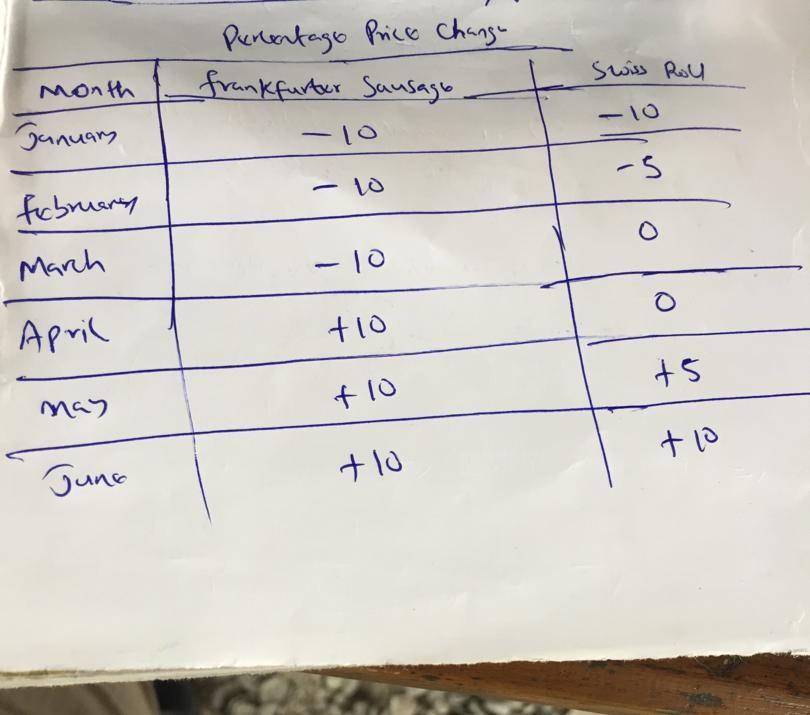
hello  your question is incomplete below is the complete question and the missing table

Your investment bank has an investment of $100 million in the stock of the Swiss Roll Corporation and a short position in the stock of the Frankfurter Sausage Company. Here is the recent price history of the two stocks: on the evidence of these six months how large would your short position in Frankfurter sausage needed to be to hedge you as far as possible against movements in the price of swiss Roll

answer : $42003667

Explanation:

$100 million in stocks

According to the data provided in the table attached below, to short the Frankfurt in order to hedge investment in Rolls is calculated below

we have to calculate the total return on both Roll corporation and Frankfurter sausage

for f-sausage

∑ (1 + monthly returns ) / 100

= ( 1 - 0.1 + 1 - 0.1 .... + 1 + 0.1 ) = -0.0297 =  -2.97%

for Roll corporation

∑ (1 + monthly returns ) / 100

= ( 1 - 0.1 + 1 - 0.05 .... + 1 + 0.1 ) = -0.012475 =  - 1.24%

next we will calculate the total loss inquired when investing in Roll corporation

Total loss = percentage loss * total investment

                 = 0.012475 * $100 million  =  - $ 1247500

we will have to offset the loss by shorting investments in F sausage

hence : $1247500 = investment in sausage * total return

             1247500 = investment in sausage * 0.0297 ( The total return of F sausage is positive because it was a short position )

hence short investment in F sausage to offset loss incurred in ROLLS INVESTMENT

= 1247500 / 0.0297 = $42003667

8 0
2 years ago
Other questions:
  • ____ analysis involves studying various market parameters in order to predict future price movements of stock.
    8·2 answers
  • Pharmaceutical companies sell some of their products to hospitals and clinics directly. they also market other products to large
    9·1 answer
  • Dixie's sales for the year were $1,678,000. Cost of goods sold, administrative and selling expenses, and depreciation expenses w
    11·1 answer
  • Which of the following cultures develops an emphasis on entrepreneurship and respect for the employee and allows the use of orga
    15·1 answer
  • Tom Owens has made a presentation to his prospect, Zero Enterprises. No matter how he has tried to move the call forward, he has
    9·1 answer
  • Discuss the various factors that account for the way divergence can be achieved in advertising creativity. Find an example of an
    6·1 answer
  • Pleasant Hills Properties is developing a golf course subdivision that includes 250 home lots; 100 lots are golf course lots and
    12·1 answer
  • 1. Why are individuals so important to the NASA project teams? 2. What is the Lessons Learned Program and how might it relate to
    13·1 answer
  • Springer Company had three intangible assets at the end of 2014 (end of the accounting year): a. A copyright purchased on Januar
    11·1 answer
  • Current assets and current liabilities for Brayden Company are as follows: 20Y9 20Y8 Current assets $498,600 $532,400 Current li
    12·1 answer
Add answer
Login
Not registered? Fast signup
Signup
Login Signup
Ask question!