answer.
Ask question
Login Signup
Ask question
All categories
  • English
  • Mathematics
  • Social Studies
  • Business
  • History
  • Health
  • Geography
  • Biology
  • Physics
  • Chemistry
  • Computers and Technology
  • Arts
  • World Languages
  • Spanish
  • French
  • German
  • Advanced Placement (AP)
  • SAT
  • Medicine
  • Law
  • Engineering
liberstina [14]
2 years ago
8

1. Which pronoun correctly completes the sentence when the direct object is replaced by a direct object pronoun?

Spanish
2 answers:
Alborosie2 years ago
4 0

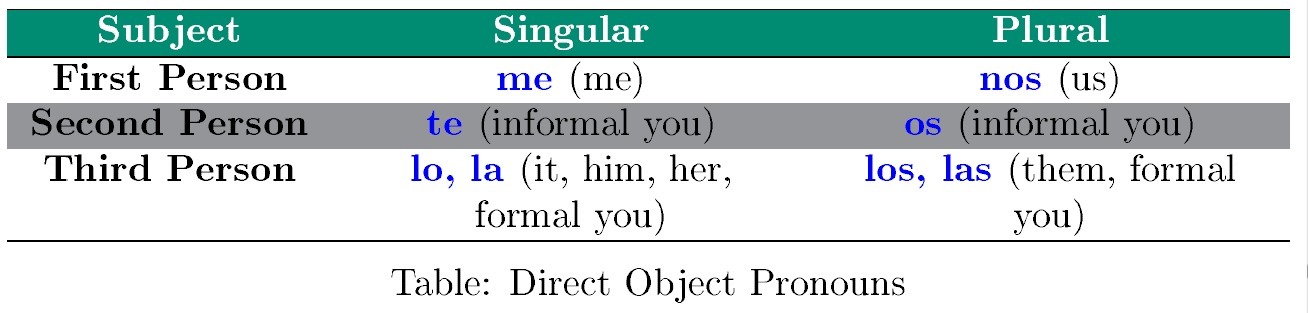
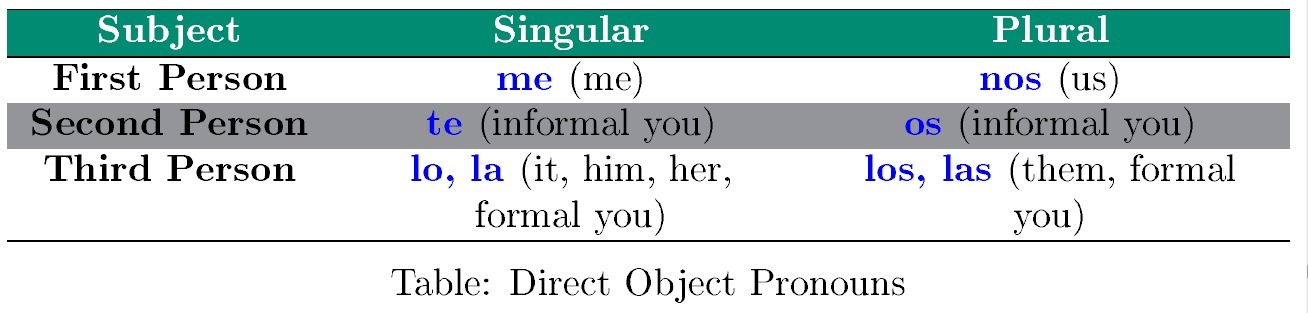
Hello, I am a Spanish Speaker and would like to help you. So, let's start with the definition. A Direct Object Pronoun (un pronombre de objeto directo) replaces a direct object, that is a noun that directly receives the action of a verb in a sentence. Moreover, direct object pronouns in Spanish agree in number and gender with the nouns they replace. The Table below shows the different forms of direct objects in Spanish. On the other hand, there are two places where indirect object pronouns can be placed namely:

1) Before a conjugated verb.

2) Attached to the end of the verb. This is only true if the verb is not conjugated, such as infinitives or gerunds or if the verb is an affirmative informal command.

In this way, let's solve this problem:

1. The right answer is te

Nosotros te vimos.

2. The right answer is me

¿Tú me llamaste?

3. The right answer is parar whose translation is stop, so you might say:

Por favor, para de sonar esa trompeta<em> (Please, </em><em>stop</em><em> ringing that trumpet.)</em>

Para de llorar <em>(</em><em>Stop</em><em> crying)</em>

Para de reir <em>(</em><em>Stop </em><em>laughing)</em>

4. The right answer is ¿Cómo se va a la carretera?

You can also say these equivalent sentences:

¿Cómo llego a la carretera/autopista?

¿Cómo agarro la carretera/autopista?

¿Cómo cojo la carretera/autopista?

¿Cómo tomo la carretera/autopista?

5. The right answer is Déjame en paz.

You can also say these equivalent sentences:

Déjame solo.

¡vete!

¡lárgate!

Ad libitum [116K]2 years ago
4 0

Question 1:

For this case, the first thing you should know is what personal pronoun we are referring to.

For this case, the pronoun is the second person of the singular.

Therefore, the direct object pronoun for the second person of the singular in Spanish is:

"te"

Thus, the complete sentence in Spanish is given by:

Nosotros te vimos

Answer:

"te"

Nosotros te vimos


Question 2:

For this case, the first thing we need to know is what personal pronoun we are referring to.

For this case the pronoun refers to the first person singular.

Therefore, the direct object pronoun in Spanish is given by:

"me"

Thus, the sentence in Spanish is given by:

¿Tú me llamaste?

Answer:

"me"

¿Tú me llamaste?


Question 3:

For this case, the first thing we must keep in mind is that "to stop" is a verb.

Normally it is a verb that indicates that you should not continue advancing.

In Spanish, we have different ways of indicating this verb.

One of the translations in Spanish for this verb comes from:

Stop = Parar

Answer:

If you want to tell someone to stop, you use:

"Parar"


Question 4:

For this case, the first thing we must do is translate the word highway in Spanish.

The translation of this word in Spanish is:

highway = carretera

Then, to ask the address in English we say:

How do I get to the highway?

The translation of this question in Spanish is:

¿Cómo se va a la carretera?

Answer:

If you want to ask directions to the highway, you say:

¿Cómo se va a la carretera?


Question 5:

For this case, it depends on the context, in Spanish, we have several expressions to tell someone to leave us alone.

Among these expressions we have:

¡Déjame solo!

¡Vete!

¡Lárgate!

¡No quiero verte!

¡Déjame en paz!

Answer:

If you want him or her to leave you alone, you say:

Déjame en paz.
You might be interested in
Yo _______________ toda la leche en el refrigerador. he bebido he bebiendo has bebido hayas bebiendo
gayaneshka [121]
The answer is ME HE BEBIDO
5 0
2 years ago
Read 2 more answers
ella (tener) ustedes (tener) yo (venir) nosotros (venir) 2 Emparejar Choose the correct option from the drop down for each item.
murzikaleks [220]

Answer:

Hello there!

1) Correct conjugation.

   -Ella tiene. (She has)

   -Ustedes tienen. (You have)

   -Yo vengo. (I come)

   -Nosotros venimos. (We come)

 2) Choose the correct option from the drop down for each item.  

El señor Beltrán es viejo.

No deseo llegar tarde.

Ustedes están en el Polo Norte.

3) Fill in the blanks with the correct forms of tener o venir.

  -Mañana hay un examen y yo tengo que estudiar. (SIMPLE PRESENT, 1st person, sg)

  -Tere y Amalia vendrán al estadio para practicar el tenis. (FUTURE, 3rd person, pl)

  -Iván y yo venimos a clase para aprender. (SIMPLE PRESENT, 2nd person, pl)

  -Los profesores tenían razón, la educación es muy importante. (SIMPLE PAST, 3rd person, pl)

  -No deseas descansar porque no tienes sueño. (SIMPLE PRESENT, 1st person, sg)

  -Usted viene al mediodía, ¿no? (SIMPLE PRESENT, 3rd person, sg)

4) Write sentences using the information provided and the correct form of tener or venir.

  -mis amigos / en autobús / de la biblioteca= Mis amigos vienen en autobús de la biblioteca. (venir) (MY FRIENDS COME FROM THE LIBRARY BY BUS)

  - yo / de / Italia nuestros primos / 10:00 p.m.= Mis primos y yo vinimos de Italia a las 10:00 p.m. (venir) (MY COUSINS AND I ARRIVED FROM ITALY AT 10 O' CLOCK)

  -tú / miedo / la película (movie) de horror= Tú le tienes miedo a la película de horror. (tener) (YOU ARE TERRIFIED BY HORROR MOVIES)

  -nosotras / ganas / mirar / televisión= Nosotras tenemos ganas de mirar televisión. (tener) (WE WANT TO WATCH T.V.)

  -usted / mucho / sed= Usted tiene mucha sed. (tener) I(WE ARE THIRSTY)

  -Ernesto / decidir / a la casa= Ernesto tiene que decidir si ir a la casa o no. (tener) (ERNESTO HAS TO DECIDE IF HE WANTS TO GO HOME OR NOT)

4 0
2 years ago
Why did Ernesto Lecuona move away from his homeland of Cuba?
Gnesinka [82]
I think its a but im not very sure
7 0
2 years ago
Read 2 more answers
Escoge las oraciones que son verdaderas. El observatorio del cerro Tololo: tiene recorridos gratis está en el Desierto Sahara ti
DENIUS [597]

Answer:tiene que ser más que eso no?

Explanation:

3 0
2 years ago
Read 2 more answers
D
Dmitrij [34]

Answer:

hey buddy just wanted to tell you that this isnt spanish.

Explanation:

3 0
2 years ago
Other questions:
  • Montevideo is located next to the mouth of which river?
    6·2 answers
  • 1. ____ una buena campaña política, no ganaremos las elecciones. Sin Hasta En 2. Hubo un escándalo de corrupción ____ el gobiern
    8·2 answers
  • Select the option that uses the appopriate pronouns.
    14·2 answers
  • 1. Mi padre __ todos los días en casa antes de ir a su trabajo.
    14·2 answers
  • Question 1 with 8 blanksCARMEN Hola, Jorge. Te llamo (1) despedirme porque me voy a Venezuela (2) ver a mi familia. Voy a estar
    11·2 answers
  • 1. Marissa dice que (says that) tiene una familia grande. cierto / falso
    6·1 answer
  • Soy Laura. Mi hermana Carlota vive en una ciudad con más restaurantes que bibliotecas. Los edificios en el centro de la ciudad d
    7·2 answers
  • Alicia is building a block pyramid similar to the pyramid shown. The top level will always have two blocks. Alicia wants her pyr
    9·1 answer
  • Ayer yo las llaves. Question 7 with 1 blankLas por todas partes. Question 8 with 1 blankYo a buscarlas cerca del carro. Question
    12·1 answer
  • Read and choose the correct option with the regular verb in the imperfect tense.
    7·1 answer
Add answer
Login
Not registered? Fast signup
Signup
Login Signup
Ask question!