answer.
Ask question
Login Signup
Ask question
All categories
  • English
  • Mathematics
  • Social Studies
  • Business
  • History
  • Health
  • Geography
  • Biology
  • Physics
  • Chemistry
  • Computers and Technology
  • Arts
  • World Languages
  • Spanish
  • French
  • German
  • Advanced Placement (AP)
  • SAT
  • Medicine
  • Law
  • Engineering
vekshin1
2 years ago
13

2. Determine the surface area of a primary settling tank sized to handle a maximum hourly flow of 0.570 m3/s at an overflow rate

of 60.0 m/d. If the effective tank depth is 3.0 m, what is the effective theoretical detention time
Engineering
2 answers:
Hitman42 [59]2 years ago
7 0

Answer:

The surface area of the primary settling tank is 0.0095 m^2.

The effective theoretical detention time is 0.05 s.

Explanation:

The surface area of the tank is calculated by dividing the volumetric flow rate by the overflow rate.

Volumetric flow rate = 0.570 m^3/s

Overflow rate = 60 m/s

Surface area = 0.570 m^3/s ÷ 60 m/s = 0.0095 m^2

Detention time is calculated by dividing the volume of the tank by the its volumetric flow rate

Volume of the tank = surface area × depth = 0.0095 m^2 × 3 m = 0.0285 m^3

Detention time = 0.0285 m^3 ÷ 0.570 m^3/s = 0.05 s

Yuki888 [10]2 years ago
7 0

Given Information:

overflow rate = v = 60 m/d

volumetric flow rate = Q = 0.570 m³/s

depth of tank = h = 3 m

Required Information:

detention time = θ = ?

Answer:

detention time = θ = 3 days or 1.2 hours or 72 minutes or 4.32x10³ seconds

Explanation:

We know that the detention time is given by

θ = V/Q

Where V is the volume of tank and Q is the volumetric flow rate of the tank.

To find out the volume of tank, first we have to find the surface area of the tank.

As we know the volumetric flow rate is given by

Q = Av

A = Q/v

Where A is the surface area of tank and v is the over flow rate and Q is the volumetric flow rate.

First convert the overflow rate from m/d into m/s

1 day has 24 hours, each hour has 60 minutes, each minute has 60 seconds.

v = 60/(24*60*60)

v = 6.94x10⁻⁴ m/s

A = Q/v

A = 0.570/6.94x10⁻⁴

A = 821.32 m²

The volume of tank is given by

V = A*h

V = 821.32*3

V = 2463.97 m³

Finally, the detention time is

θ = V/Q

θ = 2463.97/0.570

Detention time in seconds:

θ = 4.32x10³ seconds

Detention time in minutes:

θ = 4.32x10³/60 = 72 minutes

Detention time in hours:

θ = 72/60 = 1.2 hours

Detention time in days:

θ = 1.2/24 = 0.05 days

You might be interested in
A group of statisticians at a local college has asked you to create a set of functions that compute the median and mode of a set
iVinArrow [24]

Answer:

Functions to create a median and mode of a set of numbers

Explanation:

def median(list):

   if len(list) == 0:

       return 0

   list.sort()

   midIndex = len(list) / 2

   if len(list) % 2 == 1:

       return list[midIndex]

   else:

       return (list[midIndex] + list[midIndex - 1]) / 2

def mean(list):

   if len(list) == 0:

       return 0

   list.sort()

   total = 0

   for number in list:

       total += number

   return total / len(list)

def mode(list):

   numberDictionary = {}

   for digit in list:

       number = numberDictionary.get(digit, None)

       if number == None:

           numberDictionary[digit] = 1

       else:

           numberDictionary[digit] = number + 1

   maxValue = max(numberDictionary.values())

   modeList = []

   for key in numberDictionary:

       if numberDictionary[key] == maxValue:

           modeList.append(key)

   return modeList

def main():

   print "Mean of [1, 2, 3, 4, 5, 6, 7, 8, 9, 10]: ", mean(range(1, 11))

   print "Mode of [1, 1, 1, 1, 4, 4]:", mode([1, 1, 1, 1, 4, 4])

   print "Median of [1, 2, 3, 4]:", median([1, 2, 3, 4])

main()

3 0
2 years ago
Read 2 more answers
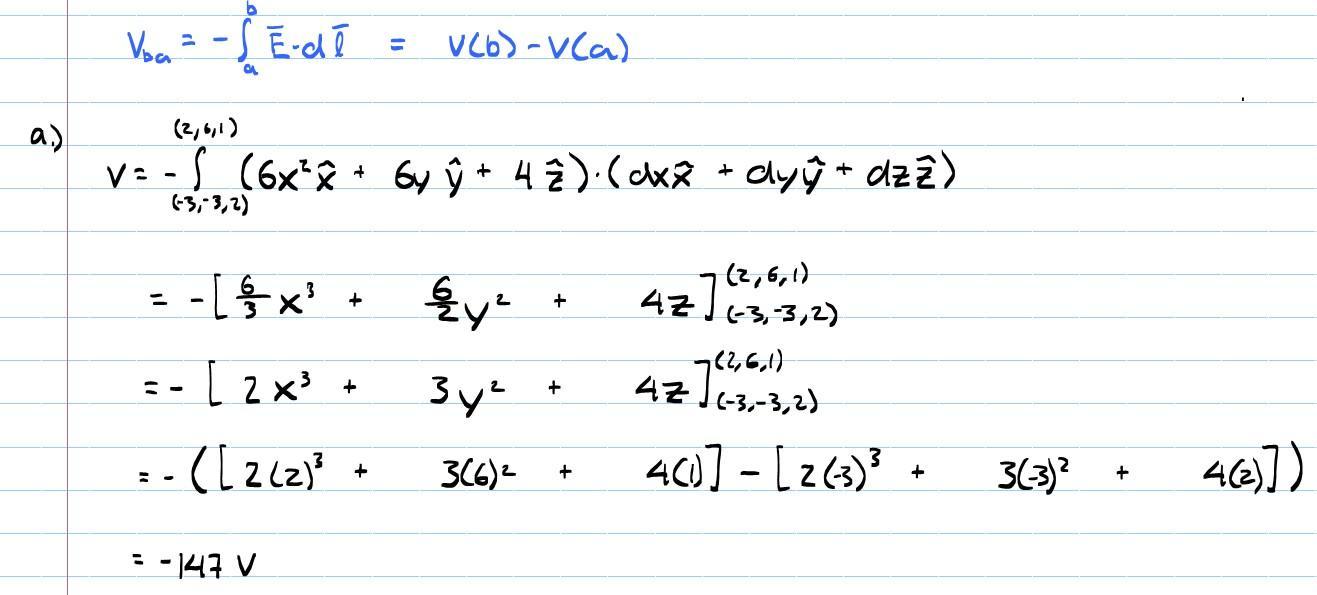
An electric field is expressed in rectangular coordinates by E = 6x2ax + 6y ay +4az V/m.Find:a) VMN if point M and N are specifi
Fittoniya [83]

Answer:

a.) -147V

b.) -120V

c.) 51V

Explanation:

a.) Equation for potential difference is the integral of the electrical field from a to b for the voltage V_ba = V(b)-V(a).

b.) The problem becomes easier to solve if you draw out the circuit. Since potential at Q is 0, then Q is at ground. So voltage across V_MQ is the same as potential at V_M.

c.) Same process as part b. Draw out the circuit and you'll see that the potential a point V_N is the same as the voltage across V_NP added with the 2V from the other box.

Honestly, these things take practice to get used to. It's really hard to explain this.

3 0
2 years ago
A conical enlargement in a vertical pipeline is 5 ft long and enlarges the pipe diameter from 12 in. to 24 in. diameter. Calcula
makkiz [27]

Answer:

F_y = 151319.01N = 15.132 KN

Explanation:

From the linear momentum equation theory, since flow is steady, the y components would be;

-V1•ρ1•V1•A1 + V2•ρ2•V2•A2 = P1•A1 - P2•A2 - F_y

We are given;

Length; L = 5ft = 1.52.

Initial diameter;d1 = 12in = 0.3m

Exit diameter; d2 = 24 in = 0.6m

Volume flow rate of water; Q2 = 10 ft³/s = 0.28 m³/s

Initial pressure;p1 = 30 psi = 206843 pa

Thus,

initial Area;A1 = π•d1²/4 = π•0.3²/4 = 0.07 m²

Exit area;A2 = π•d2²/4 = π•0.6²/4 = 0.28m²

Now, we know that volume flow rate of water is given by; Q = A•V

Thus,

At exit, Q2 = A2•V2

So, 0.28 = 0.28•V2

So,V2 = 1 m/s

When flow is incompressible, we often say that ;

Initial mass flow rate = exit mass flow rate.

Thus,

ρ1 = ρ2 = 1000 kg/m³

Density of water is 1000 kg/m³

And A1•V1 = A2•V2

So, V1 = A2•V2/A1

So, V1 = 0.28 x 1/0.07

V1 = 4 m/s

So, from initial equation of y components;

-V1•ρ1•V1•A1 + V2•ρ2•V2•A2 = P1•A1 - P2•A2 - F_y

Where F_y is vertical force of enlargement pressure and P2 = 0

Thus, making F_y the subject;

F_y = P1•A1 + V1•ρ1•V1•A1 - V2•ρ2•V2•A2

Plugging in the relevant values to get;

F_y = (206843 x 0.07) + (1² x 1000 x 0.07) - (4² x 1000 x 0.28)

F_y = 151319.01N = 15.132 KN

6 0
2 years ago
A plane wall of thickness 2L = 60 mm and thermal conductivity k= 5W/m.K experiences uniform volumetric heat generation at a rate
aniked [119]

Answer:

Explanation:

A plane wall of thickness 2L=40 mm and thermal conductivity k=5W/m⋅Kk=5W/m⋅K experiences uniform volumetric heat generation at a rateq  

˙

q

q

˙

​  

, while convection heat transfer occurs at both of its surfaces (x=-L, +L), each of which is exposed to a fluid of temperature T∞=20∘CT  

∞

​  

=20  

∘

C. Under steady-state conditions, the temperature distribution in the wall is of the form T(x)=a+bx+cx2T(x)=a+bx+cx  

2

 where a=82.0∘C,b=−210∘C/m,c=−2×104C/m2a=82.0  

∘

C,b=−210  

∘

C/m,c=−2×10  

4

C/m  

2

, and x is in meters. The origin of the x-coordinate is at the midplane of the wall. (a) Sketch the temperature distribution and identify significant physical features. (b) What is the volumetric rate of heat generation q in the wall? (c) Determine the surface heat fluxes, q

′′

x

(−L)q  

x

′′

​  

(−L) and q

′′

x

(+L)q  

x

′′

​  

(+L). How are these fluxes related to the heat generation rate? (d) What are the convection coefficients for the surfaces at x=-L and x=+L? (e) Obtain an expression for the heat flux distribution q

′′

x

(x)q  

x

′′

​  

(x). Is the heat flux zero at any location? Explain any significant features of the distribution. (f) If the source of the heat generation is suddenly deactivated (q=0), what is the rate of change of energy stored in the wall at this instant? (g) What temperature will the wall eventually reach with q=0? How much energy must be removed by the fluid per unit area of the wall (J/m2)(J/m  

2

) to reach this state? The density and specific heat of the wall material are 2600kg/m32600kg/m  

3

 and 800J/kg⋅K800J/kg⋅K, respectively.

6 0
2 years ago
A milling operation was used to remove a portion of a solid bar of square cross section. Forces of magnitude P = 18 kN are appli
monitta

The smallest allowable depth is d=16.04 \mathrm{mm} for the milled portion of bar.

<u>Explanation:</u>

Given,

Magnitude of force,\mathbf{p}=18 \mathrm{kN}

a=30 \mathrm{mm}

=0.03 \mathrm{m}

Allowable stress,\sigma_{a l l}=135 \mathrm{MPa}

cross sectional area of bar,

A=a \times d

A=a d

e - eccentricity

e=\frac{a}{2}-\frac{d}{2}

The internal forces in the cross section are equivalent to a centric force P and a bending couple M.

M=P e

=P\left(\frac{a}{2}-\frac{d}{2}\right)

=\frac{P(a-d)}{2}

Allowable stress

\sigma=\frac{P}{A}+\frac{M c}{I}

c=\frac{d}{2}

Moment of Inertia,

I=\frac{b d^{3}}{12}

=\frac{a d^{3}}{12}

\therefore \sigma=\frac{P}{a d}+\frac{\frac{P(a-d)}{2} \times \frac{d}{2}}{\frac{a d^{3}}{12}}

\sigma=\frac{P}{a d}+\frac{3 P(a-d)}{a d^{2}}\\

\sqrt{x} \sigma\left(a d^{2}\right)=P d+3 P(a-d)

\sigma\left(a d^{2}\right)=P d+3 P a-3 P d

\sigma\left(a d^{2}\right)=(P-3 P) d+3 P a

\left(\sigma a d^{2}\right)=-2 P d+3 P a

\sigma d^{2}=-\frac{2 P}{a} d+3 P

By substituting values we get,

\left(135 \times 10^{6}\right) d^{2}+\frac{2 \times 18 \times 10^{3}}{0.03} d-3\left(18 \times 10^{3}\right)=0

\left(135 \times 10^{6}\right) d^{2}+\left(12 \times 10^{5}\right) d-54 \times 10^{3}=0

On solving above equation we get,d=0.01604 \mathrm{m}\\

d=16.04 \mathrm{mm}

3 0
2 years ago
Other questions:
  • You are working in a lab where RC circuits are used to delay the initiation of a process. One particular experiment involves an
    13·1 answer
  • As shown, a load of mass 10 kg is situated on a piston of diameter D1 = 140 mm. The piston rides on a reservoir of oil of depth
    9·1 answer
  • A negative pressure respirator brings fresh air to you through a hose<br>A) True<br>B)False​
    15·2 answers
  • Air is compressed adiabatically from p1 1 bar, T1 300 K to p2 15 bar, v2 0.1227 m3 /kg. The air is then cooled at constant volum
    13·1 answer
  • The velocity of a particle which moves along the s-axis is given by v = 2-4t+5t^(3/2), where t is in seconds and v is in meters
    11·2 answers
  • The small 5-oz slider A moves without appreciable friction in the hollow tube, which rotates in a horizontal plane with a consta
    7·1 answer
  • Steam at 40 bar and 500o C enters the first-stage turbine with a volumetric flow rate of 90 m3 /min. Steam exits the turbine at
    9·1 answer
  • With thermodynamics, one cannot determine ________.
    14·1 answer
  • The following passage contains a fragment. Select the correct revision. Presley took the exuberance of gospel and added the freq
    7·1 answer
  • An airplane in level flight at an altitude h and a uniform speed v passes directly over a radar tracking station A. Calculate th
    5·1 answer
Add answer
Login
Not registered? Fast signup
Signup
Login Signup
Ask question!