answer.
Ask question
Login Signup
Ask question
All categories
  • English
  • Mathematics
  • Social Studies
  • Business
  • History
  • Health
  • Geography
  • Biology
  • Physics
  • Chemistry
  • Computers and Technology
  • Arts
  • World Languages
  • Spanish
  • French
  • German
  • Advanced Placement (AP)
  • SAT
  • Medicine
  • Law
  • Engineering
slavikrds [6]
2 years ago
11

The velocity of a particle which moves along the s-axis is given by v = 2-4t+5t^(3/2), where t is in seconds and v is in meters

per second. Evaluate the position s, velocity v, and acceleration a when t=4s. The particle is at the position s0 =2m when t=0
Engineering
2 answers:
Brut [27]2 years ago
4 0

Answer:

a) s = 42 m

b) V = 26 m/s

c) a = 11 m/s²

Explanation:

The velocity(V) = 2 - 4t + 5t^3/2 where t is in seconds and V is in m/s

a) To get the position, we have to integrate the velocity with respect to time.

We get the position(s) from the equation:

V=\frac{ds}{dt}

ds=Vdt

Integrating both sides,

s=\int\ {V} \, dt

s=\int\ {(2-4t+5t^{\frac{3}{2} })  \, dt

Integrating, we get

s=(2t-2t^{2} +2t^{\frac{5}{2} }+c)m

But at t=0, s(0) = 2 m

Therefore,

s(0)=2(0)-2(0)^{2} +2(0)^{\frac{5}{2} }+c  

2=0+0+0+c

c = 2

Therefore

s=(2t-2t^{2} +\frac{10}{5}t^{\frac{5}{2} }+2)m

When t = 4,

s=2(4)-2(4)^{2} +2(4)^{\frac{5}{2} }+2

s=8-32+64+2

s = 42 m

At t= 4s, the position s = 42m

b) The velocity equation is given by:

V=(2-4t+5t^{\frac{3}{2} })m/s

At t = 4,

V=2-4(4)+5(4)^{\frac{3}{2} }

V = 2 - 16 + 40 = 26 m/s

The velocity(V)at t = 4 s is 26 m/s

c) The acceleration(a) is given by:

a=\frac{dv}{dt}

a=\frac{d}{dt}(2-4t+5t^{ \frac{3}{2}})

Differentiating with respect to t,

a=-4+\frac{15}{2}t^{\frac{1}{2} }

a=(-4+\frac{15}{2}t^{\frac{1}{2} })m/s^{2}

At t = 4 s,

a=-4+\frac{15}{2}(4)^{\frac{1}{2} }

a=-4+15

a = 11 m/s²

Reika [66]2 years ago
4 0
<h2></h2><h2>Answer:</h2>

The position s, velocity v, and acceleration a when t = 4s are 40m, 26m/s and 11m/s² respectively.

<h2>Explanation:</h2>

The velocity, v, of the particle at any time, t, is given by;

v = 2 - 4t + 5t^{\frac{3}{2} }          ----------(i)

<em>Analysis 1: </em>To get the position, s, of the particle at any time, t, we integrate equation (i) with respect to t as follows;

s = ∫ v dt

<em>Substitute the value of v into the above as follows;</em>

s = ∫ (2 - 4t + 5t^{\frac{3}{2} }) dt          

s = 2t - \frac{4t^2}{2} + \frac{5t^{5/2}}{5/2}

s = 2t -2t² + 2t^{\frac{5}{2} } + c       [c is the constant of integration]            ------------(ii)

<em>According to the question;</em>

when t = 0, s = 2m

<em>Substitute these values into equation (ii) as follows;</em>

2 = 2(0) -2(0)² + 2(0)^{\frac{5}{2} } + c  

2 = 0 - 0 - 0 + c

c = 2

<em>Substitute the value of c = 2 back into equation (ii) as follows;</em>

s = 2t -2t² + 2t^{\frac{5}{2} } + 2      --------------------------------(iii)

<em>Analysis 2: </em>To get the acceleration, a, of the particle at any time, t, we differentiate equation (i) with respect to t as follows;

a = \frac{dv}{dt}

<em>Substitute the value of v into the above as follows;</em>

a = \frac{d(2 - 4t + 5t^{3/2})}{dt}

a = -4 + \frac{15}{2}t^{1/2}                 ----------------------------------(iv)

Now;

(a) When t = 4s, the position s, of the particle is calculated by substituting t=4 into equation (iii) as follows;

s = 2(4) -2(4)² + 2(4^{\frac{5}{2} }) + 2

s = 8 - 32 + 2(4)²°⁵

s = 8 - 32 + 2(32)

s = 8 - 32 + 64

s = 40m

(b) When t = 4s, the velocity v, of the particle is calculated by substituting t=4 into equation (i) as follows;

v = 2 - 4(4) + 5(4^{\frac{3}{2} })

v = 2 - 16 + 5(4)¹°⁵

v = 2 - 16 + 5(8)

v = 2 - 16 + 40

v = 26m/s

(c) When t = 4s, the acceleration a, of the particle is calculated by substituting t = 4 into equation (iv) as follows;

a = -4 + \frac{15}{2}(4^{1/2})

a = -4 + \frac{15}{2}(2)

a = -4 + 15

a = 11m/s²

Therefore, the position s, velocity v, and acceleration a when t=4s are 40m, 26m/s and 11m/s² respectively.


You might be interested in
5. Which of these materials in a shop contain metals and toxins and can pollute the environment? A) Antifreeze B) Solvents C) Ba
Elza [17]
As a multiple choice the only correct answer is D
3 0
2 years ago
Read 2 more answers
simple power system consists of a dc generator connected to a load center via a transmission line. The load power is 100 kW. The
Roman55 [17]

Answer:

A. ) 591.7 v

B.) 991.7v

C.) 59.7%

D.) 47.9 Kw

E.) 247925 W

F.) 59.7 %

Explanation:

Given that a simple power system consists of a dc generator connected to a load center via a transmission line. The load power is 100 kW. The transmission line is 100 km copper wire of 3 cm diameter. If the voltage at the load side is 400 V,

Let first calculate the resistance in the wire.

The resistivity (rho) of a copper wire is 1.673×10^-8 ohm metres

Resistance R =( L× rho)/A

Where Area = πr^2 = π × 0.015^2

Area = 0.00071 m^2

R = (100000 × 1.673×10^-8) / 0.00071

Resistance in wire = 2.367 ohms

Then let calculate the resistance in the load.

Also, since Power P = V^2 /R

Make R the subject of formula

R = V^2/ P

R = 400^2/100000

Resistance in load = 1.6 Ohms

Current l = V / R

I = 400/1.6 = 250 Ampere

a.) Voltage drop across the line V line will be achieved by using Ohms law.

V = I R

V = 250 × 2.367

V = 591.7 v

B.) Voltage at the source side Vsource will be

V = V line + V load

V = 400 + 591.7

V = 991.7 v

C.) Percentage of the voltage drop Vline /Vsource

591.7/991.7 × 100 = 59.7%

D.) Line losses

P = I V

P = 250 × 591.7

P = 147925 W

Power loss = 147925 - 100000

Power loss = 47,925 W

Power loss = 47.9 Kw

E.) Power delivered by the source

P = IV

P = 250 × 991.7 = 247925 W

F.) System efficiency

Efficiency = power line / power source × 100

Efficiency = 147925 / 247925 × 100

Efficiency = 59.7 %

5 0
2 years ago
Discuss the nature of materials causing turbidity in
Anestetic [448]

Answer:

a

Explanation:

5 0
2 years ago
Read 2 more answers
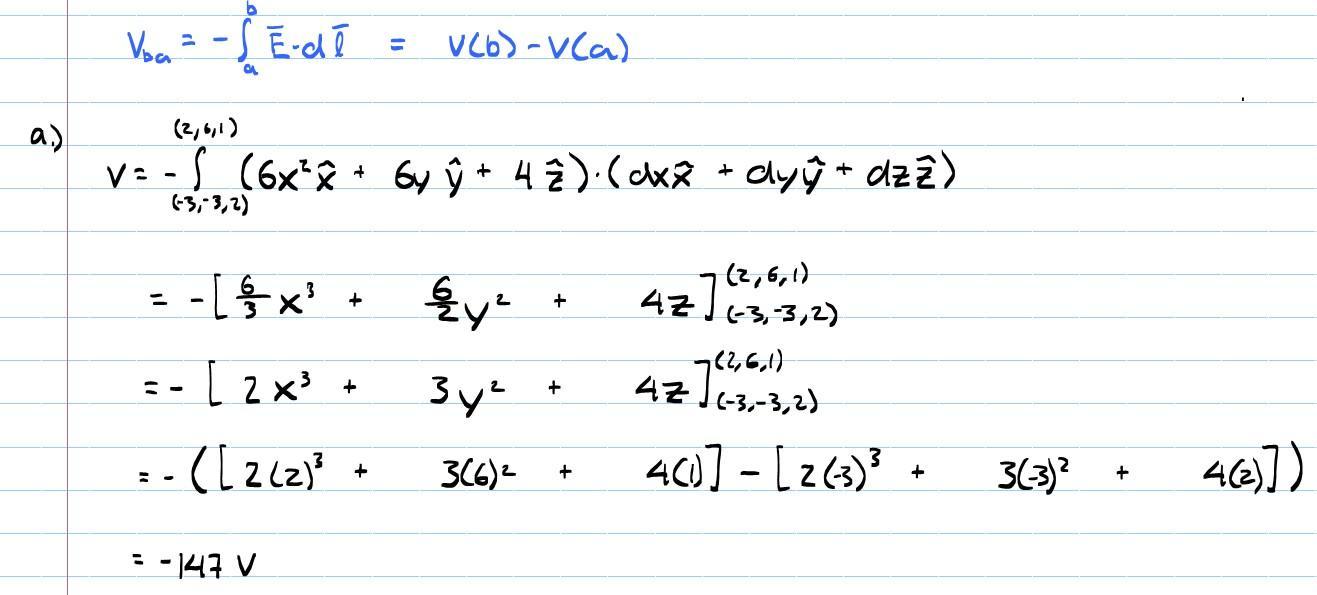
An electric field is expressed in rectangular coordinates by E = 6x2ax + 6y ay +4az V/m.Find:a) VMN if point M and N are specifi
Fittoniya [83]

Answer:

a.) -147V

b.) -120V

c.) 51V

Explanation:

a.) Equation for potential difference is the integral of the electrical field from a to b for the voltage V_ba = V(b)-V(a).

b.) The problem becomes easier to solve if you draw out the circuit. Since potential at Q is 0, then Q is at ground. So voltage across V_MQ is the same as potential at V_M.

c.) Same process as part b. Draw out the circuit and you'll see that the potential a point V_N is the same as the voltage across V_NP added with the 2V from the other box.

Honestly, these things take practice to get used to. It's really hard to explain this.

3 0
2 years ago
The legend that Benjamin Franklin flew a kite as a storm approached is only a legend—he was neither stupid nor suicidal. Suppose
Delicious77 [7]

Answer: 0.93 mA

Explanation:

In order to calculate the current passing through the water layer, as we have the potential difference between the ends of the string as a given, assuming that we can apply Ohm’s law, we need to calculate the resistance of the water layer.

We can express the resistance as follows:

R = ρ.L/A

In order to calculate the area A, we can assume that the string is a cylinder with a circular cross-section, so the Area of the water layer can be written as follows:

A= π(r22 – r12) = π( (0.0025)2-(0.002)2 ) m2 = 7.07 . 10-6 m2

Replacing by the values, we get R as follows:

R = 1.4 1010 Ω

Applying Ohm’s Law, and solving for the current I:

I = V/R = 130 106 V / 1.4 1010 Ω = 0.93 mA

7 0
2 years ago
Other questions:
  • Oil in an engine is being cooled by air in a cross-flow heat exchanger, where both fluids are unmixed. Oil (cp = 2000 J/kg. K) f
    12·1 answer
  • A driver traveling at 65 mi/h rounds a curve on a level grade to see a truck overturned across the roadway at a distance of 350
    13·1 answer
  • A logic chip used in a computer dissipates 3 W of power in an environment at 120°F, and has a heat transfer surface area of 0.08
    11·1 answer
  • The 10-kg block slides down 2 m on the rough surface with kinetic friction coefficient μk = 0.2. What is the work done by the fr
    7·1 answer
  • A horizontal pipe has an abrupt expansion from D1 5 8 cm to D2 5 16 cm. The water velocity in the smaller section is 10 m/s and
    7·1 answer
  • Q5. A hypothetical metal alloy has a grain diameter of 2.4 x 10⁻² mm. After a heat treatment at 575°C for 500 min, the grain dia
    7·1 answer
  • Two airstreams are mixed steadily and adiabatically. The first stream enters at 35°C and 30 percent relative humidity at a rate
    6·1 answer
  • Madison and Oxford are the same distance from the equator and they are both near the ocean. Use the information on the map to an
    11·1 answer
  • Chapter 19: Diesel Engine Operation and Diagnosis -Chapter Quiz
    5·1 answer
  • 140-character statement that completes this sentence: I pledge to not text and drive because...
    12·1 answer
Add answer
Login
Not registered? Fast signup
Signup
Login Signup
Ask question!