answer.
Ask question
Login Signup
Ask question
All categories
  • English
  • Mathematics
  • Social Studies
  • Business
  • History
  • Health
  • Geography
  • Biology
  • Physics
  • Chemistry
  • Computers and Technology
  • Arts
  • World Languages
  • Spanish
  • French
  • German
  • Advanced Placement (AP)
  • SAT
  • Medicine
  • Law
  • Engineering
Travka [436]
2 years ago
13

A driver traveling at 65 mi/h rounds a curve on a level grade to see a truck overturned across the roadway at a distance of 350

ft. If the driver is able to decelerate at a rate of 10ft/s2, at what speed will the vehicle hit the truck Plot the result for reaction times ranging from 0.50 to 5.00 s in increments of 0.5 s. Comment on the results.

Engineering
1 answer:
horrorfan [7]2 years ago
6 0

Answer:

When the driver first sees the overturned truck, he will continue to move at 65mi/h during this reaction time. During this time, the vehicle will travel 1.47*65*t feet, or 95.5f ft.

Distance available for braking is 350-95.5t feet. This is the distance that is available for deceleration before the vehicle hits the overturned truck. The formula for braking distance is

d=(si²-sf²)/30(F +/- 0.01G)

In this case, the initial speed (Si) is 65mi/h. The friction factor, F, is related to the deceleration rate, and is computed by dividing the deceleration rate by the deceleration rate due to gravity, or 10/32.2 =0.31. The grade is level, i.e., G = 0. The braking distance is 350 – 95.5t.

Therefore,

350-95t=(65²-sf²)/(30*0.31)

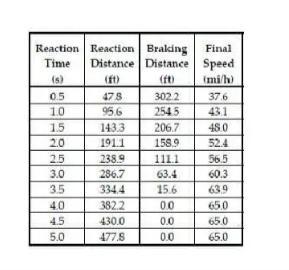
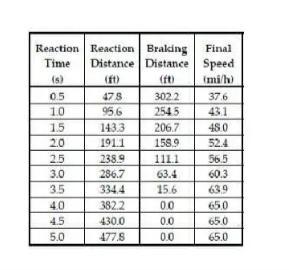
This equation is solved for various values of t from 0.50 to 5.00 s. Note that at the point where the reaction distance becomes more than 350ft, the final speed is a constant 65mi/h, and the braking distance is essentially “0.”

Check the attachment below for the table and graph.

*COMMENT*

The vehicle is going to hit the overturned truck in any event. For reaction times over approximately 3.75s, the vehicle will hit the truck at full speed, 65mi/h.
You might be interested in
You work in Madison, Wisconsin. It is January and the area has been hit with bad weather. Another weather front is expected to a
Lelu [443]

Answer:

The best first sentence of your e-mail will be-

<u>Weather forecasters are predicting a blizzard this afternoon, so, as a result of this news, our supervisor has decided to close the office at noon so people can travel home safely.</u>

<u />

5 0
2 years ago
A shaft consisting of a steel tube of 50-mm outer diameter is to transmit 100 kW of power while rotating at a frequency of 34 Hz
nikitadnepr [17]

Answer:

25 - \sqrt[4]{26.66*10^{-8} }  mm

Explanation:

Given data

steel tube : outer diameter = 50-mm

power transmitted = 100 KW

frequency(f) = 34 Hz

shearing stress ≤ 60 MPa

Determine tube thickness

firstly we calculate the ; power, angular velocity and torque of the tube

power = T(torque) * w (angular velocity)

angular velocity ( w ) = 2\pif = 2 * \pi * 34 = 213.71

Torque (T) = power / angular velocity = 100000 / 213.71 = 467.92 N.m/s

next we calculate the inner diameter  using the relation

  \frac{J}{c_{2}  } = \frac{T}{t_{max} }  = 467.92 / (60 * 10^6) =  7.8 * 10^-6 m^3

also

c2 = (50/2) = 25 mm

\frac{J}{c_{2} } = \frac{\pi }{2c_{2} } ( c^{4} _{2} - c^{4} _{1} ) =  \frac{\pi }{0.050} [ ( 0.025^{4} - c^{4} _{1}  ) ]

therefore; 0.025^4 - c^{4} _{1} = 0.050 / \pi (7.8 *10^-6)

c^{4} _{1} = 39.06 * 10 ^-8 - ( 1.59*10^-2 * 7.8*10^-6)

    39.06 * 10^-8 - 12.402 * 10^-8 =26.66 *10^-8

c_{1} = \sqrt[4]{26.66 * 10^{-8} }  =

THE TUBE THICKNESS

c_{2} - c_{1} = 25 - \sqrt[4]{26.66*10^{-8} }  mm

4 0
2 years ago
The legend that Benjamin Franklin flew a kite as a storm approached is only a legend—he was neither stupid nor suicidal. Suppose
Delicious77 [7]

Answer: 0.93 mA

Explanation:

In order to calculate the current passing through the water layer, as we have the potential difference between the ends of the string as a given, assuming that we can apply Ohm’s law, we need to calculate the resistance of the water layer.

We can express the resistance as follows:

R = ρ.L/A

In order to calculate the area A, we can assume that the string is a cylinder with a circular cross-section, so the Area of the water layer can be written as follows:

A= π(r22 – r12) = π( (0.0025)2-(0.002)2 ) m2 = 7.07 . 10-6 m2

Replacing by the values, we get R as follows:

R = 1.4 1010 Ω

Applying Ohm’s Law, and solving for the current I:

I = V/R = 130 106 V / 1.4 1010 Ω = 0.93 mA

7 0
2 years ago
A steel rotating-beam test specimen has an ultimate strength Sut of 1600 MPa. Estimate the life (N) of the specimen if it is tes
ziro4ka [17]

Answer:

the life (N) of the specimen is 46400 cycles

Explanation:

given data

ultimate strength Su = 1600 MPa

stress amplitude σa = 900 MPa

to find out

life (N) of the specimen

solution

we first calculate the endurance limit of specimen Se i.e

Se = 0.5× Su   .............1

Se = 0.5 × 1600

Se = 800 Mpa

and we know

Se for steel is 700 Mpa for Su ≥ 1400 Mpa

so we take endurance limit Se is = 700 Mpa

and strength of friction f  = 0.77 for 232 ksi

because for Se 0.5 Su at 10^{6} cycle = (1600 × 0.145 ksi ) = 232

so here coefficient value (a) will be

a = \frac{(f*Su)^2}{Se}    

a = \frac{(0.77*1600)^2}{700}  

a = 2168.3 Mpa

so

coefficient value (b) will be

a = -\frac{1}{3}log\frac{(f*Su)}{Se}

b =  -\frac{1}{3}log\frac{(0.77*1600)}{700}

b = -0.0818

so no of cycle N is

N =  (\frac{ \sigma a}{a})^{1/b}

put here value

N =  (\frac{ 900}{2168.3})^{1/-0.0818}

N = 46400

the life (N) of the specimen is 46400 cycles

5 0
2 years ago
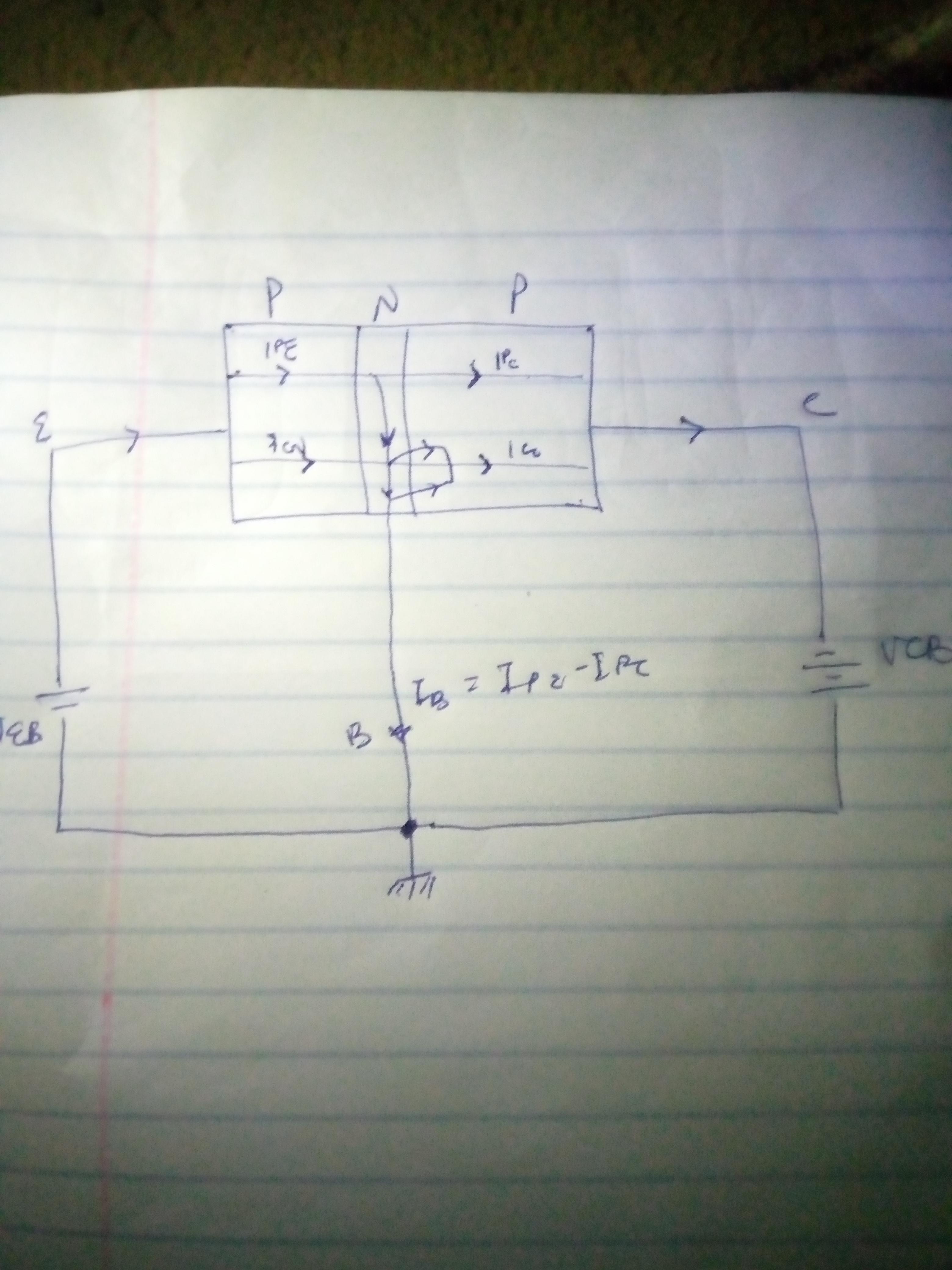
For a p-n-p BJT with NE 7 NB 7 NC, show the dominant current components, with proper arrows, for directions in the normal active
Sonja [21]

Answer:

=> base transport factor = 0.98.

=> emitter injection efficiency = 0.99.

=> common-base current gain = 0.97.

=> common-emitter current gain = 32.34.

=> ICBO = 1 × 10^-6 A.

=> base transit time = 0.325.

=> lifetime = 1.875.

Explanation:

(Kindly check the attachment for the diagram showing the dominant current components, with proper arrows, for directions in the normal active mode).

The following parameters or data are given for a p-n-p BJT with NE 7 NB 7 NC and they are: IEp = 10 mA, IEn = 100 mA, ICp = 9.8 mA, and ICn = 1 mA.

(1). The base transport factor = ICp/IEp=9.8/10 =  0.98.

(2). emitter injection efficiency =IEp/ IEp + ICn = 10/10 + 0.1 =  0.99.

(3).common-base current gain = 0.98 × 0.99 = 0.9702.

(4).common-emitter current gain =0.97 / 1- 0.97  = 32.34.

(5). Icbo = Ico = 1 × 10^-6 A.

(6). base transit time = 1248 × 10^-2 × (1.38× 10^-23/1.603 × 10^-19). = 0.325.

(7).lifetime;

= > 2 = √0.325 + √ lifetime.

= Lifetime = 2.875.

6 0
2 years ago
Other questions:
  • The four-wheel-drive all-terrain vehicle has a mass of 320 kg with center of mass G2. The driver has a mass of 82 kg with center
    15·1 answer
  • If the electric field just outside a thin conducting sheet is equal to 1.5 N/C, determine the surface charge density on the cond
    9·1 answer
  • The basic barometer can be used to measure the height of a building. If the barometric readings at the top and the bottom of a b
    15·1 answer
  • Water flows downward through a vertical 10-mm-diameter galvanized iron pipe with an average velocity for 5.0 m/s and exits as a
    5·1 answer
  • 1. A spur gear made of bronze drives a mid steel pinion with angular velocity ratio of 13 /2 : 1. Thepressure angle is 14 1/2° .
    12·1 answer
  • Find the largest number. The process of finding the maximum value (i.e., the largest of a group of values) is used frequently in
    6·1 answer
  • Anytime scaffolds are assembled or __________, a competent person must oversee the operation.
    15·2 answers
  • Who can work on a fixed ladder that extends more than 24 feet?
    11·1 answer
  • While at a concert you notice five people in the crowd headed in the same direction. Your tendency to group them is due to? *
    10·1 answer
  • A rectangular channel 3.0 m wide has a flow rate of 5.0 m3/s with a normal depth of 0.50 m. The flow then encounters a dam that
    9·1 answer
Add answer
Login
Not registered? Fast signup
Signup
Login Signup
Ask question!