answer.
Ask question
Login Signup
Ask question
All categories
  • English
  • Mathematics
  • Social Studies
  • Business
  • History
  • Health
  • Geography
  • Biology
  • Physics
  • Chemistry
  • Computers and Technology
  • Arts
  • World Languages
  • Spanish
  • French
  • German
  • Advanced Placement (AP)
  • SAT
  • Medicine
  • Law
  • Engineering
TiliK225 [7]
2 years ago
10

Discuss the nature of materials causing turbidity in

Engineering
2 answers:
natta225 [31]2 years ago
7 0
A if not B i believe
Anestetic [448]2 years ago
5 0

Answer:

a

Explanation:

You might be interested in
Determine the angular acceleration of the uniform disk if (a) the rotational inertia of the disk is ignored and (b) the inertia
lukranit [14]

Answer:

α = 7.848 rad/s^2  ... Without disk inertia

α = 6.278 rad/s^2  .... With disk inertia

Explanation:

Given:-

- The mass of the disk, M = 5 kg

- The right hanging mass, mb = 4 kg

- The left hanging mass, ma = 6 kg

- The radius of the disk, r = 0.25 m

Find:-

Determine the angular acceleration of the uniform disk without and with considering the inertia of disk

Solution:-

- Assuming the inertia of the disk is negligible. The two masses ( A & B )  are hung over the disk in a pulley system. The disk is supported by a fixed support with hinge at the center of the disk.

- We will make a Free body diagram for each end of the rope/string ties to the masses A and B.

- The tension in the left and right string is considered to be ( T ).

- Apply newton's second law of motion for mass A and mass B.

                      ma*g - T = ma*a

                      T - mb*g = mb*a

Where,

* The tangential linear acceleration ( a ) with which the system of two masses assumed to be particles move with combined constant acceleration.

- g: The gravitational acceleration constant = 9.81 m/s^2

- Sum the two equations for both masses A and B:

                      g* ( ma - mb ) = ( ma + mb )*a

                      a =  g* ( ma - mb ) / ( ma + mb )

                      a = 9.81* ( 6 - 4 ) / ( 6 + 4 ) = 9.81 * ( 2 / 10 )

                      a = 1.962 m/s^2  

- The rope/string moves with linear acceleration of ( a ) which rotates the disk counter-clockwise in the direction of massive object A.

- The linear acceleration always acts tangent to the disk at a distance radius ( r ).

- For no slip conditions, the linear acceleration can be equated to tangential acceleration ( at ). The correlation between linear-rotational kinematics is given below :

                     a = at = 1.962 m/s^2

                     at = r*α      

Where,

           α: The angular acceleration of the object ( disk )

                    α = at / r

                    α = 1.962 / 0.25

                    α = 7.848 rad/s^2                                

- Take moments about the pivot O of the disk. Apply rotational dynamics conditions:


                Sum of moments ∑M = Iα

                 ( Ta - Tb )*r = Iα

- The moment about the pivots are due to masses A and B.


               Ta: The force in string due to mass A

               Tb: The force in string due to mass B

                I: The moment of inertia of disk = 0.5*M*r^2

                   ( ma*a - mb*a )*r = 0.5*M*r^2*α

                   α = ( ma*a - mb*a ) / ( 0.5*M*r )

                   α = ( 6*1.962 - 4*1.962 ) / ( 0.5*5*0.25 )

                   α = ( 3.924 ) / ( 0.625 )

                   α = 6.278 rad/s^2

6 0
2 years ago
A three-phase line has an impedance of 0.4 j2.7 ohms per phase. The line feeds two balanced three-phase loads that are connected
Viktor [21]

Answer:

a. The magnitude of the line source voltage is

Vs = 4160 V

b. Total real and reactive power loss in the line is

Ploss = 12 kW

Qloss = j81 kvar

Sloss = 12 + j81 kVA

c. Real power and reactive power supplied at the sending end of the line

Ss = 540.046 + j476.95 kVA

Ps = 540.046 kW

Qs = j476.95 kvar

Explanation:

a. The magnitude of the line voltage at the source end of the line.

The voltage at the source end of the line is given by

Vs = Vload + (Total current×Zline)

Complex power of first load:

S₁ = 560.1 < cos⁻¹(0.707)

S₁ = 560.1 < 45° kVA

Complex power of second load:

S₂ = P₂×1 (unity power factor)

S₂ = 132×1

S₂ = 132 kVA

S₂ = 132 < cos⁻¹(1)

S₂ = 132 < 0° kVA

Total Complex power of load is

S = S₁ + S₂

S = 560.1 < 45° + 132 < 0°

S = 660 < 36.87° kVA

Total current is

I = S*/(3×Vload)   ( * represents conjugate)

The phase voltage of load is

Vload = 3810.5/√3

Vload = 2200 V

I = 660 < -36.87°/(3×2200)

I = 100 < -36.87° A

The phase source voltage is

Vs = Vload + (Total current×Zline)

Vs = 2200 + (100 < -36.87°)×(0.4 + j2.7)

Vs = 2401.7 < 4.58° V

The magnitude of the line source voltage is

Vs = 2401.7×√3

Vs = 4160 V

b. Total real and reactive power loss in the line.

The 3-phase real power loss is given by

Ploss = 3×R×I²

Where R is the resistance of the line.

Ploss = 3×0.4×100²

Ploss = 12000 W

Ploss = 12 kW

The 3-phase reactive power loss is given by

Qloss = 3×X×I²

Where X is the reactance of the line.

Qloss = 3×j2.7×100²

Qloss = j81000 var

Qloss = j81 kvar

Sloss = Ploss + Qloss

Sloss = 12 + j81 kVA

c. Real power and reactive power supplied at the sending end of the line

The complex power at sending end of the line is

Ss = 3×Vs×I*

Ss = 3×(2401.7 < 4.58)×(100 < 36.87°)

Ss = 540.046 + j476.95 kVA

So the sending end real power is

Ps = 540.046 kW

So the sending end reactive power is

Qs = j476.95 kvar

7 0
2 years ago
A 10-m long steel linkage is to be designed so that it can transmit 2 kN of force without stretching more than 5 mm nor having a
Fed [463]

Answer:

<em>minimum required diameter of the steel linkage is 3.57 mm</em>

<em></em>

Explanation:

original length of linkage l = 10 m

force to be transmitted  f = 2 kN = 2000 N

extension e = 5 mm= 0.005 m

maximum stress σ = 200 N/mm^2 = 2*10^{8}  N/m^{2}

maximum stress allowed on material σ = force/area

imputing values,

200 = 2000/area

area = 2000/(2*10^{8}) = 10^{-5} m^2

recall that area = \pi d^{2} /4

10^{-5} = \frac{3.142*d^{2} }{4} = 0.7855d^{2}

d^{2} = \frac{10^{-5} }{0.7855} = 1.273*10^{-5}

d = \sqrt{1.273*10^{-5}  } = 3.57*10^{-3} m = 3.57 mm

<em>maximum diameter of  the steel linkage d = 3.57 mm</em>

4 0
2 years ago
A conical enlargement in a vertical pipeline is 5 ft long and enlarges the pipe diameter from 12 in. to 24 in. diameter. Calcula
makkiz [27]

Answer:

F_y = 151319.01N = 15.132 KN

Explanation:

From the linear momentum equation theory, since flow is steady, the y components would be;

-V1•ρ1•V1•A1 + V2•ρ2•V2•A2 = P1•A1 - P2•A2 - F_y

We are given;

Length; L = 5ft = 1.52.

Initial diameter;d1 = 12in = 0.3m

Exit diameter; d2 = 24 in = 0.6m

Volume flow rate of water; Q2 = 10 ft³/s = 0.28 m³/s

Initial pressure;p1 = 30 psi = 206843 pa

Thus,

initial Area;A1 = π•d1²/4 = π•0.3²/4 = 0.07 m²

Exit area;A2 = π•d2²/4 = π•0.6²/4 = 0.28m²

Now, we know that volume flow rate of water is given by; Q = A•V

Thus,

At exit, Q2 = A2•V2

So, 0.28 = 0.28•V2

So,V2 = 1 m/s

When flow is incompressible, we often say that ;

Initial mass flow rate = exit mass flow rate.

Thus,

ρ1 = ρ2 = 1000 kg/m³

Density of water is 1000 kg/m³

And A1•V1 = A2•V2

So, V1 = A2•V2/A1

So, V1 = 0.28 x 1/0.07

V1 = 4 m/s

So, from initial equation of y components;

-V1•ρ1•V1•A1 + V2•ρ2•V2•A2 = P1•A1 - P2•A2 - F_y

Where F_y is vertical force of enlargement pressure and P2 = 0

Thus, making F_y the subject;

F_y = P1•A1 + V1•ρ1•V1•A1 - V2•ρ2•V2•A2

Plugging in the relevant values to get;

F_y = (206843 x 0.07) + (1² x 1000 x 0.07) - (4² x 1000 x 0.28)

F_y = 151319.01N = 15.132 KN

6 0
2 years ago
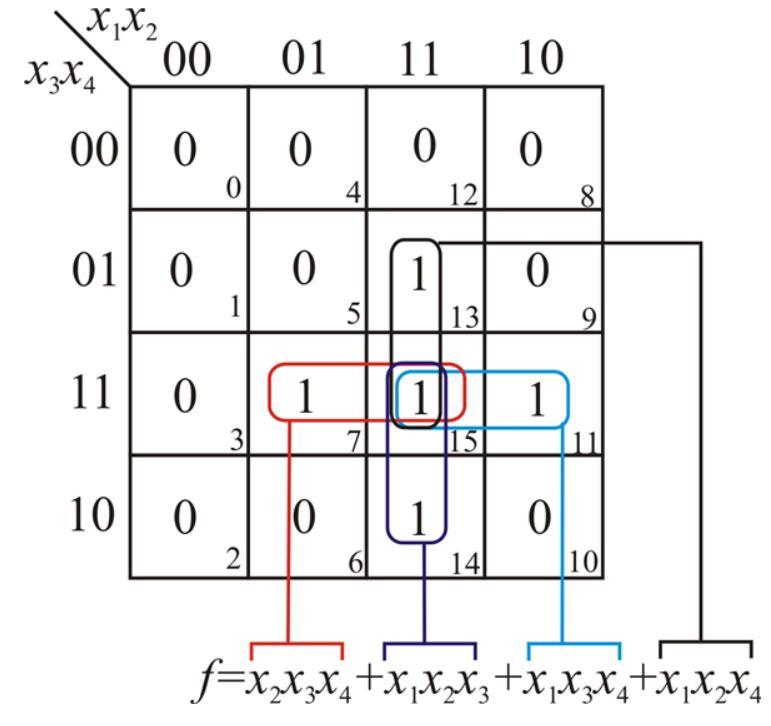
A four-variable logic function that is equal to 1 if any three or all four of its variables are equal to 1 is called a majority
gulaghasi [49]

Answer:

1. Assumption

2.Truth Table

3.K-Map

4.Mapping and Final Expression

5 0
2 years ago
Other questions:
  • Determine the amount of gamma and alpha phases in a 10-kg, 1060 steel casting as it is being cooled to the following temperature
    6·1 answer
  • If the current on your power supply exceeds 500 mA it can damage the supply. Suppose the supply is set for 37 V. What is the sma
    9·1 answer
  • A vineyard owner is planting several new rows of grapevines, and needs to know how many grapevines to plant in each row. She has
    8·1 answer
  • Refrigerant-134a at 400 psia has a specific volume of 0.1384 ft3/lbm. Determine the temperature of the refrigerant based on (a)
    6·1 answer
  • The components of an electronic system dissipating 90 W are located in a 1-m-long circular horizontal duct of 15-cm diameter. Th
    11·1 answer
  • ) A given system has four sensors that can produce an output of 0 or 1. The system operates properly when exactly one of the sen
    9·1 answer
  • John was a high school teacher earning $ 80,000 per year. He quit his job to start his own business in pizza catering. In order
    11·1 answer
  • According to the EWR specifications, ___ is responsible for picking up and disposing of debris or rubbish from
    15·1 answer
  • Test if a number grade is an A (greater than or equal to 90). If so, print "Great!". Hint: Grades may be decimals. Sample Run En
    15·1 answer
  • 1. A _____ is applied to a wall or roof rafters to add strength and keep the building straight and plumb.
    9·1 answer
Add answer
Login
Not registered? Fast signup
Signup
Login Signup
Ask question!