answer.
Ask question
Login Signup
Ask question
All categories
  • English
  • Mathematics
  • Social Studies
  • Business
  • History
  • Health
  • Geography
  • Biology
  • Physics
  • Chemistry
  • Computers and Technology
  • Arts
  • World Languages
  • Spanish
  • French
  • German
  • Advanced Placement (AP)
  • SAT
  • Medicine
  • Law
  • Engineering
Aleksandr-060686 [28]
2 years ago
11

The components of an electronic system dissipating 90 W are located in a 1-m-long circular horizontal duct of 15-cm diameter. Th

e components in the duct are cooled by forced air, which enters at 32°C at a rate of 0.65 m3/min. Assuming 85 percent of the heat generated inside is transferred to air flowing through the duct and the remaining 15 percent is lost through the outer surfaces of the duct, determine (a) the exit temperature of air and (b) the highest component surface temperature in the duct.

Engineering
1 answer:
Artyom0805 [142]2 years ago
4 0

Answer:

Given data

 electronic system dissipating = 90 W

diameter = 15 cm

The components in the duct are cooled by forced air which enters at 32°C at a rate of 0.65 m3 /min

the duct and the remaining = 15 %

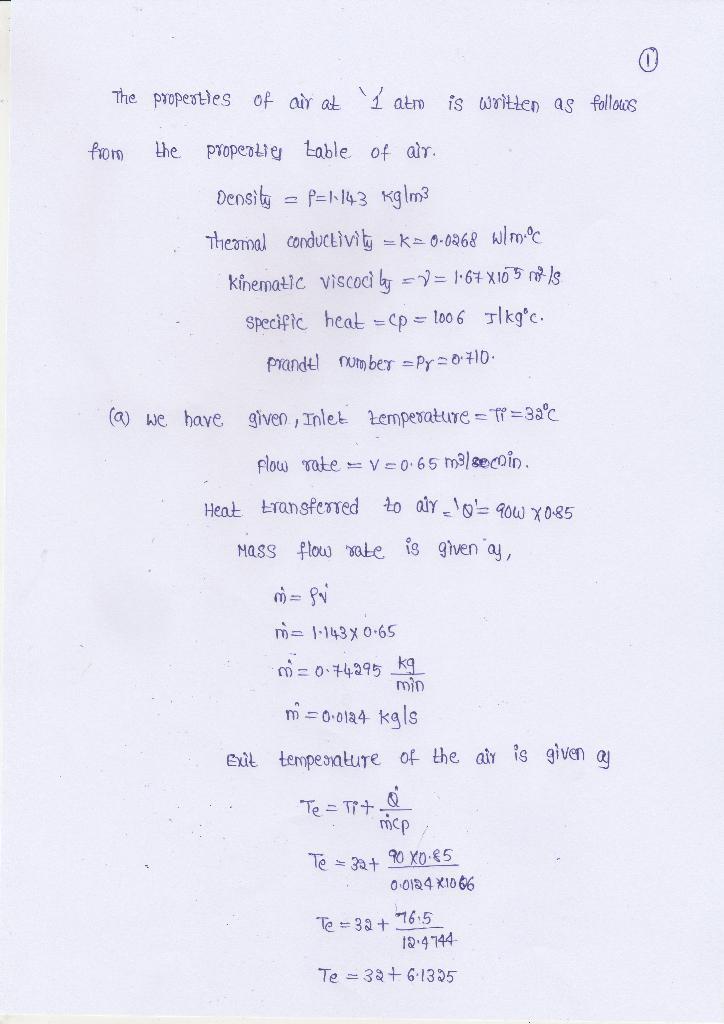
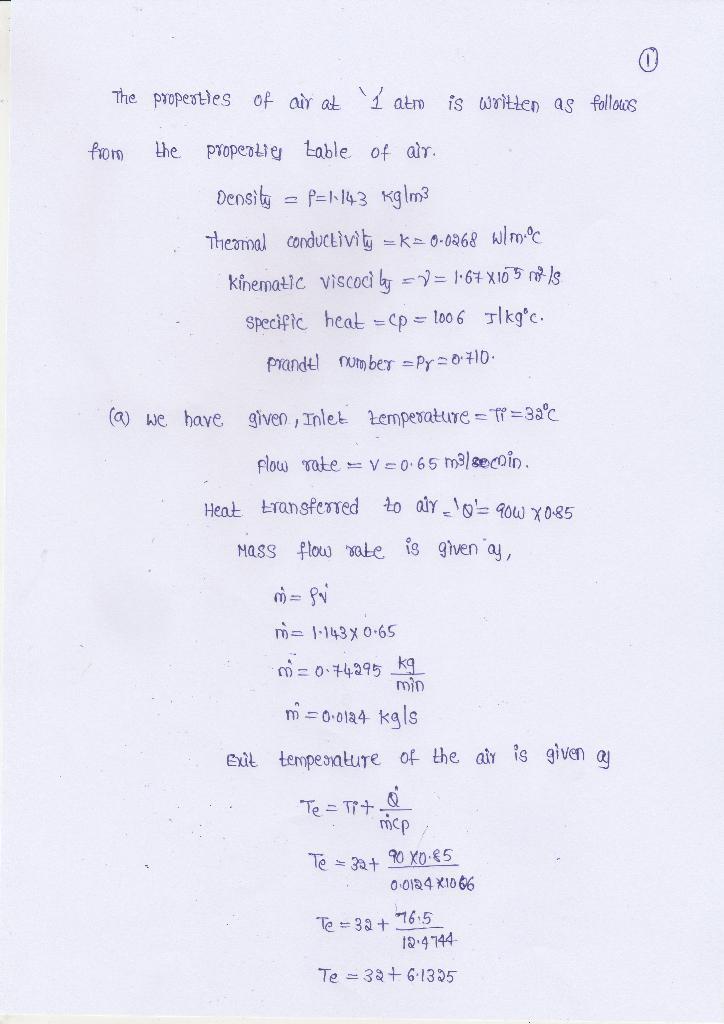
See pictures for solution.

Explanation:

See attached pictures for detailed explanation.

You might be interested in
A spring-loaded toy gun is used to shoot a ball of mass m = 1.50 kg straight up in the air. The spring has spring constant k = 6
adell [148]

Answer:

1) a) Mechanical energy is conserved because no dissipative forces perform work on the ball.

2) The muzzle velocity of the ball is approximately 5.272 meters per second.

3) The maximum height of the ball is 1.417 meters.

Explanation:

1) Which of the following statements are true?

a) Mechanical energy is conserved because no dissipative forces perform work on the ball.

True, statement indicates that there is no air resistence and no friction between ball and the inside of the gun because the first never touches the latter one.

b) The forces of gravity and the spring have potential energies associated with them.

False, force of gravity do work on the ball and spring receives a potential energy at being deformated by the ball.

c) No conservative forces act in this problem after the ball is released from the spring gun.

False, the absence of no conservative forces is guaranteed for the entire system according to the statement of the problem.

2) According to the statement, we understand that spring is deformed and once released and just after reaching its equilibrium position, the muzzle velocity is reached. As spring deformation is too small in comparison with height, we can neglect changes in gravitational potential energy. By Principle of Energy Conservation, we describe the motion of the ball by the following expression:

U_{k, 1}+K_{1}=U_{k,2}+K_{2} (Eq. 1)

Where:

U_{k,1}, U_{k,2} - Initial and final elastic potential energies of spring, measured in joules.

K_{1}, K_{2} - Initial and final translational kinetic energies of the ball, measured in joules.

After using definitions of elastic potential and translational kinetic energies, we expand the equation above as:

\frac{1}{2}\cdot m\cdot (v_{2}^{2}-v_{1}^{2}) = \frac{1}{2}\cdot k\cdot (x_{1}^{2}-x_{2}^{2})

And the final velocity is cleared:

m\cdot (v_{2}^{2}-v_{1}^{2}) = k\cdot (x_{1}^{2}-x_{2}^{2})

v_{2}^{2}-v_{1}^{2} =\frac{k}{m}\cdot (x_{1}^{2}-x_{2}^{2})

v_{2}^{2} =v_{1}^{2}+\frac{k}{m}\cdot (x_{1}^{2}-x_{2}^{2})

v_{2} = \sqrt{v_{1}^{2}+\frac{k}{m}\cdot (x_{1}^{2}-x_{2}^{2}) } (Eq. 2)

Where:

v_{1}, v_{2} - Initial and final velocities of the ball, measured in meters per second.

k - Spring constant, measured in newtons per meter.

m - Mass of the ball, measured in kilograms.

x_{1}, x_{2} - Initial and final position of spring, measured in meters.

If we know that v_{1} = 0\,\frac{m}{s}, k = 667\,\frac{N}{m}, m = 1.50\,kg, x_{1} = -0.25\,m and x_{2} = 0\,cm, the muzzle velocity of the ball is:

v_{2} =\sqrt{\left(0\,\frac{m}{s} \right)^{2}+\left(\frac{667\,\frac{N}{m} }{1.50\,kg} \right)\cdot [(-0.25\,m)^{2}-(0\,m)^{2}]}

v_{2}\approx 5.272\,\frac{m}{s}

The muzzle velocity of the ball is approximately 5.272 meters per second.

3) After leaving the toy gun, the ball is solely decelerated by gravity. We construct this model by Principle of Energy Conservation:

U_{g,2}+K_{2} = U_{g,3}+K_{3} (Eq. 3)

Where:

U_{g,2}, U_{g,3} - Initial and gravitational potential energies of the ball, measured in joules.

K_{2}, K_{3} - Initial and final translational kinetic energies of the ball, measured in joules.

After applying definitions of gravitational potential and translational kinetic energies, we expand the equation above and solve the resulting for the final height:

m\cdot g \cdot (h_{3}-h_{2}) = \frac{1}{2}\cdot m \cdot (v_{2}^{2}-v_{3}^{2})

h_{3}-h_{2}=\frac{v_{2}^{2}-v_{3}^{2}}{2\cdot g}

h_{3} = h_{2} +\frac{v_{2}^{2}-v_{3}^{2}}{2\cdot g} (Eq. 4)

h_{2}, h_{3} - Initial and final heights of the ball, measured in meters.

v_{2}, v_{3} - Initial and final velocities of the ball, measured in meters per second.

g - Gravitational acceleration, measured in meters per square second.

If we get that v_{2} = 5.272\,\frac{m}{s}, v_{3} = 0\,\frac{m}{s}, h_{2} = 0\,m and g = 9.807\,\frac{m}{s^{2}}, the maximum height of the ball is:

h_{3} = 0\,m+\frac{\left(5.272\,\frac{m}{s} \right)^{2}-\left(0\,\frac{m}{s} \right)^{2}}{2\cdot \left(9.807\,\frac{m}{s^{2}} \right)}

h_{3} = 1.417\,m

The maximum height of the ball is 1.417 meters.
5 0
2 years ago
Why is it so dangerous to use a ground lift on a metal cased power tool
MaRussiya [10]
Answer:

Removal of the safety ground connection on equipment can expose users to an increased danger of electric shock and may contradict wiring regulations. ... If a fault develops in any line-operated equipment, cable shields and equipment enclosures may become energized, creating an electric shock hazard.
7 0
1 year ago
The 10-kg block slides down 2 m on the rough surface with kinetic friction coefficient μk = 0.2. What is the work done by the fr
Rashid [163]

Answer:

153.2 J

Explanation:

Let's first list our given parameters;

mass (m) of the block = 10 kg

which slides down ( i.e displacement) = 2 m

kinetic coefficient of friction (μk) = 0.2

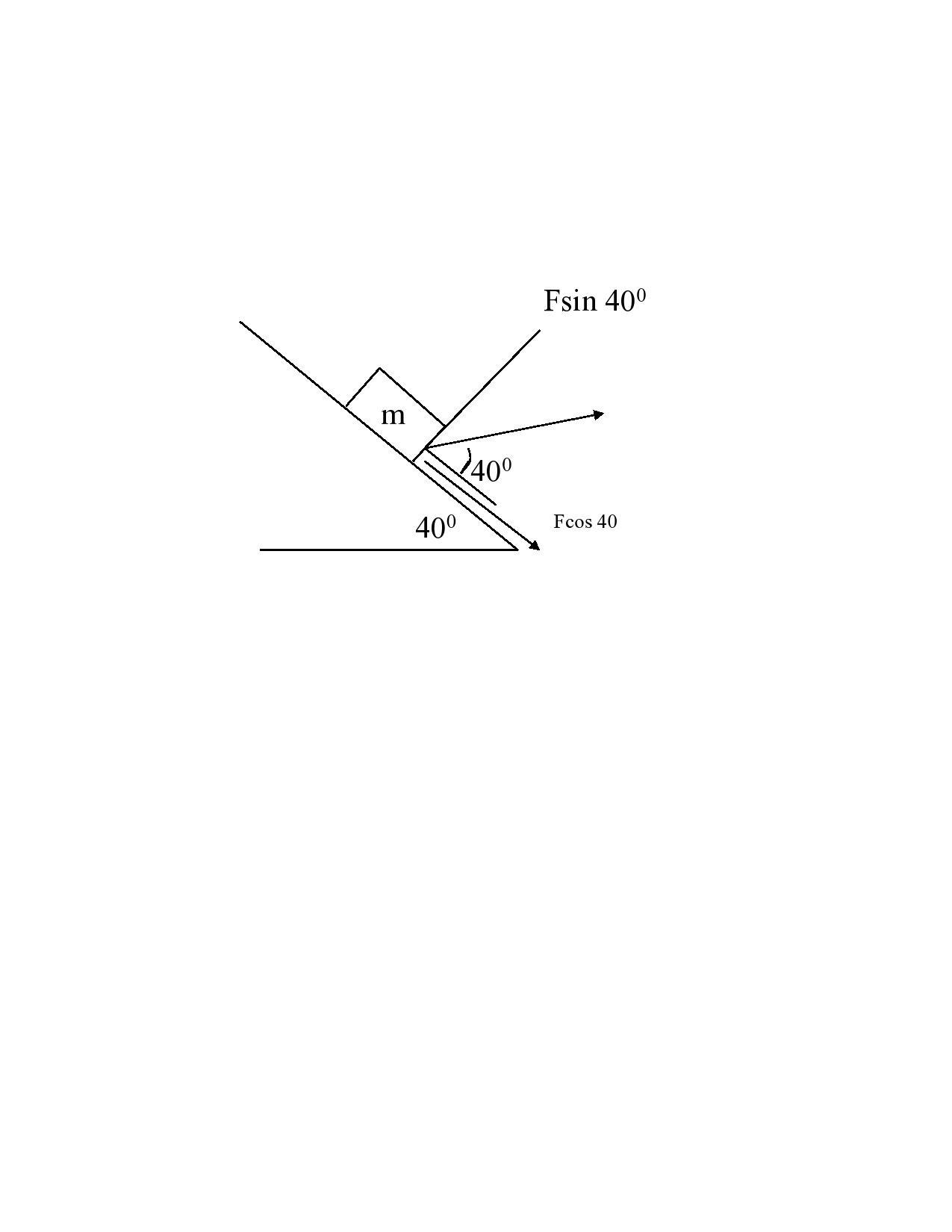
In the diagram shown below;  if we take an integral look at the component of force in the direction of the displacement; we have

F_x= Fcos 40°

F_x= 100 (cos 40°)

F_x= 76.60 N

Workdone by the friction force can now be determined as:

W = F_x × displacement

W = 76.60 × 2

W = 153.2 J

∴  the work done by the friction force = 153.2 J

7 0
2 years ago
You work in Madison, Wisconsin. It is January and the area has been hit with bad weather. Another weather front is expected to a
Lelu [443]

Answer:

The best first sentence of your e-mail will be-

<u>Weather forecasters are predicting a blizzard this afternoon, so, as a result of this news, our supervisor has decided to close the office at noon so people can travel home safely.</u>

<u />

5 0
2 years ago
Write a method printShampooInstructions(), with int parameter numCycles, and void return type. If numCycles is less than 1, prin
kirill [66]

Answer:

// The method is defined with a void return type

// It takes a parameter of integer called numCycles

// It is declared static so that it can be called from a static method

public static void printShampooInstructions(int numCycles){

// if numCycles is less than 1, it display "Too few"

   if (numCycles < 1){

       System.out.println("Too few.");

   }

// else if numCycles is less than 1, it display "Too many"

    else if (numCycles > 4){

       System.out.println("Too many.");

   }

// else it uses for loop to print the number of times to display

// Lather and rinse

  else {

       for(int i = 1; i <= numCycles; i++){

           System.out.println(i + ": Lather and rinse.");

       }

       System.out.println("Done");


   }

}

Explanation:

The code snippet is written in Java. The method is declared static so that it can be called from another static method. It has a return type of void. It takes an integer as parameter.

It display "Too few" if the passed integer is less than 1. Or it display "Too much" if the passed integer is more than 4. Else it uses for loop to display "Lather and rinse" based on the passed integer.

8 0
2 years ago
Other questions:
  • Water at 400 kPa with a quality of 75% has its pressure raised 200 kPa (to 600 kPa) in a constant volume process. What is the ne
    15·1 answer
  • A circular ceramic plate that can be modeled as a blackbody is being heated by an electrical heater. The plate is 30 cm in diame
    15·1 answer
  • Air whose density is 0.082 lbm/ft3 enters the duct of an air-conditioning system at a volume flow rate of 450 ft3/min. If the di
    8·2 answers
  • One mole of iron (6 1023 atoms) has a mass of 56 grams, and its density is 7.87 grams per cubic centimeter, so thecenter-to-cent
    15·1 answer
  • The in situ moist unit weight of a soil is 17.3 kN/m^3 and the moisture content is 16%. The specific gravity of soil solids is 2
    11·1 answer
  • Consider water at 27°C in parallel flow over an isothermal, 1‐m‐long flat plate with a velocity of 2 m/s. a) Plot the variation
    15·1 answer
  • Refrigerant-134a is compressed from 2 bar, saturated vapor, to 10 bar, 90o C in a compressor operating at steady state. The mass
    11·1 answer
  • The mechanical properties of some metals may be improved by incorporating fine particles of their oxides. If the moduli of elast
    12·1 answer
  • "From the earth to the moon". In Jules Verne’s 1865 story with this title, three men went to the moon in a shell fired from a gi
    5·1 answer
  • When comparing solids to fluids, the following is true: for elastic solids, the stress must be normal. For Newtonian fluids, the
    9·1 answer
Add answer
Login
Not registered? Fast signup
Signup
Login Signup
Ask question!