answer.
Ask question
Login Signup
Ask question
All categories
  • English
  • Mathematics
  • Social Studies
  • Business
  • History
  • Health
  • Geography
  • Biology
  • Physics
  • Chemistry
  • Computers and Technology
  • Arts
  • World Languages
  • Spanish
  • French
  • German
  • Advanced Placement (AP)
  • SAT
  • Medicine
  • Law
  • Engineering
german
2 years ago
15

One mole of iron (6 1023 atoms) has a mass of 56 grams, and its density is 7.87 grams per cubic centimeter, so thecenter-to-cent

er distance between atoms is 2.28 10-10 m. You have a long thin bar ofiron, 2.0m long, with a square cross section, 0.15 cm on a side.
You hang the rod vertically and attach a 231 kg mass to the bottom, and you observe thatthe bar becomes 1.01 cm longer. Fromthese measurements, it is possible to determine the stiffness ofone interatomic bond in iron.

What is the spring stiffness of the entire wire, considered as asingle macroscopic (large scale), very stiff spring?
Engineering
1 answer:
Nezavi [6.7K]2 years ago
7 0

Answer:

(a)

Stiffness of one inter-atomic bond in iron =  5.14*10^-9 N/m

(b)

Spring stiffness of entire wire = 45.37 N/m

Explanation:

Given data:

No of atoms = = 1 mole of iron = 6*10^23

Mass = 56 g

Density = 7.87 g / cm^3

Original Length = 2 m

Hanged mass = 231 kg

Change in length = 1.01 cm

Solution:

Force applied to bar = 231 * 9.8

                                  = 2263.8 N

Change in length = ΔL = 1.01 cm = 0.0101 m

Bar stiffness = F / ΔL = 2263.8 / 0.0101

Bar stiffness  = 2.24*10^5 N/m

Cross sectional area of bar= 0.0015*0.0015

                            = 2.25*10^-6 m^2

No. of atoms in one layer of cross-sectional area

              = Cross-Sectional area of bar / Area of one atom

No. of atoms = 2.25*10^-6 / (2.28*10^-10)^2

No. of atoms in one layer of cross-sectional area = 4.33*10^13

Length of Bar = 2 m

No. of bonds along bar length

              = Bar length / Center to center distance between atoms

No. of bonds = 2 / 2.28*10^-10

No. of bonds = 8.77*10^9

Force applied to each atom

               = Force / ( No. of atoms * No. of bonds )

Force applied to each bond = 2263.8 / ( 4.33*10^13 * 8.77*10^9)

Force applied to each bond = 5.96*10^-21 N

Strain on bar on bar =  ΔL / L = 0.0101 / 2

                      = 0.0051

Strain between atom layers will be same as above.

Bond extension (elongation) = 2.28*10^-10 * 0.0051

                       = 1.16*10^-12 m

Bond stiffness = Force applied to each bond / Bond extension

Bond stiffness = 5.96*10^-21 / 1.16*10^-12

Bond stiffness = 5.14*10^-9 N/m

Stiffness of one inter-atomic bond in iron =  5.14*10^-9 N/m

Part (b)

Spring stiffness of entire wire = (Bar stiffness  * No. of bonds) / No. of atoms

Spring stiffness = (2.24*10^5 * 8.77*10^9) / 4.33*10^13

Spring stiffness = 45.37 N/m

You might be interested in
A submarine submerges by admitting seawater (S = 1.03) into its ballast tanks. The amount of water admitted is controlled by air
ser-zykov [4K]

Answer:

Explanation:

Fw= y looking symbol sea water (2010.62-168171.2727/h+32.935)ft^3

6 0
2 years ago
A bankrupt chemical firm has been taken over by new management. On the property they found a 20,000-m3 brine pond containing 25,
Liula [17]

Answer:

Flow-rate = 0.0025 m^3/s

Explanation:

We need to assume that the flow-rate of pure water entering the pond is the same as the flow-rate of brine leaving the pond, in other words, the volume of liquid in the pond stays constant at 20,000 m^3. Using the previous assumption we can calculate the flow rate entering or leaving the tank (they are the same) building a separable differential equation dQ/dt, where Q is the milligrams (mg) of salt in a given time t, to find a solution to our problem we build a differential equation as follow:

dQ/dt = -(Q/20,000)*r  where r is the flow rate in m^3/s

what we pose with this equation is that the variable rate at which the salt leaves the pond (salt leaving over time) is equal to the concentration (amount of salt per unit of volume of liquid at a given time) times the constant rate at which the liquid leaves the tank, the minus sign in the equation is because this is the rate at which salt leaves the pond.

Rearranging the equation we get dQ/Q = -(r/20000) dt then integrating in both sides ∫dQ/Q = -∫(r/20000) dt and solving ln(Q) = -(r/20000)*t + C where C is a constant (initial value) result of solving the integrals. Please note that the integral of dQ/Q is ln(Q) and r/20000 is a constant, therefore, the integral of dt is t.

To find the initial value (C) we evaluate the integrated equation for t = 0, therefore, ln(Q) = C, because at time zero we have a concentration of 25000 mg/L = 250000000 mg/m^3 and Q is equal to the concentration of salt (mg/m^3) by the amount of liquid (always 20000 m^3) -> Q = 250000000 mg/m^3 * 20000 m^3 = 5*10^11 mg -> C = ln(5*10^11) = 26.9378. Now the equation is ln(Q) = -(r/20000)*t + 26.9378, the only thing missing is to find the constant flow rate (r) required to reduce the salt concentration in the pond to 500 mg/L = 500000 mg/m^3 within one year (equivalent to 31536000 seconds), to do so we need to find the Q we want in one year, that is Q = 500000 mg/m^3 * 20000 m^3 = 1*10^10 mg, therefore, ln(1*10^10) = -(r/20000)*31536000 + 26.9378 solving for r -> r = 0.002481 m^3/s that is approximately 0.0025 m^3/s.

Note:

  • ln() refer to natural logarithm
  • The amount of liquid in the tank never changes because the flow-rate-in is the same as the flow-rate-out
  • When solving the differential equation we calculated the flow-rate-out and we were asked for the flow-rate-in but because they are the same we could solve the problem
  • During the solving process, we always converted units to m^3 and seconds because we were asked to give the answer in m^3/seg
7 0
2 years ago
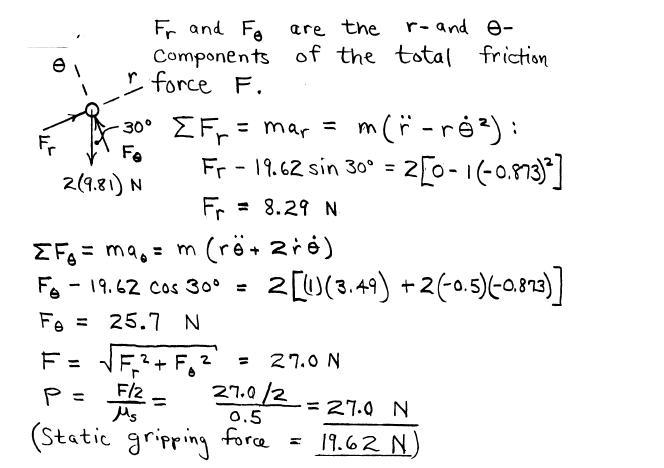
3/63 A 2‐kg sphere S is being moved in a vertical plane by a robotic arm. When the angle θ is 30°, the angular velocity of the a
miss Akunina [59]

Answer:

Ps=19.62N

Explanation:

The detailed explanation of answer is given in attached files.

5 0
2 years ago
A 150-lbm astronaut took his bathroom scale (a spring scale) and a beam scale (compares masses) to the moon where the local grav
kozerog [31]

Answer:

a)Wt =25.68 lbf

b)Wt = 150 lbf

F= 899.59 N

Explanation:

Given that

g = 5.48 ft/s^2.

m= 150 lbm

a)

Weight on the spring scale(Wt) = m g

We know that

1\ lbf=32.17 \ lmb.ft/s^2

Wt = 150 x 5.48/32 lbf

Wt =25.68 lbf

b)

On the beam scale

This is scale which does not affects by gravitational acceleration.So the wight on the beam scale will be 150 lbf.

Wt = 150 lbf

If the plane is moving upward with acceleration 6 g's then the for F

F = m a

We know that

1\ ft/s^2= 0.304\ m/s^2

5.48\ ft/s^2= 1.66\ m/s^2

a=6 g's

a=9.99\ m/s^2

So

F = 90 x 9.99 N

F= 899.59 N

3 0
2 years ago
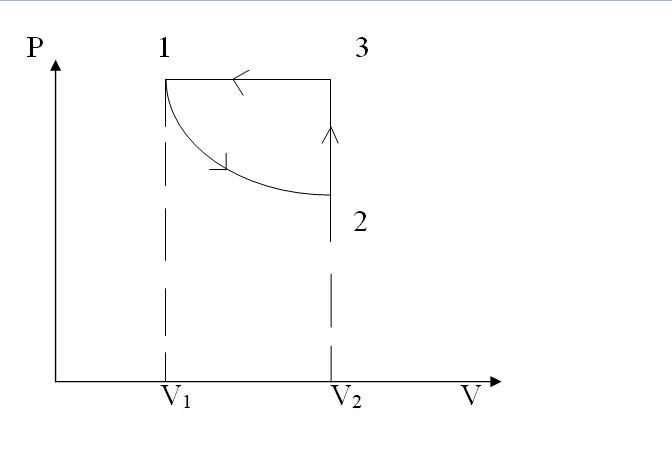
2.24 Carbon dioxide (CO2) gas in a piston-cylinder assembly undergoes three processes in series that begin and end at the same s
Gekata [30.6K]

Answer:

Explanation:

Given that:

From process 1 → 2

P_1 = 10 bar   \\  \\ V_1 = 1 m^3  \\ \\  V_2 = 4 m^3

PV^{1.5} = \ constant

\gamma = 1.5

Process 2 → 3

The volume is constant i.e V_2 =V_3 = 4m^3

P_3 = 10 \ bar

Process 3 → 1

P = constant  i.e the compression from state 1

Now, to start with 1 → 2

P_1V_1^{1.5} = P_2V_2^{1.5}

P_2 = P_1 (\dfrac{V_1}{V_2})^{1.5}

P_2 = 10 \times  (\dfrac{1}{4})^{1.5}

P_2 =1.25

The work-done for the process  1 → 2 through adiabatic expansion is:

W = \dfrac{1}{1-\gamma}[P_2V_2-P_1V_1]

We know that 1 bar = 10^5 \ N/m^2

∴

W = \dfrac{1}{1-1.5}[1.25 \times 10^5 \times 4- 10 \times 10^5 \times 1]

W =1000000 \ J

W_{1 \to 2} = 1000 kJ

For process 2 → 3

Since V is constant

Thus:

W = PΔV = 0

W_{2 \to 3} = 0

For process 3 → 1

W = PΔV

W _{3 \to 1} = P_3(V_1-V_3)

W _{3 \to 1} = 10 \times 10^5 (1-4)

W _{3 \to 1} = 10 \times 10^5 (-3)

W _{3 \to 1} = -3 \times 10^6 \ J

W _{3 \to 1} = -3000  \ kJ

The net work-done now  for the entire system is :

W_{net} = W_{1 \to 2} + W_{2 \to 3 } + W_{ 3 \to 1 }

W_{net} = (1000 + 0 + (-3000)) \ kJ

W_{net} =-2000 \ kJ

The sketch of the processes on p -V coordinates can be found in the image attached below.

4 0
2 years ago
Other questions:
  • Radioactive wastes are temporarily stored in a spherical container, the center of which is buried a distance of 10 m below the e
    13·1 answer
  • Prompt the user to enter five numbers, being five people's weights. Store the numbers in an array of doubles. Output the array's
    11·2 answers
  • For each of the following combinations of parameters, determine if the material is a low-loss dielectric, a quasi-conductor, or
    12·1 answer
  • Retype the below code. Fix the indentation as necessary to make the program work. if 'New York' in temperatures: if temperatures
    9·1 answer
  • One type of illumination system consists of rows of strip fluorescents and a ceiling that will transmit light. For this system t
    15·1 answer
  • Joe Bruin has a big lawn in front of his house that is 30 meters wide and 20 meters long. Josephine makes him go out and mow the
    5·1 answer
  • A particular NMOS device has parameters VT N = 0.6 V, L = 0.8µm, tox = 200 Å, and µn = 600 cm2 /V–s. A drain current of ID = 1.2
    14·1 answer
  • Chapter 15 – Fasteners: Determine the tensile load capacity of a 5/16 – 18 UNC thread and a 5/16 – 24 UNF thread made of the sam
    8·2 answers
  • "Vehicles begin to arrive at a parking lot at 6:00 A.M. at a rate of eight per minute. Due to an accident on the access highway,
    9·1 answer
  • Which of the following describes boundaries?
    10·1 answer
Add answer
Login
Not registered? Fast signup
Signup
Login Signup
Ask question!