answer.
Ask question
Login Signup
Ask question
All categories
  • English
  • Mathematics
  • Social Studies
  • Business
  • History
  • Health
  • Geography
  • Biology
  • Physics
  • Chemistry
  • Computers and Technology
  • Arts
  • World Languages
  • Spanish
  • French
  • German
  • Advanced Placement (AP)
  • SAT
  • Medicine
  • Law
  • Engineering
sergeinik [125]
2 years ago
13

A bankrupt chemical firm has been taken over by new management. On the property they found a 20,000-m3 brine pond containing 25,

000 mg · L−1 of salt. The new owners propose to flush the pond into their dis- charge pipe leading to the Atlantic Ocean, which has a salt concentration above 30,000 mg · L−1 .
What flow rate of fresh water (in m3 · s−1 ) must they use to reduce the salt concentration in the pond to 500 mg · L−1 within one year?
Engineering
1 answer:
Liula [17]2 years ago
7 0

Answer:

Flow-rate = 0.0025 m^3/s

Explanation:

We need to assume that the flow-rate of pure water entering the pond is the same as the flow-rate of brine leaving the pond, in other words, the volume of liquid in the pond stays constant at 20,000 m^3. Using the previous assumption we can calculate the flow rate entering or leaving the tank (they are the same) building a separable differential equation dQ/dt, where Q is the milligrams (mg) of salt in a given time t, to find a solution to our problem we build a differential equation as follow:

dQ/dt = -(Q/20,000)*r  where r is the flow rate in m^3/s

what we pose with this equation is that the variable rate at which the salt leaves the pond (salt leaving over time) is equal to the concentration (amount of salt per unit of volume of liquid at a given time) times the constant rate at which the liquid leaves the tank, the minus sign in the equation is because this is the rate at which salt leaves the pond.

Rearranging the equation we get dQ/Q = -(r/20000) dt then integrating in both sides ∫dQ/Q = -∫(r/20000) dt and solving ln(Q) = -(r/20000)*t + C where C is a constant (initial value) result of solving the integrals. Please note that the integral of dQ/Q is ln(Q) and r/20000 is a constant, therefore, the integral of dt is t.

To find the initial value (C) we evaluate the integrated equation for t = 0, therefore, ln(Q) = C, because at time zero we have a concentration of 25000 mg/L = 250000000 mg/m^3 and Q is equal to the concentration of salt (mg/m^3) by the amount of liquid (always 20000 m^3) -> Q = 250000000 mg/m^3 * 20000 m^3 = 5*10^11 mg -> C = ln(5*10^11) = 26.9378. Now the equation is ln(Q) = -(r/20000)*t + 26.9378, the only thing missing is to find the constant flow rate (r) required to reduce the salt concentration in the pond to 500 mg/L = 500000 mg/m^3 within one year (equivalent to 31536000 seconds), to do so we need to find the Q we want in one year, that is Q = 500000 mg/m^3 * 20000 m^3 = 1*10^10 mg, therefore, ln(1*10^10) = -(r/20000)*31536000 + 26.9378 solving for r -> r = 0.002481 m^3/s that is approximately 0.0025 m^3/s.

Note:

  • ln() refer to natural logarithm
  • The amount of liquid in the tank never changes because the flow-rate-in is the same as the flow-rate-out
  • When solving the differential equation we calculated the flow-rate-out and we were asked for the flow-rate-in but because they are the same we could solve the problem
  • During the solving process, we always converted units to m^3 and seconds because we were asked to give the answer in m^3/seg
You might be interested in
The wall of drying oven is constructed by sandwiching insulation material of thermal conductivity k = 0.05 W/m°K between thin me
masha68 [24]

Answer:

86 mm

Explanation:

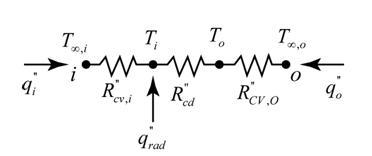
From the attached thermal circuit diagram, equation for i-nodes will be

\frac {T_ \infty, i-T_{i}}{ R^{"}_{cv, i}} + \frac {T_{o}-T_{i}}{ R^{"}_{cd}} + q_{rad} = 0 Equation 1

Similarly, the equation for outer node “o” will be

\frac {T_{ i}-T_{o}}{ R^{"}_{cd}} + \frac {T_{\infty, o} -T_{o}}{ R^{"}_{cv, o}} = 0 Equation 2

The conventive thermal resistance in i-node will be

R^{"}_{cv, i}= \frac {1}{h_{i}}= \frac {1}{30}= 0.033 m^{2}K/w Equation 3

The conventive hermal resistance per unit area is

R^{"}_{cv, o}= \frac {1}{h_{o}}= \frac {1}{10}= 0.100 m^{2}K/w Equation 4

The conductive thermal resistance per unit area is

R^{"}_{cd}= \frac {L}{K}= \frac {L}{0.05} m^{2}K/w Equation 5

Since q_{rad}  is given as 100, T_{o}  is 40 T_ \infty  is 300 T_{\infty, o}  is 25  

Substituting the values in equations 3,4 and 5 into equations 1 and 2 we obtain

\frac {300-T_{i}}{0.033} +\frac {40-T_{i}}{L/0.05} +100=0  Equation 6

\frac {T_{ i}-40}{L/0.05}+ \frac {25-40}{0.100}=0

T_{i}-40= \frac {L}{0.05}*150

T_{i}-40=3000L

T_{i}=3000L+40 Equation 7

From equation 6 we can substitute wherever there’s T_{i} with 3000L+40 as seen in equation 7 hence we obtain

\frac {300- (3000L+40)}{0.033} + \frac {40- (3000L+40)}{L/0.05}+100=0

The above can be simplified to be

\frac {260-3000L}{0.033}+ \frac {(-3000L)}{L/0.05}+100=0

\frac {260-3000L}{0.033}=50

-3000L=1.665-260

L= \frac {-258.33}{-3000}=0.086*10^{-3}m= 86mm

Therefore, insulation thickness is 86mm

8 0
2 years ago
Link BD consists of a single bar 36 mm wide and 18 mm thick. Knowing that each pin has a 12-mm diameter, determine the maximum v
MAXImum [283]

Answer:

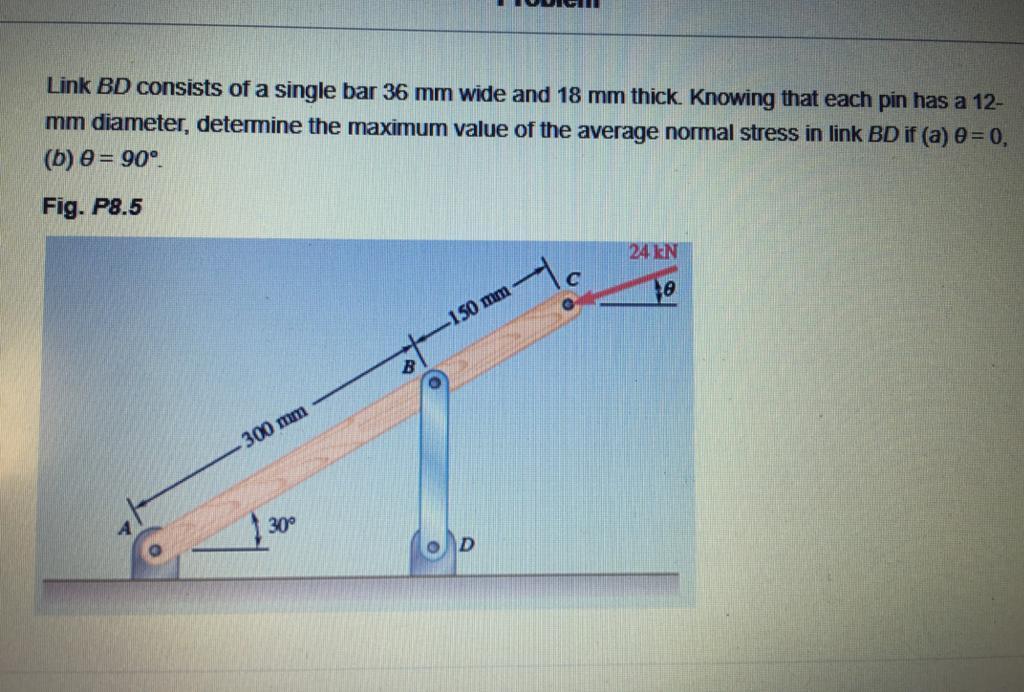
hello the diagram attached to your question is missing attached below is the missing diagram

answer :

a) 48.11 MPa

b) - 55.55 MPa

Explanation:

First we consider the equilibrium moments about point A

∑ Ma = 0

( Fbd * 300cos30° ) + ( 24sin∅ * 450cos30° ) - ( 24cos∅ * 450sin30° ) = 0

therefore ;<em> Fbd = 36 ( cos ∅tan30° - sin∅ ) kN  ----- ( 1 )</em>

A ) when ∅ = 0

Fbd = 20.7846 kN

link BD will be under tension when ∅ = 0, hence we will calculate the loading area using this equation

A = ( b - d ) t

b = 12 mm

d = 36 mm

t = 18

therefore loading area ( A ) = 432 mm^2

determine the maximum value of average normal stress in link BD  using the relation below

бbd = \frac{Fbd}{A}  = 20.7846 kN / 432 mm^2  =  48.11 MPa

b) when ∅ = 90°

Fbd = -36 kN

the negativity indicate that the loading direction is in contrast to the assumed direction of loading

There is compression in link BD

next we have to calculate the loading area using this equation ;

A = b * t

b = 36mm

t = 18mm

hence loading area = 36 * 18 = 648 mm^2

determine the maximum value of average normal stress in link BD  using the relation below

бbd = \frac{Fbd}{A} = -36 kN / 648mm^2 = -55.55 MPa

4 0
1 year ago
2. A ¼ in. diameter rod must be machined on a lathe to a smaller diameter for use as a specimen in a tension test. The rod mater
gladu [14]

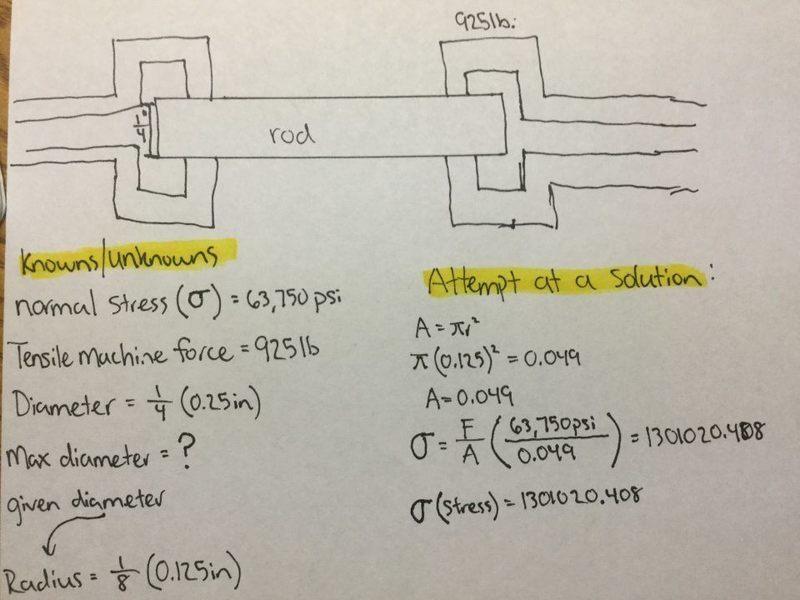
Answer:

we use

sigma=force /area\\A=\pi r^2\\D=2*r

5 0
2 years ago
1. A spur gear made of bronze drives a mid steel pinion with angular velocity ratio of 13 /2 : 1. Thepressure angle is 14 1/2° .
Alik [6]

Answer:

Given data

w1/w2=6.5/1

Power=5 KW

wp=1800 rpm

angle=14 degrees

Based on above values,the minimum diameter=30 mm

5 0
2 years ago
Consider a normal shock wave in air. The upstream conditions are given by M1=3, p1 = 1 atm, and r1 = 1.23 kg/m3. Calculate the d
mart [117]

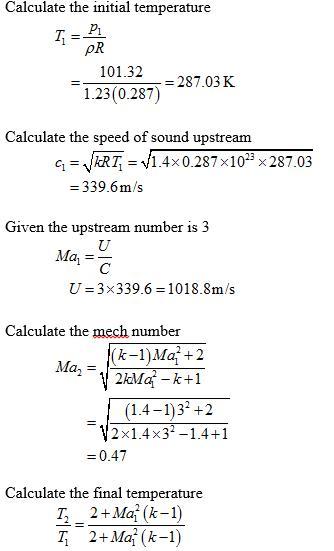
Answer and Explanation:

The answer is attached below

7 0
2 years ago
Other questions:
  • Compute the mass fractions of α ferrite and cementite in pearlite. Assume T=726⁢ C∘.
    15·1 answer
  • Which of the two materials (brittle vs. ductile) usually obtains the highest ultimate strength and why?
    5·1 answer
  • A long aluminum wire of diameter 3 mm is extruded at a temperature of 280°C. The wire is subjected to cross air flow at 20°C at
    9·1 answer
  • A 0.9% solution of NaCl is considered isotonic to mammalian cells. what molar concentration is this?
    10·1 answer
  • A negative pressure respirator brings fresh air to you through a hose<br>A) True<br>B)False​
    15·2 answers
  • Your assignment is to write a menu driven program. The menu will be responded to using a switch statement. The menu options (cas
    6·1 answer
  • Water is to be withdrawn from an 8-m-high water reservoir by drilling a 2.2-cm-diameter hole at the bottom surface. Disregarding
    12·2 answers
  • With thermodynamics, one cannot determine ________.
    14·1 answer
  • A rectangular beam having b=300 mm and d=575 mm, spans 5.5 m face to face of simple supports. It is reinforced for flexure with
    14·1 answer
  • You are the scheduler for a large commercial building project. The schedule that you prepared (based on feedback from the projec
    7·1 answer
Add answer
Login
Not registered? Fast signup
Signup
Login Signup
Ask question!