answer.
Ask question
Login Signup
Ask question
All categories
  • English
  • Mathematics
  • Social Studies
  • Business
  • History
  • Health
  • Geography
  • Biology
  • Physics
  • Chemistry
  • Computers and Technology
  • Arts
  • World Languages
  • Spanish
  • French
  • German
  • Advanced Placement (AP)
  • SAT
  • Medicine
  • Law
  • Engineering
Firlakuza [10]
2 years ago
12

For each of the following combinations of parameters, determine if the material is a low-loss dielectric, a quasi-conductor, or

a good conductor, and then calculate α,β,λ,up, and ηc:(a)Glass with μr=1,εr=5, andσ=10−12S/m at 10 GHz.(b)Animal tissue with μr=1,εr=12, and σ=0.3 S/m at 100 MHz.(c)Wood with μr=1,εr=3, and σ=10−4S/m at 1 kHz
Engineering
1 answer:
Alborosie2 years ago
8 0

Answer:

Glass: Low-Loss dielectric

  α = 8.42*10^-11 Np/m

  β = 468.3 rad/m

  λ = 1.34 cm

  up = 1.34*10^8 m/s

  ηc = 168.5 Ω

Tissue: Quasi-Conductor

  α = 9.75 Np/m

  β = 12.16 rad/m

  λ = 51.69 cm

  up = 0.52*10^8 m/s

  ηc = 39.54 + j 31.72 Ω        

Wood: Good conductor

  α = 6.3*10^-4 Np/m

  β = 6.3*10^-4 Np/m

  λ = 10 km

  up = 0.1*10^8 m/s

  ηc = 6.28*( 1 + j )

Explanation:

Given:

Glass with µr = 1, εr = 5, and σ = 10−12 S/m at 10 GHz

Animal tissue with µr = 1, εr = 12, and σ = 0.3 S/m at 100 MHz.

Wood with µr = 1, εr = 3, and σ = 10−4 S/m at 1 kHz

Find:

Determine if  the material is a low-loss dielectric, a quasi-conductor, or a good conductor, and then  calculate α, β, λ, up, and ηc:

Solution:

- We need to determine the loss tangent to determine category of the medium as follows:

                                σ / w*εr*εo

Where, w is the angular speed of wave

            εo is the permittivity of free space = 10^-9 / 36*pi

- Now we classify as follows:

    Glass = \frac{10^-^1^2 }{2*\pi * 10*10^9 * \frac{5*10^-^9}{36\pi } } = 3.6*10^-^1^3\\\\Tissue = \frac{0.3 }{2*\pi * 100*10^6 * \frac{12*10^-^9}{36\pi } } = 4.5\\\\Wood = \frac{10^-^4 }{2*\pi * 1*10^3 * \frac{3*10^-^9}{36\pi } } = 600\\  

- For σ / w*εr*εo < 0.01 --- Low-Loss dielectric and σ / w*εr*εo > 100 --- Good conducting material.

    Glass: Low-Loss dielectric

    Tissue: Quasi-Conductor

    Wood: Good conductor

- Now we will use categorized material base equations from Table 17-1 as follows:

     Glass: Low-Loss dielectric

          α = (σ / 2)*sqrt(u / εr*εo) = (10^-12 / 2)*sqrt( 4*pi*10^-7/5*8.85*10^-12)

          α = 8.42*10^-11 Np/m

          β = w*sqrt (u*εr*εo) = 2pi*10^10*sqrt (4*pi*10^-7*5*8.85*10^-12)

          β = 468.3 rad/m

          λ = 2*pi / β = 2*pi / 468.3

          λ = 1.34 cm

          up = λ*f = 0.0134*10^10

          up = 1.34*10^8 m/s

          ηc = sqrt ( u / εr*εo ) = sqrt( 4*pi*10^-7/12*8.85*10^-12)

          ηc = 168.5 Ω

     Tissue: Quasi-Conductor

          α = (σ / 2)*sqrt(u / εr*εo) = (0.3 / 2)*sqrt( 4*pi*10^-7/12*8.85*10^-12)

          α = 9.75 Np/m

          β = w*sqrt (u*εr*εo) = 2pi*100*10^6*sqrt (4*pi*10^-7*12*8.85*10^-12)

          β = 12.16 rad/m

          λ = 2*pi / β = 2*pi / 12.16

          λ = 51.69 cm

          up = λ*f = 0.5169*100*10^6

          up = 0.52*10^8 m/s

          ηc = sqrt ( u / εr*εo )*( 1 - j (σ / w*εr*εo))^-0.5

          ηc = sqrt (4*pi*10^-7*12*8.85*10^-12)*( 1 - j 4.5)^-0.5

          ηc = 39.54 + j 31.72 Ω

     Wood: Good conductor

          α = sqrt (pi*f*σ u) = sqrt( pi* 10^3 *4*pi* 10^-7 * 10^-4 )

          β = α = 6.3*10^-4 Np/m

          λ = 2*pi / β = 2*pi / 6.3*10^-4

          λ = 10 km

          up = λ*f = 10,000*1*10^3

          up = 0.1*10^8 m/s

          ηc = α*( 1 + j ) / б = 6.3*10^-4*( 1 + j ) / 10^-4

          ηc = 6.28*( 1 + j )


You might be interested in
5. Which of these materials in a shop contain metals and toxins and can pollute the environment? A) Antifreeze B) Solvents C) Ba
Elza [17]
As a multiple choice the only correct answer is D
3 0
2 years ago
Read 2 more answers
A horizontal, cylindrical, tank, with hemispherical ends, is used to store liquid chlorine at 10 bar. The vessel is 4 m internal
sp2606 [1]

Answer: 0.021818m =2.18x10^-²m

Explanation: Using Laplace principle

Design pressure is =12 bar= 1200000N/m²

T = Wall thickness

Design stress=110Mn/m²= 110,000,000N/m²

Radius= diameter/2 =4/2=2m

Design stress=Hoop stress =Pr/t where p=internal pressure or internal pressure, r=radius and t= wall thickness.

As Laplace equation stated.

110,000,000= 1,2000,00 x 2/t

t= 2,400,000/110,000,000.

t= 0.021818m

t=2.18x10^-2m.

3 0
2 years ago
Technician A that shielding gas nozzles may have different shapes. Technician B says that gelding gas nozzles is attached to the
Lilit [14]
B is correct! in this senecio
5 0
2 years ago
1. Consider a city of 10 square kilometers. A macro cellular system design divides the city up into square cells of 1 square kil
kakasveta [241]

Answer:

a) n = 1000\,users, b)\Delta t_{min} = \frac{1}{30}\,h, \Delta t_{max} = \frac{\sqrt{2} }{30}\,h, \Delta t_{mean} = \frac{1 + \sqrt{2} }{60}\,h, c) n = 10000000\,users, \Delta t_{min} = \frac{1}{3000}\,h, \Delta t_{max} = \frac{\sqrt{2} }{3000}\,h, \Delta t_{mean} = \frac{1 + \sqrt{2} }{6000}\,h

Explanation:

a) The total number of users that can be accomodated in the system is:

n = \frac{10\,km^{2}}{1\,\frac{km^{2}}{cell} }\cdot (100\,\frac{users}{cell} )

n = 1000\,users

b) The length of the side of each cell is:

l = \sqrt{1\,km^{2}}

l = 1\,km

Minimum time for traversing a cell is:

\Delta t_{min} = \frac{l}{v}

\Delta t_{min} = \frac{1\,km}{30\,\frac{km}{h} }

\Delta t_{min} = \frac{1}{30}\,h

The maximum time for traversing a cell is:

\Delta t_{max} = \frac{\sqrt{2}\cdot l }{v}

\Delta t_{max} = \frac{\sqrt{2} }{30}\,h

The approximate time is giving by the average of minimum and maximum times:

\Delta t_{mean} = \frac{1+\sqrt{2} }{2}\cdot\frac{l}{v}

\Delta t_{mean} = \frac{1 + \sqrt{2} }{60}\,h

c) The total number of users that can be accomodated in the system is:

n = \frac{10\times 10^{6}\,m^{2}}{100\,m^{2}}\cdot (100\,\frac{users}{cell} )

n = 10000000\,users

The length of each side of the cell is:

l = \sqrt{100\,m^{2}}

l = 10\,m

Minimum time for traversing a cell is:

\Delta t_{min} = \frac{l}{v}

\Delta t_{min} = \frac{0.01\,km}{30\,\frac{km}{h} }

\Delta t_{min} = \frac{1}{3000}\,h

The maximum time for traversing a cell is:

\Delta t_{max} = \frac{\sqrt{2}\cdot l }{v}

\Delta t_{max} = \frac{\sqrt{2} }{3000}\,h

The approximate time is giving by the average of minimum and maximum times:

\Delta t_{mean} = \frac{1+\sqrt{2} }{2}\cdot\frac{l}{v}

\Delta t_{mean} = \frac{1 + \sqrt{2} }{6000}\,h

8 0
2 years ago
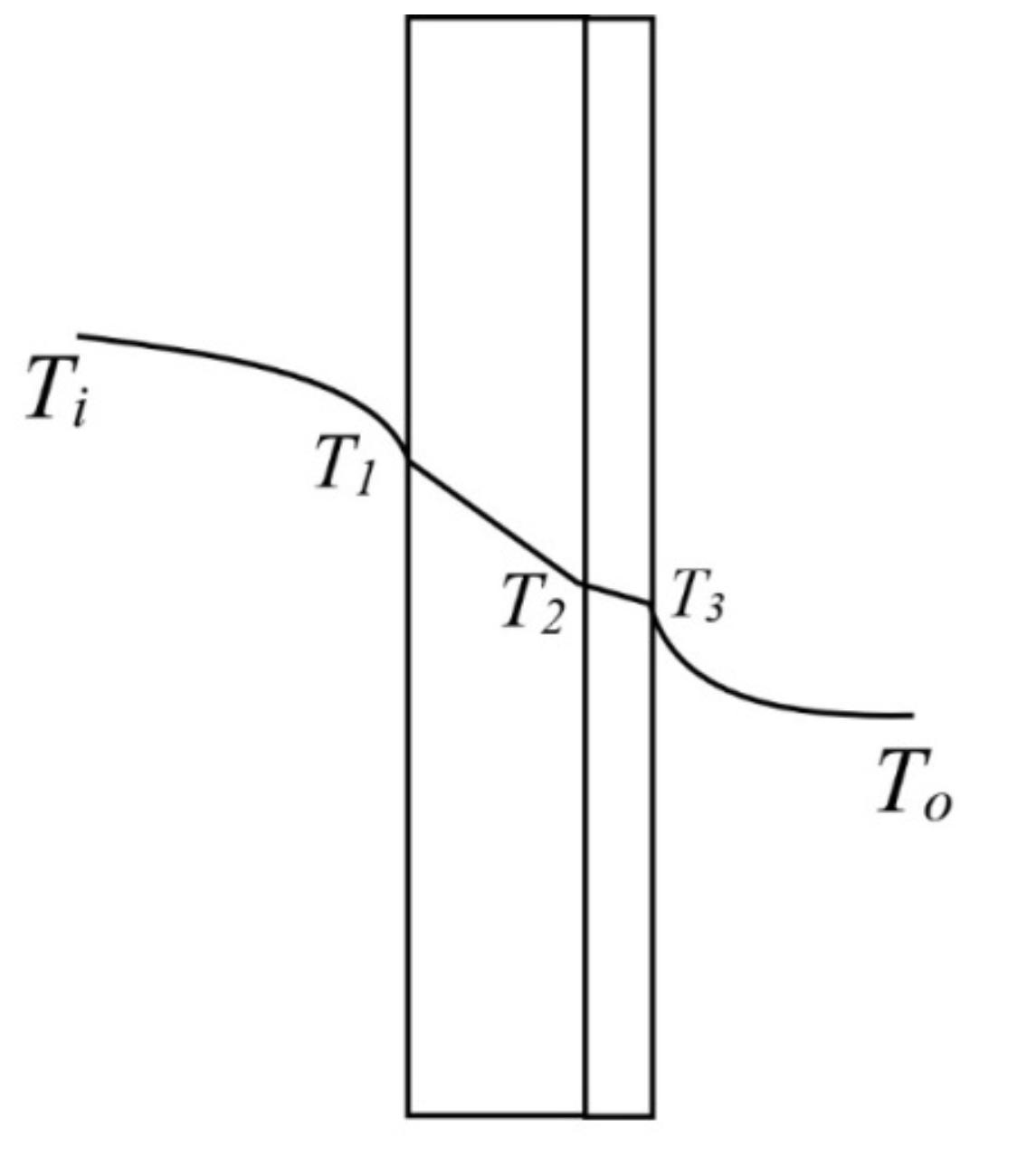
The outer surface of an engine is situated in a place where oil leakage can occur. When leaked oil comes in contact with ahot su
VladimirAG [237]

Answer:

TBC thickness of 4 mm is insufficient to prevent fire hazard

Explanation:

Given:

- Temperature of hot-fluid inner surface T_i = 333°C

- The convection coefficient hot-fluid h_i = 7 W/m^2K

- The thermal conductivity of engine cover k_1 = 14 W/mK

- The thickness of engine cover L_1 = 0.01 m

- The thermal conductivity of TBC layer k_2 = 1.1 W/mK  ... (Typing error)

- The thickness of TBC layer L_2 = 0.004 m

- Temperature of ambient air outer surface T_o = 69°C

- The convection coefficient ambient air h_o = 7 W/m^2K

Find:

Would a TBC layer of 4 mm thickness be sufficient to keep the engine cover surface below autoignition temperature of 200°C to prevent fire hazard?

Solution:

- We will use thermal circuit analogy for the 1-D problem and steady state conduction with no heat generation in the cover or TBC layer.

 The temperature at each medium interface and the Thermal resistance for each medium is given in the attachment schematic and circuit analogy.

 - We will calculate the total heat flux for the entire system q:

                       q = ( T_i - T_o ) / R_total

- R_total is the equivalent thermal resistance of the entire circuit. Since all resistances are in series we have:

                       R_total = 1 / h_i + L_1 / k_1 + L_2 / k_2 + 1 / h_o

- Plug in the values and compute:

                       R_total = 1 / 7 + 0.01 / 14 + 0.004 / 1.1 + 1 / 7

                       R_total = 0.2900649351 T-m^2 / W

- Calculate the Total heat flux q:

                       q = ( 333 - 69 ) / 0.2900649351

                       q = 910.141 W / m^2

- Just like the total current in a circuit remains same, the total heat flux remains same. We will use the total heat flux q to calculate the temperature of outer engine surface T_2 as follows:

                      q = ( T_i - T_2 ) / R_i2

Where,

                      R_i2 = 1 / h_i + L_1 / k_1

                      R_i2 = 1 / 7 + 0.01 / 14 = 0.14357 T-m^2 / W

Hence,

                      ( T_i - T_2 ) = q*R_i2

                        T_2 = T_i - q*R_i2

Plug the values in:

                        T_2 = 333 - 910.141*0.14357

                        T_2 = 202.33°C

- The outer surface of the engine cover has a temperature above T_ignition = 200°C. Hence, the TBC thickness of 4 mm is insufficient to prevent fire hazard

3 0
2 years ago
Other questions:
  • The pressure at any point in a static fluid depends only on the Select one a)- depth, surface pressure, and specific weight. b)-
    11·1 answer
  • Water at 400 kPa with a quality of 75% has its pressure raised 200 kPa (to 600 kPa) in a constant volume process. What is the ne
    15·1 answer
  • If a server takes precisely 15 seconds to serve a customer and customers arrive exactly every 20 seconds, what is the average wa
    7·1 answer
  • The critical resolved shear stress for iron is 27 MPa (4000 psi). Determine the maximum possible yield strength for a single cry
    12·1 answer
  • 4.9 Given that I 4 amps when Vs 40 volts and Is 4 amps and I 1 amp when Vs 20 volts and Is 0, use superposition and linearity to
    5·1 answer
  • A heat recovery device involves transferring energy from the hot flue gases passing through an annular region to pressurized wat
    6·1 answer
  • if the mine winch drum diameter is 6 m, calculate how far the cage will drop for each single rotation of the drum
    9·1 answer
  • What should always be done before beginning any diagnosis?
    9·1 answer
  • A rectangular channel 3.0 m wide has a flow rate of 5.0 m3/s with a normal depth of 0.50 m. The flow then encounters a dam that
    9·1 answer
  • Most fatal collisions in Florida happen during
    8·2 answers
Add answer
Login
Not registered? Fast signup
Signup
Login Signup
Ask question!