answer.
Ask question
Login Signup
Ask question
All categories
  • English
  • Mathematics
  • Social Studies
  • Business
  • History
  • Health
  • Geography
  • Biology
  • Physics
  • Chemistry
  • Computers and Technology
  • Arts
  • World Languages
  • Spanish
  • French
  • German
  • Advanced Placement (AP)
  • SAT
  • Medicine
  • Law
  • Engineering
weqwewe [10]
2 years ago
12

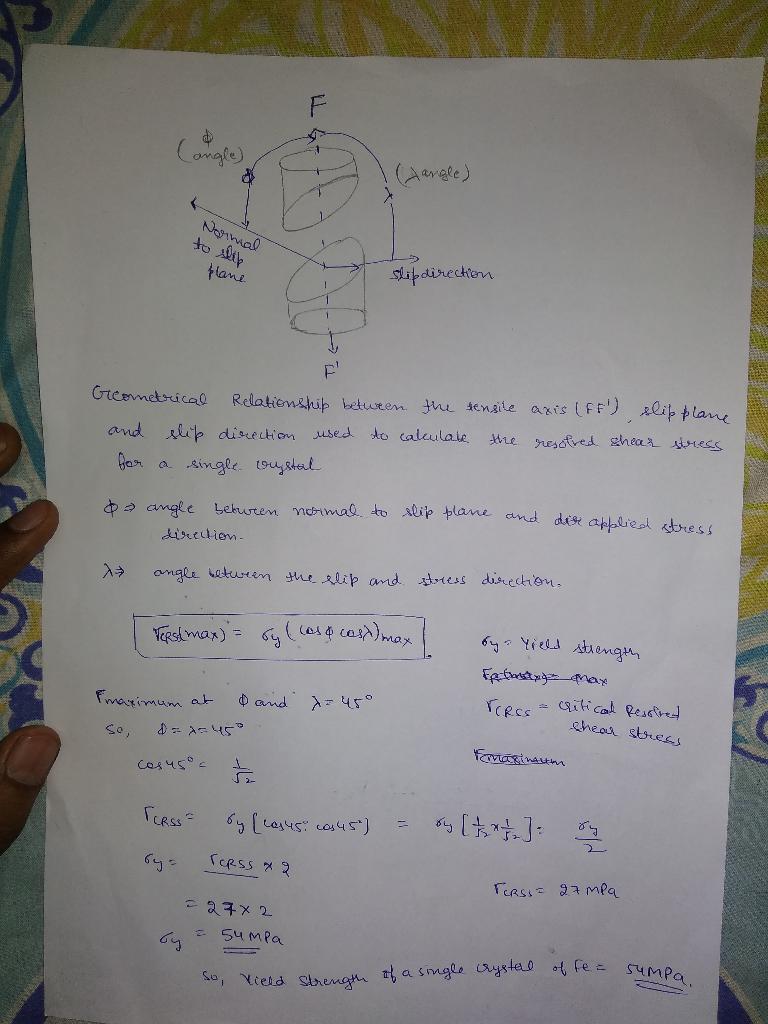
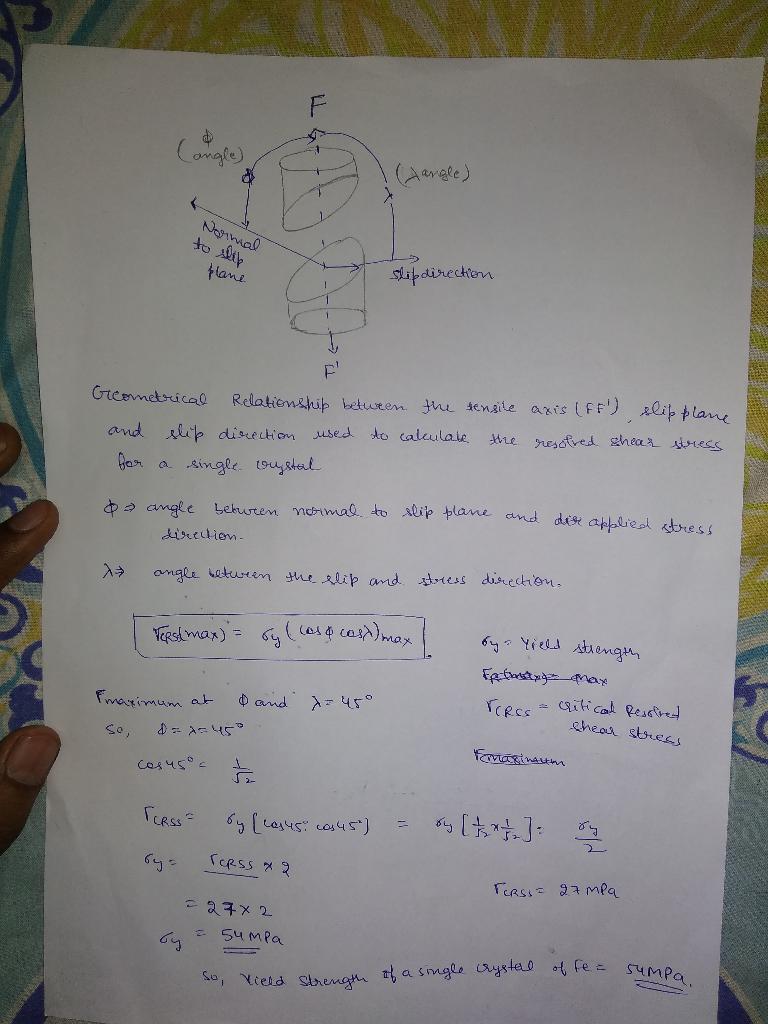
The critical resolved shear stress for iron is 27 MPa (4000 psi). Determine the maximum possible yield strength for a single cry

stal of Fe pulled in tension.

Engineering
1 answer:
jasenka [17]2 years ago
7 0

Answer:

Answer is mentioned below.

Explanation:

Answer: Calculation of maximum yield strength for a single crystal of Fe pulled in tension is shown in the image attached .

value of max. Yield strength= 54MPa

You might be interested in
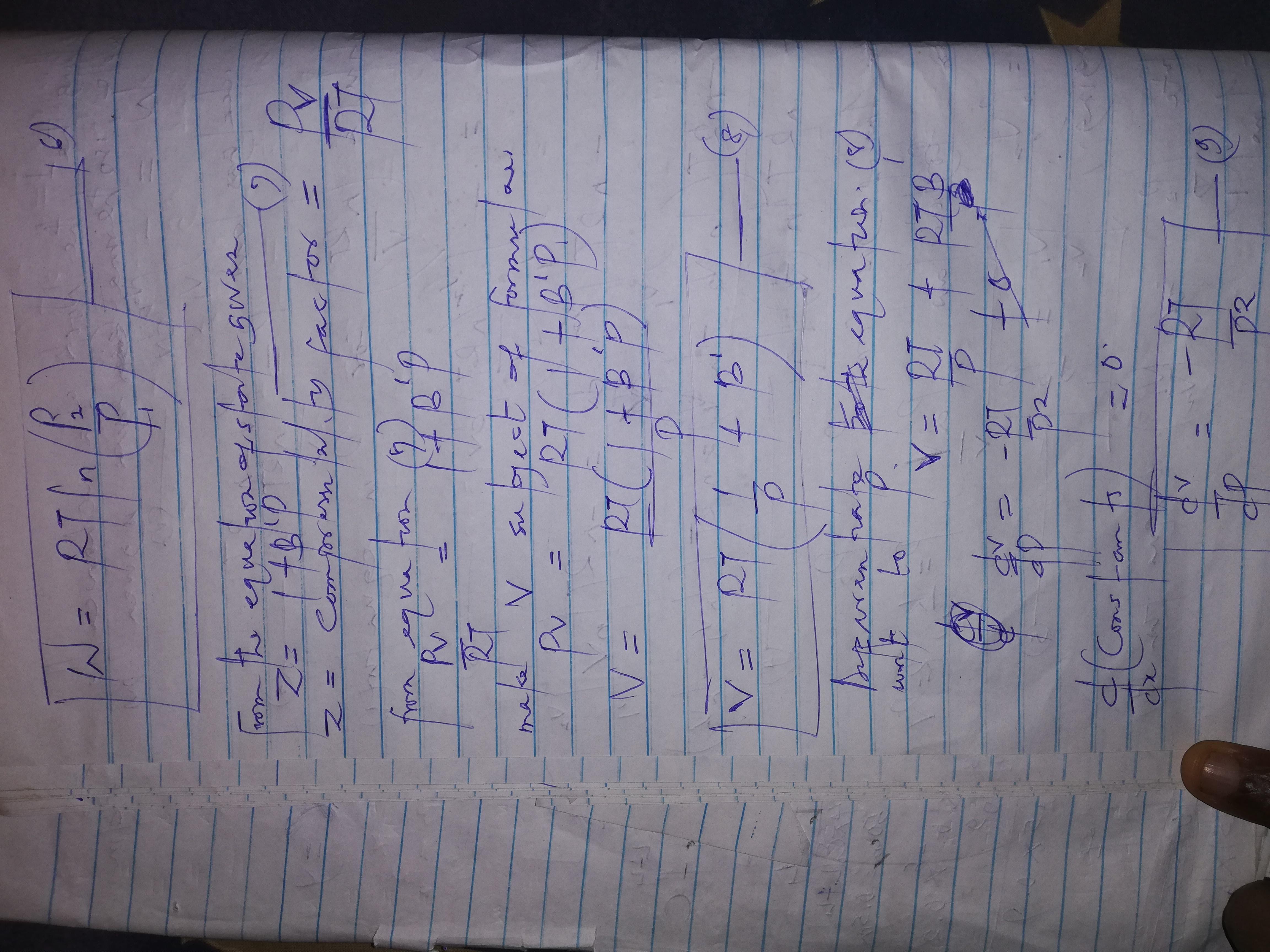
Derive an equation for the work of a mechanically reversible, isothermal compression of 1 mol of a gas from an initial pressure
Lyrx [107]

Answer:

The long derivation for work of a mechanically reversible, isothermal compression was done with detailed steps as shown in the attachment.

Explanation:

what is applied here is a long derivation from Work done in an isobaric process, the expression for the compressibility factor (Z) and the equation of state that was given. The requisite knowledge of Differentiation and Integration was used.

The detailed derivation from firs principle is as shown in the attachment.

5 0
2 years ago
Dust, dirt, or metal chips can pose a potential ____ injury risk in a shop.
pantera1 [17]

Answer:

Eye.

Explanation:

Dust, dirt, and metal chips are most unpleasant to get in your eyes. Just experience it and you'll know what I mean.

;)

3 0
2 years ago
An adiabatic gas turbine expands air at 1300 kPa and 500◦C to 100 kPa and 127◦C. Air enters the turbine through a 0.2-m2 opening
Viktor [21]

Given:

Pressure, P_{1} = 1300 kPa

Temperature,  T_{1} = 500^{\circ}

P_{2} = 100 kPa

T_{2} = 127^{\circ}  

velocity, v = 40 m/s

A = 1m^{2}

Solution:

For air propertiess at

P_{1} = 1300 kPa

T_{1} = 500^{\circ}

h_{1} = 793kJ/K

v_{1} = 0.172\frac{m^{3}}{kg}

and also at

P_{2} = 100 kPa

T_{2} = 127^{\circ}  

h_{2} = 401 KJ/K

v_{2} =  1.15\frac{m^{3}}{kg}

a) Mass flow rate is given by:

m' = \frac{Av}{v_{1}}

Now,

m = \frac{0.2\times 40}{0.172} = 46.51 kg/s

b) for the power produced by turbine, P = m'(h_{1} - h_{2})

P = 46.51\times(793 - 401) = 18.231 MW

5 0
2 years ago
A solid cylinder is concentric with a straight pipe. The cylinder is 0.5 m long and has an outside diameter of 8 cm. The pipe ha
poizon [28]

Answer :  

The force needed to move the cylinder is 25.6 N

<h2>Further explanation  </h2>

Given that,  

Length of the cylinder, l = 0.5 m  

Outer diameter of the cylinder, d = 8 cm = 0.08 m  

Outer radius of the cylinder, r=0.04\ m  

Inside diameter of the pipe, d = 8.5 cm = 0.085 m  

Inside radius of the pipe, r=0.0425\ m  

Specific gravity of the oil, \rho=0.92  

Density of oil, d=\rho\times \rho_w

Kinematic viscosity of the oil, v=5.57\times 10^{-4}\ m^2/s  

Velocity of the cylinder, u = 1 m/s  

We need to find the force needed to move the cylinder. Let the force is F.  

Specific gravity is defined as the ratio of the density of the substance to the density of water.  

Kinematic viscosity is the acquired resistance of a fluid when there is no external force is acting except gravity. It is denoted by v.

Absolute viscosity is given by :

v=\dfrac{\mu}{d}

Where, d = density of oil

And d=\rho\times \rho_w (density of oil = specific gravity × density of water )

d=0.92\times 10^3\ kg/m^3

So,  

\mu=v\times d..............(1)

\mu=5.57\times 10^{-4}\ m^2/s\times 0.92\times 10^3\ kg/m^3

\mu=0.512\ Pa-s

The separation between the cylinder and pipe is given by :

dy=\dfrac{d_p-d_c}{2}=\dfrac{8.5-8}{2}=0.25\ cm=0.0025\ m

d_p\ and\ d_c are diameter of pipe and cylinder respectively.  

The mathematical expression for the Newton's law of viscosity can be written as:  

\tau\propto\dfrac{du}{dy}  

\tau=\mu\times \dfrac{du}{dy}..........(2)  

Where  

\tau = Shear stress, \tau=\dfrac{F}{A}............(3)  

\mu = viscosity  

\dfrac{du}{dy} = rate of shear deformation

On rearranging equation (1), (2) and (3) we get :  

\dfrac{F}{A}=v\times \rho\times \dfrac{du}{dy}...............(4)  

A is the area of the cylinder, A=2\pi rl  

Equation (4) becomes :  

F=v\times \rho\times \dfrac{du}{dy}\times 2\pi rl..............(5)

A=\pi d\times l

A=\pi \times 0.08\ m\times 0.5\ m

A=0.125\ m^2

Now, equation (5) becomes :

F=(v\times \rho)\times \dfrac{du}{dy}\times 2\pi rl

F=(0.512\ Pa-s)\times (\dfrac{1}{0.0025\ m})\times \times 0.125\ m^2

F = 25.6 N

<h2>Learn more  </h2>

Kinematic viscosity : brainly.com/question/12947932

<h2>Keyword :  </h2>

Specific gravity, Kinematic viscosity, Area of cylinder, fluid mass density.  
7 0
2 years ago
A 10-mm drill rod was heat-treated and ground. The measured hardness He was found to be 300 Brinell. Estimate the endurance stre
lesya [120]

Answer:

The endurance strength for the rod is 434.6 MPa

Explanation:

Since the rod is used in rotating bending, we need to use Marin equation given by

S=k_ak_bS'_e

Here S stands for the endurance strength for rotating  bending, S'_e is the endurance strength, and k_a \text{ and } k_b are the parameters for Marin surface modification factor.

Endurance strength.

We can start finding the endurance strength, from the directions we know that the hardness H_e was found to be 300 Brinell, thus for such value we can find the ultimate tensile strength using

S_{ut}=3.41H_e

Replacing the hardness we get

S_{ut}=3.41(300) MPa \\ S_{ut}=1023 MPa

Now since the ultimate tensile strength has a value less than 1400 MPa, we can find the endurance strength using

S'_e =0.5S_{ut}

Replacing the tensile strength we get

S'_e=0.5(1023) MPa \\ S'_e = 511.5 MPa

Parameters for Marin surface modification factor.

From the directions we know that the drill rod has a ground surface finish, so then from tables we get

a=1.58 \text{ and } b = -0.085

Thus the surface factor will be

k_a=a(S_{ut})^b

Replacing values and the ultimate tensile strength

k_a=(1.58)1023^{-0.085}\\k_a=0.8766

Then we can find the rotating shaft factor, for a diameter of 10 mm, we can use the equation

k_b=1.24d^{-0.107}

Replacing the diameter we get

k_b=1.24(10)^{-0.107}\\k_b=0.9692

Estimating endurance strength for rotating shaft.

We can replace now all values we have found in Marin equation.

S=k_ak_bS'_e

S=(0.8766)(0.9692)(511.5) MPa

S=434.6 MPa

Thus the endurance strength for the rod is 434.6 MPa

3 0
2 years ago
Other questions:
  • Define a) Principal Plane b) Principal Stress c) anelasticity d) yield point e) ultimate tensile stress f) hardness g) toughness
    5·1 answer
  • (3) Calculate the heat flux through a sheet of brass 7.5 mm (0.30 in.) thick if the temperatures at the two faces are 150°Cand 5
    9·1 answer
  • Pipe (2) is supported by a pin at bracket C and by tie rod (1). The structure supports a load P at pin B. Tie rod (1) has a diam
    15·1 answer
  • Universal Containers has a junction object called "Job Production Facility". With 2 master-detail relationships to the Job and P
    15·1 answer
  • The critical resolved shear stress for iron is 27 MPa (4000 psi). Determine the maximum possible yield strength for a single cry
    12·1 answer
  • The velocity distribution for laminar flow between parallel plates is given by u umax = 1 − ( 2y h ) 2 Where h is the distance s
    15·1 answer
  • Determine the design angle ϕ (0∘≤ϕ≤90 ∘) between struts AB and AC so that the 400 lb horizontal force has a component of 600 lb
    10·1 answer
  • NEEDS TO BE IN PYTHON:ISBN-13 is a new standard for indentifying books. It uses 13 digits d1d2d3d4d5d6d7d8d910d11d12d13 . The la
    15·1 answer
  • Question 14<br> Which of these is true of a spray wash cabinet?
    6·1 answer
  • 1. Add:<br>(i) 5xy, -2xy, -11xy, 8xy<br>(iv) 3a - 2b + c, 5a + 8b -70​
    8·1 answer
Add answer
Login
Not registered? Fast signup
Signup
Login Signup
Ask question!