answer.
Ask question
Login Signup
Ask question
All categories
  • English
  • Mathematics
  • Social Studies
  • Business
  • History
  • Health
  • Geography
  • Biology
  • Physics
  • Chemistry
  • Computers and Technology
  • Arts
  • World Languages
  • Spanish
  • French
  • German
  • Advanced Placement (AP)
  • SAT
  • Medicine
  • Law
  • Engineering
astraxan [27]
2 years ago
9

(3) Calculate the heat flux through a sheet of brass 7.5 mm (0.30 in.) thick if the temperatures at the two faces are 150°Cand 5

0°C (302°F and 122°F); assume steady-state heat flow.(b) What is the heat loss per hour if the area of the sheet is 0.5 m2 (5.4 ft2)?(c) What is the heat loss per hour if soda—lime glass is used instead of brass?(d) Calculate the heat loss per hour if brass is used and the thickness is increased to 15 mm (0.59 in.).
Engineering
1 answer:
bezimeni [28]2 years ago
5 0

Answer:

a.) 1.453MW/m2,  b.)  2,477,933.33 BTU/hr  c.) 22,733.33 BTU/hr  d.) 1,238,966.67 BTU/hr

Explanation:

Heat flux is the rate at which thermal (heat) energy is transferred per unit surface area. It is measured in W/m2

Heat transfer(loss or gain) is unit of energy per unit time. It is measured in W or BTU/hr

1W = 3.41 BTU/hr

Given parameters:

thickness, t = 7.5mm = 7.5/1000 = 0.0075m

Temperatures 150 C = 150 + 273 = 423 K

                        50 C = 50 + 273 = 323 K

Temperature difference, T = 423 - 323 = 100 K

We are assuming steady heat flow;

a.) Heat flux, Q" = kT/t

K= thermal conductivity of the material

The thermal conductivity of brass, k = 109.0 W/m.K

Heat flux, Q" = \frac{109 * 100}{0.0075} = 1,453,333.33 W/m^{2} \\ Heat flux, Q" = 1.453MW/m^{2} \\

b.) Area of sheet, A = 0.5m2

Heat loss, Q = kAT/t

Heat loss, Q = \frac{109*0.5*100}{0.0075} = 726,666.667W

Heat loss, Q = 726,666.667 * 3.41 = 2,477,933.33 BTU/hr

c.) Material is now given as soda lime glass.

Thermal conductivity of soda lime glass, k is approximately 1W/m.K

Heat loss, Q=\frac{1*0.5*100}{0.0075} = 6,666.67W

Heat loss, Q = 6,666.67 * 3.41 = 22,733.33 BTU/hr

d.) Thickness, t is given as 15mm = 15/1000 = 0.015m

Heat loss, Q=\frac{109*0.5*100}{0.015} =363,333.33W

Heat loss, Q = 363,333.33 * 3.41 = 1,238,966.67 BTU/hr

You might be interested in
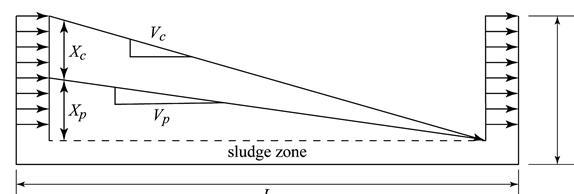
The rate of flow through an ideal clarifier is 8000m3 /d, the detention time is 1h and the depth is 3m. If a full-length movable
Fittoniya [83]

Answer:

a) 35%

b) yes it can be improved by moving the tray near the top

   Tray should be located ( 1 to 2 meters below surface )

   max removal efficiency ≈ 70%

c) The maximum removal will drop as the particle settling velocity = 0.5 m/h

Explanation:

Given data:

flow rate = 8000 m^3/d

Detention time = 1h

depth = 3m

Full length movable horizontal tray :  1m below surface

<u>a) Determine percent removal of particles having a settling velocity of 1m/h</u>

velocity of critical sized particle to be removed = Depth / Detention time

= 3 / 1 = 3m/h

The percent removal of particles having a settling velocity of 1m/h ≈ 35%

<u>b) Determine if  the removal efficiency of the clarifier can be improved by moving the tray, the location of the tray  and the maximum removal efficiency</u>

The tray should be located near the top of the tray ( i.e. 1 to 2 meters below surface ) because here the removal efficiency above the tray will be 100% but since the tank is quite small hence the

Total Maximum removal efficiency

=  percent removal_{above} + percent removal_{below}

= ( d_{a},v_{p} ) . \frac{d_{a} }{depth}  + ( d_{a},v_{p} ) . \frac{depth - d_{a} }{depth}  = 100

hence max removal efficiency ≈ 70%

<u>c) what is the effect of moving the tray would be if the particle settling velocity were equal to 0.5m/h?</u>

The maximum removal will drop as the particle settling velocity = 0.5 m/h

7 0
2 years ago
The top 3 most popular male names of 2017 are Oliver, Declan, and Henry according to babynames. Write a program that modifies th
Flura [38]

Answer:

The code is given below in Python with appropriate comments

Explanation:

# convert list to set

male_names = set(['Oliver','Declan','Henry'])

# get remove and add name from user

remove_name = input("Enter remove name: ")

add_name = input("Enter add name: ")

# remove name from set

male_names.remove(remove_name)

# add new name ij set

male_names.add(add_name)

# sort the set

a = sorted(male_names)

# print the set

print(a)

7 0
2 years ago
A 0.2-m^3 rigid tank equipped with a pressure regulator contains steam at 2MPa and 320C. The steam in the tank is now heated. Th
prohojiy [21]

Answer:

Q=486.49 KJ/kg

Explanation:

Given that

V= 0.2 m³

At initial condition

P= 2 MPa

T=320 °C

Final condition

P= 2 MPa

T=540°C

From steam table

At P= 2 MPa and T=320 °C

h₁=3070.15 KJ/kg

At P= 2 MPa and T=540°C

h₂=3556.64  KJ/kg

So the heat transfer ,Q=h₂ - h₁

Q= 3556.64 - 3070.15  KJ/kg

Q=486.49 KJ/kg

7 0
2 years ago
(3) Calculate the heat flux through a sheet of brass 7.5 mm (0.30 in.) thick if the temperatures at the two faces are 150°Cand 5
bezimeni [28]

Answer:

a.) 1.453MW/m2,  b.)  2,477,933.33 BTU/hr  c.) 22,733.33 BTU/hr  d.) 1,238,966.67 BTU/hr

Explanation:

Heat flux is the rate at which thermal (heat) energy is transferred per unit surface area. It is measured in W/m2

Heat transfer(loss or gain) is unit of energy per unit time. It is measured in W or BTU/hr

1W = 3.41 BTU/hr

Given parameters:

thickness, t = 7.5mm = 7.5/1000 = 0.0075m

Temperatures 150 C = 150 + 273 = 423 K

                        50 C = 50 + 273 = 323 K

Temperature difference, T = 423 - 323 = 100 K

We are assuming steady heat flow;

a.) Heat flux, Q" = kT/t

K= thermal conductivity of the material

The thermal conductivity of brass, k = 109.0 W/m.K

Heat flux, Q" = \frac{109 * 100}{0.0075} = 1,453,333.33 W/m^{2} \\ Heat flux, Q" = 1.453MW/m^{2} \\

b.) Area of sheet, A = 0.5m2

Heat loss, Q = kAT/t

Heat loss, Q = \frac{109*0.5*100}{0.0075} = 726,666.667W

Heat loss, Q = 726,666.667 * 3.41 = 2,477,933.33 BTU/hr

c.) Material is now given as soda lime glass.

Thermal conductivity of soda lime glass, k is approximately 1W/m.K

Heat loss, Q=\frac{1*0.5*100}{0.0075} = 6,666.67W

Heat loss, Q = 6,666.67 * 3.41 = 22,733.33 BTU/hr

d.) Thickness, t is given as 15mm = 15/1000 = 0.015m

Heat loss, Q=\frac{109*0.5*100}{0.015} =363,333.33W

Heat loss, Q = 363,333.33 * 3.41 = 1,238,966.67 BTU/hr

5 0
2 years ago
A plate of an alloy steel has a plane-strain fracture toughness of 50 MPa√m. If it is known that the largest surface crack is 0.
Ivahew [28]

Answer:

option B is correct. Fracture will definitely not occur

Explanation:

The formula for fracture toughness is given by;

K_ic = σY√πa

Where,

σ is the applied stress

Y is the dimensionless parameter

a is the crack length.

Let's make σ the subject

So,

σ = [K_ic/Y√πa]

Plugging in the relevant values;

σ = [50/(1.1√π*(0.5 x 10^(-3))]

σ = 1147 MPa

Thus, the material can withstand a stress of 1147 MPa

So, if tensile stress of 1000 MPa is applied, fracture will not occur because the material can withstand a higher stress of 1147 MPa before it fractures. So option B is correct.

8 0
2 years ago
Other questions:
  • What can your employer do to protect you from overhead power lines?
    8·1 answer
  • The rigid bar CDE is attached to a pin support at E and rests on the 30 mm diameter brass cylinder BD. A 22 mm diameter steel ro
    8·1 answer
  • Your assignment is to write a menu driven program. The menu will be responded to using a switch statement. The menu options (cas
    6·1 answer
  • Two physical properties that have a major influence on the cracking of workpieces, tools, or dies during thermal cycling are the
    13·1 answer
  • A well-insulated tank in a vapor power plant operates at steady state. Saturated liquid water enters at inlet 1 at a rate of 125
    8·1 answer
  • Steam at 40 bar and 500o C enters the first-stage turbine with a volumetric flow rate of 90 m3 /min. Steam exits the turbine at
    9·1 answer
  • Argon contained in a closed, rigid tank, initially at 33.7°C, 2.1 bar, and a volume of 4.2 m3, is heated to a final pressure of
    12·1 answer
  • A soil element is subjected to a minor principle stress of 50 kPa on a plane rotated 20 ° counterclockwise from vertical. If the
    10·1 answer
  • Who play 1v1 lol unblocked games 76
    8·2 answers
  • How does Accenture generate value for clients through Agile and DevOps?
    15·2 answers
Add answer
Login
Not registered? Fast signup
Signup
Login Signup
Ask question!