answer.
Ask question
Login Signup
Ask question
All categories
  • English
  • Mathematics
  • Social Studies
  • Business
  • History
  • Health
  • Geography
  • Biology
  • Physics
  • Chemistry
  • Computers and Technology
  • Arts
  • World Languages
  • Spanish
  • French
  • German
  • Advanced Placement (AP)
  • SAT
  • Medicine
  • Law
  • Engineering
Goshia [24]
2 years ago
13

Two physical properties that have a major influence on the cracking of workpieces, tools, or dies during thermal cycling are the

rmal conductivity and thermal expansion.Explain why.
Engineering
1 answer:
krok68 [10]2 years ago
7 0

Answer:

Explanation:

It is generally known that the thermal stresses developed during thermal cycle results into cracking, and these thermal stresses are due to temperature gradients .

Stresses will be equivalently lower for a particular temperature gradient when the thermal expansion is low.

It also known that there will be a reduction in the temperature gradient if the thermal conductivity is high, as heat is dissipated faster and more equally and  with it, as well as  when deformation takes place due to thermal stresses, cracking occurs but if the ductility is high, more deformation will be allowed without cracking and thus reduces the tendency for cracking.

You might be interested in
Steam enters a turbine operating at steady state at 1 MPa, 200 °C and exits at 40 °C with a quality of 83%. Stray heat transfer
Andrei [34K]

Answer:

(a) Work out put=692.83\frac{KJ}{Kg}

(b) Change in specific entropy=0.0044\frac{KJ}{Kg-K}

Explanation:

Properties of steam at 1 MPa and 200°C

        h_1=2827.4\frac{KJ}{Kg},s_1=6.69\frac{KJ}{Kg-K}

We know that if we know only one property in side the dome then we will find the other property by using steam property table.

Given that dryness or quality of steam at the exit of turbine is 0.83 and temperature T=40°C.So from steam table we can find pressure corresponding to saturation temperature 40°C.

Properties of saturated steam at 40°C

      h_f= 167.5\frac{KJ}{Kg} ,h_g= 2537.4\frac{KJ}{Kg}

 s_f= 0.57\frac{KJ}{Kg-K} ,s_g= 8.25\frac{KJ}{Kg-K}

So the enthalpy of steam at the exit of turbine  

h_2=h_f+x(h_g-h_f)\frac{KJ}{Kg}

h_2=167.5+0.83(2537.4-167.5)\frac{KJ}{Kg}

h_2=2134.57\frac{KJ}{Kg}

s_2=s_f+x(s_g-s_f)\frac{KJ}{Kg-K}

s_2=0.57+0.83(8.25-0.57)\frac{KJ}{Kg-K}

s_2=6.6944\frac{KJ}{Kg-K}

(a)

Work out put =h_1-h_2

                      =2827.4-2134.57 \frac{KJ}{Kg}

Work out put =692.83 \frac{KJ}{Kg}

(b) Change in specific entropy

     s_2-s_1=6.6944-6.69\frac{KJ}{Kg-K}

Change in specific entropy =0.0044\frac{KJ}{Kg-K}

3 0
2 years ago
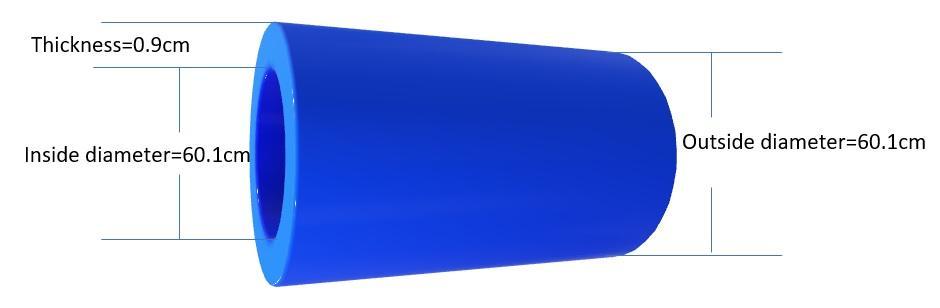
Water is flowing in a metal pipe. The pipe OD (outside diameter) is 61 cm. The pipe length is 120 m. The pipe wall thickness is
Yuki888 [10]

Answer:

1113kN

Explanation:

The ouside diameter OD of the pipe is 61cm and the thickness T is 0.9cm, so the inside diameter ID will be:

Inside Diameter = Outside Diameter - Thickness

Inside Diameter = 61cm - 0.9cm = 60.1cm

Converting this diameter to meters, we have:

60.1cm*\frac{1m}{100cm}=0.601m

This inside diameter is useful to calculate the volume V of water inside the pipe, that is the volume of a cylinder:

V_{water}=\pi  r^{2}h

V_{water}=\pi (\frac{0.601m}{2})^{2}*120m

V_{water}=113.28m^{3}

The problem gives you the water density d as 1.0kg/L, but we need to convert it to proper units, so:

d_{water}=1.0\frac{Kg}{L}*\frac{1L}{1000cm^{3}}*(\frac{100cm}{1m})^{3}

d_{water}=1000\frac{Kg}{m^{3}}

Now, water density is given by the equation d=\frac{m}{V}, where m is the water mass and V is the water volume. Solving the equation for water mass and replacing the values we have:

m_{water}=d_{water}.V_{water}

m_{water}=1000\frac{Kg}{mx^{3}}*113.28m^{3}

m_{water}=113280Kg

With the water mass we can find the weight of water:

w_{water}=m_{water} *g

w_{water}=113280kg*9.8\frac{m}{s^{2}}

w_{water}=1110144N

Finally we find the total weight add up the weight of the water and the weight of the pipe,so:

w_{total}=w_{water}+w_{pipe}

w_{total}=1110144N+2500N

w_{total}=1112644N

Converting this total weight to kN, we have:

1112644N*\frac{0.001kN}{1N}=1113kN

7 0
2 years ago
Identify an object in your house that contains a physical system and list three questions you could use to define the system
jonny [76]

Answer:

ALL CAREFULLY ANSWERED CORRECTLY

Explanation:

1) A loaf of Bread PHYSICAL SYSTEM

✓ How can the environment affect the edibility of the bread

✓ What are the constituents that makes up the bread

✓ What process is involved in these constituents mixing to form the loaf.

2) The law of thermodynamics makes us to understand that when heat/energy passes through a system, the systems internal energy changes with respect to the conservation of energy law. That is energy lost = energy gained. Typically, ice would melt in a cup of hot tea because of the thermal energy in the molecules of the hot tea. When you heat a material, you are adding thermal kinetic energy to its molecules and usually raising its temperature. The temperature of the ice raises due to the kinetic energy added to it and it melts to water.

3) The theory of systems view the world as a complex system of interconnected parts. If we consider the society; (financial systems, political systems, etc) we will agree that they individually have their own components and it's the summation of this components that makes the system, this implies that system thinking could be applicable in this kinda of systems as long as they are made up of components.

4) Technology has boosted every sector of our lives and it has the capacity to do more. Restricting it's importance to entertainment alone would be an underusing of its potentials. Engineering students infact should not need any drive to be encouraged about maximizing all it can do in shaping our world.

5) ~ Nature shows its splendid soul

~Never ceases to leave us in amazement

~And we are in love

4 0
2 years ago
A double-acting duplex pump with 6.5-in. liners, 2.5-in. rods, and 18-in. strokes was operated at 3,000 psig and 20 cycles/min.
Stella [2.4K]

Answer:

Pump factor = Fp =  7.854 gal/cycle

Ev = 82.00 %

P_H = 183.29 hp

Explanation:

Given data:

Dimension of duplex pump

6.5 inch liner  

2.5 inch rod

18 inch strokes

Pressure 3000 psig

Pit dimension

7 ft wide

20 ft long

Ls = 18 inch

Velocity = (18)/10

volumetric efficiency is given as E_v = (Actual flow rate)/(Theortical flow rate) * 100

we know that flow rate is given as = Area * velocity

Theoritical flow rate = \frac{\pi}{2}\times Ls(2d_l^2 - d_r^2)\times N

Ev = \frac{7\times 12 \times 20\times 12\times 12 \times \frac{18}{10} inch^3/min}{\frac{\pi}{2} \times 18 (2\times 6.5^2 -2.5^2) \times 20}

Ev = 82.00 %

Pump factor Fp = = \frac{\pi}{2}\times Ls(2d_l^2 - d_r^2)\times Ev

Fp =\frac{\pi}{2} \times 18 (2\times 6.5^2 -2.5^2) \times 0.82

Fp = 1814.22 in^3/cyl

Fp =  7.854 gal/cycle

Flow rate q = NFp = 20 \times 7.854 = 157.08 gal/min

Power Ph = \frac{\DeltaP q}{1714} = \frac{3000 \times 157.08}{1714} = 274.93 hp

6 0
2 years ago
Twenty distinct cars park in the same parking lot every day. Ten of these cars are US-made, while the other ten are foreign-made
Zina [86]

Answer:

Total no. of ways to line up cars is 20! = 2.43 c 10^18

Probability that the cars alternate is 0.00001 or 0.001%

Explanation:

Since, the position of a car is random.Therefore, number ways in which cars can line up is given as:

<u>No. of ways = 20! = 2.43 x 10^18</u>

For the probability that cars alternate, two groups will be formed, one consisting of US-made 10 cars and other containing 10 foreign made. The number of favorable outcomes for this can be found out as the arrangements of 2! between these groups multiplied by the arrangements of 10! for each group, due to the arrangements among the groups themselves.

Favorable Outcomes = 2! x 10! x 10!

Thus the probability of event will be:

Probability = Favorable Outcomes/Total No. of Ways

Probability = (2! x 10! x 10!)/20!

<u>Probability = 0.00001 = 0.001%</u>

4 0
2 years ago
Other questions:
  • Which of the two materials (brittle vs. ductile) usually obtains the highest ultimate strength and why?
    5·1 answer
  • A pitfall cited in Section 1.10 is expecting to improve the overall performance of a computer by improving only one aspect of th
    6·1 answer
  • Pipe (2) is supported by a pin at bracket C and by tie rod (1). The structure supports a load P at pin B. Tie rod (1) has a diam
    15·1 answer
  • Water flows downward through a vertical 10-mm-diameter galvanized iron pipe with an average velocity for 5.0 m/s and exits as a
    5·1 answer
  • Suppose that a class CalendarDate has been defined for storing a calendar date with month, day and year components. (In our sect
    6·1 answer
  • 6.8.1: Function pass by pointer: Transforming coordinates. Define a function CoordTransform() that transforms its first two inpu
    9·1 answer
  • Q5. A hypothetical metal alloy has a grain diameter of 2.4 x 10⁻² mm. After a heat treatment at 575°C for 500 min, the grain dia
    7·1 answer
  • Water enters a circular tube whose walls are maintained at constant temperature at specified flow rate and temperature. For full
    8·1 answer
  • The molecular weight of a 10g rubber band
    12·1 answer
  • George is replacing a burned out resistor in a circuit board. The board has a 10, a 20, and a 40 on resistor, all in parallel. W
    5·1 answer
Add answer
Login
Not registered? Fast signup
Signup
Login Signup
Ask question!