answer.
Ask question
Login Signup
Ask question
All categories
  • English
  • Mathematics
  • Social Studies
  • Business
  • History
  • Health
  • Geography
  • Biology
  • Physics
  • Chemistry
  • Computers and Technology
  • Arts
  • World Languages
  • Spanish
  • French
  • German
  • Advanced Placement (AP)
  • SAT
  • Medicine
  • Law
  • Engineering
mart [117]
2 years ago
12

The molecular weight of a 10g rubber band

Engineering
1 answer:
Archy [21]2 years ago
8 0

Answer:

The answer to this question is 1 * 10g /mole = 10

Explanation:

From the question given, the first step to take is to find the weight of a 10g rubber band.

Now,

The molecular weight of rubber band , tires the primary chains may have molecular weights is of order of 1 x 10 g/

Therefore it is 1 * 10g/mole =10

You might be interested in
A liquid with a specific gravity of 2.6 and a viscosity of 2.0 cP flows through a smooth pipe of unknown diameter, resulting in
sasho [114]
.......,.,.,.,.,.,,.,.,,.,.,.,.,.,.,.,,.,.,,.,,,.,,.,,.,.,.,.,,............,,,,,,’mmdjidvdhxxkf jkkk he in d
6 0
2 years ago
Six years ago, an 80-kW diesel electric set cost $160,000. The cost index for this class of equipment six years ago was 187 and
exis [7]

Answer:

new boiler total cost = $229706.825

new boiler total cost = $127512

Explanation:

given data

power p1 = 80 kW

cost C = $160000

cost index CI 1 = 187

cost index CI 2= 194

cost capacity factor f = 0.6

power p2 = 120 kW

current cost = $18000

to find out

total cost and cost of 40 kW

solution

we consider here CN cost for new boiler and CO cost for old boiler

and x is capacity of new boiler

first we find old boiler current cost that is

current cost CO = C × \frac{CI 1 }{CI 2 }   .............1

put here value

current cost = 160000 × \frac{194 }{187 }

new current cost = $165989.304

and

use here power sizing technique for 124 kW

CN/CO = (\frac{p2}{p1} )^{f}    ...............2

put here value and find CN

CN/CO = (\frac{p2}{p1} )^{f}  

CN / 165989.304 = (\frac{120}{80} )^{0.6}  

CN = 211706.825

so new cost = $211706.825

so

total cost for new boiler is

total cost = new cost + current cost

total cost = 211706.825 + 18000

new boiler total cost = $229706.825

and

for 40 kW new cost will be

use equation 2

CN/CO = (\frac{p2}{p1} )^{f}

CN / 165989.304 = (\frac{40}{80} )^{0.6}  

CN = 109512

so new cost is $109512

so

total cost for new boiler is

total cost = new cost + current cost

total cost = 109512 + 18000

new boiler total cost = $127512

7 0
2 years ago
A railcar with an overall mass of 78,000 kg traveling with a speed vi is approaching a barrier equipped with a bumper consisting
sergij07 [2.7K]

Answer:

v₀ = 2,562 m / s  = 9.2 km/h

Explanation:

To solve this problem let's use Newton's second law

              F = m a = m dv / dt = m dv / dx dx / dt = m dv / dx v

              F dx = m v dv

We replace and integrate

            -β ∫ x³ dx = m ∫ v dv

            β x⁴/ 4 = m v² / 2

We evaluate between the lower (initial) integration limits v = v₀, x = 0 and upper limit v = 0 x = x_max

        -β (0- x_max⁴) / 4 = ½ m (v₀²2 - 0)

         x_max⁴ = 2 m /β   v₀²


Let's look for the speed that the train can have for maximum compression

         x_max = 20 cm = 0.20 m


         v₀ =√(β/2m)   x_max²

Let's calculate

          v₀ = √(640 106/2 7.8 104)    0.20²

          v₀ = 64.05  0.04

          v₀ = 2,562 m / s

          v₀ = 2,562 m / s (1lm / 1000m) (3600s / 1h)

          v₀ = 9.2 km / h

5 0
2 years ago
A converging-diverging nozzle is designed to operate with an exit Mach number of 1.75 . The nozzle is supplied from an air reser
Flura [38]

Answer:

a. 4.279 MPa

b. 3.198 MPa to 4.279 MPa

c. 0.939 MPa

d. Below 3.198 MPa

Explanation:

From the given parameters

M_{exit} = 1.75 MPa  

M at 1.6 MPa gives A_{exit}/A* = 1.2502

M at 1.8 MPa gives  A_{exit}/A* = 1.4390

Therefore, by interpolation, we have M_{exit} = 1.75 MPa  gives A

However, we shall use M_{exit} = 1.75 MPa and A

Similarly,

P_{exit}/P₀ = 0.1878

a) Where the nozzle is choked at the throat there is subsonic flow in the following diverging part of the nozzle. From tables, we have

A_{exit}/A* = 1.387. by interpolation M

Therefore P_{exit} = P₀ × P

Which shows that the nozzle is choked for back pressures lower than 4.279 MPa

b) Where there is a normal shock at the exit of the nozzle, we have;

M₁ = 1.75 MPa, P₁ = 0.1878 × 5 = 0.939 MPa

Where the normal shock is at M₁ = 1.75 MPa, P₂/P₁ = 3.406

Where the normal shock occurs at the nozzle exit, we have

P_b = 3.406\times 0.939 = 3.198 MPa

Where the shock occurs t the section prior to the nozzle exit from the throat, the back pressure was derived as P_b = 4.279 MPa

Therefore the back pressure value ranges from 3.198 MPa to 4.279 MPa

c) At M_{exit} = 1.75 MPa  and P

d) Where the back pressure is less than 3.198 MPa according to isentropic flow relations supersonic flow will exist at the exit plane    

8 0
2 years ago
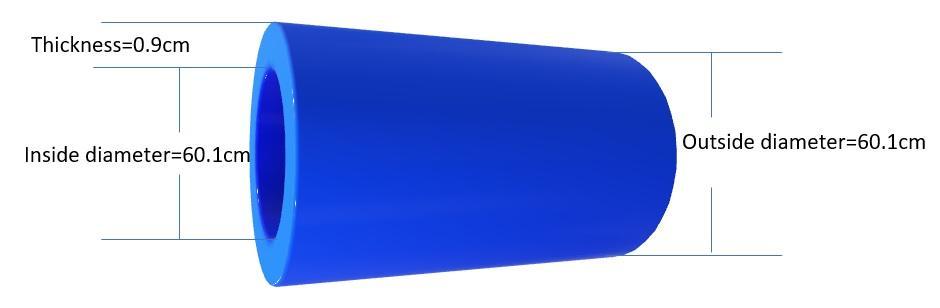
Water is flowing in a metal pipe. The pipe OD (outside diameter) is 61 cm. The pipe length is 120 m. The pipe wall thickness is
Yuki888 [10]

Answer:

1113kN

Explanation:

The ouside diameter OD of the pipe is 61cm and the thickness T is 0.9cm, so the inside diameter ID will be:

Inside Diameter = Outside Diameter - Thickness

Inside Diameter = 61cm - 0.9cm = 60.1cm

Converting this diameter to meters, we have:

60.1cm*\frac{1m}{100cm}=0.601m

This inside diameter is useful to calculate the volume V of water inside the pipe, that is the volume of a cylinder:

V_{water}=\pi  r^{2}h

V_{water}=\pi (\frac{0.601m}{2})^{2}*120m

V_{water}=113.28m^{3}

The problem gives you the water density d as 1.0kg/L, but we need to convert it to proper units, so:

d_{water}=1.0\frac{Kg}{L}*\frac{1L}{1000cm^{3}}*(\frac{100cm}{1m})^{3}

d_{water}=1000\frac{Kg}{m^{3}}

Now, water density is given by the equation d=\frac{m}{V}, where m is the water mass and V is the water volume. Solving the equation for water mass and replacing the values we have:

m_{water}=d_{water}.V_{water}

m_{water}=1000\frac{Kg}{mx^{3}}*113.28m^{3}

m_{water}=113280Kg

With the water mass we can find the weight of water:

w_{water}=m_{water} *g

w_{water}=113280kg*9.8\frac{m}{s^{2}}

w_{water}=1110144N

Finally we find the total weight add up the weight of the water and the weight of the pipe,so:

w_{total}=w_{water}+w_{pipe}

w_{total}=1110144N+2500N

w_{total}=1112644N

Converting this total weight to kN, we have:

1112644N*\frac{0.001kN}{1N}=1113kN

7 0
2 years ago
Other questions:
  • Water has a density of 1.94 slug/ft^3. What is the density expressed in SI units? Express the answer to three significant figure
    8·1 answer
  • 1. A glass window of width W = 1 m and height H = 2 m is 5 mm thick and has a thermal conductivity of kg = 1.4 W/m*K. If the inn
    8·1 answer
  • The purification of hydrogen gas is possible by diffusion through a thin palladium sheet. Calculate the number of kilograms of h
    8·1 answer
  • The procedure for determining the presence of Non-Condensable Gasses in refrigerant contained in an external recovery tank utili
    5·2 answers
  • Five Kilograms of continuous boron fibers are introduced in a unidirectional orientation into of an 8kg aluminum matrix. Calcula
    9·1 answer
  • An air standard cycle with constant specific heats is executed in a closed pistoncylinder system and is composed of the followin
    10·1 answer
  • A glycerin pump is powered by a 5-kW electric motor. The pressure differential between the outlet and the inlet of the pump at f
    13·1 answer
  • A fuel oil is burned with air in a furnace. The combustion produces 813 kW of thermal energy, of which 65% is transferred as hea
    13·1 answer
  • Use the drop -down menus to select the appropriate question type. Picking between two possible alternatives: Showing an understa
    7·1 answer
  • Mr. Ray deposited $200,000 in the Old and Third National Bank. If the bank pays 8% interest, how much will he have in the accoun
    10·2 answers
Add answer
Login
Not registered? Fast signup
Signup
Login Signup
Ask question!