answer.
Ask question
Login Signup
Ask question
All categories
  • English
  • Mathematics
  • Social Studies
  • Business
  • History
  • Health
  • Geography
  • Biology
  • Physics
  • Chemistry
  • Computers and Technology
  • Arts
  • World Languages
  • Spanish
  • French
  • German
  • Advanced Placement (AP)
  • SAT
  • Medicine
  • Law
  • Engineering
Triss [41]
2 years ago
8

1. A glass window of width W = 1 m and height H = 2 m is 5 mm thick and has a thermal conductivity of kg = 1.4 W/m*K. If the inn

er and outer surface temperatures of the glass are 15°C and -20°C. respectively, on a cold winter day, what is the rate of heat loss through the glass?
2. To reduce heat loss through windows, it is customary to use a double pane construction in which adjoining panes are separated by an air space. If the spacing is 10 mm and the glass surfaces in contact with the air have temperatures of 10° C and - 15°C, what is the rate of heat loss from a 1 m times 2 m window? The thermal conductivity of air is ka = 0.024 W/m*K.
Engineering
1 answer:
emmasim [6.3K]2 years ago
5 0

Answer:

1. \dot Q=19600\ W

2. \dot Q=120\ W

Explanation:

1.

Given:

  • height of the window pane, h=2\ m
  • width of the window pane, w=1\ m
  • thickness of the pane, t=5\ mm= 0.005\ m
  • thermal conductivity of the glass pane, k_g=1.4\ W.m^{-1}.K^{-1}
  • temperature of the inner surface, T_i=15^{\circ}C
  • temperature of the outer surface, T_o=-20^{\circ}C

<u>According to the Fourier's law the rate of heat transfer is given as:</u>

\dot Q=k_g.A.\frac{dT}{dx}

here:

A = area through which the heat transfer occurs = 2\times 1=2\ m^2

dT = temperature difference across the thickness of the surface = 35^{\circ}C

dx = t = thickness normal to the surface = 0.005\ m

\dot Q=1.4\times 2\times \frac{35}{0.005}

\dot Q=19600\ W

2.

  • air spacing between two glass panes, dx=0.01\ m
  • area of each glass pane, A=2\times 1=2\ m^2
  • thermal conductivity of air, k_a=0.024\ W.m^{-1}.K^{-1}
  • temperature difference between the surfaces, dT=25^{\circ}C

<u>Assuming layered transfer of heat through the air and the air between the glasses is always still:</u>

\dot Q=k_a.A.\frac{dT}{dx}

\dot Q=0.024\times 2\times \frac{25}{0.01}

\dot Q=120\ W

You might be interested in
Small droplets of carbon tetrachloride at 68 °F are formed with a spray nozzle. If the average diameter of the droplets is 200 u
Licemer1 [7]

Answer:

the difference in pressure between the inside and outside of the droplets is 538 Pa

Explanation:

given data

temperature = 68 °F

average diameter = 200 µm

to find out

what is the difference in pressure between the inside and outside of the droplets

solution

we know here surface tension of carbon tetra chloride at 68 °F is get from table 1.6 physical properties of liquid that is

σ = 2.69 × 10^{-2} N/m

so average radius = \frac{diameter}{2} =  100 µm = 100 ×10^{-6} m

now here we know relation between pressure difference and surface tension

so we can derive difference pressure as

2π×σ×r = Δp×π×r²    .....................1

here r is radius and  Δp pressure difference and σ surface tension

Δp = \frac{2 \sigma }{r}    

put here value

Δp = \frac{2*2.69*10^{-2}}{100*10^{-6}}  

Δp = 538

so the difference in pressure between the inside and outside of the droplets is 538 Pa

7 0
2 years ago
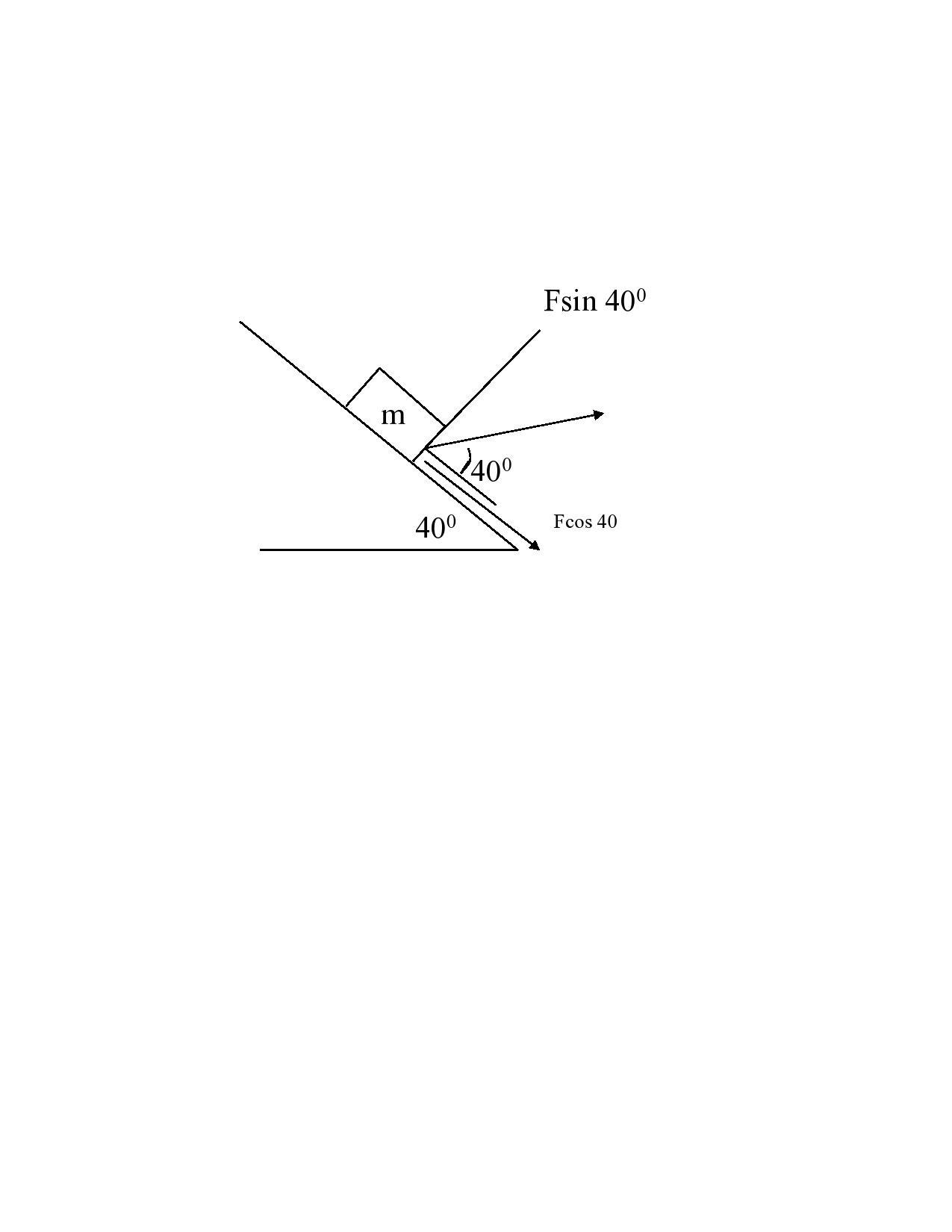
The 10-kg block slides down 2 m on the rough surface with kinetic friction coefficient μk = 0.2. What is the work done by the fr
Rashid [163]

Answer:

153.2 J

Explanation:

Let's first list our given parameters;

mass (m) of the block = 10 kg

which slides down ( i.e displacement) = 2 m

kinetic coefficient of friction (μk) = 0.2

In the diagram shown below;  if we take an integral look at the component of force in the direction of the displacement; we have

F_x= Fcos 40°

F_x= 100 (cos 40°)

F_x= 76.60 N

Workdone by the friction force can now be determined as:

W = F_x × displacement

W = 76.60 × 2

W = 153.2 J

∴  the work done by the friction force = 153.2 J

7 0
2 years ago
Why is it so dangerous to use a ground lift on a metal cased power tool
MaRussiya [10]
Answer:

Removal of the safety ground connection on equipment can expose users to an increased danger of electric shock and may contradict wiring regulations. ... If a fault develops in any line-operated equipment, cable shields and equipment enclosures may become energized, creating an electric shock hazard.
7 0
1 year ago
6.28 A six-lane freeway (three lanes in each direction) in rolling terrain has 10-ft lanes and obstructions 4 ft from the right
dimulka [17.4K]

Answer:

Assume Base free flow speed (BFFS) = 70 mph

Lane width = 10 ft

Reduction in speed corresponding to lane width, fLW = 6.6 mph

Lateral Clearance = 4 ft

Reduction in speed corresponding to lateral clearance, fLC = 0.8 mph

Interchanges/Ramps = 9/ 6 miles = 1.5 /mile

Reduction in speed corresponding to Interchanges/ramps, fID = 5 mph

No. of lanes = 3

Reduction in speed corresponding to number of lanes, fN = 3 mph

Free Flow Speed (FFS) = BFFS – fLW – fLC – fN – fID = 70 – 6.6 – 0.8 – 3 – 5 = 54.6 mph

Peak Flow, V = 2000 veh/hr

Peak 15-min flow = 600 veh

Peak-hour factor = 2000/ (4*600) = 0.83

Trucks and Buses = 12 %

RVs = 6 %

Rolling Terrain

fHV = 1/ (1 + 0.12 (2.5-1) + 0.06 (2.0-1)) = 1/1.24 = 0.806

fP = 1.0

Peak Flow Rate, Vp = V / (PHV*n*fHV*fP) = 2000/ (0.83*3*0.806*1.0) = 996.54 ~ 997 veh/hr/ln

Vp < (3400 – 30 FFS)

S = FFS

S = 54.6 mph

Density = Vp/S = (997) / (54.6) = 18.26 veh/mi/ln

7 0
2 years ago
The solid aluminum shaft has a diameter of 50 mm. Determine the absolute maximum shear stress in the shaft and sketch the shear-
jarptica [38.1K]

Answer:

Max shear = 8.15 x 10^7 N/m2

Explanation:

In order to find the maximum stress for a solid shaft having radius r, we will be applying the Torsion formula which can be written as;

Allowable Shear Stress = Torque x Radius / pi/2 x radius^4

Putting the values we have;

T = 2000 N/m

Radius = Diameter/2 = 0.05 / 2 = 0.025 m

Putting values in formula;

Max shear = 2000 x 0.025 / 3.14/2 x (0.025)^4

Max shear = 8.15 x 10^7 N/m2

5 0
2 years ago
Other questions:
  • A square loop of wire surrounds a solenoid. The side of the square is 0.1 m, while the radius of the solenoid is 0.025 m. The sq
    6·1 answer
  • A long aluminum wire of diameter 3 mm is extruded at a temperature of 280°C. The wire is subjected to cross air flow at 20°C at
    9·1 answer
  • The top 3 most popular male names of 2017 are Oliver, Declan, and Henry according to babynames. Write a program that modifies th
    6·1 answer
  • The rigid bar CDE is attached to a pin support at E and rests on the 30 mm diameter brass cylinder BD. A 22 mm diameter steel ro
    8·1 answer
  • The following passage contains a fragment. Select the correct revision. Presley took the exuberance of gospel and added the freq
    7·1 answer
  • Two airstreams are mixed steadily and adiabatically. The first stream enters at 35°C and 30 percent relative humidity at a rate
    6·1 answer
  • 1. A spur gear made of bronze drives a mid steel pinion with angular velocity ratio of 13 /2 : 1. Thepressure angle is 14 1/2° .
    12·1 answer
  • The mechanical properties of some metals may be improved by incorporating fine particles of their oxides. If the moduli of elast
    12·1 answer
  • Thermal energy generated by the electrical resistance of a 5-mm-diameter and 4-m-long bare cable is dissipated to the surroundin
    12·1 answer
  • Q10. Select the correct option for the following questions – (10 points, 2 each) a. After an edge dislocation has passed through
    15·1 answer
Add answer
Login
Not registered? Fast signup
Signup
Login Signup
Ask question!