answer.
Ask question
Login Signup
Ask question
All categories
  • English
  • Mathematics
  • Social Studies
  • Business
  • History
  • Health
  • Geography
  • Biology
  • Physics
  • Chemistry
  • Computers and Technology
  • Arts
  • World Languages
  • Spanish
  • French
  • German
  • Advanced Placement (AP)
  • SAT
  • Medicine
  • Law
  • Engineering
vova2212 [387]
2 years ago
15

Q10. Select the correct option for the following questions – (10 points, 2 each) a. After an edge dislocation has passed through

some region of a crystal, the atomic arrangement of that region is disordered, Justify your answer - • True • False b. The process by which plastic deformation is produced by dislocation motion is called ____. • Interstitial Dislocation • Slip • Additional plain • Screw c. How does the theoretical strength of a solid material compare with its experimental strength? • Strength theoretical < Strength experimental • Strength theoretical = Strength experimental • Strength theoretical > Strength experimental d. The atoms surrounding a screw dislocation experience what kind(s) of strain(s)? • Shear strain • Compressive strain • Tensile strain e. For a particular crystal structure, the slip direction is that direction in the slip plane having the • highest linear density. • lowest linear density.
Engineering
1 answer:
Gnom [1K]2 years ago
4 0

Answer:

a. True - Because the atomic arrangements of that region is disorderer because of the extra half plane atoms in between the line

b.Slip

C. Strength theoretical is greater than strength experimental

d. Shear stress

e. Highest linear density

You might be interested in
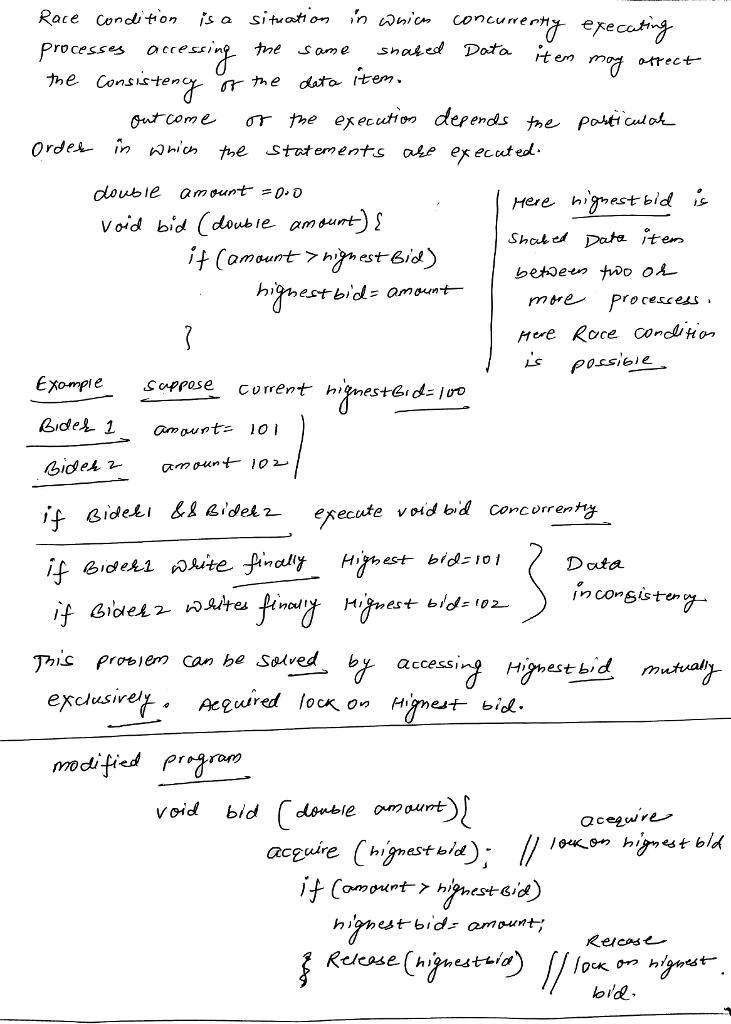
Race conditions are possible in many computer systems. Consider an online auction system where the current highest bid for each
kumpel [21]

Answer:

See attached picture.

Explanation:

5 0
2 years ago
Refrigerant-134a enters a diffuser steadily as saturated vapor at 600 kPa with a velocity of 160 m/s, and it leaves at 700 kPa a
Zina [86]

Answer:

a) V_2 = 82.1 m/s

b) m = 0.298 Kg/s

Explanation:

from A-11 to A-13 we have the following data

P_1 = 600 kpa

V_1 = 0.033925 m^3/kg

h_1 = 262.52 kJ/kg

P_2 = 700 kpa

V_2 = 0.0313 m^3/kg

T_2 = 40°C = 313K

h_2 = 278.66 kJ/kg

Now, from the conversation of mass,

A_2*V_2/u_2 = A_1*V_1/u_1

V_2 = A_1/A_2*u_2/u_1*V_1

V_2 = A_1/1.8*A_1 * 0.0313 /0.033925*160

V_2 = 82.1 m/s

now from the energy balance equation

E_in = E_out

Q_in + m(h_1 + V_1^2/2) =  m(h_2 + V_2^2/2)

m = 0.298 Kg/s

4 0
2 years ago
Read 2 more answers
3.24 Program: Drawing a half arrow (Java) This program outputs a downwards facing arrow composed of a rectangle and a right tria
eimsori [14]

Answer:

Here is the JAVA program:

import java.util.Scanner; // to get input from user

public class DrawHalfArrow{ // start of the class half arrow

public static void main(String[] args) { // starts of main() function body

    Scanner scnr = new Scanner(System.in); //reads input

int arrowBaseHeight = 0; // stores the height of arrow base

int arrowBaseWidth  = 0; // holds width of arrow base

int arrowHeadWidth = 0; // contains the width of arrow head

// prompts the user to enter arrow base height, width and arrow head width

System.out.println("Enter arrow base height: ");

arrowBaseHeight = scnr.nextInt(); // scans and reads the input as int

System.out.println("Enter arrow base width: ");

arrowBaseWidth = scnr.nextInt();

/* while loop to continue asking user for an arrow head width until the value entered is greater than the value of arrow base width */

while (arrowHeadWidth <= arrowBaseWidth) {

    System.out.println("Enter arrow head width: ");

    arrowHeadWidth = scnr.nextInt(); }

//start of the nested loop

//outer loop iterates a number of times equal to the height of the arrow base

 for (int i = 0; i < arrowBaseHeight; i++) {

//inner loop prints the stars asterisks

      for (int j = 0; j <arrowBaseWidth; j++) {

          System.out.print("*");        } //displays stars

          System.out.println();          }

//temporary variable to hold arrowhead width value

int k = arrowHeadWidth;

//outer loop to iterate no of times equal to the height of the arrow head

for (int i = 1; i <= arrowHeadWidth; i++)

{     for(int j = k; j > 0; j--)     {//inner loop to print stars

       System.out.print("*");    } //displays stars

   k = k - 1;

   System.out.println(); } } } // continues to add more asterisks for new line

Explanation:

The program asks to enter the height of the arrow base, width of the arrow base and the width of arrow head. When asking to enter the width of the arrow head, a condition is checked that the arrow head width arrowHeadWidth should be less than or equal to width of arrow base arrowBaseWidth. The while loop keeps iterating until the user enters the arrow head width larger than the value of arrow base width.

The loop is used to output an arrow base of height arrowBaseHeight. So point (1) is satisfied.

The nested loop is being used which as a whole outputs an arrow base of width arrowBaseWidth. The inner loop draws the stars and forms the base width of the arrow, and the outer loop iterates a number of times equal to the height of the arrow. So (2) is satisfied.

A temporary variable k is used to hold the original value of arrowHeadWidth so that it keeps safe when modification is done.

The last nested loop is used to output an arrow head of width arrowHeadWidth. The inner loop forms the arrow head and prints the stars needed to form an arrow head. So (3) is satisfied.

The value of temporary variable k is decreased by 1 so the next time it enters  the nested for loop it will be one asterisk lesser.

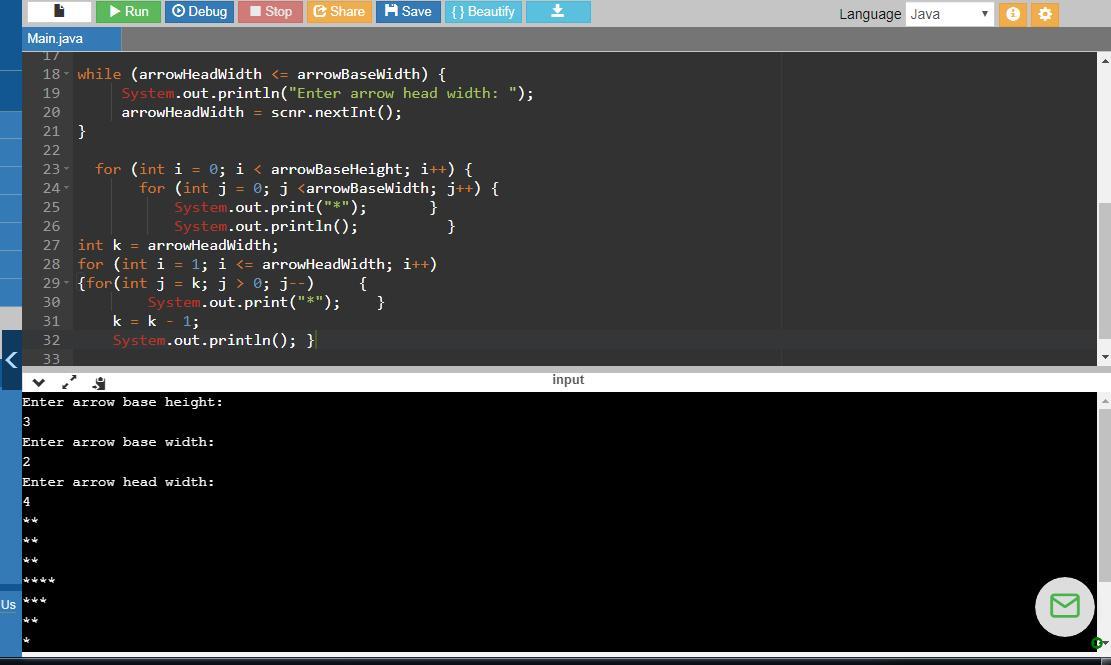
The screenshot of output is attached.

3 0
2 years ago
Methane and oxygen react in the presence of a catalyst to form formaldehyde. In a parallel reaction, methane is oxidized to carb
Nezavi [6.7K]

Answer:

y_{CH_4}^2=\frac{5mol/s}{100mol/s}=0.05\\y_{O_2}^2=\frac{3mol/s}{100mol/s}=0.03\\y_{H_2O}^2=\frac{47mol/s}{100mol/s}=0.47\\y_{HCHO}^2=\frac{43mol/s}{100mol/s}=0.43\\y_{CO_2}^2=\frac{2mol/s}{100mol/s}=0.02

Explanation:

Hello,

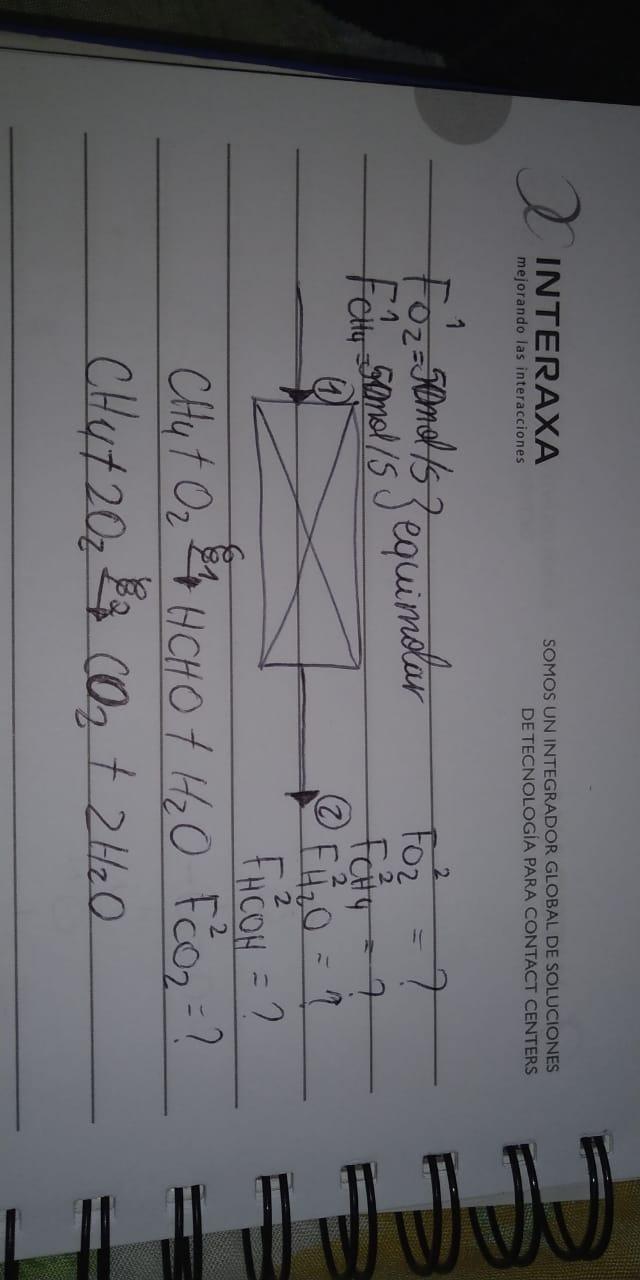
a. On the attached document, you can see a brief scheme of the process. Thus, to know the degrees of freedom, we state the following unknowns:

- \xi_1 and \xi_2: extent of the reactions (2).

- F_{O_2}^2, F_{CH_4}^2, F_{H_2O}^2, F_{HCHO}^2 and F_{CO_2}^2: Molar flows at the second stream (5).

On the other hand, we've got the following equations:

- F_{O_2}^2=50mol/s-\xi_1-2\xi_2: oxygen mole balance.

- F_{CH_4}^2=50mol/s-\xi_1-\xi_2: methane mole balance.

- F_{H_2O}^2=\xi_1+2\xi_2: water mole balance.

- F_{HCHO}^2=\xi_1: formaldehyde mole balance.

- F_{CO_2}^2=\xi_2: carbon dioxide mole balance.

Thus, the degrees of freedom are:

DF=7unknowns-5equations=2

It means that we need two additional equations or data to solve the problem.

b. Here, the two missing data are given. For the fractional conversion of methane, we define:

0.900=\frac{\xi_1+\xi_2}{50mol/s}

And for the fractional yield of formaldehyde we can set it in terms of methane as the reagents are equimolar:

0.860=\frac{F_{HCHO}^2}{50mol/s}

In such a way, one realizes that the output formaldehyde's molar flow is:

F_{HCHO}^2=0.860*50mol/s=43mol/s

Which is equal to the first reaction extent \xi_1, therefore, one computes the second one from the fractional conversion of methane as:

\xi_2=0.900*50mol/s-\xi_1\\\xi_2=0.900*50mol/s-43mol/s\\\xi_2=2mol/s

Now, one computes the rest of the output flows via:

- F_{O_2}^2=50mol/s-43mol/s-2*2mol/s=3mol/s

- F_{CH_4}^2=50mol/s-43mol/s-2mol/s=5mol/s

- F_{H_2O}^2=43mol/s+2*2mol/s=47mol/s

- F_{HCHO}^2=43mol/s

- F_{CO_2}^2=2mol/s

The total output molar flow is:

F_{O_2}+F_{CH_4}+F_{H_2O}+F_{HCHO}+F_{CO_2}=100mol/s

Therefore the output stream composition turns out into:

y_{CH_4}^2=\frac{5mol/s}{100mol/s}=0.05\\y_{O_2}^2=\frac{3mol/s}{100mol/s}=0.03\\y_{H_2O}^2=\frac{47mol/s}{100mol/s}=0.47\\y_{HCHO}^2=\frac{43mol/s}{100mol/s}=0.43\\y_{CO_2}^2=\frac{2mol/s}{100mol/s}=0.02

Best regards.

7 0
2 years ago
A shopaholic has to buy a pair of jeans , a pair of shoes l,a skirt and a top with budgeted dollar.Given the quantity of each pr
fredd [130]

Answer:

you might be facing some difficulty in observing this point of division between your question and me

0 0
2 years ago
Other questions:
  • A steel rotating-beam test specimen has an ultimate strength Sut of 1600 MPa. Estimate the life (N) of the specimen if it is tes
    8·1 answer
  • 5. A typical paper clip weighs 0.59 g and consists of BCC iron. Calculate (a) the number of
    5·1 answer
  • The rigid bar CDE is attached to a pin support at E and rests on the 30 mm diameter brass cylinder BD. A 22 mm diameter steel ro
    8·1 answer
  • An uninsulated, thin-walled pipe of 100-mm diameter is used to transport water to equipment that operates outdoors and uses the
    9·1 answer
  • Sea water with a density of 1025 kg/m3 flows steadily through a pump at 0.21 m3 /s. The pump inlet is 0.25 m in diameter. At the
    8·1 answer
  • The Gill Art Gallery wishes to maintain data on their customers, artists and paintings. They may have several paintings by each
    7·1 answer
  • Water (cp = 4180 J/kg·°C) enters the 2.5 cm internal diameter tube of a double-pipe counter-flow heat exchanger at 17°C at a rat
    7·1 answer
  • Consider a steady developing laminar flow of water in a constant-diameter horizontal discharge pipe attached to a tank. The flui
    14·1 answer
  • what is the advantage of decreasing the field current of a separately excited dc motor below its nominal value
    7·1 answer
  • Problema sobre programacion orientada a objetos!!
    14·1 answer
Add answer
Login
Not registered? Fast signup
Signup
Login Signup
Ask question!