answer.
Ask question
Login Signup
Ask question
All categories
  • English
  • Mathematics
  • Social Studies
  • Business
  • History
  • Health
  • Geography
  • Biology
  • Physics
  • Chemistry
  • Computers and Technology
  • Arts
  • World Languages
  • Spanish
  • French
  • German
  • Advanced Placement (AP)
  • SAT
  • Medicine
  • Law
  • Engineering
ddd [48]
2 years ago
10

Refrigerant-134a enters a diffuser steadily as saturated vapor at 600 kPa with a velocity of 160 m/s, and it leaves at 700 kPa a

nd 40∘C. The refrigerant is gaining heat at a rate of 2 kJ/s as it passes through the diffuser. If the exit area is 80 percent greater than the inlet area, determine (a) the exit velocity and (b) the mass flow rate of the refrigerant.

Engineering
2 answers:
Zina [86]2 years ago
4 0

Answer:

a) V_2 = 82.1 m/s

b) m = 0.298 Kg/s

Explanation:

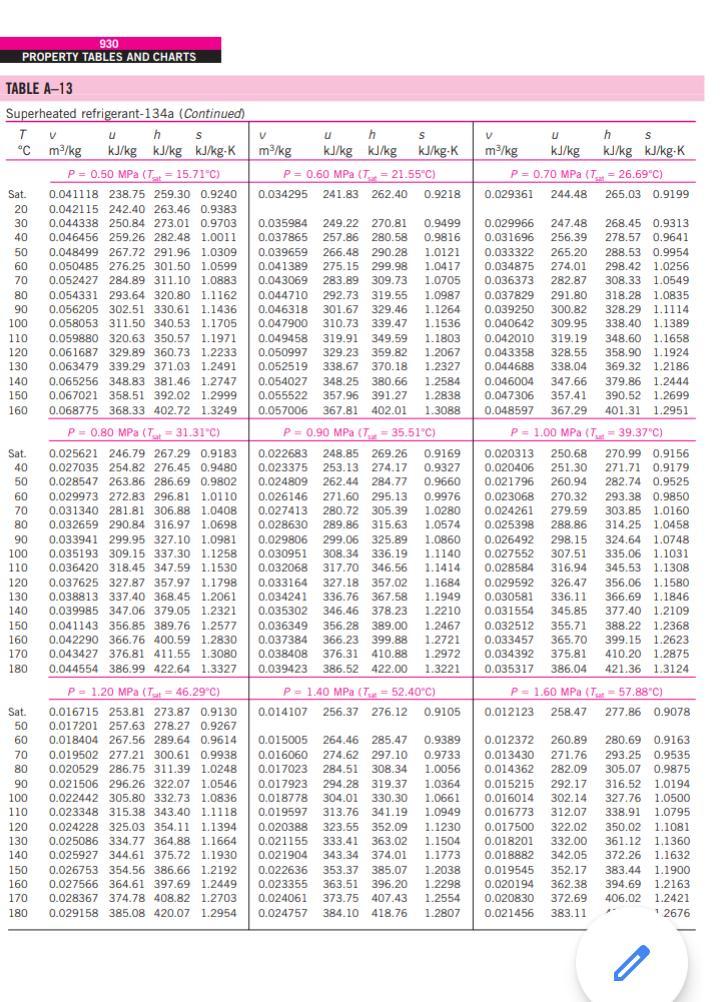
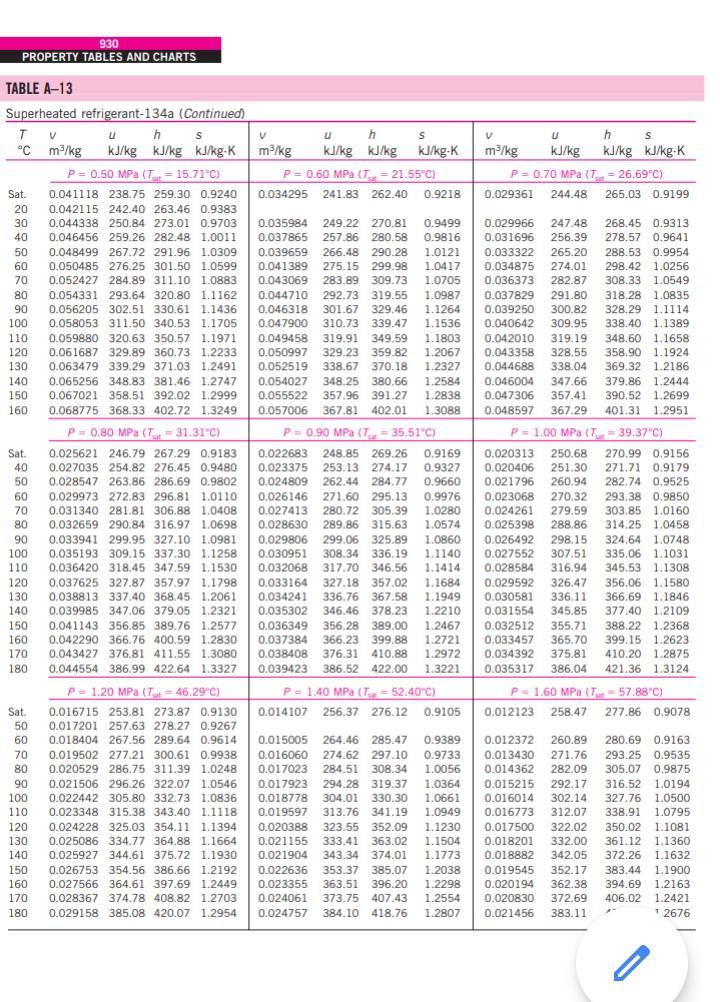
from A-11 to A-13 we have the following data

P_1 = 600 kpa

V_1 = 0.033925 m^3/kg

h_1 = 262.52 kJ/kg

P_2 = 700 kpa

V_2 = 0.0313 m^3/kg

T_2 = 40°C = 313K

h_2 = 278.66 kJ/kg

Now, from the conversation of mass,

A_2*V_2/u_2 = A_1*V_1/u_1

V_2 = A_1/A_2*u_2/u_1*V_1

V_2 = A_1/1.8*A_1 * 0.0313 /0.033925*160

V_2 = 82.1 m/s

now from the energy balance equation

E_in = E_out

Q_in + m(h_1 + V_1^2/2) =  m(h_2 + V_2^2/2)

m = 0.298 Kg/s

grin007 [14]2 years ago
4 0

Answer:

A) V2 = 82.1 m/s

B) m' = 0.298 kg/s

Explanation:

A) From the tables attached,

At P1 = 600 KPa, we have specific volume and specific enthalpy as;

v1 = 0.033925 m³/kg

And h1 = 262.52 Kj/kg or 262520 J/kg

Also at P2 = 700 KPa, and T2 = 40°C = 313K, we have specific volume and specific enthalpy as ;

v2 = 0.03133 m³/kg and h2 = 278.66 Kj/kg or 278660 J/kg

From conservation of mass, we know that;

A1V1/v1 = A2V2/v2

So, making V2 the subject, we have;

(A1V1v2)/(v1A2) = V2

Now, from the question, the exit area (A2) is 80% greater than the inlet Area (A1). Thus, A2 = A1 + 0.8A1 = 1.8A1

So,

(A1V1v2)/(v1 x 1.8 xA1) = V2

So, A1 will cancel out to give;

(V1v2)/(v1 x 1.8) = V2

Plugging in relevant values;

(160 x 0.0313)/(0.033925 x 1.8) = 82.1 m/s

B) From energy balance, we know that;

E'in = E'out

Thus,

Q'in + m'(h1 + (v1²/2)) = m'(h2 + (v2²/2))

From the question, Q'in = 2kj = 2000J

Thus;

2000 + m'(262520 + (160²/2)) = m'(278660 + (82.1²/2))

So,

2000 + 275320m' = 282030 m'

m'(282030 - 275320) = 2000

m' = 2000/6710 = 0.298 kg/s
You might be interested in
Water at 200C flows through a pipe of 10 mm diameter pipe at 1 m/s. Is the flow Turbulent ? a. Yes b. No
Degger [83]

Answer:

Yes, the flow is turbulent.

Explanation:

Reynolds number gives the nature of flow. If he Reynolds number is less than 2000 then the flow is laminar else turbulent.

Given:

Diameter of pipe is 10mm.

Velocity of the pipe is 1m/s.

Temperature of water is 200°C.

The kinematic viscosity at temperature 200°C is 1.557\times10^{-7}m2/s.

Calculation:

Step1

Expression for Reynolds number is given as follows:

Re=\frac{vd}{\nu}

Here, v is velocity, \nu is kinematic viscosity, d is diameter and Re is Reynolds number.

Substitute the values in the above equation as follows:

Re=\frac{vd}{\nu}

Re=\frac{1\times(10mm)(\frac{1m}{1000mm})}{1.557\times10^{-7}}

Re=64226.07579

Thus, the Reynolds number is 64226.07579. This is greater than 2000.

Hence, the given flow is turbulent flow.

5 0
2 years ago
A liquid with a specific gravity of 2.6 and a viscosity of 2.0 cP flows through a smooth pipe of unknown diameter, resulting in
sasho [114]
.......,.,.,.,.,.,,.,.,,.,.,.,.,.,.,.,,.,.,,.,,,.,,.,,.,.,.,.,,............,,,,,,’mmdjidvdhxxkf jkkk he in d
6 0
2 years ago
Radioactive wastes are temporarily stored in a spherical container, the center of which is buried a distance of 10 m below the e
puteri [66]

Given:

outer radius, R' = 10 m

inner diameter, d = 2 m

inner radius, R = \frac{d}{2} = 1 m

surface temperature, T' = 20^{\circ}C

Thermal conductivity of soil, K = 0.52 W/mK

Solution:

To calculate the thermal temperature of conductor, T, we know amount of heat, Q is given by :

Q =  \frac{T - T'}{\frac{R' - R}{4\pi KRR'}}

500 =  (T - 20)\frac{4\pi \times0.52\times 1\times 10}{10 - 1}

T = 68.86 +20 = 88.865^{\circ}C  

Therefore, outside surface temperature is 88.865^{\circ}C  

4 0
2 years ago
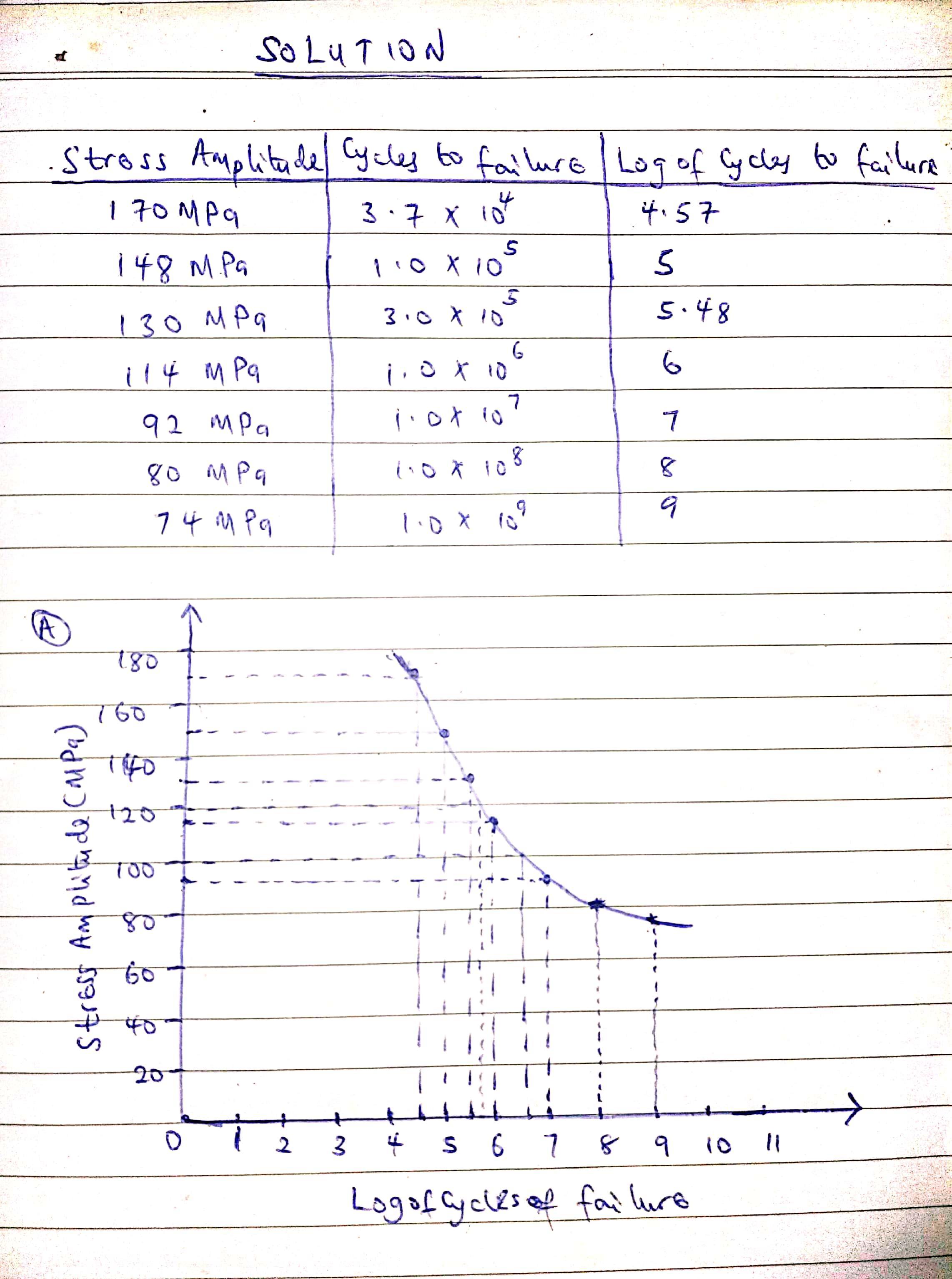
The fatigue data for a brass alloy are given as follows: Stress Amplitude (MPa) Cycles to Failure 170 3.7 × 10⁴ 148 1.0 × 10⁵ 13
prohojiy [21]

Answer:

i) S–N plot is attached

ii) fatigue strength = 100 MPa

iii) fatigue life = 5.62 x 10^(5) cycles

Explanation:

i) I have attached the S–N plot (stress amplitude versus logarithm of cycles to failure)

ii) The question says we should find the fatigue strength at 4 × 10^(6) cycles.

So let's find the log of this and trace it on the graph attached.

Log(4 × 10^(6)) = 6.6

From the graph attached, at log of cycle value of 6.6, the fatigue strength is approximately 100 MPa

iii) The question says we should find the fatigue life for 120 MPa.

Thus, from the graph, at stress amplitude of 120 MPa, the log of cycles is approximately 5.75.

Thus,the fatigue life will be the inverse log of 5.75.

Thus, fatigue life = 10^(5.75)

Fatigue life = 5.62 x 10^(5)

8 0
2 years ago
The emissivity of galvanized steel sheet, a common roofing material, is ε = 0.13 at temperatures around 300 K, while its absorpt
Step2247 [10]

Answer:

759.99W/m²

Explanation:

Question: If the temperature of the sheet is 77C,what is the incident solar radiation on aday with Tinf= Tsurr= 16°C?

Given

Energy Equation of the Gas

αs * Gs * A + h * A * (T inf - Tg) + εσA (Tsurr⁴- Tg⁴) = 0

Where σ= 5.67 *10^-8 W/m²K⁴ (Stefan-Boltzmann constant)

ε = 0.13 (Emisivity)

αs = 0.65 (Absorptivity for solar radiation)

h = 7W/m²K⁴

Tg = 77 + 273.15K = 350.15K

T inf = 16 + 273.15 = 288.15K

T surr= T inf = 288.15

Substitute the above values in the Gas Equation, we have

0.65 * Gs * A + 7 * A * (288.15 - 350.15) + 0.13 * 5.67 * 10^-8 * A * (288.15⁴ - 350.15⁴) = 0

0.65 * Gs * A = - 7 * A * (288.15 - 350.15) - 0.13 * 5.67 * 10^-8 * A * (288.15⁴ - 350.15⁴)

A cancels out, so we are left with

0.65 * Gs = - 7 * (288.15 - 350.15) - 0.13 * 5.67 * 10^-8 * (288.15⁴ - 350.15⁴)

0.65Gs = 434 - 0.7372 * 10^-8(−8,137,940,481.697)

0.65Gs = 434 + 0.7372 * 81.37940481697

0.65Gs = 493.992897231070284

Gs = 493.992897231070284/0.65

Gs = 759.9890726631850

Gs = 759.99W/m² ------- Approximated

3 0
2 years ago
Other questions:
  • Gina is about to use a fire extinguisher on a small fire. What factor determines the type of extinguisher she should use
    9·2 answers
  • A pitfall cited in Section 1.10 is expecting to improve the overall performance of a computer by improving only one aspect of th
    6·1 answer
  • The basic barometer can be used to measure the height of a building. If the barometric readings at the top and the bottom of a b
    15·1 answer
  • An aircraft component is fabricated from an aluminum alloy that has a plane-strain fracture toughness of 40 MPa1m (36.4 ksi1in.)
    15·1 answer
  • The critical resolved shear stress for iron is 27 MPa (4000 psi). Determine the maximum possible yield strength for a single cry
    12·1 answer
  • The atomic radii of a divalent cation and a monovalent anion are 0.77 nm and 0.136 nm, respectively.1- Calculate the force of at
    11·1 answer
  • In this module you learned about searching, sorting and algorithms in C++ and how to implement these elements in your C++ progra
    6·1 answer
  • Refrigerant-134a is compressed from 2 bar, saturated vapor, to 10 bar, 90o C in a compressor operating at steady state. The mass
    11·1 answer
  • Anytime scaffolds are assembled or __________, a competent person must oversee the operation.
    15·2 answers
  • The u velocity component of a steady, two-dimensional, incompressible flow field is u = 3 ax 2 - 2 bxy, where a and b are consta
    6·1 answer
Add answer
Login
Not registered? Fast signup
Signup
Login Signup
Ask question!