answer.
Ask question
Login Signup
Ask question
All categories
  • English
  • Mathematics
  • Social Studies
  • Business
  • History
  • Health
  • Geography
  • Biology
  • Physics
  • Chemistry
  • Computers and Technology
  • Arts
  • World Languages
  • Spanish
  • French
  • German
  • Advanced Placement (AP)
  • SAT
  • Medicine
  • Law
  • Engineering
Alex787 [66]
2 years ago
9

Gina is about to use a fire extinguisher on a small fire. What factor determines the type of extinguisher she should use

Engineering
2 answers:
amm18122 years ago
8 0

There’s 5 different types of fire extinguishers that you can differentiate by their color codes.

Red - Water based

Creme - Foam based

Blue - Powder based

Black - CO2 or carbon dioxide based

Yellow - Wet chemical based

What would determine the type of fire extinguisher used would be the class of fire it is.

Class A - Combustible materials ( i.e. paper, wood) Extinguishers to use - Red, Creme, Blue, and Yellow. (Do not use Black)

Class B - Flammable liquids ( i.e. paint, petrol, alcohol) Extinguishers to use - Creme, Blue, and Black. (Do not use Red or Yellow)

Class C - Flammable gases ( i.e. butane, methane) Extinguishers to use - Blue (Do not use Red, Creme, Black or Yellow)

Class D - Flammable metals ( i.e. lithium, potassium) Extinguishers to use - Blue (Do not use Red, Creme, Black or Yellow)

Class F - Deep fat fryers ( i.e. chip pans) Extinguishers to use - Yellow (Do not use Red, Creme, Blue or Black)

Electrical - any sort of electrical equipment

( i.e. computers, generators) Extinguishers to use - Blue and Black (Do not use Red, Creme or Yellow)

Cerrena [4.2K]2 years ago
3 0
There’s 5 different types of fire extinguishers that you can differentiate by their color codes.
Red - Water based
Creme - Foam based
Blue - Powder based
Black - CO2 or carbon dioxide based
Yellow - Wet chemical based

What would determine the type of fire extinguisher used would be the class of fire it is.

Class A - Combustible materials ( i.e. paper, wood) Extinguishers to use - Red, Creme, Blue, and Yellow. (Do not use Black)


Class B - Flammable liquids ( i.e. paint, petrol, alcohol) Extinguishers to use - Creme, Blue, and Black. (Do not use Red or Yellow)

Class C - Flammable gases ( i.e. butane, methane) Extinguishers to use - Blue (Do not use Red, Creme, Black or Yellow)

Class D - Flammable metals ( i.e. lithium, potassium) Extinguishers to use - Blue (Do not use Red, Creme, Black or Yellow)

Class F - Deep fat fryers ( i.e. chip pans) Extinguishers to use - Yellow (Do not use Red, Creme, Blue or Black)

Electrical - any sort of electrical equipment
( i.e. computers, generators) Extinguishers to use - Blue and Black (Do not use Red, Creme or Yellow)
You might be interested in
1. A glass window of width W = 1 m and height H = 2 m is 5 mm thick and has a thermal conductivity of kg = 1.4 W/m*K. If the inn
emmasim [6.3K]

Answer:

1. \dot Q=19600\ W

2. \dot Q=120\ W

Explanation:

1.

Given:

  • height of the window pane, h=2\ m
  • width of the window pane, w=1\ m
  • thickness of the pane, t=5\ mm= 0.005\ m
  • thermal conductivity of the glass pane, k_g=1.4\ W.m^{-1}.K^{-1}
  • temperature of the inner surface, T_i=15^{\circ}C
  • temperature of the outer surface, T_o=-20^{\circ}C

<u>According to the Fourier's law the rate of heat transfer is given as:</u>

\dot Q=k_g.A.\frac{dT}{dx}

here:

A = area through which the heat transfer occurs = 2\times 1=2\ m^2

dT = temperature difference across the thickness of the surface = 35^{\circ}C

dx = t = thickness normal to the surface = 0.005\ m

\dot Q=1.4\times 2\times \frac{35}{0.005}

\dot Q=19600\ W

2.

  • air spacing between two glass panes, dx=0.01\ m
  • area of each glass pane, A=2\times 1=2\ m^2
  • thermal conductivity of air, k_a=0.024\ W.m^{-1}.K^{-1}
  • temperature difference between the surfaces, dT=25^{\circ}C

<u>Assuming layered transfer of heat through the air and the air between the glasses is always still:</u>

\dot Q=k_a.A.\frac{dT}{dx}

\dot Q=0.024\times 2\times \frac{25}{0.01}

\dot Q=120\ W

5 0
2 years ago
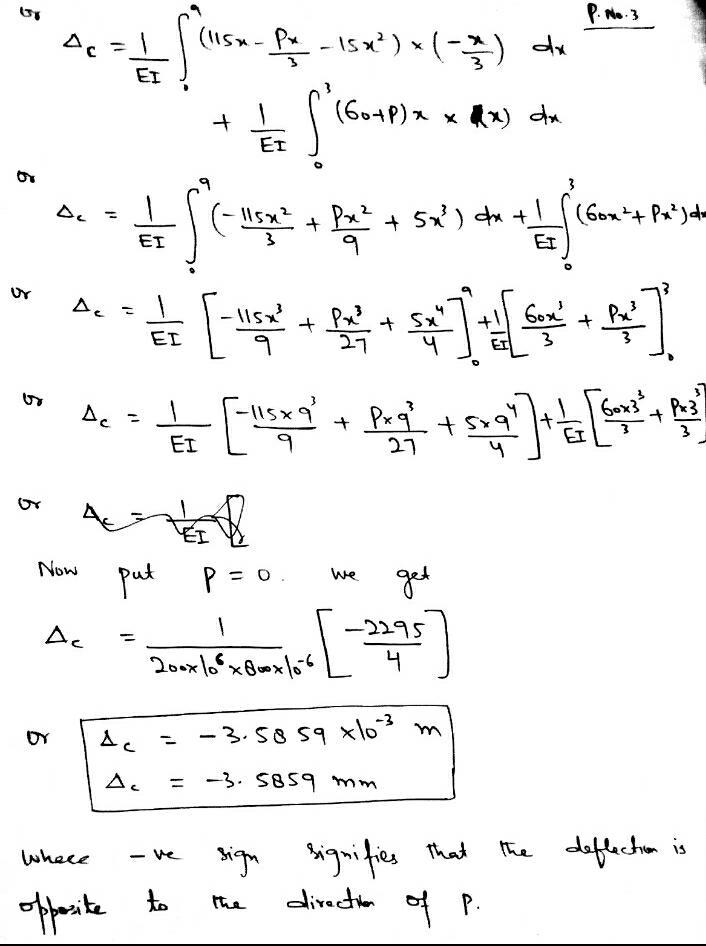
Determine the deflection at the center of the beam. Express your answer in terms of some or all of the variables LLL, EEE, III,
Rom4ik [11]

Answer:

See explanations for step by step procedures to get answer.

Explanation:

Given that;

Determine the deflection at the center of the beam. Express your answer in terms of some or all of the variables LLL, EEE, III, and M0M0M_0. Enter positive value if the deflection is upward and negative value if the deflection is downward.

4 0
2 years ago
A 20 mm 3 20 mm silicon chip is mounted such thatthe edges are flush in a substrate. The substrate provides anunheated starting
sasho [114]

Answer:

q= 1.77 W

Explanation:

Given data, Dimensions = 20mm x 20mm, Unheated starting length (ε) = 20 mm, Air flow temperature = 25 C, Velocity of flow = 25m/s, Surface Temperature = 75 C

To find maximum allowed power dissipated use the formula Q = hA(ΔT), where Q = Maximum allowed power dissipated from surface , h = heat transfer coefficiant, A = Area of Surface, ΔT = Temperature difference between surface and surrounding

we need to find h, which is given by (Nu x K)/x, where Nu is the Nusselt's Number, k is the thermal conductivity at film temperature and x is the length of the substrate.

For Nu use the Churchill and Ozoe relation used for parallel flow over the flat plate , Nu = (Nux (ε=0))/[1-(ε/x)^3/4]^1/3

Nux (ε=0) = 0.453 x Re^0.5 x Pr^1/3, where Re is the Reynolds number calculated by [Rex = Vx/v, where V is the velocity and v is the kinematic velocity, x being the length of the substrate] and Pr being the Prandtl Number

The constants, namel Pr, k and v are temperature dependent, so we need to find the film temperature

Tfilm = (Tsubstrate + Tmax)/2 = (25 + 75)/2 = 50 C

At 50 C, Pr = 0.7228, k = 0.02735w/m.k , v = 1.798 x 10^-5 m2/s

First find Rex and keep using the value in the subsequent formulas until we reach Q

Rex = Vx/v = 25 x (0.02 + 0.02)/ 1.798 x 10^-5  = 55617.35 < 5 x 10^5, thus flow is laminar, (x = L + ε)

Nux = (Nux (ε=0))/[1-(ε/x)^3/4]^1/3 = 0.453 x Re^0.5 x Pr^1/3/[1-(ε/x)^3/4]^1/3

= 0.453 x 55617.35 ^0.5 x 0.7228^1/3/ [1 - (0.02/0.04)^3/4]^1/3 = 129.54

h = (Nu x K)/x = (129.54 x 0.02735)/0.04 = 88.75W/m2.k

Q = 88.75 x (0.02)^2 x (75-25) = 1.77 W

7 0
2 years ago
Finally you will implement the full Pegasos algorithm. You will be given the same feature matrix and labels array as you were gi
Diano4ka-milaya [45]

Answer:

In[7] def pegasos(feature_matrix, labels, T, L):

   """

   .

   let learning rate = 1/sqrt(t),

   where t is a counter for the number of updates performed so far       (between 1   and nT inclusive).

Args:

       feature_matrix - A numpy matrix describing the given data. Each row

           represents a single data point.

       labels - A numpy array where the kth element of the array is the

           correct classification of the kth row of the feature matrix.

       T -  the maximum number of times that you should iterate through the feature matrix before terminating the algorithm.

       L - The lamba valueto update the pegasos

   Returns: Is defined as a  tuple in which the first element is the final value of θ and the second element is the value of θ0

   """

   (nsamples, nfeatures) = feature_matrix.shape

   theta = np.zeros(nfeatures)

   theta_0 = 0

   count = 0

   for t in range(T):

       for i in get_order(nsamples):

           count += 1

           eta = 1.0 / np.sqrt(count)

           (theta, theta_0) = pegasos_single_step_update(

               feature_matrix[i], labels[i], L, eta, theta, theta_0)

   return (theta, theta_0)

In[7] (np.array([1-1/np.sqrt(2), 1-1/np.sqrt(2)]), 1)

Out[7] (array([0.29289322, 0.29289322]), 1)

In[8] feature_matrix = np.array([[1, 1], [1, 1]])

   labels = np.array([1, 1])

   T = 1

   L = 1

   exp_res = (np.array([1-1/np.sqrt(2), 1-1/np.sqrt(2)]), 1)


   pegasos(feature_matrix, labels, T, L)

Out[8] (array([0.29289322, 0.29289322]), 1.0)

Explanation:

In[7] def pegasos(feature_matrix, labels, T, L):

   """

   .

   let learning rate = 1/sqrt(t),

   where t is a counter for the number of updates performed so far       (between 1   and nT inclusive).

Args:

       feature_matrix - A numpy matrix describing the given data. Each row

           represents a single data point.

       labels - A numpy array where the kth element of the array is the

           correct classification of the kth row of the feature matrix.

       T -  the maximum number of times that you should iterate through the feature matrix before terminating the algorithm.

       L - The lamba valueto update the pegasos

   Returns: Is defined as a  tuple in which the first element is the final value of θ and the second element is the value of θ0

   """

   (nsamples, nfeatures) = feature_matrix.shape

   theta = np.zeros(nfeatures)

   theta_0 = 0

   count = 0

   for t in range(T):

       for i in get_order(nsamples):

           count += 1

           eta = 1.0 / np.sqrt(count)

           (theta, theta_0) = pegasos_single_step_update(

               feature_matrix[i], labels[i], L, eta, theta, theta_0)

   return (theta, theta_0)

In[7] (np.array([1-1/np.sqrt(2), 1-1/np.sqrt(2)]), 1)

Out[7] (array([0.29289322, 0.29289322]), 1)

In[8] feature_matrix = np.array([[1, 1], [1, 1]])

   labels = np.array([1, 1])

   T = 1

   L = 1

   exp_res = (np.array([1-1/np.sqrt(2), 1-1/np.sqrt(2)]), 1)


   pegasos(feature_matrix, labels, T, L)

Out[8] (array([0.29289322, 0.29289322]), 1.0)

6 0
2 years ago
1. Mark ‘N’ if a wrong type of units is used. Mark ‘Y’ otherwise. (1 point each)
maxonik [38]

Answer:

bsbsdbsd

Explanation:

7 0
2 years ago
Other questions:
  • The hot water needs of an office are met by heating tab water by a heat pump from 16 C to 50 C at an average rate of 0.2 kg/min.
    5·1 answer
  • 3. (20 points) Suppose we wish to search a linked list of length n, where each element contains a key k along with a hash value
    7·1 answer
  • Suppose that a class CalendarDate has been defined for storing a calendar date with month, day and year components. (In our sect
    6·1 answer
  • The Hamming encoder/decoder in the lecture detected and corrected one error bit. By adding a thirteen bit which is the exclusive
    13·1 answer
  • The mass fractions of a mixture of gases are 15 percent nitrogen, 5 percent helium, 60 percent methane, and 20 percent ethane. T
    9·1 answer
  • A mixture of air and methane is formed in the inlet manifold of a natural gas-fueled internal combustion engine. The mole fracti
    14·1 answer
  • An ideal Diesel cycle has a compression ratio of 18 and a cutoff ratio of 1.5. Determine the maximum air temperature and the rat
    9·1 answer
  • Draw an ERD for each of the following situations. (If you believe that you need to make additional assumptions, clearly state th
    15·1 answer
  • Chapter 19: Diesel Engine Operation and Diagnosis -Chapter Quiz
    5·1 answer
  • 1. A _____ is applied to a wall or roof rafters to add strength and keep the building straight and plumb.
    9·1 answer
Add answer
Login
Not registered? Fast signup
Signup
Login Signup
Ask question!