answer.
Ask question
Login Signup
Ask question
All categories
  • English
  • Mathematics
  • Social Studies
  • Business
  • History
  • Health
  • Geography
  • Biology
  • Physics
  • Chemistry
  • Computers and Technology
  • Arts
  • World Languages
  • Spanish
  • French
  • German
  • Advanced Placement (AP)
  • SAT
  • Medicine
  • Law
  • Engineering
bekas [8.4K]
2 years ago
5

The hot water needs of an office are met by heating tab water by a heat pump from 16 C to 50 C at an average rate of 0.2 kg/min.

If the COP of this heat pump is 2.8, the required power input is: (a) 1.33 kW (d) 10.2 kW (b) 0.17 kW (c) 0.041 kW
Engineering
1 answer:
Alex777 [14]2 years ago
7 0

Answer:

option B

Explanation:

given,

heating tap water from 16° C to 50° C

at the average rate of 0.2 kg/min

the COP of this heat pump is 2.8

power output = ?

COP = \dfrac{Q_H}{W_{in}}\\W_{in} = \dfrac{Q_H}{COP}\\W_{in} = \dfrac{\dfrac{0.2}{60}\times 4.18\times (50-16)}{2.8}\\W_{in} = 0.169

the required power input is 0.169 kW or 0.17 kW

hence, the correct answer is option B

You might be interested in
The wall of drying oven is constructed by sandwiching insulation material of thermal conductivity k = 0.05 W/m°K between thin me
masha68 [24]

Answer:

86 mm

Explanation:

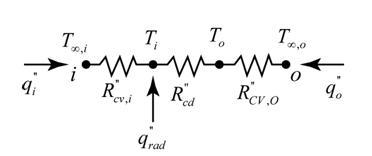
From the attached thermal circuit diagram, equation for i-nodes will be

\frac {T_ \infty, i-T_{i}}{ R^{"}_{cv, i}} + \frac {T_{o}-T_{i}}{ R^{"}_{cd}} + q_{rad} = 0 Equation 1

Similarly, the equation for outer node “o” will be

\frac {T_{ i}-T_{o}}{ R^{"}_{cd}} + \frac {T_{\infty, o} -T_{o}}{ R^{"}_{cv, o}} = 0 Equation 2

The conventive thermal resistance in i-node will be

R^{"}_{cv, i}= \frac {1}{h_{i}}= \frac {1}{30}= 0.033 m^{2}K/w Equation 3

The conventive hermal resistance per unit area is

R^{"}_{cv, o}= \frac {1}{h_{o}}= \frac {1}{10}= 0.100 m^{2}K/w Equation 4

The conductive thermal resistance per unit area is

R^{"}_{cd}= \frac {L}{K}= \frac {L}{0.05} m^{2}K/w Equation 5

Since q_{rad}  is given as 100, T_{o}  is 40 T_ \infty  is 300 T_{\infty, o}  is 25  

Substituting the values in equations 3,4 and 5 into equations 1 and 2 we obtain

\frac {300-T_{i}}{0.033} +\frac {40-T_{i}}{L/0.05} +100=0  Equation 6

\frac {T_{ i}-40}{L/0.05}+ \frac {25-40}{0.100}=0

T_{i}-40= \frac {L}{0.05}*150

T_{i}-40=3000L

T_{i}=3000L+40 Equation 7

From equation 6 we can substitute wherever there’s T_{i} with 3000L+40 as seen in equation 7 hence we obtain

\frac {300- (3000L+40)}{0.033} + \frac {40- (3000L+40)}{L/0.05}+100=0

The above can be simplified to be

\frac {260-3000L}{0.033}+ \frac {(-3000L)}{L/0.05}+100=0

\frac {260-3000L}{0.033}=50

-3000L=1.665-260

L= \frac {-258.33}{-3000}=0.086*10^{-3}m= 86mm

Therefore, insulation thickness is 86mm

8 0
2 years ago
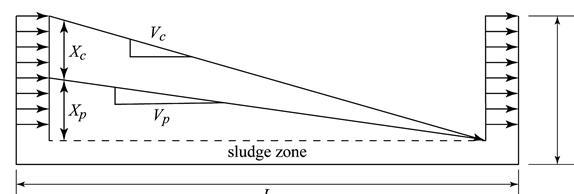
The rate of flow through an ideal clarifier is 8000m3 /d, the detention time is 1h and the depth is 3m. If a full-length movable
Fittoniya [83]

Answer:

a) 35%

b) yes it can be improved by moving the tray near the top

   Tray should be located ( 1 to 2 meters below surface )

   max removal efficiency ≈ 70%

c) The maximum removal will drop as the particle settling velocity = 0.5 m/h

Explanation:

Given data:

flow rate = 8000 m^3/d

Detention time = 1h

depth = 3m

Full length movable horizontal tray :  1m below surface

<u>a) Determine percent removal of particles having a settling velocity of 1m/h</u>

velocity of critical sized particle to be removed = Depth / Detention time

= 3 / 1 = 3m/h

The percent removal of particles having a settling velocity of 1m/h ≈ 35%

<u>b) Determine if  the removal efficiency of the clarifier can be improved by moving the tray, the location of the tray  and the maximum removal efficiency</u>

The tray should be located near the top of the tray ( i.e. 1 to 2 meters below surface ) because here the removal efficiency above the tray will be 100% but since the tank is quite small hence the

Total Maximum removal efficiency

=  percent removal_{above} + percent removal_{below}

= ( d_{a},v_{p} ) . \frac{d_{a} }{depth}  + ( d_{a},v_{p} ) . \frac{depth - d_{a} }{depth}  = 100

hence max removal efficiency ≈ 70%

<u>c) what is the effect of moving the tray would be if the particle settling velocity were equal to 0.5m/h?</u>

The maximum removal will drop as the particle settling velocity = 0.5 m/h

7 0
2 years ago
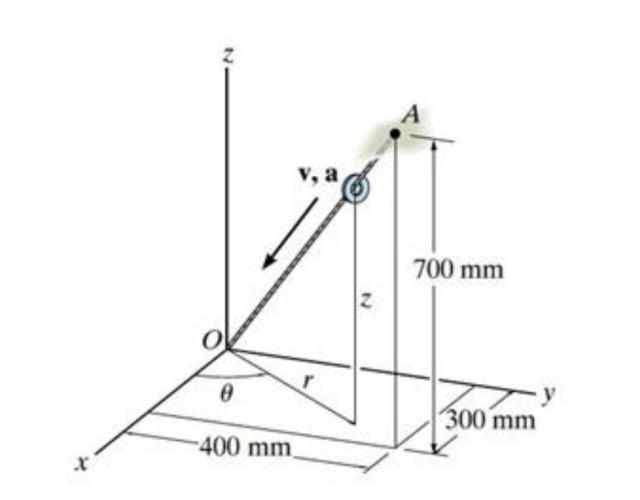
The small washer is sliding down the cord OA. When it is at the midpoint, its speed is 28 m/s and its acceleration is 7 m/s 2 .
Neporo4naja [7]

Answer:

Velocity components

V_r = -16.28 m/s

V_z = -22.8 m/s

V_q = 0 m/s

For Acceleration components;

a_r = -4.07m/s^2

a_z = -5.70m/s^2

a_q = 0m/s^2

Explanation:

We are given:

Speed v_o = 28 m/s

Acceleration a_o= 7 m/s^2

We first need to find the radial position r of washer in x-y plane.

Therefore

r = \sqrt{300^2 + 400^2}

r = 500 mm

To find length along direction OA we have:

L = \sqrt{500^2 + 700^2}L = 860 mm

Therefore, the radial and vertical components of velocity will be given as:

V_r = V_o*cos(Q)

V_z = V_o*sin(Q)

Where Q is the angle between OA and vector r.

Therefore,

V_r = 28 * \frac{r}{L} = > 28 * \frac{500}{860}

V_r = -16.28 m/s

• V_z = 28 * \frac{700}{860} = -22.8

• V_q = 0 m/s

The radial and vertical components of acceleration will be:

a_r = a_o*cos(Q)

a_z = a_o*sin(Q)

Therefore we have:

• a_r = 7* \frac{500}{860} = -4.07m/s^2

• a_z = 7 * \frac{700}{860} = -5.70 m/s^2

• a_q = 0 m/s^2

Note : image is missing, so I attached it

3 0
2 years ago
What properties should the head of a carpenter’s hammer possess? How would you manufacture a hammer head?
BabaBlast [244]

Properties of Carpenter's hammer possess

Explanation:

1.The head of a carpenter's hammer should possess the impact resistance, so that the chips do not peel off the striking face while working.

2.The hammer head should also be very hard, so that it does not deform while driving or eradicate any nails in wood.

3.Carpenter's hammer is used to impact smaller areas of an object.It can drive nails in the wood,can crush  the rock and shape the metal.It is not suitable for heavy work.

How hammer head is manufactured :

1.Hammer head is produced by metal forging process.

2.In this process metal is heated and this molten metal is placed in the cavities said to be dies.

3.One die is fixed and another die is movable.Ram forces the two dies under the forces which gives the metal desired shape.

4.The third process is repeated for several times.

5 0
2 years ago
What are the three most common metals used in die casting?
Anit [1.1K]

Answer:

Aluminium,Copper,Magnesium

Explanation:

The three most common metal of die casting are as follows

1.Aluminium

2.Copper

3.Magnesium

Die casting is the process in which metal is forced in the die to produces the desired casting product.Generally two type of machines are used like cold chamber and hot chamber machining,it depends on the metals.Die casting produces simple shape of casting ,it can not use for complex casting.

3 0
2 years ago
Other questions:
  • A_____ transducer is a device that can convert an electronic controller output signal into a standard pneumatic output. A. pneum
    13·1 answer
  • A petrol engine produces 20 hp using 35 kW of heat transfer from burning fuel. What is its thermal efficiency, and how much powe
    14·1 answer
  • 3. (20 points) Suppose we wish to search a linked list of length n, where each element contains a key k along with a hash value
    7·1 answer
  • A pitfall cited in Section 1.10 is expecting to improve the overall performance of a computer by improving only one aspect of th
    6·1 answer
  • Sea water with a density of 1025 kg/m3 flows steadily through a pump at 0.21 m3 /s. The pump inlet is 0.25 m in diameter. At the
    8·1 answer
  • The mass fractions of a mixture of gases are 15 percent nitrogen, 5 percent helium, 60 percent methane, and 20 percent ethane. T
    9·1 answer
  • Benzene vapor at 480°C is cooled and converted to a liquid at 25°C in a continuous condenser. The condensate is drained into 1.7
    15·1 answer
  • An ideal Stirling cycle filled with air uses a 75 F energy reservoir as a sink. The engine is designed to so that the maximum ai
    8·1 answer
  • What is the component called that usually has a dual-voltage selector switch and has cables that connect to the motherboard and
    15·1 answer
  • A surface grinding operation is used to finish a flat plate that is 5.50 in wide and 12.500 in long. The starting thickness is 1
    9·1 answer
Add answer
Login
Not registered? Fast signup
Signup
Login Signup
Ask question!