answer.
Ask question
Login Signup
Ask question
All categories
  • English
  • Mathematics
  • Social Studies
  • Business
  • History
  • Health
  • Geography
  • Biology
  • Physics
  • Chemistry
  • Computers and Technology
  • Arts
  • World Languages
  • Spanish
  • French
  • German
  • Advanced Placement (AP)
  • SAT
  • Medicine
  • Law
  • Engineering
SIZIF [17.4K]
2 years ago
15

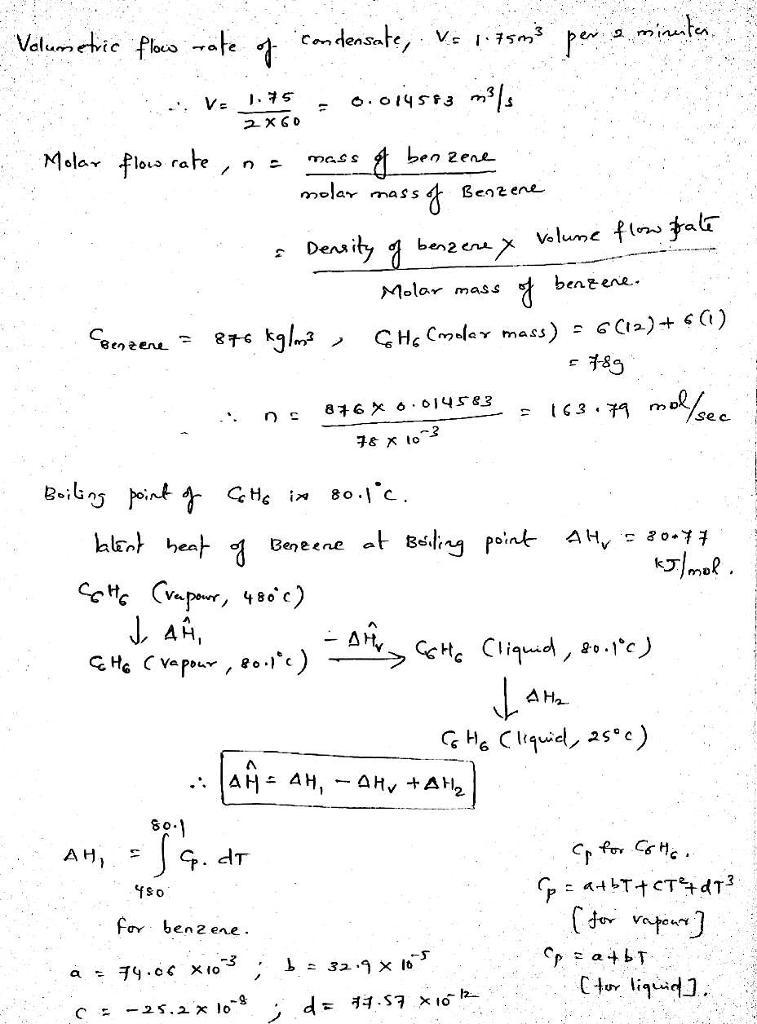
Benzene vapor at 480°C is cooled and converted to a liquid at 25°C in a continuous condenser. The condensate is drained into 1.7

5-m3 drums, each of which takes 2.0 minutes to fill. Calculate the rate (kW) at which heat is transferred from the benzene in the condenser.

Engineering
1 answer:
Serhud [2]2 years ago
5 0

Answer:

See explaination

Explanation:

Please kindly check attachment for the step by step solution of the given problem.

You might be interested in
A three-point bending test was performed on an aluminum oxide specimen having a circular cross section of radius 3.5 mm (0.14 in
RideAnS [48]

To resolve this problem we have,

R=3.5mm\\F_f1=950N\\L_1=50mm\\b=12mm\\L_2=40mm

F_{f2} is unknown.

With these dates we can calculate the Flexural strenght of the specimen,

\sigma{fs}=\frac{F_{f1}L}{\pi R^3}\\\sigma{fs}=\frac{(950)(50*10^{-3})}{\pi 3.5*10^{-3}}\\\sigma{fs}=352.65Mpa

After that, we can calculate the flexural strenght for the square cross section using the previously value.

\sigma{fs}=\frac{F_{f2}L}{\pi R^3}\\(352.65*10^6)=\frac{3Ff(40*10^{-3})}{2(12*10^{-10})}\\F_{f2}=\frac{352.65*10^6}{34722.22}\\F_{f2}=10156.32N\\F_{f2}=10.2kN

6 0
2 years ago
A cylindrical specimen of a brass alloy having a length of 60 mm (2.36 in.) must elongate only 10.8 mm (0.425 in.) when a tensil
Gemiola [76]

The radius of the specimen is 60 mm

<u>Explanation:</u>

Given-

Length, L = 60 mm

Elongated length, l = 10.8 mm

Load, F = 50,000 N

radius, r = ?

We are supposed to calculate the radius of a cylindrical brass specimen in order to produce an elongation of 10.8 mm when a load of 50,000 N is applied. It is necessary to compute the strain corresponding to this

elongation using Equation:

ε = Δl / l₀

ε = 10.8 / 60

ε = 0.18

We know,

σ = F / A

Where A = πr²

According to the stress-strain curve of brass alloy,

σ = 440 MPa

Thus,

sigma = 50,000 / \pi  (r)^2\\\\440 X 10^6 = \frac{50,000}{3.14 X (r)^2}\\\\r = 0.06m\\r = 60mm\\\\\\

Therefore, the radius of the specimen is 60 mm

3 0
2 years ago
If water molecules pass through a membrane with a steady state flux of 220 mole/(m2 day), how long will it take, in hours, for 0
goblinko [34]

Answer:

<em>0.0386 hr</em>

<em></em>

Explanation:

Area = 565 cm^2 = 0.0565 m^2  (1 cm^2 = 0.0001 m^2)

flux state rate = 220 mole/m^2-day

<em>There are 24 hrs in a day,</em> therefore rate in hrs will be

220/24 = 9.17 mole/m^2-hr

mass of water = 0.4 kg

molar mass of water = (1 x 2) + 16 = 18 kg/mole

therefore,

<em>mole of water = mass of water/molar mass of water</em>

mole of water = 0.4/18 = 0.02 mole

<em>mole flux = mole/area</em> = 0.02/0.0565 = 0.354 mol/m^2

<em>time that will be taken will be for water to pass = mole flux/mole flux rate</em>

time = 0.354/9.17 = <em>0.0386 hr</em>

7 0
2 years ago
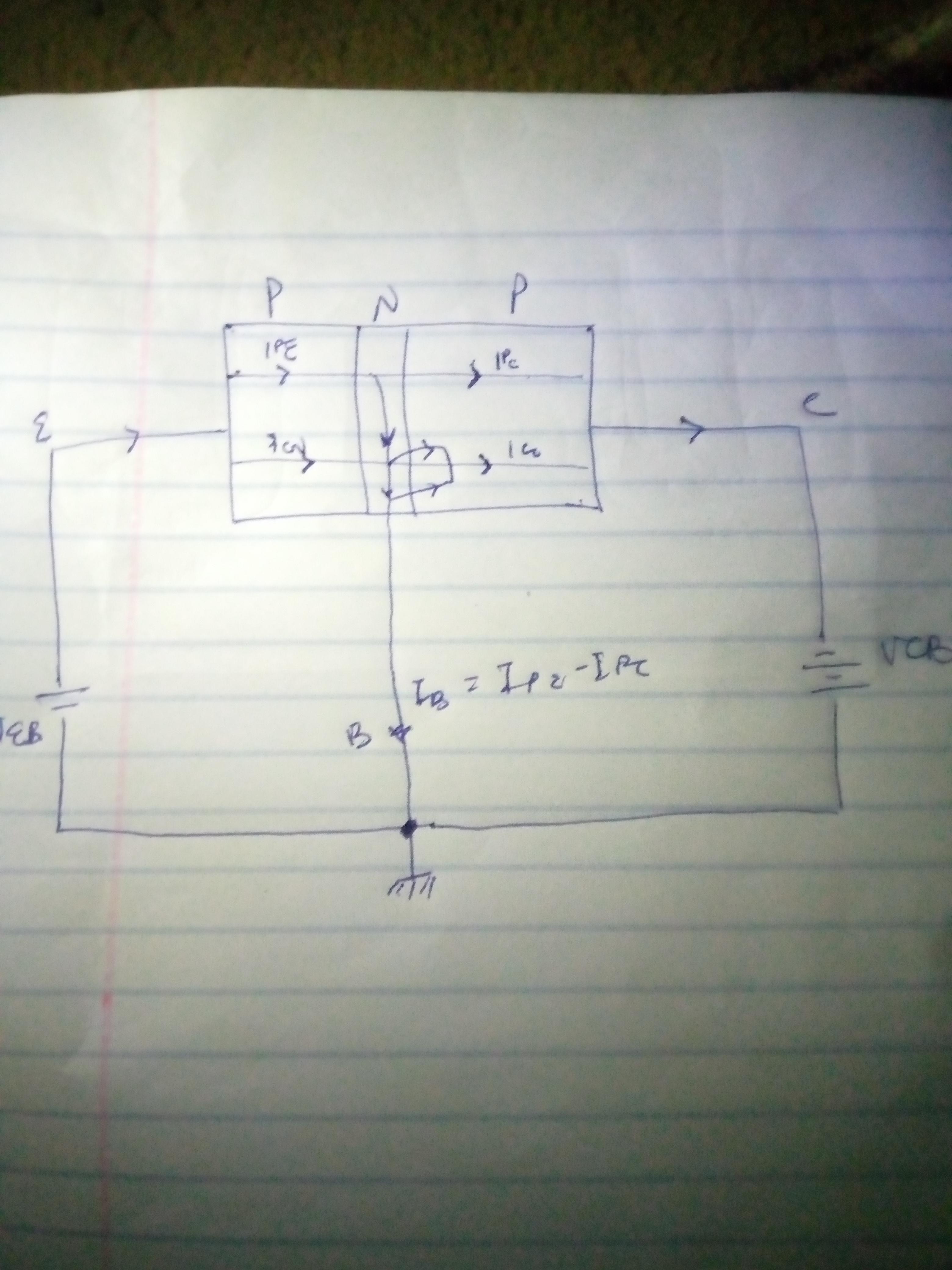
For a p-n-p BJT with NE 7 NB 7 NC, show the dominant current components, with proper arrows, for directions in the normal active
Sonja [21]

Answer:

=> base transport factor = 0.98.

=> emitter injection efficiency = 0.99.

=> common-base current gain = 0.97.

=> common-emitter current gain = 32.34.

=> ICBO = 1 × 10^-6 A.

=> base transit time = 0.325.

=> lifetime = 1.875.

Explanation:

(Kindly check the attachment for the diagram showing the dominant current components, with proper arrows, for directions in the normal active mode).

The following parameters or data are given for a p-n-p BJT with NE 7 NB 7 NC and they are: IEp = 10 mA, IEn = 100 mA, ICp = 9.8 mA, and ICn = 1 mA.

(1). The base transport factor = ICp/IEp=9.8/10 =  0.98.

(2). emitter injection efficiency =IEp/ IEp + ICn = 10/10 + 0.1 =  0.99.

(3).common-base current gain = 0.98 × 0.99 = 0.9702.

(4).common-emitter current gain =0.97 / 1- 0.97  = 32.34.

(5). Icbo = Ico = 1 × 10^-6 A.

(6). base transit time = 1248 × 10^-2 × (1.38× 10^-23/1.603 × 10^-19). = 0.325.

(7).lifetime;

= > 2 = √0.325 + √ lifetime.

= Lifetime = 2.875.
6 0
2 years ago
Twenty distinct cars park in the same parking lot every day. Ten of these cars are US-made, while the other ten are foreign-made
Zina [86]

Answer:

Total no. of ways to line up cars is 20! = 2.43 c 10^18

Probability that the cars alternate is 0.00001 or 0.001%

Explanation:

Since, the position of a car is random.Therefore, number ways in which cars can line up is given as:

<u>No. of ways = 20! = 2.43 x 10^18</u>

For the probability that cars alternate, two groups will be formed, one consisting of US-made 10 cars and other containing 10 foreign made. The number of favorable outcomes for this can be found out as the arrangements of 2! between these groups multiplied by the arrangements of 10! for each group, due to the arrangements among the groups themselves.

Favorable Outcomes = 2! x 10! x 10!

Thus the probability of event will be:

Probability = Favorable Outcomes/Total No. of Ways

Probability = (2! x 10! x 10!)/20!

<u>Probability = 0.00001 = 0.001%</u>

4 0
2 years ago
Other questions:
  • A hydrogen-filled balloon to be used in high altitude atmosphere studies will eventually be 100 ft in diameter. At 150,000 ft, t
    7·1 answer
  • A cylindrical drum (2 ft. dia ,3 ft height) is filled with a fluid whose density is 40 lb/ft^3. Determine (a. the total volume o
    10·1 answer
  • The pump of a water distribution system is powered by a 6-kW electric motor whose efficiency is 95 percent. The water flow rate
    5·1 answer
  • Outline an algorithm in **pseudo code** for checking whether an array H[1..n] is a heap and determine its time efficiency.
    6·1 answer
  • Compute the strain-hardening exponent (n) for an alloy in which a true stress of 415 MPa produces a true strain of 0.10; assume
    10·1 answer
  • Which statement concerning symbols used on plans is true?
    10·1 answer
  • The mass fractions of a mixture of gases are 15 percent nitrogen, 5 percent helium, 60 percent methane, and 20 percent ethane. T
    9·1 answer
  • The fatigue data for a brass alloy are given as follows: Stress Amplitude (MPa) Cycles to Failure 170 3.7 × 10⁴ 148 1.0 × 10⁵ 13
    9·1 answer
  • Which of the following describes boundaries?
    10·1 answer
  • A three-phase line has an impedance of 0.4 j2.7 ohms per phase. The line feeds two balanced three-phase loads that are connected
    9·1 answer
Add answer
Login
Not registered? Fast signup
Signup
Login Signup
Ask question!