answer.
Ask question
Login Signup
Ask question
All categories
  • English
  • Mathematics
  • Social Studies
  • Business
  • History
  • Health
  • Geography
  • Biology
  • Physics
  • Chemistry
  • Computers and Technology
  • Arts
  • World Languages
  • Spanish
  • French
  • German
  • Advanced Placement (AP)
  • SAT
  • Medicine
  • Law
  • Engineering
sdas [7]
2 years ago
9

A three-phase line has an impedance of 0.4 j2.7 ohms per phase. The line feeds two balanced three-phase loads that are connected

in parallel. The first load is absorbing 560.1kVA at 0.707 power factor lagging. The second load absorbs 132 kW at unity power factor. The line-to-line voltage at the load end of the line is 3810.5 volts. Determine: a. The magnitude of the line voltage at the source end of the line. b. Total real and reactive power loss in the line. c. Real power and reactive power supplied at the sending end of the line.
Engineering
1 answer:
Viktor [21]2 years ago
7 0

Answer:

a. The magnitude of the line source voltage is

Vs = 4160 V

b. Total real and reactive power loss in the line is

Ploss = 12 kW

Qloss = j81 kvar

Sloss = 12 + j81 kVA

c. Real power and reactive power supplied at the sending end of the line

Ss = 540.046 + j476.95 kVA

Ps = 540.046 kW

Qs = j476.95 kvar

Explanation:

a. The magnitude of the line voltage at the source end of the line.

The voltage at the source end of the line is given by

Vs = Vload + (Total current×Zline)

Complex power of first load:

S₁ = 560.1 < cos⁻¹(0.707)

S₁ = 560.1 < 45° kVA

Complex power of second load:

S₂ = P₂×1 (unity power factor)

S₂ = 132×1

S₂ = 132 kVA

S₂ = 132 < cos⁻¹(1)

S₂ = 132 < 0° kVA

Total Complex power of load is

S = S₁ + S₂

S = 560.1 < 45° + 132 < 0°

S = 660 < 36.87° kVA

Total current is

I = S*/(3×Vload)   ( * represents conjugate)

The phase voltage of load is

Vload = 3810.5/√3

Vload = 2200 V

I = 660 < -36.87°/(3×2200)

I = 100 < -36.87° A

The phase source voltage is

Vs = Vload + (Total current×Zline)

Vs = 2200 + (100 < -36.87°)×(0.4 + j2.7)

Vs = 2401.7 < 4.58° V

The magnitude of the line source voltage is

Vs = 2401.7×√3

Vs = 4160 V

b. Total real and reactive power loss in the line.

The 3-phase real power loss is given by

Ploss = 3×R×I²

Where R is the resistance of the line.

Ploss = 3×0.4×100²

Ploss = 12000 W

Ploss = 12 kW

The 3-phase reactive power loss is given by

Qloss = 3×X×I²

Where X is the reactance of the line.

Qloss = 3×j2.7×100²

Qloss = j81000 var

Qloss = j81 kvar

Sloss = Ploss + Qloss

Sloss = 12 + j81 kVA

c. Real power and reactive power supplied at the sending end of the line

The complex power at sending end of the line is

Ss = 3×Vs×I*

Ss = 3×(2401.7 < 4.58)×(100 < 36.87°)

Ss = 540.046 + j476.95 kVA

So the sending end real power is

Ps = 540.046 kW

So the sending end reactive power is

Qs = j476.95 kvar

You might be interested in
6.28 A six-lane freeway (three lanes in each direction) in rolling terrain has 10-ft lanes and obstructions 4 ft from the right
dimulka [17.4K]

Answer:

Assume Base free flow speed (BFFS) = 70 mph

Lane width = 10 ft

Reduction in speed corresponding to lane width, fLW = 6.6 mph

Lateral Clearance = 4 ft

Reduction in speed corresponding to lateral clearance, fLC = 0.8 mph

Interchanges/Ramps = 9/ 6 miles = 1.5 /mile

Reduction in speed corresponding to Interchanges/ramps, fID = 5 mph

No. of lanes = 3

Reduction in speed corresponding to number of lanes, fN = 3 mph

Free Flow Speed (FFS) = BFFS – fLW – fLC – fN – fID = 70 – 6.6 – 0.8 – 3 – 5 = 54.6 mph

Peak Flow, V = 2000 veh/hr

Peak 15-min flow = 600 veh

Peak-hour factor = 2000/ (4*600) = 0.83

Trucks and Buses = 12 %

RVs = 6 %

Rolling Terrain

fHV = 1/ (1 + 0.12 (2.5-1) + 0.06 (2.0-1)) = 1/1.24 = 0.806

fP = 1.0

Peak Flow Rate, Vp = V / (PHV*n*fHV*fP) = 2000/ (0.83*3*0.806*1.0) = 996.54 ~ 997 veh/hr/ln

Vp < (3400 – 30 FFS)

S = FFS

S = 54.6 mph

Density = Vp/S = (997) / (54.6) = 18.26 veh/mi/ln

7 0
2 years ago
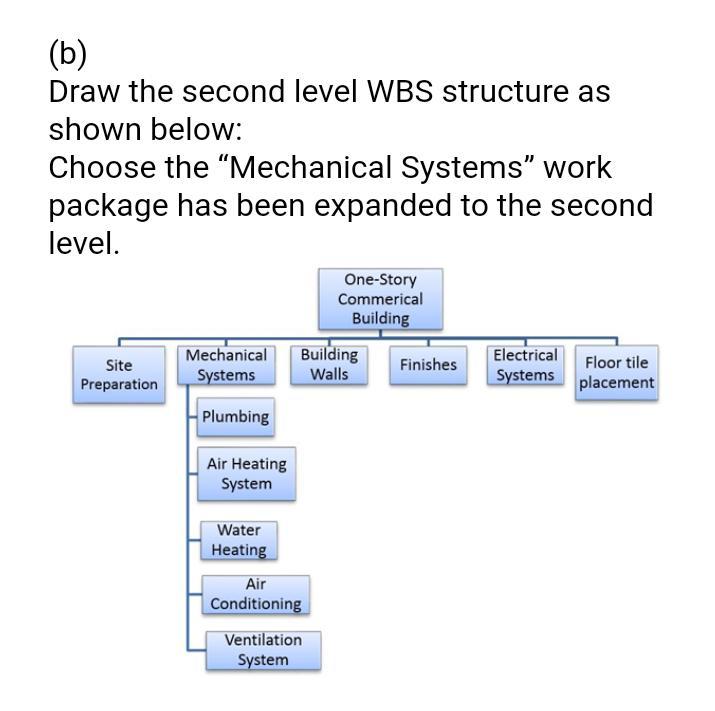
Develop a preliminary work breakdown structure (WBS) for a small one-story commercial building to be constructed on the site of
Zielflug [23.3K]

Answer:

The preliminary work breakdown structure will be divided into two steps, the first is to draw the first level and the second is to draw the second level.

Explanation:

Please look at attachment.

6 0
2 years ago
Read 2 more answers
A thermal energy storage unit consists of a large rectangular channel, which is well insulated on its outer surface and encloses
yaroslaw [1]

Answer:

the temperature of the aluminum at this time is 456.25° C

Explanation:

Given that:

width w of the aluminium slab = 0.05 m

the initial temperature T_1 = 25° C

T{\infty} =600^0C

h = 100 W/m²

The properties of Aluminium at temperature of 600° C by considering the conditions for which the storage unit is charged; we have ;

density ρ = 2702 kg/m³

thermal conductivity k = 231 W/m.K

Specific heat c = 1033 J/Kg.K

Let's first find the Biot Number Bi which can be expressed by the equation:

Bi = \dfrac{hL_c}{k} \\ \\ Bi = \dfrac{h \dfrac{w}{2}}{k}

Bi = \dfrac{hL_c}{k} \\ \\ Bi = \dfrac{100 \times \dfrac{0.05}{2}}{231}

Bi = \dfrac{2.5}{231}

Bi = 0.0108

The time constant value \tau_t is :

\tau_t = \dfrac{pL_cc}{h} \\ \\ \tau_t = \dfrac{p \dfrac{w}{2}c}{h}

\tau_t = \dfrac{2702* \dfrac{0.05}{2}*1033}{100}

\tau_t = \dfrac{2702* 0.025*1033}{100}

\tau_t = 697.79

Considering Lumped capacitance analysis since value for Bi is less than 1

Then;

Q= (pVc)\theta_1 [1-e^{\dfrac {-t}{ \tau_1}}]

where;

Q = -\Delta E _{st} which correlates with the change in the internal energy of the solid.

So;

Q= (pVc)\theta_1 [1-e^{\dfrac {-t}{ \tau_1}}]= -\Delta E _{st}

The maximum value for the change in the internal energy of the solid  is :

(pVc)\theta_1 = -\Delta E _{st}max

By equating the two previous equation together ; we have:

\dfrac{-\Delta E _{st}}{\Delta E _{st}{max}}= \dfrac{  (pVc)\theta_1 [1-e^{\dfrac {-t}{ \tau_1}}]} { (pVc)\theta_1}

Similarly; we need to understand that the ratio of the energy storage to the maximum possible energy storage = 0.75

Thus;

0.75=  [1-e^{\dfrac {-t}{ \tau_1}}]}

So;

0.75=  [1-e^{\dfrac {-t}{ 697.79}}]}

1-0.75=  [e^{\dfrac {-t}{ 697.79}}]}

0.25 =  e^{\dfrac {-t}{ 697.79}}

In(0.25) =  {\dfrac {-t}{ 697.79}}

-1.386294361= \dfrac{-t}{697.79}

t = 1.386294361 × 697.79

t = 967.34 s

Finally; the temperature of Aluminium is determined as follows;

\dfrac{T - T _{\infty}}{T_1-T_{\infty}}= e ^ {\dfrac{-t}{\tau_t}}

\dfrac{T - 600}{25-600}= e ^ {\dfrac{-967.34}{697.79}

\dfrac{T - 600}{25-600}= 0.25

\dfrac{T - 600}{-575}= 0.25

T - 600 = -575 × 0.25

T - 600 = -143.75

T = -143.75 + 600

T = 456.25° C

Hence; the temperature of the aluminum at this time is 456.25° C

3 0
2 years ago
Holmes owns two suits: one black and one tweed. He always wears either a tweed suit or sandals. Whenever he wears his tweed suit
vazorg [7]

Answer:

He wore his black suit, another color of shirt (not purple) and shoes

Explanation:

Holmes owns two suits: one black and one tweed.

Whenever he wears his tweed suit and a purple shirt, he chooses not to wear a tie and whenever he wears sandals, he always wears a purple shirt.

So, if he wore a bow tie yesterday, it means he wore his black suit, another color of shirt (not purple) and shoes because the shirt color is not purple

4 0
2 years ago
Write a program named CheckMonth2 that prompts a user to enter a birth month and day. Display an error message that says Invalid
bonufazy [111]

Answer:

#Welcome message

print("welcome to CheckMonth2")

#prompting  day and month

day = int(input("Please, add a day: "))

month = int(input("please, add a month: "))

#Defining max number of days per each month

monthly_days = [31,29,31,30,31,30,31,31,30,31,30,31]

#Validating day and month were added properly

if month > 12 or month < 1:

   print("invalid date for the month")

elif day > monthly_days[month-1] or day < 1:

    #Printing error message

   print("invalid date for the month")

else:

   #printing correct message

   print ("{}/{} is a valid birthday".format(day,month))

Explanation:

This code was  made using Python and consists of the following parts:

  • A Welcome message with the name of the code.
  • A line to prompt the day.
  • A line to prompt the month.
  • A list to define the number of day per month. For example, the first posistion of the list corrresponds to the maximum number of days in January, the next is for February and so on.
  • A conditional tests to validate the day and month are in correct. ranges.
  • Output the error message if conditions are not met.
  • Output date if contidios are met.
3 0
2 years ago
Other questions:
  • The hot water needs of an office are met by heating tab water by a heat pump from 16 C to 50 C at an average rate of 0.2 kg/min.
    5·1 answer
  • A 60-kg woman holds a 9-kg package as she stands within an elevator which briefly accelerates upward at a rate of g/4. Determine
    14·1 answer
  • An electrical utility delivers 6.25E10 kWh of power to its customers in a year. What is the average power required during the ye
    15·1 answer
  • What is the PW (at i 5%) of SuperTool's new test equipment? The development cost is $1.2M. Net revenues will begin at $300,000 f
    9·1 answer
  • Check the answer that best describes the relationship between f(x) and x. (For example if f(x) is Θ(x) check that as your answer
    12·1 answer
  • A single crystal of a metal that has the FCC crystal structure is oriented such that a tensile stress is applied parallel to the
    7·1 answer
  • Define initial set and final set. Briefly discuss one method used to determine them. The following laboratory tests are performe
    12·1 answer
  • A spherical tank for storing gas under pressure is 25 m in diameter and is made of steel 15 mm thick. The yield point of the mat
    5·2 answers
  • George is replacing a burned out resistor in a circuit board. The board has a 10, a 20, and a 40 on resistor, all in parallel. W
    5·1 answer
  • Problema sobre programacion orientada a objetos!!
    14·1 answer
Add answer
Login
Not registered? Fast signup
Signup
Login Signup
Ask question!