answer.
Ask question
Login Signup
Ask question
All categories
  • English
  • Mathematics
  • Social Studies
  • Business
  • History
  • Health
  • Geography
  • Biology
  • Physics
  • Chemistry
  • Computers and Technology
  • Arts
  • World Languages
  • Spanish
  • French
  • German
  • Advanced Placement (AP)
  • SAT
  • Medicine
  • Law
  • Engineering
raketka [301]
2 years ago
7

A single crystal of a metal that has the FCC crystal structure is oriented such that a tensile stress is applied parallel to the

[100] direction. If the critical resolved shear stress for this material is 0.5 MPa, calculate the magnitude(s) of applied stress(es) necessary to cause slip to occur on the (111) plane in each of the [101], [101], and [011] directions
Engineering
1 answer:
morpeh [17]2 years ago
5 0

The magnitude of applied stress in the direction of 101 is 12.25 MPA and in the direction of 011, it is not defined.                                          

<u>Explanation</u>:        

<u>Given</u>:

tensile stress is applied parallel to the [100] direction

Shear stress is 0.5 MPA.

<u>To calculate</u>:

The magnitude of applied stress in the direction of [101] and [011].

<u>Formula</u>:

zcr=σ cosФ cosλ

<u>Solution</u>:

For in the direction of 101

cosλ = (1)(1)+(0)(0)+(0)(1)/√(1)(2)

cos λ = 1/√2

The magnitude of stress in the direction of 101 is 12.25 MPA

In the direction of 011

We have an angle between 100 and 011

cosλ = (1)(0)+(0)(-1)+(0)(1)/√(1)(2)

cosλ  = 0

Therefore the magnitude of stress to cause a slip in the direction of 011 is not defined.                                                                                                                                                                      


You might be interested in
A shaft consisting of a steel tube of 50-mm outer diameter is to transmit 100 kW of power while rotating at a frequency of 34 Hz
nikitadnepr [17]

Answer:

25 - \sqrt[4]{26.66*10^{-8} }  mm

Explanation:

Given data

steel tube : outer diameter = 50-mm

power transmitted = 100 KW

frequency(f) = 34 Hz

shearing stress ≤ 60 MPa

Determine tube thickness

firstly we calculate the ; power, angular velocity and torque of the tube

power = T(torque) * w (angular velocity)

angular velocity ( w ) = 2\pif = 2 * \pi * 34 = 213.71

Torque (T) = power / angular velocity = 100000 / 213.71 = 467.92 N.m/s

next we calculate the inner diameter  using the relation

  \frac{J}{c_{2}  } = \frac{T}{t_{max} }  = 467.92 / (60 * 10^6) =  7.8 * 10^-6 m^3

also

c2 = (50/2) = 25 mm

\frac{J}{c_{2} } = \frac{\pi }{2c_{2} } ( c^{4} _{2} - c^{4} _{1} ) =  \frac{\pi }{0.050} [ ( 0.025^{4} - c^{4} _{1}  ) ]

therefore; 0.025^4 - c^{4} _{1} = 0.050 / \pi (7.8 *10^-6)

c^{4} _{1} = 39.06 * 10 ^-8 - ( 1.59*10^-2 * 7.8*10^-6)

    39.06 * 10^-8 - 12.402 * 10^-8 =26.66 *10^-8

c_{1} = \sqrt[4]{26.66 * 10^{-8} }  =

THE TUBE THICKNESS

c_{2} - c_{1} = 25 - \sqrt[4]{26.66*10^{-8} }  mm

4 0
2 years ago
a 250 pound person would use a type 1 ladder even if they were carrying a load with them true or faults​
Marysya12 [62]

Answer:True

Explanation:

6 0
2 years ago
Read 2 more answers
A 20 mm 3 20 mm silicon chip is mounted such thatthe edges are flush in a substrate. The substrate provides anunheated starting
sasho [114]

Answer:

q= 1.77 W

Explanation:

Given data, Dimensions = 20mm x 20mm, Unheated starting length (ε) = 20 mm, Air flow temperature = 25 C, Velocity of flow = 25m/s, Surface Temperature = 75 C

To find maximum allowed power dissipated use the formula Q = hA(ΔT), where Q = Maximum allowed power dissipated from surface , h = heat transfer coefficiant, A = Area of Surface, ΔT = Temperature difference between surface and surrounding

we need to find h, which is given by (Nu x K)/x, where Nu is the Nusselt's Number, k is the thermal conductivity at film temperature and x is the length of the substrate.

For Nu use the Churchill and Ozoe relation used for parallel flow over the flat plate , Nu = (Nux (ε=0))/[1-(ε/x)^3/4]^1/3

Nux (ε=0) = 0.453 x Re^0.5 x Pr^1/3, where Re is the Reynolds number calculated by [Rex = Vx/v, where V is the velocity and v is the kinematic velocity, x being the length of the substrate] and Pr being the Prandtl Number

The constants, namel Pr, k and v are temperature dependent, so we need to find the film temperature

Tfilm = (Tsubstrate + Tmax)/2 = (25 + 75)/2 = 50 C

At 50 C, Pr = 0.7228, k = 0.02735w/m.k , v = 1.798 x 10^-5 m2/s

First find Rex and keep using the value in the subsequent formulas until we reach Q

Rex = Vx/v = 25 x (0.02 + 0.02)/ 1.798 x 10^-5  = 55617.35 < 5 x 10^5, thus flow is laminar, (x = L + ε)

Nux = (Nux (ε=0))/[1-(ε/x)^3/4]^1/3 = 0.453 x Re^0.5 x Pr^1/3/[1-(ε/x)^3/4]^1/3

= 0.453 x 55617.35 ^0.5 x 0.7228^1/3/ [1 - (0.02/0.04)^3/4]^1/3 = 129.54

h = (Nu x K)/x = (129.54 x 0.02735)/0.04 = 88.75W/m2.k

Q = 88.75 x (0.02)^2 x (75-25) = 1.77 W

7 0
2 years ago
. A belt drive is desired to couple the motor with a mixer for processing corn syrup. The 25-hp electric motor is rated at 950 r
forsale [732]

Answer:

Hello the table which is part of the question is missing and below are the table values

For a 5V belt the available diameters are : 5.5, 5.8, 5.9, 6.2, 6.3, 6.6, 12.5, 13.9, 15.5, 16.1, 18.5, 20.1

Answers:

belt size = 140 in with diameter of 20.1n

actual speed of belt = 288.49 in/s

actual center distance = 49.345 in

Explanation:

Given data :

Electric motor (driver sheave) speed (w1) = 950 rpm

Driven sheave speed (w2) = 250 rpm

pick D1 ( diameter of driver sheave)  = 5.8 in  ( from table )

To select an appropriate belt size we apply the equation for the velocity ratio to get the diameter first

VR = \frac{w1}{w2} = 950 / 250

also since the speed of  belt would be constant then ;

Vb = w1r1 = w2r2 ------- equation 1

r = d/2

substituting the value of r into equation 1

equation 2 becomes : \frac{w1}{w2} = \frac{d2}{d1}    = VR

Appropriate belt size ( d2) can be calculated as

d2 = \frac{w1d1}{w2} = \frac{950 * 5.8}{250} = 22.04

From the given table the appropriate belt size would be : 20.1 because it is the closest to the calculated value

next we have to determine the belt length /size

L = 2C + \frac{\pi }{2} ( d1+d2) + \frac{(d2-d1)^2}{4C}

inputting  all the values into the above equation including the value of C as calculated below

L ≈ 140 in

Calculating the center distance

we use this equation to get the ideal center distance

d2< C_{ideal} < 3( d1 +d2)

22.04 < c < 3 ( 5.8 + 20.1 )

22.04 < c < 77.7

the center distance is between 22.04 and 77.7  but taking an average value

ideal center distance would be ≈ 48 in

To calculate the actual center distance we use

C = \frac{B+\sqrt{B^2 - 32(d2-d1)^2} }{16} -------- equation 3

B = 4L -2\pi (d2 + d1 )

inputting all the values into (B)

B = 140(4) - 2\pi( 20.01 + 5.8 )

B ≈ 399.15 in

inputting all the values gotten Back to equation 3 to get the actual center distance

C = 49.345 in ( actual center distance )

Calculating the actual belt speed

w1 = 950 rpm = 99.48 rad/s

belt speed ( Vb) = w1r1 = w1 * \frac{d1}{2}

                           = 99.48 * 5.8 / 2 = 288.49 in/s

3 0
2 years ago
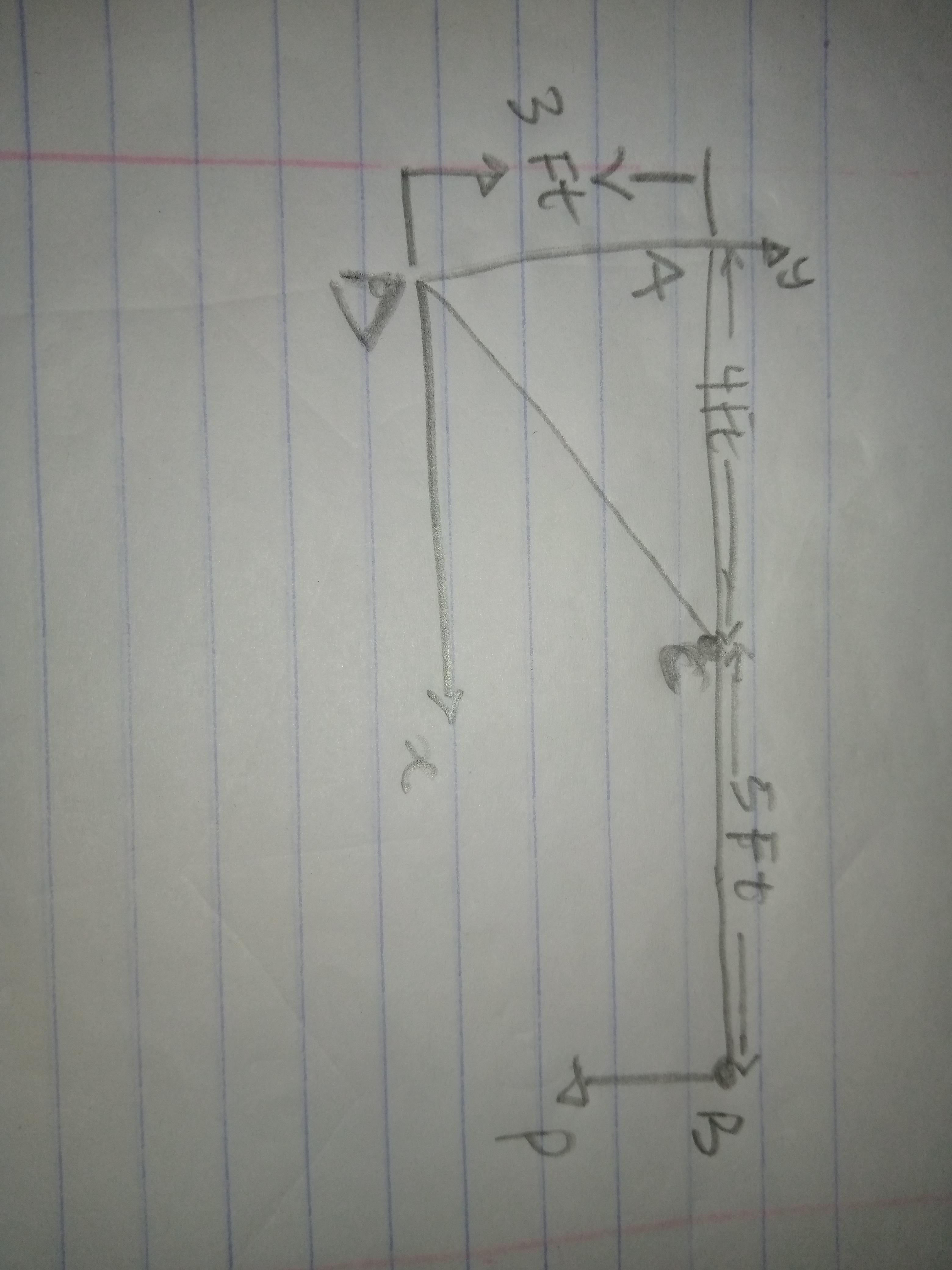
Rigid bar ACB is supported by an elastic cir-cular strut DC having an outer diameter of 15 in. and inner diameter of 14.4 in. Th
Ne4ueva [31]

Answer:

The change in length of the circular strut DC = 0.0028 in.

The vertical displacement of the rigid bar at point B = 0.00378 in.

Explanation:

We have the following parameters or information in the question given above:

=> The outer diameter = 15 in., the inner diameter = 14.4 in., the modulus elasticity of E = 29,000 ksi, and the Point load P = 5kips.

The diagram showing the rigid bar ACB is supported by an elastic cir-cular strut DC  is given in  the attached picture below.

According to Newton's law of motion, it can be seen that the force on CD, that is FCD is equal and opposite to ACD. Hence, FCD = ACD.

Where FCD = p × [4 + 5] ÷ [sin Ф × 4].

kindly note that from the diagram sin Ф = 3/5, cos Ф = 4/5 and tan Ф = 3/4. Also p =5.

Hence, FCD =[ 5 × 9] ÷ [3/5 × 4] = 18.75 kip. So FCD = ACD.

The next thing here is to determine the area and length of CD, say the area of CD is G, thus, G = π/4 × [ 15² - 14.4²] = 13.854 in².

The lenght of CD is = √[4² + 3²] = √[16 + 9] = 5ft. Thus, 5 × 12 = 60in.

Hence, the change in length of the circular strut DC = [18.75 × 60] ÷ 13.854 × 29000 = 0.0028 in.

The vertical deflection of CD = 0.0028 × 3/5 = 0.00168 in.

We have that; 4 /CV = 9BV. Hence, BV = 9/4× CV.

(CV = vertical deflection of CD).

The vertical displacement of the rigid bar at point B = 9/ 4 × 0.00168 in = 0.00378 in.  

7 0
2 years ago
Other questions:
  • Six years ago, an 80-kW diesel electric set cost $160,000. The cost index for this class of equipment six years ago was 187 and
    8·1 answer
  • Your roommate wants to learn about organizational chart. You can tell her that these charts can tell you all of these about an o
    10·1 answer
  • Outline an algorithm in **pseudo code** for checking whether an array H[1..n] is a heap and determine its time efficiency.
    6·1 answer
  • Given a 5x5 matrix for Playfair cipher a. How many possible keys does the Playfair cipher have? Ignore the fact that some keys m
    6·1 answer
  • A binary star system consists of two stars of masses m1m1m_1 and m2m2m_2. The stars, which gravitationally attract each other, r
    9·1 answer
  • Vehicles arrive at a single toll booth beginning at 8:00 A.M. They arrive and depart according to a uniform deterministic distri
    9·1 answer
  • A rectangular beam having b=300 mm and d=575 mm, spans 5.5 m face to face of simple supports. It is reinforced for flexure with
    14·1 answer
  • An ideal Diesel cycle has a compression ratio of 18 and a cutoff ratio of 1.5. Determine the maximum air temperature and the rat
    9·1 answer
  • Toeboards are usually ___ inches high and used on landings and balconies.
    8·1 answer
  • Use the drop -down menus to select the appropriate question type. Picking between two possible alternatives: Showing an understa
    7·1 answer
Add answer
Login
Not registered? Fast signup
Signup
Login Signup
Ask question!