answer.
Ask question
Login Signup
Ask question
All categories
  • English
  • Mathematics
  • Social Studies
  • Business
  • History
  • Health
  • Geography
  • Biology
  • Physics
  • Chemistry
  • Computers and Technology
  • Arts
  • World Languages
  • Spanish
  • French
  • German
  • Advanced Placement (AP)
  • SAT
  • Medicine
  • Law
  • Engineering
sammy [17]
2 years ago
10

Rigid bar ACB is supported by an elastic cir-cular strut DC having an outer diameter of 15 in. and inner diameter of 14.4 in. Th

e strut is made of steel with a modulus elasticity of load P 5kips5 E 5 29,000 ksi. Point is applied at B. Calculate the change in length of the circular strut DC. What is the vertical displacement of the rigid bar at point B
Engineering
1 answer:
Ne4ueva [31]2 years ago
7 0

Answer:

The change in length of the circular strut DC = 0.0028 in.

The vertical displacement of the rigid bar at point B = 0.00378 in.

Explanation:

We have the following parameters or information in the question given above:

=> The outer diameter = 15 in., the inner diameter = 14.4 in., the modulus elasticity of E = 29,000 ksi, and the Point load P = 5kips.

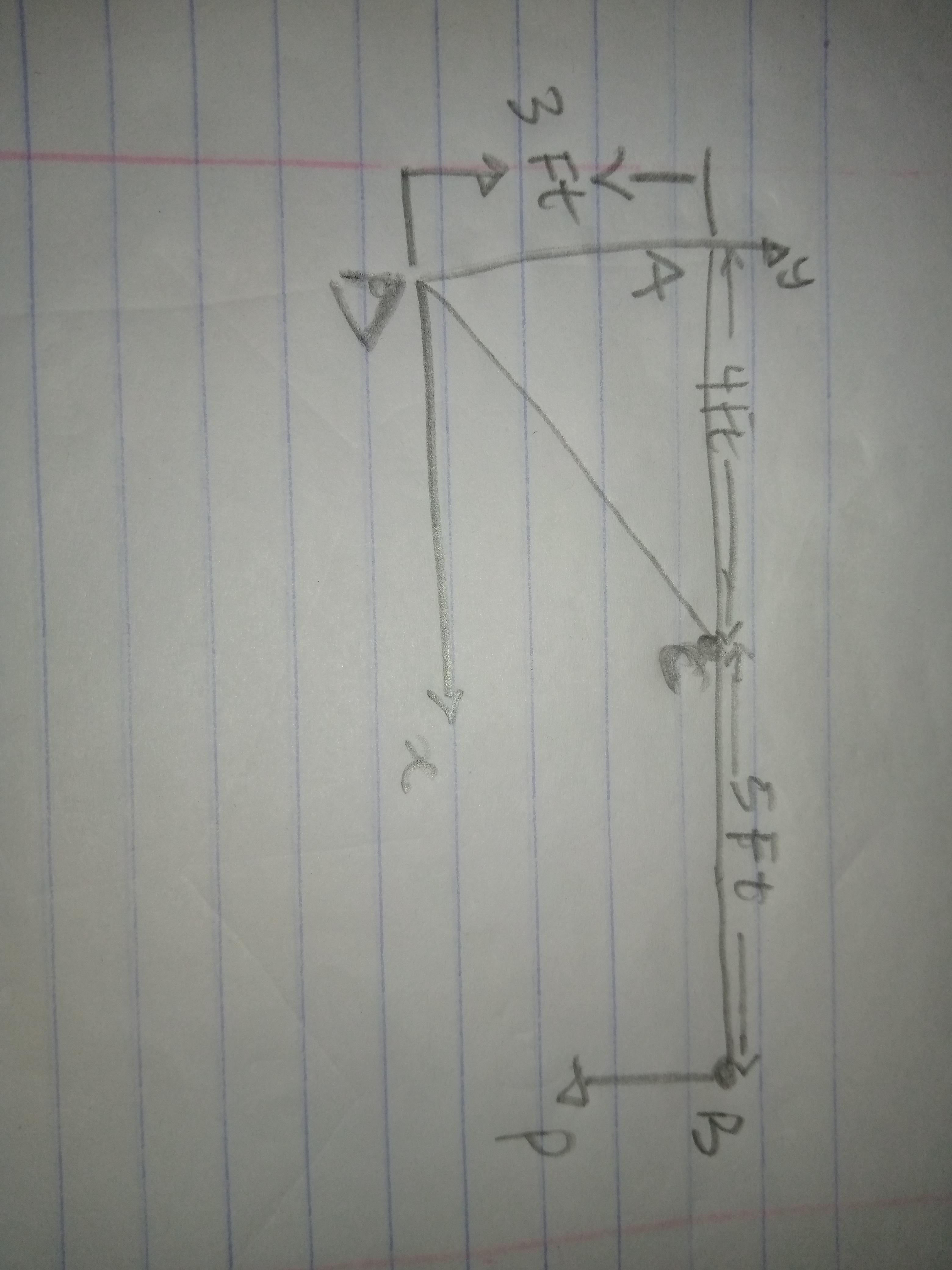
The diagram showing the rigid bar ACB is supported by an elastic cir-cular strut DC  is given in  the attached picture below.

According to Newton's law of motion, it can be seen that the force on CD, that is FCD is equal and opposite to ACD. Hence, FCD = ACD.

Where FCD = p × [4 + 5] ÷ [sin Ф × 4].

kindly note that from the diagram sin Ф = 3/5, cos Ф = 4/5 and tan Ф = 3/4. Also p =5.

Hence, FCD =[ 5 × 9] ÷ [3/5 × 4] = 18.75 kip. So FCD = ACD.

The next thing here is to determine the area and length of CD, say the area of CD is G, thus, G = π/4 × [ 15² - 14.4²] = 13.854 in².

The lenght of CD is = √[4² + 3²] = √[16 + 9] = 5ft. Thus, 5 × 12 = 60in.

Hence, the change in length of the circular strut DC = [18.75 × 60] ÷ 13.854 × 29000 = 0.0028 in.

The vertical deflection of CD = 0.0028 × 3/5 = 0.00168 in.

We have that; 4 /CV = 9BV. Hence, BV = 9/4× CV.

(CV = vertical deflection of CD).

The vertical displacement of the rigid bar at point B = 9/ 4 × 0.00168 in = 0.00378 in.  
You might be interested in
Gina is about to use a fire extinguisher on a small fire. What factor determines the type of extinguisher she should use
amm1812

There’s 5 different types of fire extinguishers that you can differentiate by their color codes.

Red - Water based

Creme - Foam based

Blue - Powder based

Black - CO2 or carbon dioxide based

Yellow - Wet chemical based

What would determine the type of fire extinguisher used would be the class of fire it is.

Class A - Combustible materials ( i.e. paper, wood) Extinguishers to use - Red, Creme, Blue, and Yellow. (Do not use Black)

Class B - Flammable liquids ( i.e. paint, petrol, alcohol) Extinguishers to use - Creme, Blue, and Black. (Do not use Red or Yellow)

Class C - Flammable gases ( i.e. butane, methane) Extinguishers to use - Blue (Do not use Red, Creme, Black or Yellow)

Class D - Flammable metals ( i.e. lithium, potassium) Extinguishers to use - Blue (Do not use Red, Creme, Black or Yellow)

Class F - Deep fat fryers ( i.e. chip pans) Extinguishers to use - Yellow (Do not use Red, Creme, Blue or Black)

Electrical - any sort of electrical equipment

( i.e. computers, generators) Extinguishers to use - Blue and Black (Do not use Red, Creme or Yellow)

8 0
2 years ago
Read 2 more answers
An automobile having a mass of 900 kg initially moves along a level highway at 100 km/h relative to the highway. It then climbs
creativ13 [48]

Answer:

ΔKE=-347.278 kJ

ΔPE= 441.45 kJ

Explanation:

given:

mass m=900 kg

the gravitational acceleration g=9.81 m/s^2

the initial velocity V_{1}=100 km/h-->100*10^3/3600=27.78 m/s

height above the highway h=50 m

h1=0m

the final velocity V_{F}=0 m/s

<u>To find:</u>

the change in kinetic energy ΔKE

the change in potential energy ΔPE

<u>assumption:</u>

We take the highway as a datum

<u>solution:</u>

ΔKE=5*m*(V_{F}^2-V_{1}^2)

      =-347.278 kJ

ΔPE=m*g*(h-h1)

      = 441.45 kJ

5 0
2 years ago
Consider an infinitely thin flat plate of chord c at an angle of attack α in a supersonic flow. The pressure on the upper and lo
amm1812

Answer:

X_cp = c/2

Explanation:

We are given;

Chord = c

Angle of attack = α

p u (s) = c 1

​p1(s)=c2,

and c2 > c1

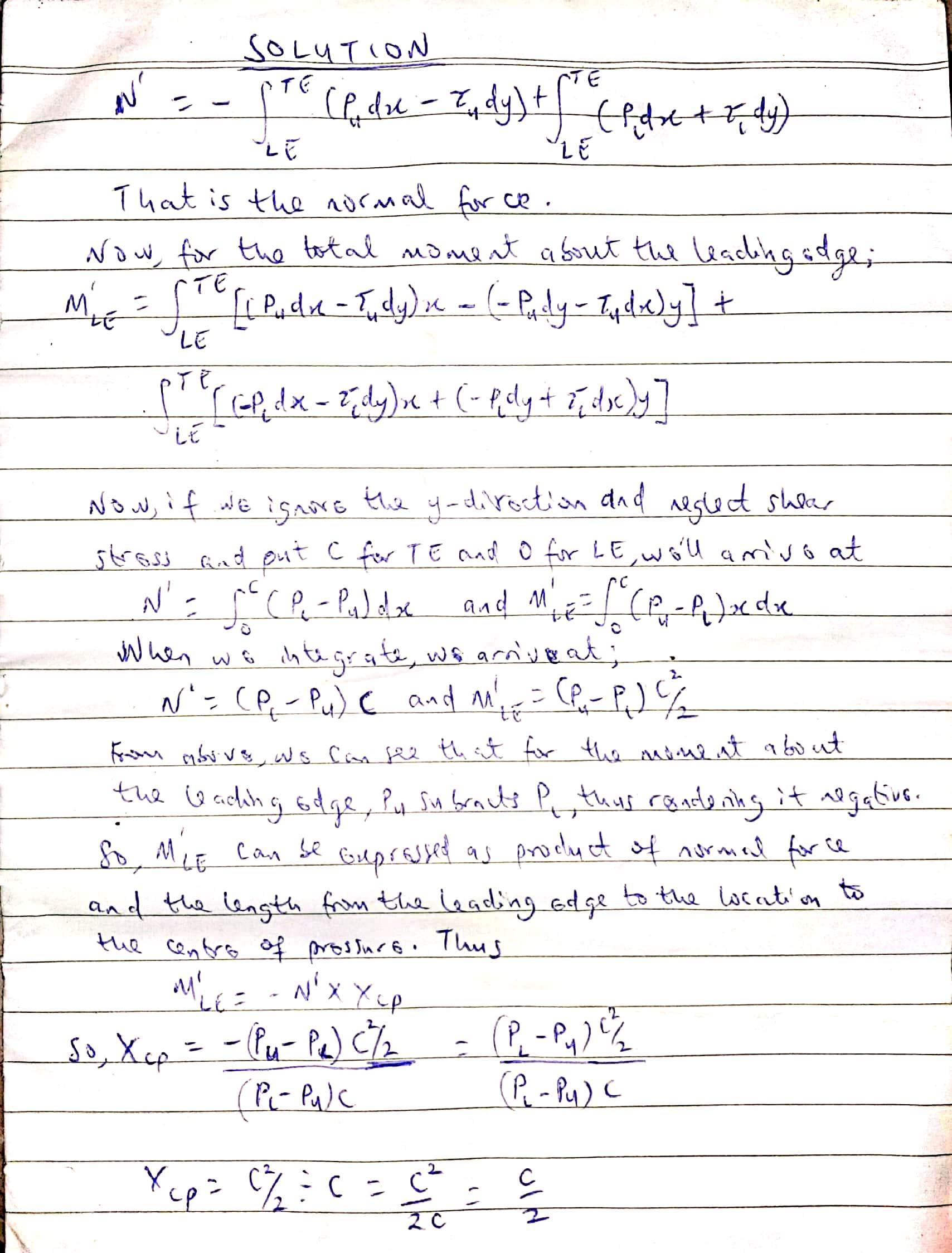
First of all, we need to find the resultant normal force on the plate and the total moment about leading edge.

I've attached the solution

4 0
2 years ago
Oliver is designing a new children’s slide to increase the speed at which a child can descend. His first design involved steel b
AVprozaik [17]

Answer:

The correct option is;

A) Steel becomes too hot in the Sun and can burn the children

Explanation:

The properties of steel includes;

Low specific heat capacity, high thermal and electrical toughness, high hardness, high tensile strength, high yield strength, appreciable elongation, high fatigue strength, can easily corrode, high malleability and ability to creep

Therefore, due to the low specific heat capacity, which is 0.511 J/(g·°C) and high conductivity of steel which is about 32 W/(m·k), the temperature of the steel can rapidly rise and the hot steel surface can readily conduct the heat, (due to the temperature difference) to other bodies that come in contact

8 0
2 years ago
A conical enlargement in a vertical pipeline is 5 ft long and enlarges the pipe diameter from 12 in. to 24 in. diameter. Calcula
makkiz [27]

Answer:

F_y = 151319.01N = 15.132 KN

Explanation:

From the linear momentum equation theory, since flow is steady, the y components would be;

-V1•ρ1•V1•A1 + V2•ρ2•V2•A2 = P1•A1 - P2•A2 - F_y

We are given;

Length; L = 5ft = 1.52.

Initial diameter;d1 = 12in = 0.3m

Exit diameter; d2 = 24 in = 0.6m

Volume flow rate of water; Q2 = 10 ft³/s = 0.28 m³/s

Initial pressure;p1 = 30 psi = 206843 pa

Thus,

initial Area;A1 = π•d1²/4 = π•0.3²/4 = 0.07 m²

Exit area;A2 = π•d2²/4 = π•0.6²/4 = 0.28m²

Now, we know that volume flow rate of water is given by; Q = A•V

Thus,

At exit, Q2 = A2•V2

So, 0.28 = 0.28•V2

So,V2 = 1 m/s

When flow is incompressible, we often say that ;

Initial mass flow rate = exit mass flow rate.

Thus,

ρ1 = ρ2 = 1000 kg/m³

Density of water is 1000 kg/m³

And A1•V1 = A2•V2

So, V1 = A2•V2/A1

So, V1 = 0.28 x 1/0.07

V1 = 4 m/s

So, from initial equation of y components;

-V1•ρ1•V1•A1 + V2•ρ2•V2•A2 = P1•A1 - P2•A2 - F_y

Where F_y is vertical force of enlargement pressure and P2 = 0

Thus, making F_y the subject;

F_y = P1•A1 + V1•ρ1•V1•A1 - V2•ρ2•V2•A2

Plugging in the relevant values to get;

F_y = (206843 x 0.07) + (1² x 1000 x 0.07) - (4² x 1000 x 0.28)

F_y = 151319.01N = 15.132 KN

6 0
2 years ago
Other questions:
  • Pam Jones worked for 41 years at the same company and had positive performance ratings and personnel records. She needed a calcu
    9·1 answer
  • A particle has an initial velocity of v0 = 14 ft/s to the right, at s0 = 0, and a = 2 ft/s2 to the left. determine its position
    5·1 answer
  • Write a program that prompts the user to enter time in 12-hour notation. The program then outputs the time in 24-hour notation.
    6·1 answer
  • Two physical properties that have a major influence on the cracking of workpieces, tools, or dies during thermal cycling are the
    13·1 answer
  • With thermodynamics, one cannot determine ________.
    14·1 answer
  • "From the earth to the moon". In Jules Verne’s 1865 story with this title, three men went to the moon in a shell fired from a gi
    5·1 answer
  • Benzene vapor at 480°C is cooled and converted to a liquid at 25°C in a continuous condenser. The condensate is drained into 1.7
    15·1 answer
  • What are some goals of NYFEA? Select three options.
    9·2 answers
  • 1. A _____ is applied to a wall or roof rafters to add strength and keep the building straight and plumb.
    9·1 answer
  • George is replacing a burned out resistor in a circuit board. The board has a 10, a 20, and a 40 on resistor, all in parallel. W
    5·1 answer
Add answer
Login
Not registered? Fast signup
Signup
Login Signup
Ask question!