answer.
Ask question
Login Signup
Ask question
All categories
  • English
  • Mathematics
  • Social Studies
  • Business
  • History
  • Health
  • Geography
  • Biology
  • Physics
  • Chemistry
  • Computers and Technology
  • Arts
  • World Languages
  • Spanish
  • French
  • German
  • Advanced Placement (AP)
  • SAT
  • Medicine
  • Law
  • Engineering
WARRIOR [948]
2 years ago
9

The mass fractions of a mixture of gases are 15 percent nitrogen, 5 percent helium, 60 percent methane, and 20 percent ethane. T

his mixture is enclosed in a 10 m3 rigid, wellinsulated vessel at 200 kPa and 20oC. A paddle wheel in the vessel is turned until 100 kJ of work have been done on the mixture. Calculate the mixture’s final pressure and temperature.
Engineering
1 answer:
Naya [18.7K]2 years ago
6 0

Answer:

The mixture's final temperature is 297.848k

The mixture's final pressure is 203.2kpa

Explanation:

Mass fraction of Nitrogen= 0.15 MfN2

Mass fraction of Helium= 0.05 MfHe

Mass fraction of Methane= 0.6 Mf CH4

Mass fraction of Ethane = 0.2 C2H6

Volume of the tank= 10m^3

Initial mixture pressure= Pm= 200kpa

Initial mixture temperature = 20°C = 20 +273.15= 293.15

Workdone,w = 100KJ

From the property table, molar mass and specific heat of constant are given below:

MN2= 28.013 kg/kmol

MHe= 4.003 "

MCH4= 16.043 "

MC2H6= 30.07 "

CPN2= 1.039 kJ/kgmol

CPHe= 5.1926

CPCH4 = 2.2537

CPC2H6 = 1.7662

For an ideal gas, the molar mass of the mixture is computed as follows:

Mm= mm/Nm

= mm/Σm1/M1

The molar masses of the mixture would bw

Mm= 1/ (mfN2/N2 + mfHe/He + mfCH4/CH4 + mfC2H6/C2H6)

Mm = 1/ (0.15/28.13 + 0.05/4.003 + 0.6/16.043 + 0.2/30.07)

Mm= 16.156kg/kmol

The specific heat at constant pressure of a mixture is computed as:

Cpm= Σk, i=1 mfiCp.i

=MfN2CP.N2+MfHeCP.He+MfCH4.CP.CH4+MfC2H6.CPC2H6

=0.15×1.039 + 0.05 × 5.1926 + 0.6 × 2.2537 + 0.2×1.7662

=2.121kJ/kg-K

Apparent constant gas of mixture can be calculated as:

Rm= RM/Mm

= 8.314/16.156

= 0.5146kJ/kg-K

The specific heat of a mixture at constant volume:

Cv.m = Cp.m - Rm

=2.121 - 0.5146

= 1.6064kJ/kg-K

The mass of a mixture present in the vessel is computed using ideal Gass equation

Mm= P1Vm/RmT1

= 200 × 10 / 0.5146 × 293.15

=13.25kg

From the first law of thermodynamics, we have:

Q - W = ΔE

The vessel is well insulated, so the heat of transfer Q=0

Neglecting potential and kinetic energy, change in energy becomes internal.

Hence,

ΔE= U2 - U1

= mmCv.m = T2 - T1

Substitute the values known into the first law of thermodynamics

0 - W = Cvm (T2 - T1)

Therefore, work supplied to the system is given by:

W = mmCvm (T2 - T1)

100 = 13.25 × 1.6064 × ( T2 - 293.15)

T2= 293. 15 + 4.698

T2= 297.848k

Therefore, the final mixture temperature is 297.848k

The final pressure is expressed as

P2= P1. T2/T1

P2= 200 × 297.89/293.15

P2= 203.2kpa

The mixture's final pressure is 203.2kpa

You might be interested in
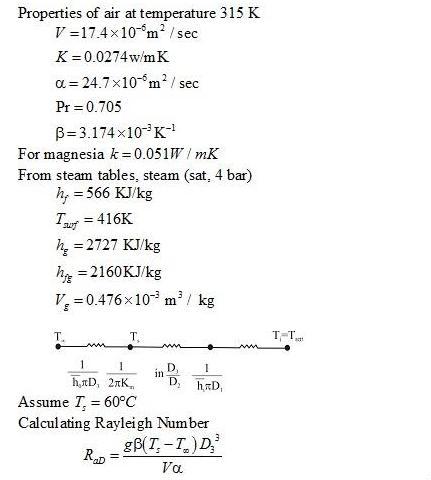
1. Saturated steam at 4 bars absolute pressure with a mean velocity of 3 m/s flows through a horizontal SS304 stainless-steel pi
saveliy_v [14]

Answer:

(a) Rate of heat transfer = 34.65 W/m

(b) quality of outlet of pipe  x = 0.967

(c) Temperature of outer surface of insulation, T₂ = U1.157°C

Yes it is safe to touch, (But gentle touch)

Explanation:

Detailed explanation is given in the attach document.

5 0
2 years ago
A steady tensile load of 5.00kN is applied to a square bar, 12mm on a side and having a length of 1.65m. compute the stress in t
Shtirlitz [24]

Answer:

The stress in the bar is 34.72 MPa.

The design factor (DF) for each case is:

A) DF=0.17

B) DF=0.09

C) DF=0.125

D) DF=0.12

E) DF=0.039

F) DF=1.26

G) DF=5.5

Explanation:

The design factor is the relation between design stress and failure stress. In the case of ductile materials like metals, the failure stress considered is the yield stress. In the case of plastics or ceramics, the failure stress considered is the breaking stress (ultimate stress). If the design factor is less than 1, the structure or bar will endure the applied stress. By the opposite side, when the DF is higher than 1, the structure will collapse or the bar will break.

we will calculate the design stress in this case:

\displaystyle \sigma_{dis}=\frac{T_l}{Sup}=\frac{5.00KN}{(12\cdot10^{-3}m)^2}=34.72MPa

The design factor for metals is:

DF=\displaystyle \frac{\sigma_{dis}}{\sigma_{f}}=\frac{\sigma_{dis}}{\sigma_{y}}

The design factor for plastic and ceramics is:

DF=\displaystyle \frac{\sigma_{dis}}{\sigma_{f}}=\frac{\sigma_{dis}}{\sigma_{u}}

We now need to know the yield stress or the ultimate stress for each material. We use the AISI and ASTM charts for steels, materials charts for non-ferrous materials and plastics safety charts for the plastic materials.

For these cases:

A) The yield stress of AISI 120 hot-rolled steel (actually is AISI 1020) is 205 MPa, therefore:

DF=\displaystyle\frac{34.72MPa}{205MPa}=0.17

B) The yield stress of AISI 8650 OQT 1000 steel is 385 MPa, therefore:

DF=\displaystyle\frac{34.72MPa}{385MPa}=0.09

C) The yield stress of ductile iron A536-84 (60-40-18) is 40Kpsi, this is 275.8 MPa, therefore:

DF=\displaystyle\frac{34.72MPa}{275.8MPa}=0.125

D) The yield stress of aluminum allot 6061-T6 is 290 MPa, therefore:

DF=\displaystyle\frac{34.72MPa}{290MPa}=0.12

E) The yield stress of titanium alloy Ti-6Al-4V annealed (certified by manufacturers) is 880 MPa, therefore:

DF=\displaystyle\frac{34.72MPa}{880MPa}=0.039

F) The ultimate stress of rigid PVC plastic (certified by PVC Pipe Association) is 4Kpsi or 27.58 MPa, therefore:

DF=\displaystyle\frac{34.72MPa}{27.58 MPa}=1.26

In this case, the bar will break.

F) You have to consider that phenolic plastics are used as matrix in composite materials and seldom are used alone with no reinforcement. In this question is not explained if this material is reinforced or not, therefore I will use the ultimate stress of most pure phenolic plastics, in this case, 6.31 MPa:

DF=\displaystyle\frac{34.72MPa}{6.31 MPa}=5.5

This material will break.

3 0
2 years ago
On the reality television show "Survivor," two tribes compete for luxuries such as food and shelter. During such challenges, one
Ivan

Answer:

Realistic Group Conflict Theory

Explanation:

Realistic Group Conflict theory is a socio-psychological model of internal conflicts among groups.

These groups may compete for a scarce resources based on reality or perception.

These conflicts may be over political power, capital, or social status, etc.

According to this theory, in the competition, only one group wins over the scarce resources while the other has to lose.

Thus The reality show on the television showing two tribes competing for food and shelter where the success of one is the failure for the other is based on Realistic Group Conflict Theory.

5 0
2 years ago
A 60-kg woman holds a 9-kg package as she stands within an elevator which briefly accelerates upward at a rate of g/4. Determine
Anuta_ua [19.1K]

Answer:

force R = 846.11 N

lifting force L = 110.36 N

if cable fail complete both R and L will be zero

Explanation:

given data

mass woman mw = 60 kg

mass package mp = 9 kg

accelerates rate a = g/4

to find out

force R and lifting force L and if cable fail than what values would R and L acquire

solution

we calculate here first reaction R force

we know elevator which accelerates upward

so now by direction of motion , balance the force that is express as

R - ( mw + mp ) × g = ( mw + mp ) × a

here put all these value and a = g/4 and use g = 9.81 m/s²

R - ( 60 + 9 ) × 9.81 = ( 60 + 9  ) × g/4

R = ( 69  ) × 9.81/4  + ( 69 ) 9.81

R = 69  ( 9.81 + 2.4525 )

force R = 846.11 N

and

lifting force is express as here

lifting force = mp ( g + a)

put here value

lifting force = 9 ( 9.81 + 9.81/4)

lifting force L = 110.36 N

and

we know if cable completely fail than body move free fall and experience no force

so both R and L will be zero

5 0
2 years ago
A thermometer requires 1 minute to indicate 98% of the response to a unit step input. Assuming the thermometer to be a first ord
Rama09 [41]

Answer:

Time constant = 15.34 seconds

The thermometer shows an error of 0.838°

Explanation:

Given

t = 1 minute = 60 seconds

c(t) = 98% = 0.98

According to the question, the thermometer is a first order system.

The first order system transfer function is given as;

C(s)/R(s) = 1/(sT + 1).

To calculate the time constant, we need to calculate the step response.

This is given as

r(t) = u(t) --- Take Laplace Transformation

R(s) = 1/s

Substitute 1/s for R(s) in C(s)/R(s) = 1/(sT + 1).

We have

C(s)/1/s = 1/(sT + 1)

C(s) = 1/(sT + 1) * 1/s

C(s) = 1/s - 1/(s + 1/T) --- Take Inverse Laplace Transformation

L^-1(C(s)) = L^-1(1/s - 1/(s + 1/T))

Since, e^-t <–> 1/(s + 1) --- {L}

1 <–> 1/s {L}

So, the unit response c(t) = 1 - e^-(t/T)

Substitute 0.98 for c(t) and 60 for t

0.98 = 1 - e^-(60/T)

0.98 - 1 = - e^-(60/T)

-0.02 = - e^-(60/T)

e^-(60/T) = 0.02

ln(e^-(60/T)) = ln(0.02)

-60/T = -3.912

T = -60/-3.912

T = 15.34 seconds

Time constant = 15.34 seconds

The error signal is given as

E(s) = R(s) - C(s)

Where the temperature changes at the rate of 10°/min; 10°/60 s = 1/6

So.

E(s) = R(s) - 1/6 C(s)

Calculating C(s)

C(s) = 1/s - 1/(s + 1/T)

C(s) = 1/s - 1/(s + 1/15.34)

Remember that R(s) = 1/s

So, E(s) becomes

E(s) = 1/s - 1/6(1/s - 1/(s + 1/15.34))

E(s) = 1/s - 1/6(1/s - 1/(s + 0.0652)

E(s) = 1/s - 1/6s + 1/(6(s+0.0652))

E(s) = 5/6s + 1/(6(s+0.0652))

E(s) = 0.833/s + 1/(6(s+0.0652)) ---- Take Inverse Laplace Transformation

e(t) = 1/6e^-0.652t + 0.833

For a first order system, the system attains a steady state condition when time is 4 times of Time constant.

So,

Time = 4 * 15.34

Time = 61.36 seconds

So, e(t) becomes

e(t) = 1/6e^-0.652t + 0.833

e(t) = 1/(6e^-0.652(61.36)) + 0.833

e(t) = 0.83821342824942664566211

e(t) = 0.838 --- Approximated

Hence, the thermometer shows an error of 0.838°

4 0
2 years ago
Read 2 more answers
Other questions:
  • A particle has an initial velocity of v0 = 14 ft/s to the right, at s0 = 0, and a = 2 ft/s2 to the left. determine its position
    5·1 answer
  • Water is the working fluid in an ideal Rankine cycle. The condenser pressure is 8 kPa, and saturated vapor enters the turbine at
    10·1 answer
  • A signalized intersection approach has an upgrade of 4%. The total width of the cross street at this intersection is 60 feet. Th
    15·1 answer
  • A driver traveling at 65 mi/h rounds a curve on a level grade to see a truck overturned across the roadway at a distance of 350
    13·1 answer
  • A mass of 12 kg saturated refrigerant-134a vapor is contained in a piston-cylinder device at 240 kPa. Now 300 kJ of heat is tran
    8·1 answer
  • Can crushers help us recycle in a space efficient way which is good for saving the earth and for giving you more room in your ap
    7·1 answer
  • Five Kilograms of continuous boron fibers are introduced in a unidirectional orientation into of an 8kg aluminum matrix. Calcula
    9·1 answer
  • What ratio between differential gain and common-mode gain is called​
    9·1 answer
  • Who play 1v1 lol unblocked games 76
    8·2 answers
  • 1. A _____ is applied to a wall or roof rafters to add strength and keep the building straight and plumb.
    9·1 answer
Add answer
Login
Not registered? Fast signup
Signup
Login Signup
Ask question!