answer.
Ask question
Login Signup
Ask question
All categories
  • English
  • Mathematics
  • Social Studies
  • Business
  • History
  • Health
  • Geography
  • Biology
  • Physics
  • Chemistry
  • Computers and Technology
  • Arts
  • World Languages
  • Spanish
  • French
  • German
  • Advanced Placement (AP)
  • SAT
  • Medicine
  • Law
  • Engineering
svlad2 [7]
2 years ago
10

Water is the working fluid in an ideal Rankine cycle. The condenser pressure is 8 kPa, and saturated vapor enters the turbine at

(a) 18 MPa and (b) 4 MPa. The net power output of the cycle is 100 MW.
Determine for each case a) the mass flow rate of steam, in kg/h, b) the heat transfer rates for the working fluid passing through the boiler and condenser, each in kW, and c) the thermal efficiency.
Engineering
1 answer:
sergeinik [125]2 years ago
6 0

Explanation:

The obtained data from water properties tables are:

Point 1 (condenser exit) @ 8 KPa, saturated fluid

h_{f} = 173.358 \\h_{fg} = 2402.522

Point 2 (Pump exit) @ 18 MPa, saturated fluid & @ 4 MPa, saturated fluid

h_{2a} =  489.752\\h_{2b} =  313.2

Point 3 (Boiler exit) @ 18 MPa, saturated steam & @ 4 MPa, saturated steam

h_{3a} = 2701.26 \\s_{3a} = 7.1656\\h_{3b} = 2634.14\\s_{3b} = 7.6876

Point 4 (Turbine exit) @ 8 KPa, mixed fluid

x_{a} = 0.8608\\h_{4a} = 2241.448938\\x_{b} = 0.9291\\h_{4b} = 2405.54119

Calculate mass flow rates

Part a) @ 18 MPa

mass flow

\frac{100*10^6 }{w_{T} - w_{P}} = \frac{100*10^3 }{(h_{3a}  - h_{4a}) - (h_{2a}  - h_{f})}\\\\= \frac{100*10^ 3}{(2701.26  - 2241.448938 ) - (489.752  - 173.358)}\\\\= 697.2671076 \frac{kg}{s} = 2510161.587 \frac{kg}{hr}

Heat transfer rate through boiler

Q_{in}  = mass flow * (h_{3a} -  h_{2a})\\Q_{in} = (697.2671076)*(2701.26-489.752)\\\\Q_{in} = 1542011.787 W

Heat transfer rate through condenser

Q_{out}  = mass flow * (h_{4a} -  h_{f})\\Q_{out} = (697.2671076)*(2241.448938-173.358)\\\\Q_{out} = 1442011.787 W

Thermal Efficiency

n = \frac{W_{net}  }{Q_{in} } = \frac{100*10^3}{1542011.787}  \\\\n = 0.06485

Part b) @ 4 MPa

mass flow

\frac{100*10^6 }{w_{T} - w_{P}} = \frac{100*10^3 }{(h_{3b}  - h_{4b}) - (h_{2b}  - h_{f})}\\\\= \frac{100*10^ 3}{(2634.14  - 2405.54119 ) - (313.12  - 173.358)}\\\\= 1125 \frac{kg}{s} = 4052374.235 \frac{kg}{hr}

Heat transfer rate through boiler

Q_{in}  = mass flow * (h_{3b} -  h_{2b})\\Q_{in} = (1125.65951)*(2634.14-313.12)\\\\Q_{in} = 2612678.236 W

Heat transfer rate through condenser

Q_{out}  = mass flow * (h_{4b} -  h_{f})\\Q_{out} = (1125)*(2405.54119-173.358)\\\\Q_{out} = 2511206.089 W

Thermal Efficiency

n = \frac{W_{net}  }{Q_{in} } = \frac{100*10^3}{1542011.787}  \\\\n = 0.038275

You might be interested in
Two kilograms of oxygen fills the cylinder of a piston-cylinder assembly. The initial volume and pressure are 2 m3 and 1 bar, re
valentinak56 [21]

Answer: Heat transfer (Q) is 521 kJ.

Explanation: In the piston-cilinder assembly, we can suppose that the oxygen act as an ideal gas, so, it can be used the General Gas Equation:

PV=\frac{m}{M}RT, where:

P is pressure;

V is volume;

m is mass;

M is molar mass;

R is a constant: R = 8.314.10^{-5} m³bar.K⁻¹.mol⁻¹;

T is temperature;

Using this equation, find the intial temperature:

PV = \frac{m}{M}RT

1.2 = \frac{2}{16}.8.314.10^{-5}.T

T = 1.924.10^{5} K

To determine the final temperature, use Combined Gas Law:

\frac{P_{i} . V_{i} }{T_{i} } = \frac{P.V }{T}, in which, the left side of the equality is related to the initial values and the right side, to the final values.

As pressure is constant:

\frac{V_{i} }{T_{i} } =\frac{V}{T}

T = \frac{V.T_{i} }{V_{i} }

T = \frac{4.1.924.10^{-5} }{2}

T = 3.85.10^{5} K

With the temperatures, calculate the heat transfer of the process:

Q = m.k.ΔT, where:

k is heat constant

ΔT = T - T_{i}

Q = m.k.ΔT

Q = 2.1.35.(3.85 - 1.92).10^{5}

Q = 521 kJ

The heat transfer in the process is 521 kJ.

6 0
2 years ago
Read 2 more answers
A certain printer requires that all of the following conditions be satisfied before it will send a HIGH to la microprocessor ack
Elza [17]

Answer:

D) AND gate.

Explanation:

Given that:

A certain printer requires that all of the following conditions be satisfied before it will send a HIGH to la microprocessor acknowledging that it is ready to print

These conditions are:

1. The printer's electronic circuits must be energized.

2. Paper must be loaded and ready to advance.

3. The printer must be "on line" with the microprocessor.

Now; if these conditions are met  the logic gate produces a HIGH output indicating readiness to print.

The objective here is to determine the basic logic gate used in this circuit.

Now;

For NOR gate;

NOR gate gives HIGH only when all the inputs are low. but the question states it that "a HIGH is generated and applied to a 3-input logic gate". This already falsify NOR gate to be the right answer.

For NOT gate.

NOT gate operates with only one input and one output device but here; we are dealing with 3-input logic gate.

Similarly, OR gate gives output as a high if any one of the input signals is high but we need "a HIGH that is generated and applied to a 3-input logic gate".

Finally, AND gate output is HIGH only when all the input signal is HIGH and vice versa, i.e AND gate output is LOW only when all the input signal is LOW. So AND gate satisfies the given criteria that; all the three conditions must be true for the final signal to be HIGH.

3 0
2 years ago
A three-point bending test was performed on an aluminum oxide specimen having a circular cross section of radius 3.5 mm (0.14 in
RideAnS [48]

To resolve this problem we have,

R=3.5mm\\F_f1=950N\\L_1=50mm\\b=12mm\\L_2=40mm

F_{f2} is unknown.

With these dates we can calculate the Flexural strenght of the specimen,

\sigma{fs}=\frac{F_{f1}L}{\pi R^3}\\\sigma{fs}=\frac{(950)(50*10^{-3})}{\pi 3.5*10^{-3}}\\\sigma{fs}=352.65Mpa

After that, we can calculate the flexural strenght for the square cross section using the previously value.

\sigma{fs}=\frac{F_{f2}L}{\pi R^3}\\(352.65*10^6)=\frac{3Ff(40*10^{-3})}{2(12*10^{-10})}\\F_{f2}=\frac{352.65*10^6}{34722.22}\\F_{f2}=10156.32N\\F_{f2}=10.2kN

6 0
2 years ago
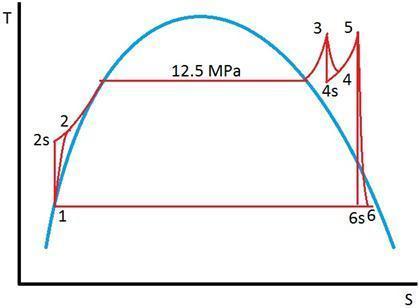
A steam power plant operates on the reheat Rankine cycle. Steam enters the highpressure turbine at 12.5 MPa and 550°C at a rate
gayaneshka [121]

Answer:

A) condenser pressure = 9.73 kPa,

B) 10242 kw

C) 36.9%

Explanation:

given data

entrance pressure of steam = 12.5 MPa

temperature of steam = 550⁰c

flow rate of steam = 7.7 kg/s

outer pressure = 2 MPa

reheated steam temperature = 450⁰c

isentropic efficiency of turbine( nt ) = 85% = 0.85

isentropic efficiency of pump = 90% = 0.90

From steam tables

at 12.5 MPa and 550⁰c ; h3 = 3476.5 kJ/kg,  S3 = 6.6317 kJ/kgK

also for an Isentropic expansion

S4s = S3 .

therefore when S4s = 6.6317 kJ/kg and P4 = 2 MPa

h4s = 2948.1 kJ/kg

nt = 0.85

nt (0.85) = \frac{h3-h4}{h3-h4s} = \frac{3476.5 - h4}{3476.5 - 2948.1}

making h4 subject of the equation

h4 = 3476.5 - 0.85 (3476.5 - 2948.1)

h4 = 3027.3 kj/kg

at P5 = 2 MPa and T5 = 450⁰c

h5 = 3358.2 kj/kg,  s5 = 7.2815 kj/kgk

at P6 , x6 = 0.95  and s5 = s6

using nt = 0.85 we can calculate for h6 and h6s

from the chart attached below we can see that

p6 = 9.73 kPa, h6 = 2463.3 kj/kg

B) the net power output

solution is attached below

c) thermal efficiency

thermal efficiency = 1 - \frac{qout}{qin} = 1 - ( 2273.7/ 3603.8) = 36.9% ≈ 37%

8 0
2 years ago
. A piston-cylinder device whose piston is resting on top of a set of stops initially contains 0.5 kg of helium gas at 100 kPa a
Delvig [45]

Answer:

Qin = 1857 kJ

Explanation:

Given

m = 0.5 Kg

T₁ = 25°C = (25 + 273) K = 298 K

P₁ = 100 kPa

P₂ = 500 kPa

First, the temperature when the piston starts rising is determined from the ideal gas equations at the initial state and at that state:

T₂ = T₁*P₂/P₁

⇒  T₂ = 298 K*(500 kPa/100 kPa) = 1490 K

Until the piston starts rising no work is done so the heat transfer is the change in internal energy

Qin = ΔU = m*cv*(T₂-T₁)

⇒   Qin = 0.5*3.1156*(1490 - 298) kJ = 1857 kJ

8 0
2 years ago
Other questions:
  • Oil with a density of 800 kg/m3 is pumped from a pressure of 0.6 bar to a pressure of 1.4 bar, and the outlet is 3 m above the i
    9·1 answer
  • Tin atoms are introduced into a FCC copper crystal, producing an alloy with a lattice pa- rameter of 3.7589 x 10⁻⁸ cm and a dens
    8·1 answer
  • You are working in a lab where RC circuits are used to delay the initiation of a process. One particular experiment involves an
    13·1 answer
  • A subway car leaves station A; it gains speed at the rate of 4 ft/s^2 for of until it has reached and then at the rate 6 then th
    8·1 answer
  • What is the PW (at i 5%) of SuperTool's new test equipment? The development cost is $1.2M. Net revenues will begin at $300,000 f
    9·1 answer
  • Discuss your interpretation of the confidence-precision trade-off, and provide a few examples of how you might make a choice in
    14·1 answer
  • An ideal Diesel cycle has a compression ratio of 18 and a cutoff ratio of 1.5. Determine the maximum air temperature and the rat
    9·1 answer
  • the ____ method is the safest turning technique to use as it does not expose your hands to the airbags deployment area
    15·1 answer
  • Question 14<br> Which of these is true of a spray wash cabinet?
    6·1 answer
  • How does Accenture generate value for clients through Agile and DevOps?
    15·2 answers
Add answer
Login
Not registered? Fast signup
Signup
Login Signup
Ask question!