answer.
Ask question
Login Signup
Ask question
All categories
  • English
  • Mathematics
  • Social Studies
  • Business
  • History
  • Health
  • Geography
  • Biology
  • Physics
  • Chemistry
  • Computers and Technology
  • Arts
  • World Languages
  • Spanish
  • French
  • German
  • Advanced Placement (AP)
  • SAT
  • Medicine
  • Law
  • Engineering
Anastaziya [24]
2 years ago
15

the ____ method is the safest turning technique to use as it does not expose your hands to the airbags deployment area

Engineering
1 answer:
Slav-nsk [51]2 years ago
6 0

Answer:

Push/pull Method

Explanation:

Push/pull method is seen as the best method to use when a driver what to steer a wheel to point the car in a particular direction reason been that PUSH/PULL method enables the driver to sit perfectly well in order to firmly hold the wheel which is why this method is often recommended as the safest and most effective way of steering than other steering method.

Therefore the PUSH/PULL method is the safest and the best turning technique to use because it does not expose the driver hands to the airbags area reason been that air bag are sometimes place in the centre of the steering wheel which means that when a driver cross his/her arms when steering will block the air bag in a situation where the air bag needed to explode out because airbag can explodes out with a lot of force which in turn could force the driver arms towards his/ her face which is dangerous.

You might be interested in
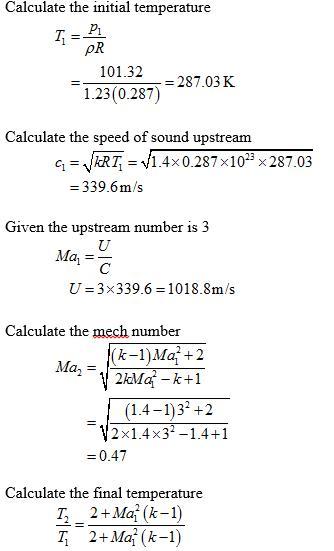
Consider a normal shock wave in air. The upstream conditions are given by M1=3, p1 = 1 atm, and r1 = 1.23 kg/m3. Calculate the d
mart [117]

Answer and Explanation:

The answer is attached below

7 0
2 years ago
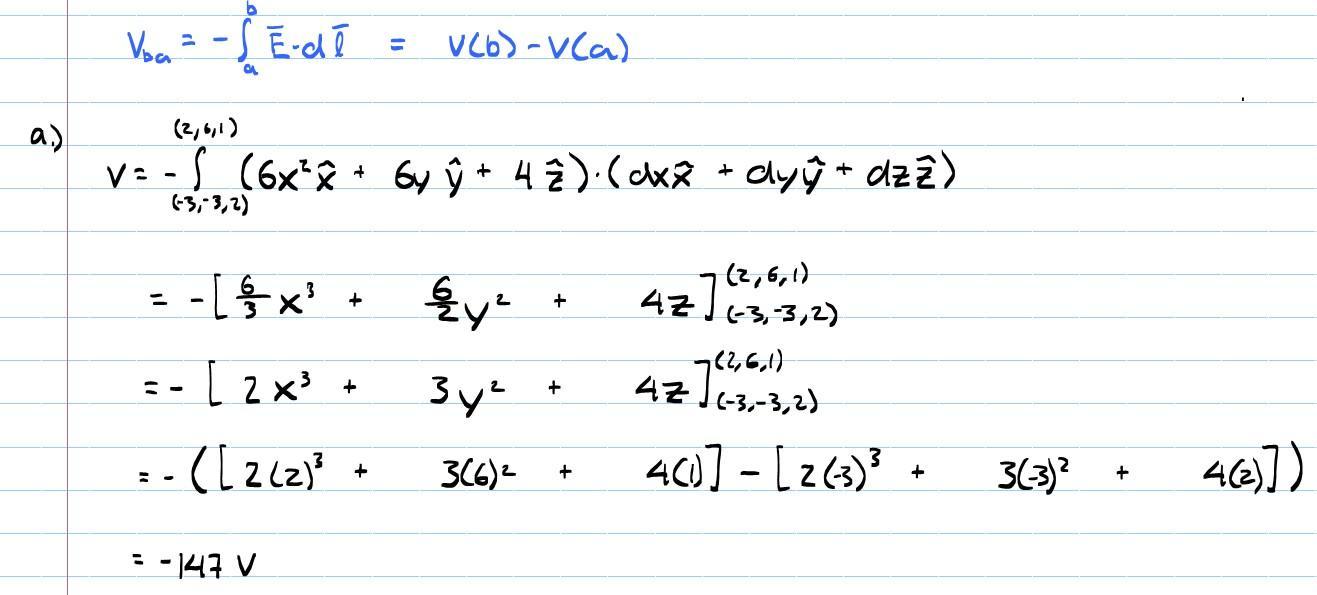
An electric field is expressed in rectangular coordinates by E = 6x2ax + 6y ay +4az V/m.Find:a) VMN if point M and N are specifi
Fittoniya [83]

Answer:

a.) -147V

b.) -120V

c.) 51V

Explanation:

a.) Equation for potential difference is the integral of the electrical field from a to b for the voltage V_ba = V(b)-V(a).

b.) The problem becomes easier to solve if you draw out the circuit. Since potential at Q is 0, then Q is at ground. So voltage across V_MQ is the same as potential at V_M.

c.) Same process as part b. Draw out the circuit and you'll see that the potential a point V_N is the same as the voltage across V_NP added with the 2V from the other box.

Honestly, these things take practice to get used to. It's really hard to explain this.

3 0
2 years ago
A thermometer requires 1 minute to indicate 98% of the response to a unit step input. Assuming the thermometer to be a first ord
Rama09 [41]

Answer:

Time constant = 15.34 seconds

The thermometer shows an error of 0.838°

Explanation:

Given

t = 1 minute = 60 seconds

c(t) = 98% = 0.98

According to the question, the thermometer is a first order system.

The first order system transfer function is given as;

C(s)/R(s) = 1/(sT + 1).

To calculate the time constant, we need to calculate the step response.

This is given as

r(t) = u(t) --- Take Laplace Transformation

R(s) = 1/s

Substitute 1/s for R(s) in C(s)/R(s) = 1/(sT + 1).

We have

C(s)/1/s = 1/(sT + 1)

C(s) = 1/(sT + 1) * 1/s

C(s) = 1/s - 1/(s + 1/T) --- Take Inverse Laplace Transformation

L^-1(C(s)) = L^-1(1/s - 1/(s + 1/T))

Since, e^-t <–> 1/(s + 1) --- {L}

1 <–> 1/s {L}

So, the unit response c(t) = 1 - e^-(t/T)

Substitute 0.98 for c(t) and 60 for t

0.98 = 1 - e^-(60/T)

0.98 - 1 = - e^-(60/T)

-0.02 = - e^-(60/T)

e^-(60/T) = 0.02

ln(e^-(60/T)) = ln(0.02)

-60/T = -3.912

T = -60/-3.912

T = 15.34 seconds

Time constant = 15.34 seconds

The error signal is given as

E(s) = R(s) - C(s)

Where the temperature changes at the rate of 10°/min; 10°/60 s = 1/6

So.

E(s) = R(s) - 1/6 C(s)

Calculating C(s)

C(s) = 1/s - 1/(s + 1/T)

C(s) = 1/s - 1/(s + 1/15.34)

Remember that R(s) = 1/s

So, E(s) becomes

E(s) = 1/s - 1/6(1/s - 1/(s + 1/15.34))

E(s) = 1/s - 1/6(1/s - 1/(s + 0.0652)

E(s) = 1/s - 1/6s + 1/(6(s+0.0652))

E(s) = 5/6s + 1/(6(s+0.0652))

E(s) = 0.833/s + 1/(6(s+0.0652)) ---- Take Inverse Laplace Transformation

e(t) = 1/6e^-0.652t + 0.833

For a first order system, the system attains a steady state condition when time is 4 times of Time constant.

So,

Time = 4 * 15.34

Time = 61.36 seconds

So, e(t) becomes

e(t) = 1/6e^-0.652t + 0.833

e(t) = 1/(6e^-0.652(61.36)) + 0.833

e(t) = 0.83821342824942664566211

e(t) = 0.838 --- Approximated

Hence, the thermometer shows an error of 0.838°

4 0
2 years ago
Read 2 more answers
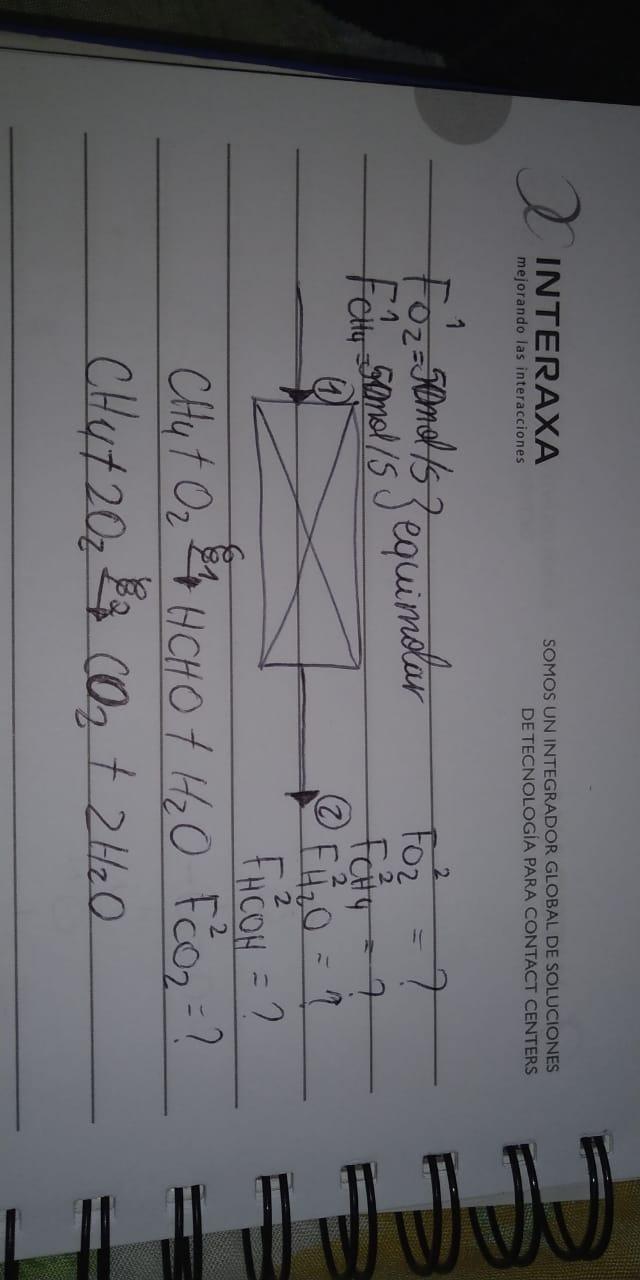
Methane and oxygen react in the presence of a catalyst to form formaldehyde. In a parallel reaction, methane is oxidized to carb
Nezavi [6.7K]

Answer:

y_{CH_4}^2=\frac{5mol/s}{100mol/s}=0.05\\y_{O_2}^2=\frac{3mol/s}{100mol/s}=0.03\\y_{H_2O}^2=\frac{47mol/s}{100mol/s}=0.47\\y_{HCHO}^2=\frac{43mol/s}{100mol/s}=0.43\\y_{CO_2}^2=\frac{2mol/s}{100mol/s}=0.02

Explanation:

Hello,

a. On the attached document, you can see a brief scheme of the process. Thus, to know the degrees of freedom, we state the following unknowns:

- \xi_1 and \xi_2: extent of the reactions (2).

- F_{O_2}^2, F_{CH_4}^2, F_{H_2O}^2, F_{HCHO}^2 and F_{CO_2}^2: Molar flows at the second stream (5).

On the other hand, we've got the following equations:

- F_{O_2}^2=50mol/s-\xi_1-2\xi_2: oxygen mole balance.

- F_{CH_4}^2=50mol/s-\xi_1-\xi_2: methane mole balance.

- F_{H_2O}^2=\xi_1+2\xi_2: water mole balance.

- F_{HCHO}^2=\xi_1: formaldehyde mole balance.

- F_{CO_2}^2=\xi_2: carbon dioxide mole balance.

Thus, the degrees of freedom are:

DF=7unknowns-5equations=2

It means that we need two additional equations or data to solve the problem.

b. Here, the two missing data are given. For the fractional conversion of methane, we define:

0.900=\frac{\xi_1+\xi_2}{50mol/s}

And for the fractional yield of formaldehyde we can set it in terms of methane as the reagents are equimolar:

0.860=\frac{F_{HCHO}^2}{50mol/s}

In such a way, one realizes that the output formaldehyde's molar flow is:

F_{HCHO}^2=0.860*50mol/s=43mol/s

Which is equal to the first reaction extent \xi_1, therefore, one computes the second one from the fractional conversion of methane as:

\xi_2=0.900*50mol/s-\xi_1\\\xi_2=0.900*50mol/s-43mol/s\\\xi_2=2mol/s

Now, one computes the rest of the output flows via:

- F_{O_2}^2=50mol/s-43mol/s-2*2mol/s=3mol/s

- F_{CH_4}^2=50mol/s-43mol/s-2mol/s=5mol/s

- F_{H_2O}^2=43mol/s+2*2mol/s=47mol/s

- F_{HCHO}^2=43mol/s

- F_{CO_2}^2=2mol/s

The total output molar flow is:

F_{O_2}+F_{CH_4}+F_{H_2O}+F_{HCHO}+F_{CO_2}=100mol/s

Therefore the output stream composition turns out into:

y_{CH_4}^2=\frac{5mol/s}{100mol/s}=0.05\\y_{O_2}^2=\frac{3mol/s}{100mol/s}=0.03\\y_{H_2O}^2=\frac{47mol/s}{100mol/s}=0.47\\y_{HCHO}^2=\frac{43mol/s}{100mol/s}=0.43\\y_{CO_2}^2=\frac{2mol/s}{100mol/s}=0.02

Best regards.

7 0
2 years ago
The wires each have a diameter of 12 mm, length of 0.6 m, and are made from 304 stainless steel. Determine the magnitude of forc
Sonbull [250]

Answer:

Magnitude of force P = 25715.1517 N

Explanation:

Given - The wires each have a diameter of 12 mm, length of 0.6 m, and are made from 304 stainless steel.

To find - Determine the magnitude of force P so that the rigid beam tilts 0.015∘.

Proof -

Given that,

Diameter = 12 mm = 0.012 m

Length = 0.6 m

\theta = 0.015°

Youngs modulus of elasticity of 34 stainless steel is 193 GPa

Now,

By applying the conditions of equilibrium, we have

∑fₓ = 0, ∑f_{y} = 0, ∑M = 0

If ∑M_{A} = 0

⇒F_{BC}×0.9 - P × 0.6 = 0

⇒F_{BC}×3 - P × 2 = 0

⇒F_{BC} = \frac{2P}{3}

If ∑M_{B} = 0

⇒F_{AD}×0.9 = P × 0.3

⇒F_{AD} ×3 = P

⇒F_{AD} = \frac{P}{3}

Now,

Area, A = \frac{\pi }{4} X (0.012)^{2} = 1.3097 × 10⁻⁴ m²

We know that,

Change in Length , \delta = \frac{P l}{A E}

Now,

\delta_{AD} = \frac{P(0.6)}{3(1.3097)(10^{-4}) (193)(10^{9}  } = 9.1626 × 10⁻⁹ P

\delta_{BC} = \frac{2P(0.6)}{3(1.3097)(10^{-4}) (193)(10^{9}  } = 1.83253 × 10⁻⁸ P

Given that,

\theta = 0.015°

⇒\theta = 2.618 × 10⁻⁴ rad

So,

\theta =  \frac{\delta_{BC} - \delta_{AD}}{0.9}

⇒2.618 × 10⁻⁴ = (  1.83253 × 10⁻⁸ P - 9.1626 × 10⁻⁹ P) / 0.9

⇒P = 25715.1517 N

∴ we get

Magnitude of force P = 25715.1517 N

6 0
2 years ago
Other questions:
  • An exercise room has six weight-lifting machines that have no motors and seven treadmills, each equipped with a 2.5-hp (shaft ou
    13·1 answer
  • Air is compressed adiabatically from p1 1 bar, T1 300 K to p2 15 bar, v2 0.1227 m3 /kg. The air is then cooled at constant volum
    13·1 answer
  • Technician A says that the most efficient method of EVAP system leak detection is introducing smoke under low pressure from a ma
    7·1 answer
  • A mixture of air and methane is formed in the inlet manifold of a natural gas-fueled internal combustion engine. The mole fracti
    14·1 answer
  • The mechanical properties of some metals may be improved by incorporating fine particles of their oxides. If the moduli of elast
    12·1 answer
  • A pair of spur gears with 20 degree pressure angle, full-depth, involute teeth transmits 65 hp. The pinion is mounted on a shaft
    5·1 answer
  • A glycerin pump is powered by a 5-kW electric motor. The pressure differential between the outlet and the inlet of the pump at f
    13·1 answer
  • The rectangular frame is composed of four perimeter two-force members and two cables AC and BD which are incapable of supporting
    9·1 answer
  • Who can work on a fixed ladder that extends more than 24 feet?
    11·1 answer
  • How does Accenture generate value for clients through Agile and DevOps?
    15·2 answers
Add answer
Login
Not registered? Fast signup
Signup
Login Signup
Ask question!