answer.
Ask question
Login Signup
Ask question
All categories
  • English
  • Mathematics
  • Social Studies
  • Business
  • History
  • Health
  • Geography
  • Biology
  • Physics
  • Chemistry
  • Computers and Technology
  • Arts
  • World Languages
  • Spanish
  • French
  • German
  • Advanced Placement (AP)
  • SAT
  • Medicine
  • Law
  • Engineering
LuckyWell [14K]
2 years ago
13

A glycerin pump is powered by a 5-kW electric motor. The pressure differential between the outlet and the inlet of the pump at f

ull load is measured to be 211 kPa. If the flow rate through the pump is 18 L/s, and the changes in elevation and the flow velocity across the pump are negligible, what is the overall efficiency of the pump
Engineering
1 answer:
Mila [183]2 years ago
6 0

Answer:

Explanation:

Given that:

The pressure differential between the outlet and the inlet of the pump at full load is measured to be ΔP is 211 kPa.

the flow rate through the pump is 18 L/s

The Formula of flow rate.

{Q_f} = \frac{{{P_o}}}{{\Delta P}}

Rearrange

{P_o} = \Delta P\left( {{Q_f}} \right)

Substitute 211{\rm{ kPa}}\, for\, \Delta P \,and\, 18{\rm{ L/s}}\, for\, {Q_f}

\begin{array}{c}\\{P_o} = \left( {211{\rm{ kPa}}} \right)\left( {\left( {18{\rm{ L/s}}} \right)\left( {\frac{{{{10}^{ - 3}}{\rm{ }}{{\rm{m}}^{\rm{3}}}{\rm{/s}}}}{{1\;{\rm{L/s}}}}} \right)} \right)\\\\ = 3.8{\rm{ kW}}\\\end{array}

​The formula for the overall efficiency of the pump.

\eta = \frac{{{P_o}}}{{{{\rm{P}}_{in}}}} \times 100

input the values 3.8kW for {P_o} and 5kW for {P_i}

\begin{array}{c}\\\eta = \left( {\frac{{3.8{\rm{ kW}}}}{{5{\rm{ kW}}}}} \right) \times 100\\\\ = 76\% \\\end{array}

The overall efficiency of the glycerin pump is 76% .

You might be interested in
three balls each have a mass m if a has a speed v just before a direct collision with B determine the speed of C after collision
ratelena [41]

Answer:

Vc2= V(l+e) ^2/4

Vg2= V(l-e^2)/4

Explanation:

Conservation momentum, when ball A strikes Ball B

Where,

M= Mass

V= Velocity

Ma(VA)1+ Mg(Vg)2= Ma(Va)2+ Ma(Vg)2

MV + 0= MVg2

Coefficient of restitution =

e= (Vg)2- (Va)2/(Va)1- (Vg)1

e= (Vg)2- (Va)2/ V-0

Solving equation 1 and 2 yield

(Va)2= V(l-e) /2

(Vg)2= V(l+e)/2

Conservative momentum when ball b strikes c

Mg(Vg)2+Mc(Vc)1 = Mg(Vg)3+Mc(Vc)2

=> M[V(l+e) /2] + 0 = M(Vg)3 + M(Vc) 2

Coefficient of Restitution,

e= (Vc)2 - (Vg)2/(Vg)2- (Vc)1

=> e= (Vc)2 - (Vg)2/V(l+e) /2

Solving equation 3 and 4,

Vc2= V(l+e) ^2/4

Vg2= V(l-e^2)/4

8 0
2 years ago
Read 2 more answers
An excited electron in an Na atom emits radiation at a wavelength 589 nm and returns to the ground state. If the mean time for t
11Alexandr11 [23.1K]

Answer:   Inherent width in the emission line: 9.20 × 10⁻¹⁵ m or 9.20 fm

                length of the photon emitted: 6.0 m

Explanation:

The emitted wavelength is 589 nm and the transition time is ∆t = 20 ns.

Recall the Heisenberg's uncertainty principle:-

                                 ∆t∆E ≈ h ( Planck's Constant)

The transition time ∆t corresponds to the energy that is ∆E

E=h/t = \frac{(1/2\pi)*6.626*10x^{-34} J.s}{20*10x^{-9} } = 5.273*10x^{-27} J =  3.29* 10^{-8} eV.

The corresponding uncertainty in the emitted frequency ∆v is:

∆v= ∆E/h = (5.273*10^-27 J)/(6.626*10^ J.s)=  7.958 × 10^6 s^-1

To find the corresponding spread in wavelength and hence the line width ∆λ, we can differentiate

                                                    λ = c/v

                                                    dλ/dv = -c/v² = -λ²/c

Therefore,

      ∆λ = (λ²/c)*(∆v) = {(589*10⁻⁹ m)²/(3.0*10⁸ m/s)} * (7.958*10⁶ s⁻¹)

                                 =  9.20 × 10⁻¹⁵ m or 9.20 fm

     The length of the photon (<em>l)</em> is

l = (light velocity) × (emission duration)

  = (3.0 × 10⁸  m/s)(20 × 10⁻⁹ s) = 6.0 m          


6 0
2 years ago
An 80-L vessel contains 4 kg of refrigerant-134a at a pressure of 160kPa. Determine (a) the temperature, (b) the quality, (c) th
makvit [3.9K]

Answer:

temperature -15.6 C, quality x=0.646, enthalpy h=667.20 KJ, volume of vapor phase Vg= 79.8 L

Explanation:

property table for R-134a

https://www.ohio.edu/mechanical/thermo/property_tables/R134a/R134a_PresSat.html

at 160 KPa , temperature = -15.66 C

quality x=mass of vapour/ total mass of liq-vap mixture

alternaternately: x=(v-vf)/(vg-vf)    

v=total volume i.e. volume of container"80L"   80L=0.08 cubic meter

vf=vol of liquid phase  vg=vol of vapor phase vf, vg values at 160Kpa

x=(0.08-0.0007437)/(0.1235-0.0007437)=0.646

enthalpy

h=hf+xhfg          hf, hfg values at 160Kpa

h=hf+xhfg=31.2+0.646(209.9)=166.80 KJ/Kg

for 4Kg R-134a h=m(166.80 KJ/Kg )=667.20 KJ

volume of vapor phase

vg at 160Kpa=0.1235 cubic meter for quality=1.

in this case quality=0.646 , so it will occupy 64.6% space of the vapor phase at quality=1.

vol. of vapor phase=0.646*0.1235=0.0798 cubic meter=79.8 L

7 0
2 years ago
A three-point bending test was performed on an aluminum oxide specimen having a circular cross section of radius 3.5 mm (0.14 in
RideAnS [48]

To resolve this problem we have,

R=3.5mm\\F_f1=950N\\L_1=50mm\\b=12mm\\L_2=40mm

F_{f2} is unknown.

With these dates we can calculate the Flexural strenght of the specimen,

\sigma{fs}=\frac{F_{f1}L}{\pi R^3}\\\sigma{fs}=\frac{(950)(50*10^{-3})}{\pi 3.5*10^{-3}}\\\sigma{fs}=352.65Mpa

After that, we can calculate the flexural strenght for the square cross section using the previously value.

\sigma{fs}=\frac{F_{f2}L}{\pi R^3}\\(352.65*10^6)=\frac{3Ff(40*10^{-3})}{2(12*10^{-10})}\\F_{f2}=\frac{352.65*10^6}{34722.22}\\F_{f2}=10156.32N\\F_{f2}=10.2kN

6 0
2 years ago
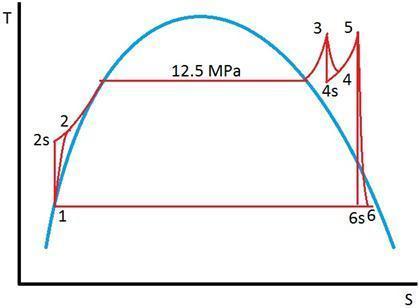
A steam power plant operates on the reheat Rankine cycle. Steam enters the highpressure turbine at 12.5 MPa and 550°C at a rate
gayaneshka [121]

Answer:

A) condenser pressure = 9.73 kPa,

B) 10242 kw

C) 36.9%

Explanation:

given data

entrance pressure of steam = 12.5 MPa

temperature of steam = 550⁰c

flow rate of steam = 7.7 kg/s

outer pressure = 2 MPa

reheated steam temperature = 450⁰c

isentropic efficiency of turbine( nt ) = 85% = 0.85

isentropic efficiency of pump = 90% = 0.90

From steam tables

at 12.5 MPa and 550⁰c ; h3 = 3476.5 kJ/kg,  S3 = 6.6317 kJ/kgK

also for an Isentropic expansion

S4s = S3 .

therefore when S4s = 6.6317 kJ/kg and P4 = 2 MPa

h4s = 2948.1 kJ/kg

nt = 0.85

nt (0.85) = \frac{h3-h4}{h3-h4s} = \frac{3476.5 - h4}{3476.5 - 2948.1}

making h4 subject of the equation

h4 = 3476.5 - 0.85 (3476.5 - 2948.1)

h4 = 3027.3 kj/kg

at P5 = 2 MPa and T5 = 450⁰c

h5 = 3358.2 kj/kg,  s5 = 7.2815 kj/kgk

at P6 , x6 = 0.95  and s5 = s6

using nt = 0.85 we can calculate for h6 and h6s

from the chart attached below we can see that

p6 = 9.73 kPa, h6 = 2463.3 kj/kg

B) the net power output

solution is attached below

c) thermal efficiency

thermal efficiency = 1 - \frac{qout}{qin} = 1 - ( 2273.7/ 3603.8) = 36.9% ≈ 37%

8 0
2 years ago
Other questions:
  • generally compound curves are not filtered recommended for A. Road B. water way C. underground road D. rail way​
    12·1 answer
  • A closed system consisting of 4 lb of a gas undergoes a process during which the relation between pressure and volume is pVn 5 c
    7·1 answer
  • How much extra water does a 21.5 ft, 175-lb concrete canoe displace compared to an ultra-lightweight 38-lb Kevlar canoe of the s
    8·1 answer
  • Oil in an engine is being cooled by air in a cross-flow heat exchanger, where both fluids are unmixed. Oil (cp = 2000 J/kg. K) f
    12·1 answer
  • Two physical properties that have a major influence on the cracking of workpieces, tools, or dies during thermal cycling are the
    13·1 answer
  • The driving force for fluid flow is the pressure difference, and a pump operates by raising the pressure of a fluid (by converti
    13·1 answer
  • Sea water with a density of 1025 kg/m3 flows steadily through a pump at 0.21 m3 /s. The pump inlet is 0.25 m in diameter. At the
    8·1 answer
  • An equation used to evaluate vacuum filtration is Q = ΔpA2 α(VRw + ARf) , Where Q ≐ L3/T is the filtrate volume flow rate, Δp ≐
    13·1 answer
  • What ratio between differential gain and common-mode gain is called​
    9·1 answer
  • Mr. Ray deposited $200,000 in the Old and Third National Bank. If the bank pays 8% interest, how much will he have in the accoun
    10·2 answers
Add answer
Login
Not registered? Fast signup
Signup
Login Signup
Ask question!