answer.
Ask question
Login Signup
Ask question
All categories
  • English
  • Mathematics
  • Social Studies
  • Business
  • History
  • Health
  • Geography
  • Biology
  • Physics
  • Chemistry
  • Computers and Technology
  • Arts
  • World Languages
  • Spanish
  • French
  • German
  • Advanced Placement (AP)
  • SAT
  • Medicine
  • Law
  • Engineering
alukav5142 [94]
2 years ago
8

Tin atoms are introduced into a FCC copper crystal, producing an alloy with a lattice pa- rameter of 3.7589 x 10⁻⁸ cm and a dens

ity of 8.772 g/cm3. Calculate the atomic percentage of tin present in the alloy.
Engineering
1 answer:
stira [4]2 years ago
7 0

Given:

Lattice parameter, a = 3.7589\times 10^{-8}cm

density, \rho = 8.772g/cm^{3}\\

Solution:

We know that  for FCC, total no. of atoms in a crystal lattice = 4

let the number of atoms in Tin for alloying be 'n'

⇒ Total no. of Copper atoms in the alloy,  = 4 - n

Also mass of Copper, m = 63.54 g/mol

atomic mass of Tin = 118.69 g/mol

We Know density of the crystal lattice is given by the formula:

\rho = \frac{m\times Z}{a^{3}\times N_{A}}                 (1)

where,

N_{A} = Avagadro's number =  6.23\times 10_{23}

Putting all the values in eqn (1), we get

8.772 = \frac{118.69\times x\times (4 - n)\times 63.54}{(3.7589\times 10^{-8})^{3}\times 6.023\times 10^{23}}

280.6 = 55.15n +254.16

n = 0.479 atoms/cell

Now to calculate the atomic percentage of Tin present in the alloy:

atomic percentage = \frac{no. of atoms in Tin/cell}{Total no. of atoms in FCC lattice}

atomic % Tin present in alloy = \frac{0.479}{4} = 0.1198\times 100

atomic % Tin present in alloy = 11.98%

You might be interested in
A thin, flat plate that is 0.2 m × 0.2 m on a side is oriented parallel to an atmospheric airstream having a velocity of 40 m/s.
Leto [7]

Answer:

The rate of heat transfer from both sides of the plate to the air is 240 W

Explanation:

Given;

area of the flat plate = 0.2 m × 0.2 m = 0.04 m²

velocity of atmospheric air stream, v = 40 m/s

drag force, F =  0.075 N

The rate of heat transfer from both sides of the plate to the air:

q = 2 [h'(A)(Ts -T∞)]

where;

h' is heat transfer coefficient obtained from Chilton-Colburn analogy

h' = \frac{C_f}{2} \rho u C_p P_r^{-2/3}\\\\\frac{C_f}{2} = \frac{\tau'_s}{2*\rho u^2/2}

Properties of air at 70°C and 1 atm:

ρ = 1.018 kg/m³, cp = 1009 J/kg.K, Pr = 0.7, v = 20.22 x 10⁻⁶ m²/s

\frac{C_f}{2} = \frac{(0.075/2)/(0.2)^2}{2*(1.018)(40)^2/2} = 5.756*10^{-4}\\\\Thus,\\h' = 5.756*10^{-4} (1.018*40*1009)*(0.7)^{-2/3}\\\\h' = 30 \ W/m^2.K

Finally;

q = 2 [ 30(0.04)(120 - 20) ]

q = 240 W

Therefore, the rate of heat transfer from both sides of the plate to the air is 240 W

4 0
2 years ago
Read 2 more answers
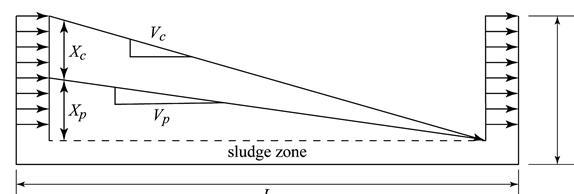
The rate of flow through an ideal clarifier is 8000m3 /d, the detention time is 1h and the depth is 3m. If a full-length movable
Fittoniya [83]

Answer:

a) 35%

b) yes it can be improved by moving the tray near the top

   Tray should be located ( 1 to 2 meters below surface )

   max removal efficiency ≈ 70%

c) The maximum removal will drop as the particle settling velocity = 0.5 m/h

Explanation:

Given data:

flow rate = 8000 m^3/d

Detention time = 1h

depth = 3m

Full length movable horizontal tray :  1m below surface

<u>a) Determine percent removal of particles having a settling velocity of 1m/h</u>

velocity of critical sized particle to be removed = Depth / Detention time

= 3 / 1 = 3m/h

The percent removal of particles having a settling velocity of 1m/h ≈ 35%

<u>b) Determine if  the removal efficiency of the clarifier can be improved by moving the tray, the location of the tray  and the maximum removal efficiency</u>

The tray should be located near the top of the tray ( i.e. 1 to 2 meters below surface ) because here the removal efficiency above the tray will be 100% but since the tank is quite small hence the

Total Maximum removal efficiency

=  percent removal_{above} + percent removal_{below}

= ( d_{a},v_{p} ) . \frac{d_{a} }{depth}  + ( d_{a},v_{p} ) . \frac{depth - d_{a} }{depth}  = 100

hence max removal efficiency ≈ 70%

<u>c) what is the effect of moving the tray would be if the particle settling velocity were equal to 0.5m/h?</u>

The maximum removal will drop as the particle settling velocity = 0.5 m/h

7 0
2 years ago
If the current on your power supply exceeds 500 mA it can damage the supply. Suppose the supply is set for 37 V. What is the sma
lilavasa [31]

Answer:

74 Ω

Explanation:

Data provided in the question:

Maximum value of the current that can be provided = 500 mA

= 500 × 10⁻³ A  

Applied voltage set for the system = 37 V

Now,  

The smallest resistance that can be measured    

= [ Applied voltage ] ÷ [ Maximum current that can be applied ]

= 37 ÷ (  500 × 10⁻³ )

= 74 Ω

4 0
2 years ago
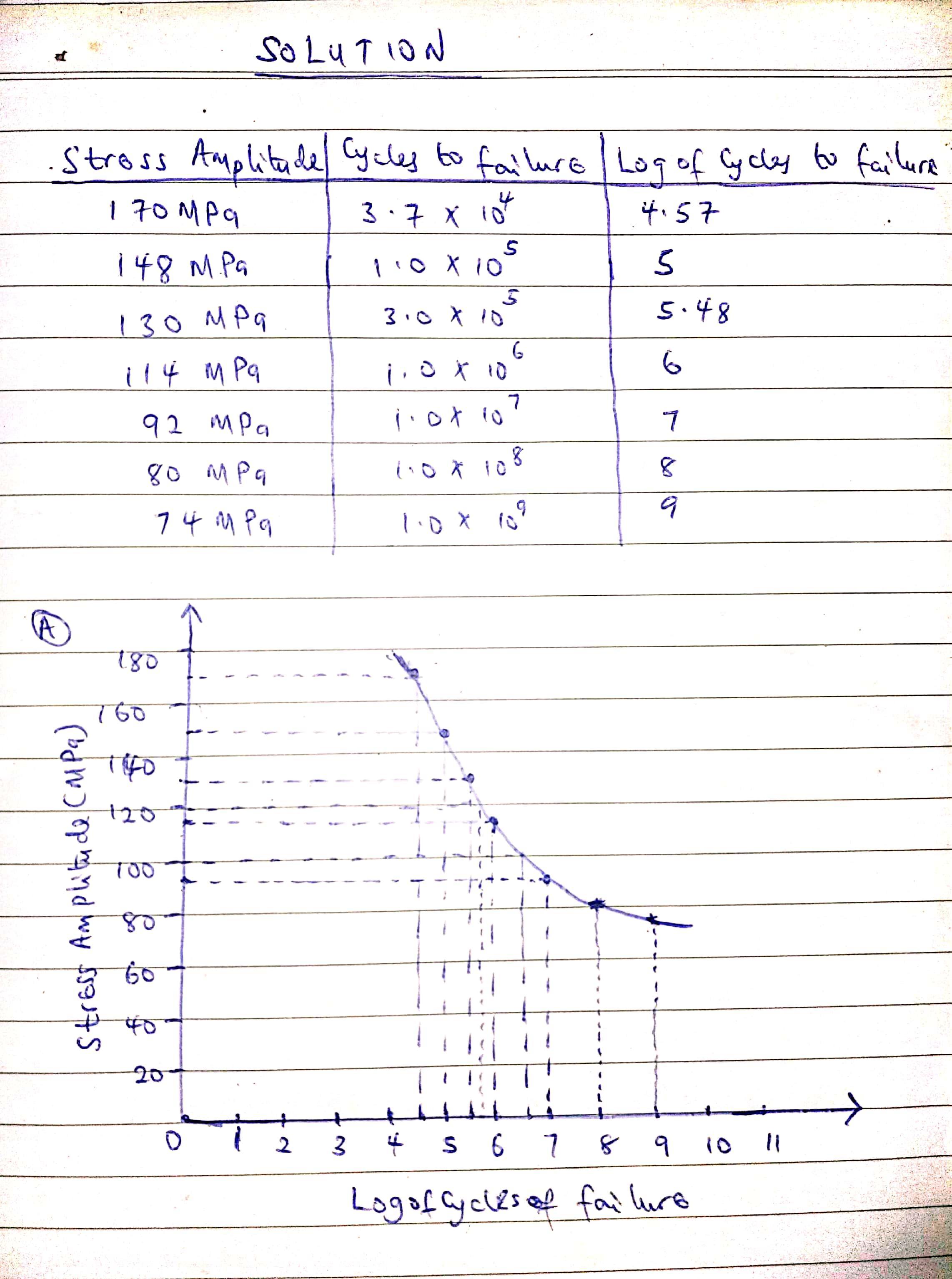
The fatigue data for a brass alloy are given as follows: Stress Amplitude (MPa) Cycles to Failure 170 3.7 × 10⁴ 148 1.0 × 10⁵ 13
prohojiy [21]

Answer:

i) S–N plot is attached

ii) fatigue strength = 100 MPa

iii) fatigue life = 5.62 x 10^(5) cycles

Explanation:

i) I have attached the S–N plot (stress amplitude versus logarithm of cycles to failure)

ii) The question says we should find the fatigue strength at 4 × 10^(6) cycles.

So let's find the log of this and trace it on the graph attached.

Log(4 × 10^(6)) = 6.6

From the graph attached, at log of cycle value of 6.6, the fatigue strength is approximately 100 MPa

iii) The question says we should find the fatigue life for 120 MPa.

Thus, from the graph, at stress amplitude of 120 MPa, the log of cycles is approximately 5.75.

Thus,the fatigue life will be the inverse log of 5.75.

Thus, fatigue life = 10^(5.75)

Fatigue life = 5.62 x 10^(5)

8 0
2 years ago
A horizontal, cylindrical, tank, with hemispherical ends, is used to store liquid chlorine at 10 bar. The vessel is 4 m internal
sp2606 [1]

Answer: 0.021818m =2.18x10^-²m

Explanation: Using Laplace principle

Design pressure is =12 bar= 1200000N/m²

T = Wall thickness

Design stress=110Mn/m²= 110,000,000N/m²

Radius= diameter/2 =4/2=2m

Design stress=Hoop stress =Pr/t where p=internal pressure or internal pressure, r=radius and t= wall thickness.

As Laplace equation stated.

110,000,000= 1,2000,00 x 2/t

t= 2,400,000/110,000,000.

t= 0.021818m

t=2.18x10^-2m.

3 0
2 years ago
Other questions:
  • A circular ceramic plate that can be modeled as a blackbody is being heated by an electrical heater. The plate is 30 cm in diame
    15·1 answer
  • A vineyard owner is planting several new rows of grapevines, and needs to know how many grapevines to plant in each row. She has
    8·1 answer
  • Refrigerant-134a at 400 psia has a specific volume of 0.1384 ft3/lbm. Determine the temperature of the refrigerant based on (a)
    6·1 answer
  • Two airstreams are mixed steadily and adiabatically. The first stream enters at 35°C and 30 percent relative humidity at a rate
    6·1 answer
  • Oil enters a counterflow heat exchanger at 600 K with a mass flow rate of 10 kg/s and exits at 200 K. A separate stream of liqui
    12·1 answer
  • What are practical considerations you might encounter when you increase the moment of inertia (I) while keeping the cross-sectio
    13·1 answer
  • Air ows steadily in a thermally insulated pipe with a constant diameter of 6.35 cm, and an average friction factor of 0.005. At
    5·1 answer
  • The BARO sensor informs the PCM about changes in weather and ____________________.
    14·1 answer
  • You are the scheduler for a large commercial building project. The schedule that you prepared (based on feedback from the projec
    7·1 answer
  • A rectangular channel 3.0 m wide has a flow rate of 5.0 m3/s with a normal depth of 0.50 m. The flow then encounters a dam that
    9·1 answer
Add answer
Login
Not registered? Fast signup
Signup
Login Signup
Ask question!