answer.
Ask question
Login Signup
Ask question
All categories
  • English
  • Mathematics
  • Social Studies
  • Business
  • History
  • Health
  • Geography
  • Biology
  • Physics
  • Chemistry
  • Computers and Technology
  • Arts
  • World Languages
  • Spanish
  • French
  • German
  • Advanced Placement (AP)
  • SAT
  • Medicine
  • Law
  • Engineering
Anarel [89]
2 years ago
13

What are practical considerations you might encounter when you increase the moment of inertia (I) while keeping the cross-sectio

nal area fixed?
Engineering
1 answer:
Mrrafil [7]2 years ago
4 0

Answer:

The answer is below

Explanation:

The practical considerations you might encounter when you increase the moment of inertia (I) while keeping the cross-sectional area fixed are:

1. Shapes of moment of inertia: Engineers should consider or know the different shapes of moment of inertia for different shape

2. Understanding the orientation of the beam: this will allow engineers to either increase or decrease the moment of inertia of a beam without increasing its cross sectional area.

You might be interested in
Which of the following is correct regarding the principal stresses and maximum in-plane shear stresses? a. Principal stresses ca
ziro4ka [17]

Answer:

option B.

Explanation:

The correct answer is option B.

Principal stress is the maximum normal stress a body can have. In principal stress, there is purely normal stress. On principal plane shear stress is zero.

In-plane shear stress are the shear stress which is acting on the plane.

The statement which is correct regarding principle plane and shear stress is that The shear stress over principal stress planes is always zero.

4 0
2 years ago
thermal energy is being added to steam at 475.8 kPa and 75% quality. determine the amount of thermal energy to be added to creat
eduard

Answer:

q_{in} = 528.6\,\frac{kJ}{kg}

Explanation:

Let assume that heating process occurs at constant pressure, the phenomenon is modelled by the use of the First Law of Thermodynamics:

q_{in} = h_{g} - h_{mix}

The specific enthalpies are:

Liquid-Vapor Mixture:

h_{mix} = 2217.2\,\frac{kJ}{kg}

Saturated Vapor:

h_{g} = 2745.8\,\frac{kJ}{kg}

The thermal energy per unit mass required to heat the steam is:

q_{in} = 2745.8\,\frac{kJ}{kg} - 2217.2\,\frac{kJ}{kg}

q_{in} = 528.6\,\frac{kJ}{kg}

7 0
2 years ago
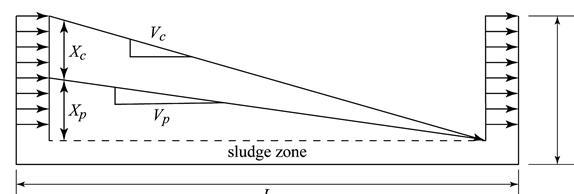
The rate of flow through an ideal clarifier is 8000m3 /d, the detention time is 1h and the depth is 3m. If a full-length movable
Fittoniya [83]

Answer:

a) 35%

b) yes it can be improved by moving the tray near the top

   Tray should be located ( 1 to 2 meters below surface )

   max removal efficiency ≈ 70%

c) The maximum removal will drop as the particle settling velocity = 0.5 m/h

Explanation:

Given data:

flow rate = 8000 m^3/d

Detention time = 1h

depth = 3m

Full length movable horizontal tray :  1m below surface

<u>a) Determine percent removal of particles having a settling velocity of 1m/h</u>

velocity of critical sized particle to be removed = Depth / Detention time

= 3 / 1 = 3m/h

The percent removal of particles having a settling velocity of 1m/h ≈ 35%

<u>b) Determine if  the removal efficiency of the clarifier can be improved by moving the tray, the location of the tray  and the maximum removal efficiency</u>

The tray should be located near the top of the tray ( i.e. 1 to 2 meters below surface ) because here the removal efficiency above the tray will be 100% but since the tank is quite small hence the

Total Maximum removal efficiency

=  percent removal_{above} + percent removal_{below}

= ( d_{a},v_{p} ) . \frac{d_{a} }{depth}  + ( d_{a},v_{p} ) . \frac{depth - d_{a} }{depth}  = 100

hence max removal efficiency ≈ 70%

<u>c) what is the effect of moving the tray would be if the particle settling velocity were equal to 0.5m/h?</u>

The maximum removal will drop as the particle settling velocity = 0.5 m/h

7 0
2 years ago
A steady tensile load of 5.00kN is applied to a square bar, 12mm on a side and having a length of 1.65m. compute the stress in t
Shtirlitz [24]

Answer:

The stress in the bar is 34.72 MPa.

The design factor (DF) for each case is:

A) DF=0.17

B) DF=0.09

C) DF=0.125

D) DF=0.12

E) DF=0.039

F) DF=1.26

G) DF=5.5

Explanation:

The design factor is the relation between design stress and failure stress. In the case of ductile materials like metals, the failure stress considered is the yield stress. In the case of plastics or ceramics, the failure stress considered is the breaking stress (ultimate stress). If the design factor is less than 1, the structure or bar will endure the applied stress. By the opposite side, when the DF is higher than 1, the structure will collapse or the bar will break.

we will calculate the design stress in this case:

\displaystyle \sigma_{dis}=\frac{T_l}{Sup}=\frac{5.00KN}{(12\cdot10^{-3}m)^2}=34.72MPa

The design factor for metals is:

DF=\displaystyle \frac{\sigma_{dis}}{\sigma_{f}}=\frac{\sigma_{dis}}{\sigma_{y}}

The design factor for plastic and ceramics is:

DF=\displaystyle \frac{\sigma_{dis}}{\sigma_{f}}=\frac{\sigma_{dis}}{\sigma_{u}}

We now need to know the yield stress or the ultimate stress for each material. We use the AISI and ASTM charts for steels, materials charts for non-ferrous materials and plastics safety charts for the plastic materials.

For these cases:

A) The yield stress of AISI 120 hot-rolled steel (actually is AISI 1020) is 205 MPa, therefore:

DF=\displaystyle\frac{34.72MPa}{205MPa}=0.17

B) The yield stress of AISI 8650 OQT 1000 steel is 385 MPa, therefore:

DF=\displaystyle\frac{34.72MPa}{385MPa}=0.09

C) The yield stress of ductile iron A536-84 (60-40-18) is 40Kpsi, this is 275.8 MPa, therefore:

DF=\displaystyle\frac{34.72MPa}{275.8MPa}=0.125

D) The yield stress of aluminum allot 6061-T6 is 290 MPa, therefore:

DF=\displaystyle\frac{34.72MPa}{290MPa}=0.12

E) The yield stress of titanium alloy Ti-6Al-4V annealed (certified by manufacturers) is 880 MPa, therefore:

DF=\displaystyle\frac{34.72MPa}{880MPa}=0.039

F) The ultimate stress of rigid PVC plastic (certified by PVC Pipe Association) is 4Kpsi or 27.58 MPa, therefore:

DF=\displaystyle\frac{34.72MPa}{27.58 MPa}=1.26

In this case, the bar will break.

F) You have to consider that phenolic plastics are used as matrix in composite materials and seldom are used alone with no reinforcement. In this question is not explained if this material is reinforced or not, therefore I will use the ultimate stress of most pure phenolic plastics, in this case, 6.31 MPa:

DF=\displaystyle\frac{34.72MPa}{6.31 MPa}=5.5

This material will break.

3 0
2 years ago
A converging-diverging nozzle is designed to operate with an exit Mach number of 1.75 . The nozzle is supplied from an air reser
Flura [38]

Answer:

a. 4.279 MPa

b. 3.198 MPa to 4.279 MPa

c. 0.939 MPa

d. Below 3.198 MPa

Explanation:

From the given parameters

M_{exit} = 1.75 MPa  

M at 1.6 MPa gives A_{exit}/A* = 1.2502

M at 1.8 MPa gives  A_{exit}/A* = 1.4390

Therefore, by interpolation, we have M_{exit} = 1.75 MPa  gives A

However, we shall use M_{exit} = 1.75 MPa and A

Similarly,

P_{exit}/P₀ = 0.1878

a) Where the nozzle is choked at the throat there is subsonic flow in the following diverging part of the nozzle. From tables, we have

A_{exit}/A* = 1.387. by interpolation M

Therefore P_{exit} = P₀ × P

Which shows that the nozzle is choked for back pressures lower than 4.279 MPa

b) Where there is a normal shock at the exit of the nozzle, we have;

M₁ = 1.75 MPa, P₁ = 0.1878 × 5 = 0.939 MPa

Where the normal shock is at M₁ = 1.75 MPa, P₂/P₁ = 3.406

Where the normal shock occurs at the nozzle exit, we have

P_b = 3.406\times 0.939 = 3.198 MPa

Where the shock occurs t the section prior to the nozzle exit from the throat, the back pressure was derived as P_b = 4.279 MPa

Therefore the back pressure value ranges from 3.198 MPa to 4.279 MPa

c) At M_{exit} = 1.75 MPa  and P

d) Where the back pressure is less than 3.198 MPa according to isentropic flow relations supersonic flow will exist at the exit plane    

8 0
2 years ago
Other questions:
  • Tin atoms are introduced into a FCC copper crystal, producing an alloy with a lattice pa- rameter of 3.7589 x 10⁻⁸ cm and a dens
    8·1 answer
  • A long aluminum wire of diameter 3 mm is extruded at a temperature of 280°C. The wire is subjected to cross air flow at 20°C at
    9·1 answer
  • Water is the working fluid in an ideal Rankine cycle. The condenser pressure is 8 kPa, and saturated vapor enters the turbine at
    10·1 answer
  • Some states have osha programs, but you should always defer to the federal program.
    8·2 answers
  • Given a 5x5 matrix for Playfair cipher a. How many possible keys does the Playfair cipher have? Ignore the fact that some keys m
    6·1 answer
  • A negative pressure respirator brings fresh air to you through a hose<br>A) True<br>B)False​
    15·2 answers
  • A vineyard owner is planting several new rows of grapevines, and needs to know how many grapevines to plant in each row. She has
    8·1 answer
  • Sea water with a density of 1025 kg/m3 flows steadily through a pump at 0.21 m3 /s. The pump inlet is 0.25 m in diameter. At the
    8·1 answer
  • Technician A says that the most efficient method of EVAP system leak detection is introducing smoke under low pressure from a ma
    7·1 answer
  • A mixture of air and methane is formed in the inlet manifold of a natural gas-fueled internal combustion engine. The mole fracti
    14·1 answer
Add answer
Login
Not registered? Fast signup
Signup
Login Signup
Ask question!