answer.
Ask question
Login Signup
Ask question
All categories
  • English
  • Mathematics
  • Social Studies
  • Business
  • History
  • Health
  • Geography
  • Biology
  • Physics
  • Chemistry
  • Computers and Technology
  • Arts
  • World Languages
  • Spanish
  • French
  • German
  • Advanced Placement (AP)
  • SAT
  • Medicine
  • Law
  • Engineering
AleksandrR [38]
2 years ago
5

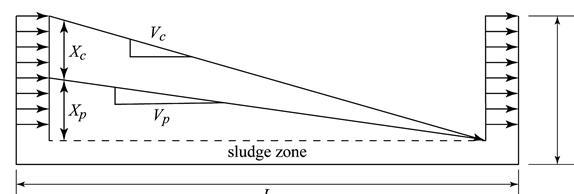
The rate of flow through an ideal clarifier is 8000m3 /d, the detention time is 1h and the depth is 3m. If a full-length movable

horizontal tray is set 1m below the surface of the water, a) determine the percent removal of particles having a settling velocity of 1m/h. b) Could the removal efficiency of the clarifier to be improved by moving the tray? If so, where should the tray be located and what would be the maximum removal efficiency? c) What effect would moving the tray have if the particle settling velocity were equal to 0.5m/h?
Engineering
1 answer:
Fittoniya [83]2 years ago
7 0

Answer:

a) 35%

b) yes it can be improved by moving the tray near the top

   Tray should be located ( 1 to 2 meters below surface )

   max removal efficiency ≈ 70%

c) The maximum removal will drop as the particle settling velocity = 0.5 m/h

Explanation:

Given data:

flow rate = 8000 m^3/d

Detention time = 1h

depth = 3m

Full length movable horizontal tray :  1m below surface

<u>a) Determine percent removal of particles having a settling velocity of 1m/h</u>

velocity of critical sized particle to be removed = Depth / Detention time

= 3 / 1 = 3m/h

The percent removal of particles having a settling velocity of 1m/h ≈ 35%

<u>b) Determine if  the removal efficiency of the clarifier can be improved by moving the tray, the location of the tray  and the maximum removal efficiency</u>

The tray should be located near the top of the tray ( i.e. 1 to 2 meters below surface ) because here the removal efficiency above the tray will be 100% but since the tank is quite small hence the

Total Maximum removal efficiency

=  percent removal_{above} + percent removal_{below}

= ( d_{a},v_{p} ) . \frac{d_{a} }{depth}  + ( d_{a},v_{p} ) . \frac{depth - d_{a} }{depth}  = 100

hence max removal efficiency ≈ 70%

<u>c) what is the effect of moving the tray would be if the particle settling velocity were equal to 0.5m/h?</u>

The maximum removal will drop as the particle settling velocity = 0.5 m/h

You might be interested in
The emissivity of galvanized steel sheet, a common roofing material, is ε = 0.13 at temperatures around 300 K, while its absorpt
Step2247 [10]

Answer:

759.99W/m²

Explanation:

Question: If the temperature of the sheet is 77C,what is the incident solar radiation on aday with Tinf= Tsurr= 16°C?

Given

Energy Equation of the Gas

αs * Gs * A + h * A * (T inf - Tg) + εσA (Tsurr⁴- Tg⁴) = 0

Where σ= 5.67 *10^-8 W/m²K⁴ (Stefan-Boltzmann constant)

ε = 0.13 (Emisivity)

αs = 0.65 (Absorptivity for solar radiation)

h = 7W/m²K⁴

Tg = 77 + 273.15K = 350.15K

T inf = 16 + 273.15 = 288.15K

T surr= T inf = 288.15

Substitute the above values in the Gas Equation, we have

0.65 * Gs * A + 7 * A * (288.15 - 350.15) + 0.13 * 5.67 * 10^-8 * A * (288.15⁴ - 350.15⁴) = 0

0.65 * Gs * A = - 7 * A * (288.15 - 350.15) - 0.13 * 5.67 * 10^-8 * A * (288.15⁴ - 350.15⁴)

A cancels out, so we are left with

0.65 * Gs = - 7 * (288.15 - 350.15) - 0.13 * 5.67 * 10^-8 * (288.15⁴ - 350.15⁴)

0.65Gs = 434 - 0.7372 * 10^-8(−8,137,940,481.697)

0.65Gs = 434 + 0.7372 * 81.37940481697

0.65Gs = 493.992897231070284

Gs = 493.992897231070284/0.65

Gs = 759.9890726631850

Gs = 759.99W/m² ------- Approximated
3 0
2 years ago
A single crystal of a metal that has the FCC crystal structure is oriented such that a tensile stress is applied parallel to the
morpeh [17]

The magnitude of applied stress in the direction of 101 is 12.25 MPA and in the direction of 011, it is not defined.                                          

<u>Explanation</u>:        

<u>Given</u>:

tensile stress is applied parallel to the [100] direction

Shear stress is 0.5 MPA.

<u>To calculate</u>:

The magnitude of applied stress in the direction of [101] and [011].

<u>Formula</u>:

zcr=σ cosФ cosλ

<u>Solution</u>:

For in the direction of 101

cosλ = (1)(1)+(0)(0)+(0)(1)/√(1)(2)

cos λ = 1/√2

The magnitude of stress in the direction of 101 is 12.25 MPA

In the direction of 011

We have an angle between 100 and 011

cosλ = (1)(0)+(0)(-1)+(0)(1)/√(1)(2)

cosλ  = 0

Therefore the magnitude of stress to cause a slip in the direction of 011 is not defined.                                                                                                                                                                      


5 0
2 years ago
The legend that Benjamin Franklin flew a kite as a storm approached is only a legend—he was neither stupid nor suicidal. Suppose
Delicious77 [7]

Answer: 0.93 mA

Explanation:

In order to calculate the current passing through the water layer, as we have the potential difference between the ends of the string as a given, assuming that we can apply Ohm’s law, we need to calculate the resistance of the water layer.

We can express the resistance as follows:

R = ρ.L/A

In order to calculate the area A, we can assume that the string is a cylinder with a circular cross-section, so the Area of the water layer can be written as follows:

A= π(r22 – r12) = π( (0.0025)2-(0.002)2 ) m2 = 7.07 . 10-6 m2

Replacing by the values, we get R as follows:

R = 1.4 1010 Ω

Applying Ohm’s Law, and solving for the current I:

I = V/R = 130 106 V / 1.4 1010 Ω = 0.93 mA

7 0
2 years ago
The roof of a building frame is subjected to the wind loading shown. Determine (a) the equivalent force-couple system at D, (b)
bulgar [2K]

Answer:

quivalent force-couple system at D, (b) the resultant of the loading and its line of action.Explanation:

5 0
2 years ago
At steady state, a reversible refrigeration cycle discharges energy at the rate QH to a hot reservoir at temperature TH, while r
ludmilkaskok [199]

Answer:

a) COP_{R} = 25.014, b) T_{H} = 327.78\,K\,(54.63\,^{\textdegree}C)

Explanation:

a) The coefficient of performance of a reversible refrigeration cycle is:

COP_{R} = \frac{T_{L}}{T_{H}-T_{L}}

Temperatures must be written on absolute scales (Kelvin for SI units, Rankine for Imperial units)

COP_{R} = \frac{275.15\,K}{286.15\,K-275.15\,K}

COP_{R} = 25.014

b) The respective coefficient of performance is determined:

COP_{R} = \frac{Q_{L}}{Q_{H}-Q_{L}}

COP_{R} = \frac{8.75\,kW}{10.5\,kW-8.75\,kW}

COP_{R} = 5

But:

COP_{R} = \frac{T_{L}}{T_{H}-T_{L}}

The temperature at hot reservoir is found with some algebraic help:

COP_{R} \cdot (T_{H}-T_{L})=T_{L}

T_{H}-T_{L} = \frac{T_{L}}{COP_{R}}

T_{H} = T_{L}\cdot \left(1+\frac{1}{COP_{R}}  \right)

T_{H} = 273.15\,K \cdot \left(1+\frac{1}{5}  \right)

T_{H} = 327.78\,K\,(54.63\,^{\textdegree}C)

8 0
2 years ago
Read 2 more answers
Other questions:
  • A_____ transducer is a device that can convert an electronic controller output signal into a standard pneumatic output. A. pneum
    13·1 answer
  • The rigid bar CDE is attached to a pin support at E and rests on the 30 mm diameter brass cylinder BD. A 22 mm diameter steel ro
    8·1 answer
  • CHALLENGE ACTIVITY 2.8.1: Using constants in expressions. The cost to ship a package is a flat fee of 75 cents plus 25 cents per
    7·1 answer
  • Define a function pyramid_volume with parameters base_length, base_width, and pyramid_height, that returns the volume of a pyram
    10·1 answer
  • Water flows downward through a vertical 10-mm-diameter galvanized iron pipe with an average velocity for 5.0 m/s and exits as a
    5·1 answer
  • three balls each have a mass m if a has a speed v just before a direct collision with B determine the speed of C after collision
    5·2 answers
  • Python Homework
    12·1 answer
  • Technician A says that the most efficient method of EVAP system leak detection is introducing smoke under low pressure from a ma
    7·1 answer
  • Milton has been tracking the migrating patterns of whales in the northwest Atlantic Ocean for five years. He knows where and whe
    5·2 answers
  • Air ows steadily in a thermally insulated pipe with a constant diameter of 6.35 cm, and an average friction factor of 0.005. At
    5·1 answer
Add answer
Login
Not registered? Fast signup
Signup
Login Signup
Ask question!
