answer.
Ask question
Login Signup
Ask question
All categories
  • English
  • Mathematics
  • Social Studies
  • Business
  • History
  • Health
  • Geography
  • Biology
  • Physics
  • Chemistry
  • Computers and Technology
  • Arts
  • World Languages
  • Spanish
  • French
  • German
  • Advanced Placement (AP)
  • SAT
  • Medicine
  • Law
  • Engineering
Stells [14]
2 years ago
5

Air ows steadily in a thermally insulated pipe with a constant diameter of 6.35 cm, and an average friction factor of 0.005. At

the pipe entrance, the air has a Mach number of 0.12, stagnation pressure 280 kPa, and stagnation temperature 825 K. Determine:
a. The length of pipe required to reach the sonic state
b. The static pressure and temperature at the exit if the pipe is 25 m long
Engineering
1 answer:
Diano4ka-milaya [45]2 years ago
7 0

Solution:

Given :

D = 6.35 cm

$\bar f = 0.005$

$P_s = 280 \ kPa$

$T_s= 825 K

a). From fanno flow table (γ = 1.4)

At $M_1 = 0.12$ ,    $\left(\frac{4 \bar f L_{max}}{D}\right)_1 = 45.408$

At $M_2 = 1$ ,      $\left(\frac{4 \bar f L_{max}}{D}\right)_2 = 0$

∴  $\left(\frac{4 \bar f L_{max}}{D}\right)_1 - \left(\frac{4 \bar f L_{max}}{D}\right)_2 = \frac{4 \bar f L}{D}$

$45.408 - 0 = \frac{4 \times 0.005 \times L}{0.0635}$

$45.408  = \frac{4 \times 0.005 \times L}{0.0635}$

L = 144.17 m

b). If L = 25 m

$\frac{4 \bar f L}{D}=\frac{4 \times 0.005 \times 25}{0.0635} = 7.874$

From fanno flow , (γ = 1.4)

$At, M_2 = 0.26 , \frac{4 \bar f L}{D} = 7.874$

$\frac{P_s}{P_1}=\frac{T_s}{T_1}^{\frac{\gamma}{\gamma - 1}} = (1+\frac{\gamma-1}{2}M_1^2)^{\frac{\gamma}{\gamma - 1}}$

$\frac{280}{P_1}=\frac{825}{T_1}^{\frac{1.4}{1.4 - 1}} = (1+\frac{1.4-1}{2}(0.12)^2)^{\frac{1.4}{1.4 - 1}}$

$\frac{280}{P_1}=\left(\frac{825}{T_1}\right)^{3.5} =1.0101$

$P_1 = 277.2 \ kPa$

$T_1=822.63 \ K$

$\frac{T_2}{T_1}=\frac{1+\frac{\gamma -1}{2}M_1^2}{1+\frac{\gamma -1}{2}M_2^2}$

$\frac{T_2}{822.63}=\frac{1+\frac{1.4 -1}{2}(0.12)^2}{1+\frac{1.4 -1}{2}(0.26)^2}$

$\frac{T_2}{822.63}=\frac{1.00288}{1.01352}$

$T_2=814 \ K$

$\frac{P_2}{P_1}=\frac{M_1}{M_2}\left(\frac{1+\frac{\gamma -1}{2}M_1^2}{1+\frac{\gamma -1}{2}M_2^2}\right)^{1/2}$

$\frac{P_2}{P_1}=\frac{0.12}{0.26}\left(\frac{1+\frac{1.4 -1}{2}(0.12)^2}{1+\frac{1.4 -1}{2}(0.26)^2}\right)^{1/2}$

$\frac{P_2}{277.2}=0.459$

$P_2=127.27 \ kPa$

You might be interested in
A converging-diverging nozzle is designed to operate with an exit Mach number of 1.75 . The nozzle is supplied from an air reser
Flura [38]

Answer:

a. 4.279 MPa

b. 3.198 MPa to 4.279 MPa

c. 0.939 MPa

d. Below 3.198 MPa

Explanation:

From the given parameters

M_{exit} = 1.75 MPa  

M at 1.6 MPa gives A_{exit}/A* = 1.2502

M at 1.8 MPa gives  A_{exit}/A* = 1.4390

Therefore, by interpolation, we have M_{exit} = 1.75 MPa  gives A

However, we shall use M_{exit} = 1.75 MPa and A

Similarly,

P_{exit}/P₀ = 0.1878

a) Where the nozzle is choked at the throat there is subsonic flow in the following diverging part of the nozzle. From tables, we have

A_{exit}/A* = 1.387. by interpolation M

Therefore P_{exit} = P₀ × P

Which shows that the nozzle is choked for back pressures lower than 4.279 MPa

b) Where there is a normal shock at the exit of the nozzle, we have;

M₁ = 1.75 MPa, P₁ = 0.1878 × 5 = 0.939 MPa

Where the normal shock is at M₁ = 1.75 MPa, P₂/P₁ = 3.406

Where the normal shock occurs at the nozzle exit, we have

P_b = 3.406\times 0.939 = 3.198 MPa

Where the shock occurs t the section prior to the nozzle exit from the throat, the back pressure was derived as P_b = 4.279 MPa

Therefore the back pressure value ranges from 3.198 MPa to 4.279 MPa

c) At M_{exit} = 1.75 MPa  and P

d) Where the back pressure is less than 3.198 MPa according to isentropic flow relations supersonic flow will exist at the exit plane    

8 0
2 years ago
Discuss the nature of materials causing turbidity in
Anestetic [448]

Answer:

a

Explanation:

5 0
2 years ago
Read 2 more answers
A double-acting duplex pump with 6.5-in. liners, 2.5-in. rods, and 18-in. strokes was operated at 3,000 psig and 20 cycles/min.
Stella [2.4K]

Answer:

Pump factor = Fp =  7.854 gal/cycle

Ev = 82.00 %

P_H = 183.29 hp

Explanation:

Given data:

Dimension of duplex pump

6.5 inch liner  

2.5 inch rod

18 inch strokes

Pressure 3000 psig

Pit dimension

7 ft wide

20 ft long

Ls = 18 inch

Velocity = (18)/10

volumetric efficiency is given as E_v = (Actual flow rate)/(Theortical flow rate) * 100

we know that flow rate is given as = Area * velocity

Theoritical flow rate = \frac{\pi}{2}\times Ls(2d_l^2 - d_r^2)\times N

Ev = \frac{7\times 12 \times 20\times 12\times 12 \times \frac{18}{10} inch^3/min}{\frac{\pi}{2} \times 18 (2\times 6.5^2 -2.5^2) \times 20}

Ev = 82.00 %

Pump factor Fp = = \frac{\pi}{2}\times Ls(2d_l^2 - d_r^2)\times Ev

Fp =\frac{\pi}{2} \times 18 (2\times 6.5^2 -2.5^2) \times 0.82

Fp = 1814.22 in^3/cyl

Fp =  7.854 gal/cycle

Flow rate q = NFp = 20 \times 7.854 = 157.08 gal/min

Power Ph = \frac{\DeltaP q}{1714} = \frac{3000 \times 157.08}{1714} = 274.93 hp

6 0
2 years ago
Raul doesn’t feel like he needs to write down events that will happen months from now. Explain to him why it is important to use
MAXImum [283]
The primary reason for having a calendar is to organize the days, weeks, months and years. It keeps a track of which day of the week events fall and when special events are going to happen. Historically speaking calendars were often uses to preserve religious holidays and events.
4 0
2 years ago
Read 2 more answers
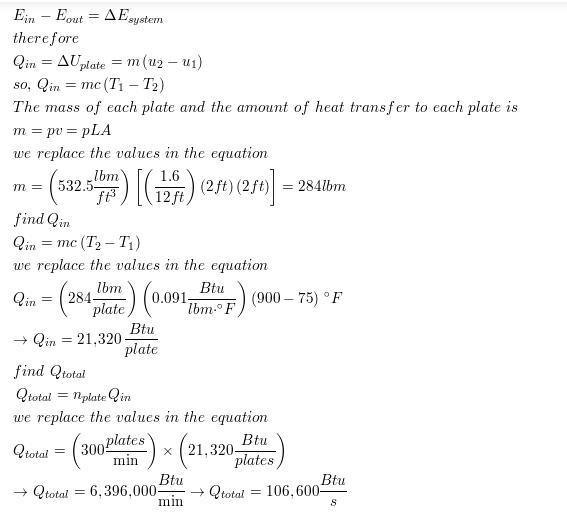
In a production facility, 1.6-in-thick 2-ft × 2-ft square brass plates (rho = 532.5 lbm/ft3 and cp = 0.091 Btu/lbm·°F) that are
Gnoma [55]

Answer:

106600 btu/s

<u>note: </u>

<u><em> solution is attached due to error in mathematical equation. please find the attachment</em></u>

8 0
2 years ago
Other questions:
  • Radioactive wastes are temporarily stored in a spherical container, the center of which is buried a distance of 10 m below the e
    13·1 answer
  • The hot water needs of an office are met by heating tab water by a heat pump from 16 C to 50 C at an average rate of 0.2 kg/min.
    5·1 answer
  • Define a) Principal Plane b) Principal Stress c) anelasticity d) yield point e) ultimate tensile stress f) hardness g) toughness
    5·1 answer
  • The four-wheel-drive all-terrain vehicle has a mass of 320 kg with center of mass G2. The driver has a mass of 82 kg with center
    15·1 answer
  • A subway car leaves station A; it gains speed at the rate of 4 ft/s^2 for of until it has reached and then at the rate 6 then th
    8·1 answer
  • You work in Madison, Wisconsin. It is January and the area has been hit with bad weather. Another weather front is expected to a
    9·1 answer
  • An uninsulated, thin-walled pipe of 100-mm diameter is used to transport water to equipment that operates outdoors and uses the
    9·1 answer
  • three balls each have a mass m if a has a speed v just before a direct collision with B determine the speed of C after collision
    5·2 answers
  • air at 600 kPa, 330 K enters a well-insulated, horizontal pipe having a diameter of 1.2 cm and exits at 120 kPa, 300 K. Applying
    10·1 answer
  • Q10. Select the correct option for the following questions – (10 points, 2 each) a. After an edge dislocation has passed through
    15·1 answer
Add answer
Login
Not registered? Fast signup
Signup
Login Signup
Ask question!