answer.
Ask question
Login Signup
Ask question
All categories
  • English
  • Mathematics
  • Social Studies
  • Business
  • History
  • Health
  • Geography
  • Biology
  • Physics
  • Chemistry
  • Computers and Technology
  • Arts
  • World Languages
  • Spanish
  • French
  • German
  • Advanced Placement (AP)
  • SAT
  • Medicine
  • Law
  • Engineering
Leto [7]
2 years ago
5

Define a) Principal Plane b) Principal Stress c) anelasticity d) yield point e) ultimate tensile stress f) hardness g) toughness

h) elastic limit
Engineering
1 answer:
bagirrra123 [75]2 years ago
4 0

Answer:

Principal Plane: It is that plane in a stressed body over which no shearing stresses act. As we know that in a stressed body on different planes 2 different kind of stresses act normal stresses acting normal to the plane ans shearing stresses acting in the plane. The special planes over which no shearing stresses act and only normal stresses are present are termed as principal planes.

Principal Stress: The stresses in the principal planes are termed as normal stresses.

Anelasticity: It is the behavior of a material in which no definite relation can found to exist between stress and strain at any point in the stressed body.

Yield Point: It is the point in the stress-strain curve of a body at which the stress in the body reaches it's yield value or the object is just about to undergo plastic deformation if we just increase value of stress above this value. It is often not well defined in high strength materials or in some materials such as mild steel 2 yield points are observed.

Ultimate tensile strength: It is the maximum value of stress that a body can develop prior to fracture.

Hardness: it is defined as the ability of the body to resist scratches or indentation or abrasion.

Toughness: It is the ability of the body to absorb energy and deform without fracture when it is loaded. The area under the stress strain curve is taken as a measure of toughness of the body.

Elastic limit: The stress limit upto  which the body regains it's original shape upon removal of the stresses is termed as elastic limit of the body.

You might be interested in
The closed tank of a fire engine is partly filled with water, the air space above being under pressure. A 6 cm bore connected to
skelet666 [1.2K]

Answer:

The air pressure in the tank is 53.9 kN/m^{2}

Solution:

As per the question:

Discharge rate, Q = 20 litres/ sec = 0.02\ m^{3}/s

(Since, 1 litre = 10^{-3} m^{3})

Diameter of the bore, d = 6 cm = 0.06 m

Head loss due to friction, H_{loss} = 45 cm = 0.45\ m

Height, h_{roof} = 2.5\ m

Now,

The velocity in the bore is given by:

v = \frac{Q}{\pi (\frac{d}{2})^{2}}

v = \frac{0.02}{\pi (\frac{0.06}{2})^{2}} = 7.07\ m/s

Now, using Bernoulli's eqn:

\frac{P}{\rho g} + \frac{v^{2}}{2g} + h = k                  (1)

The velocity head is given by:

\frac{v_{roof}^{2}}{2g} = \frac{7.07^{2}}{2\times 9.8} = 2.553

Now, by using energy conservation on the surface of water on the roof and that in the tank :

\frac{P_{tank}}{\rho g} + \frac{v_{tank}^{2}}{2g} + h_{tank} = \frac{P_{roof}}{\rho g} + \frac{v_{tank}^{2}}{2g} + h_{roof} + H_{loss}

\frac{P_{tank}}{\rho g} + 0 + 0 = \0 + 2.553 + 2.5 + 0.45

P_{tank} = 5.5\times \rho \times g

P_{tank} = 5.5\times 1\times 9.8 = 53.9\ kN/m^{2}

4 0
2 years ago
A thermal energy storage unit consists of a large rectangular channel, which is well insulated on its outer surface and encloses
yaroslaw [1]

Answer:

the temperature of the aluminum at this time is 456.25° C

Explanation:

Given that:

width w of the aluminium slab = 0.05 m

the initial temperature T_1 = 25° C

T{\infty} =600^0C

h = 100 W/m²

The properties of Aluminium at temperature of 600° C by considering the conditions for which the storage unit is charged; we have ;

density ρ = 2702 kg/m³

thermal conductivity k = 231 W/m.K

Specific heat c = 1033 J/Kg.K

Let's first find the Biot Number Bi which can be expressed by the equation:

Bi = \dfrac{hL_c}{k} \\ \\ Bi = \dfrac{h \dfrac{w}{2}}{k}

Bi = \dfrac{hL_c}{k} \\ \\ Bi = \dfrac{100 \times \dfrac{0.05}{2}}{231}

Bi = \dfrac{2.5}{231}

Bi = 0.0108

The time constant value \tau_t is :

\tau_t = \dfrac{pL_cc}{h} \\ \\ \tau_t = \dfrac{p \dfrac{w}{2}c}{h}

\tau_t = \dfrac{2702* \dfrac{0.05}{2}*1033}{100}

\tau_t = \dfrac{2702* 0.025*1033}{100}

\tau_t = 697.79

Considering Lumped capacitance analysis since value for Bi is less than 1

Then;

Q= (pVc)\theta_1 [1-e^{\dfrac {-t}{ \tau_1}}]

where;

Q = -\Delta E _{st} which correlates with the change in the internal energy of the solid.

So;

Q= (pVc)\theta_1 [1-e^{\dfrac {-t}{ \tau_1}}]= -\Delta E _{st}

The maximum value for the change in the internal energy of the solid  is :

(pVc)\theta_1 = -\Delta E _{st}max

By equating the two previous equation together ; we have:

\dfrac{-\Delta E _{st}}{\Delta E _{st}{max}}= \dfrac{  (pVc)\theta_1 [1-e^{\dfrac {-t}{ \tau_1}}]} { (pVc)\theta_1}

Similarly; we need to understand that the ratio of the energy storage to the maximum possible energy storage = 0.75

Thus;

0.75=  [1-e^{\dfrac {-t}{ \tau_1}}]}

So;

0.75=  [1-e^{\dfrac {-t}{ 697.79}}]}

1-0.75=  [e^{\dfrac {-t}{ 697.79}}]}

0.25 =  e^{\dfrac {-t}{ 697.79}}

In(0.25) =  {\dfrac {-t}{ 697.79}}

-1.386294361= \dfrac{-t}{697.79}

t = 1.386294361 × 697.79

t = 967.34 s

Finally; the temperature of Aluminium is determined as follows;

\dfrac{T - T _{\infty}}{T_1-T_{\infty}}= e ^ {\dfrac{-t}{\tau_t}}

\dfrac{T - 600}{25-600}= e ^ {\dfrac{-967.34}{697.79}

\dfrac{T - 600}{25-600}= 0.25

\dfrac{T - 600}{-575}= 0.25

T - 600 = -575 × 0.25

T - 600 = -143.75

T = -143.75 + 600

T = 456.25° C

Hence; the temperature of the aluminum at this time is 456.25° C

3 0
2 years ago
What does the following program segment do? Declare Count As Integer Declare Sum As Integer Set Sum = 0 For (Count = 1; Count &l
Troyanec [42]

1225

<u>Explanation:</u>

This segment helps initialize sum as 0. The for loop is used to increment with every execution and it is added to the sum. The loop runs 49 times and every time the count is added to the sum. In short it is the sum of first 49 natural numbers i.e 1+2+3+......+49.

6 0
2 years ago
Why do overhung rotors need to be balanced on or near resonance?
Anika [276]

Explanation:

Balancing:

  Generally balancing are of two types

1.Static balancing:In this only force balancing is done.

2.Dynamic balancing:in this force as well as moment balancing is done.

Balancing become compulsory for over hanging rotor because unbalance force produce lots of vibration and lots of sound due to this rotor or the whole system in which rotor is attached can be damage.

5 0
2 years ago
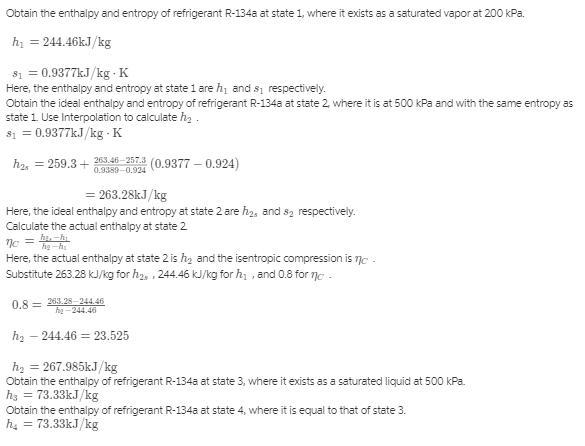
Consider a two-stage cascade refrigeration system operating between the pressure limits of 1.2 MPa and 200 kPa with refrigerant-
lina2011 [118]

Answer:

Answer in detail is attached below.

Explanation:

3 0
2 years ago
Other questions:
  • Small droplets of carbon tetrachloride at 68 °F are formed with a spray nozzle. If the average diameter of the droplets is 200 u
    10·1 answer
  • A group of statisticians at a local college has asked you to create a set of functions that compute the median and mode of a set
    5·2 answers
  • A particle has an initial velocity of v0 = 14 ft/s to the right, at s0 = 0, and a = 2 ft/s2 to the left. determine its position
    5·1 answer
  • A curve in a speed track has a radius of 1000 ft and a rated speed of 120 mi/h. (From Sample Prob. 12.7 is the definition of rat
    10·1 answer
  • An aircraft component is fabricated from an aluminum alloy that has a plane-strain fracture toughness of 40 MPa1m (36.4 ksi1in.)
    15·1 answer
  • 2. A ¼ in. diameter rod must be machined on a lathe to a smaller diameter for use as a specimen in a tension test. The rod mater
    9·1 answer
  • The Gill Art Gallery wishes to maintain data on their customers, artists and paintings. They may have several paintings by each
    7·1 answer
  • ) A given system has four sensors that can produce an output of 0 or 1. The system operates properly when exactly one of the sen
    9·1 answer
  • A rectification column is fed 100 kg mol/h of a mixture of 50 mol % benzene and 50 mol % toluene at 101.32 kPa abs pressure. The
    5·1 answer
  • You are the scheduler for a large commercial building project. The schedule that you prepared (based on feedback from the projec
    7·1 answer
Add answer
Login
Not registered? Fast signup
Signup
Login Signup
Ask question!