answer.
Ask question
Login Signup
Ask question
All categories
  • English
  • Mathematics
  • Social Studies
  • Business
  • History
  • Health
  • Geography
  • Biology
  • Physics
  • Chemistry
  • Computers and Technology
  • Arts
  • World Languages
  • Spanish
  • French
  • German
  • Advanced Placement (AP)
  • SAT
  • Medicine
  • Law
  • Engineering
AlexFokin [52]
2 years ago
12

Oil enters a counterflow heat exchanger at 600 K with a mass flow rate of 10 kg/s and exits at 200 K. A separate stream of liqui

d water enters at 20°C, 5 bar. Each stream experiences no significant change in pressure. Stray heat transfer with the surroundings of the heat exchanger and kinetic and potential energy effects can be ignored. The specific heat of the oil is constant, c = 2 kJ/kg · K. If the designer wants to ensure no water vapor is present in the exiting water stream, what is the minimum mass flow rate for the water, in kg/s?

Engineering
1 answer:
Elis [28]2 years ago
7 0

Answer:

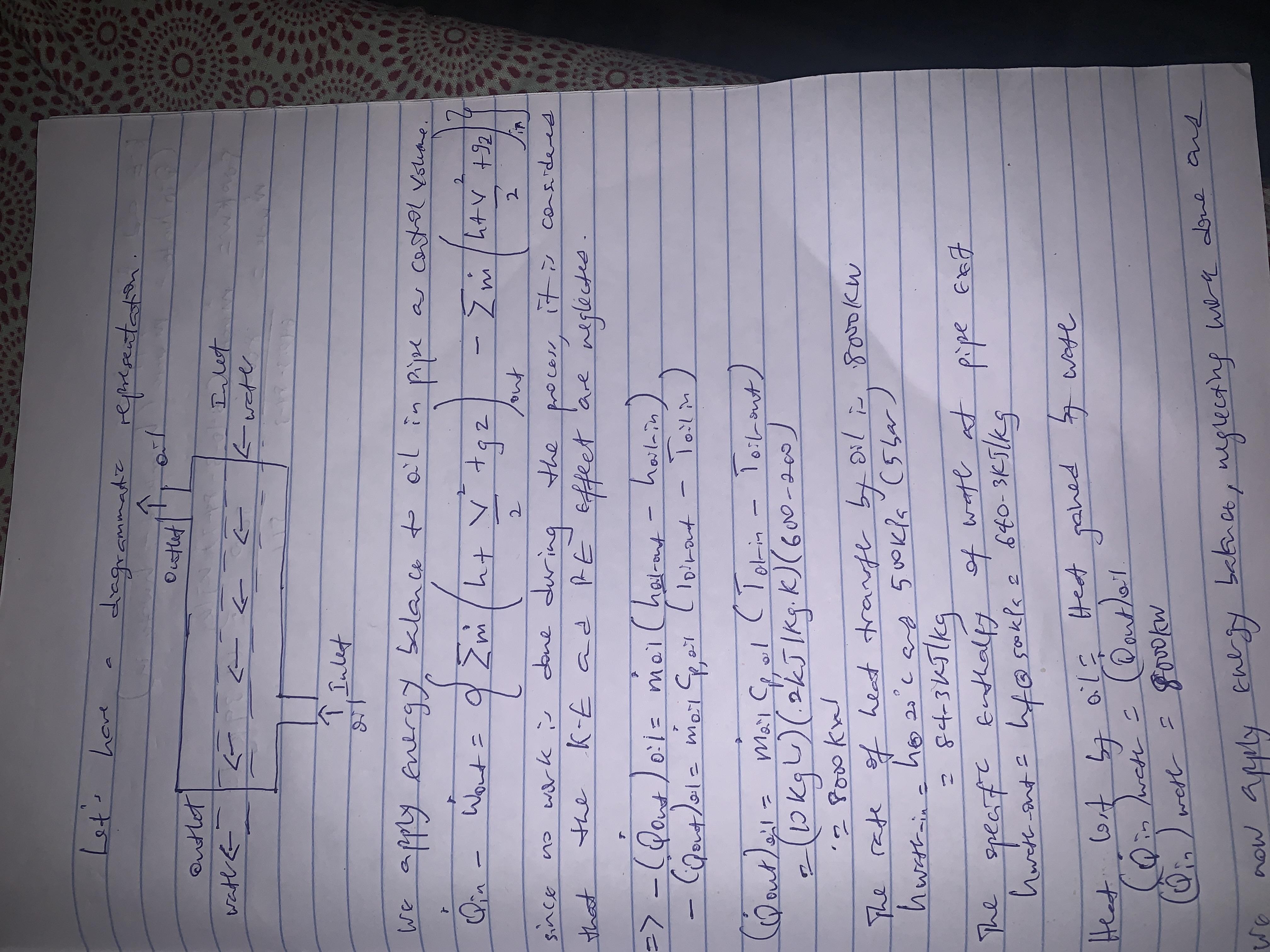
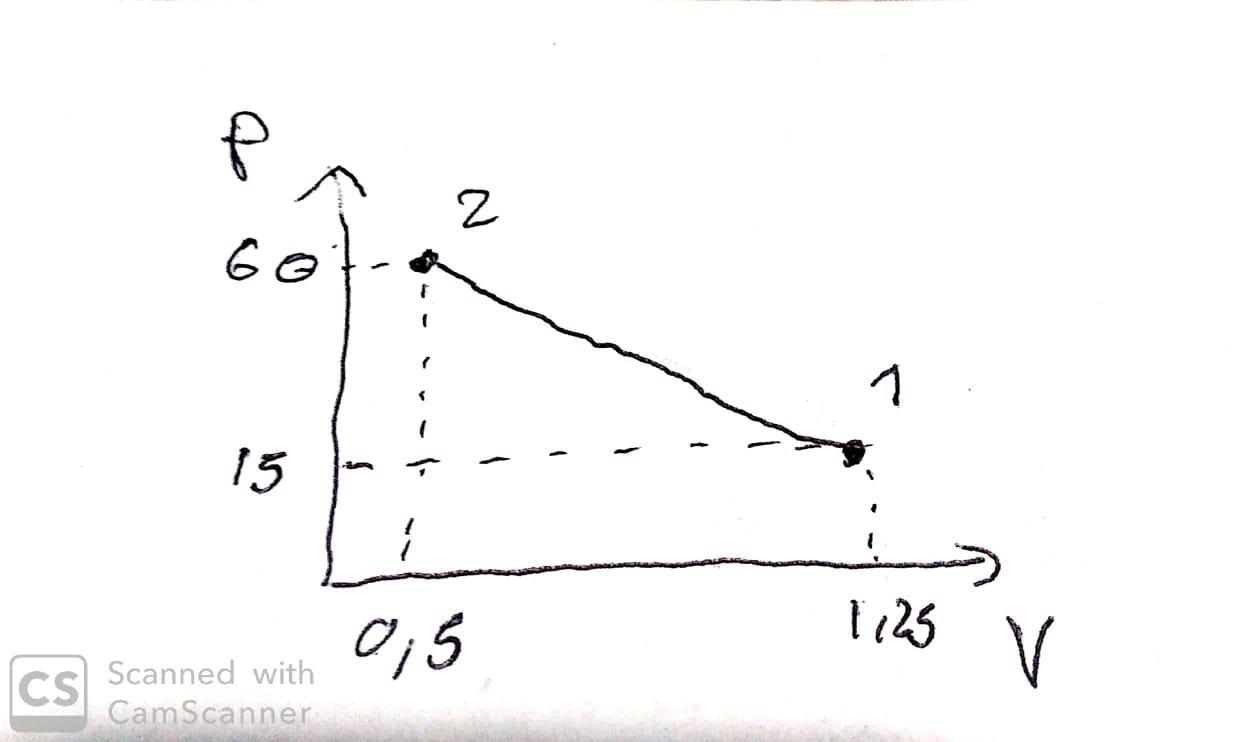
The minimum mass flow rate for the water is 14.39kg/s

Explanation:

In this question, we are asked to calculate the minimum mass flow rate for the water in kg/s.

Please check attachment for complete solution and step by step explanation

You might be interested in
Add a calculated field named AccountTime that calculates the number of days each client's accounts have been open. Assume today'
Troyanec [42]

Answer:

The following steps should be followed to create the calculated field:

1. Enter AccountTime: (The AccountTime must be enclosed in #). #12/31/2017#-OpenDate in the first empty field.

2. Right-click the field then click properties. This will allow you format the selected field.

3. Rght-click the query tab and click Save. This will allow you save the query

4. Lastly, Close the query.

5 0
2 years ago
Write cout statements with stream manipulators that perform the following:
Semenov [28]

Answer:

A)cout<<setw(9)<<fixed<<setprecision(2)<<34.789;

B)cout<<setw(5)<<fixed<<setprecision(3)<<7.0;

C)cout<<fixed<<5.789E12;

D)cout<<left<<setw(7)<<67;

Explanation:

Stream Manipulators are functions specifically designed to be used in conjunction with the insertion (<<) and extraction (>>) operators on stream objects in C++ programming while the 'cout' statement is used to display the output of a C++to the standard output device.

setw:  used to specify the minimum number of character positions on the output field

setprecision: Sets the decimal precision to be used to format floating-point values on output operations.

fixed:  is used to set the floatfield format flag for the specified str stream.

left: adjust output to the left.

A) To display the number 34.789 in a field of eight spaces with two decimal places of precision. cout<<setw(9)<<fixed<<setprecision(2)<<34.789;

B) To display the number 7.0 in a field of six spaces with three decimal places of precision. cout<<setw(5)<<fixed<<setprecision(3)<<7.0;

C) To print out the number 5.789e+12 in fixed-point notation.  cout<<fixed<<5.789E12;

(D) To display the number 67 left-justified in a field of six spaces. cout<<left<<setw(7)<<67;

7 0
2 years ago
Write a program with total change amount as an integer input, and output the change using the fewest coins, one coin type per li
pshichka [43]

Answer:

The C code is given below with appropriate comments

Explanation:

#include<stdio.h>

//defining constants

#define DOLLAR 100

#define QUARTER 25

#define DIME 10

#define NICKEL 5

#define PENNIES 1

//converting method

void ExactChange(int userTotal,int coinVals[])

{

//checking dollars

if (userTotal >=100)

{

coinVals[0]=userTotal/DOLLAR;

userTotal=userTotal-(100*coinVals[0]);

}

//checking quarters

if (userTotal >=25)

{

coinVals[1]=userTotal/QUARTER;

userTotal=userTotal-(25*coinVals[1] );

}

//checking dimes

if (userTotal >=10)

{

coinVals[2]=userTotal/DIME;

userTotal=userTotal-(10*coinVals[2]);

}

//checking nickels

if (userTotal >=5)

{

coinVals[3]=userTotal/NICKEL;

userTotal=userTotal-(5*coinVals[3]);

}

//checking pennies

if (userTotal >=1)

{

coinVals[4]=userTotal/PENNIES;

userTotal=userTotal-coinVals[4];

}

}

//main method

int main() {

//defining the variables

int amount;

//asking for input

printf("Enter the amount in cents :");

//reading the input

scanf("%d",&amount);

//validating the input

if(amount<1)

{

//printing the message

printf("No change..!");

}

//when the input is >0

else

{

int coinVals[5]={0,0,0,0,0};

ExactChange(amount,coinVals);

//checking dollars

if (coinVals[0]>0)

{

//printing dollars

printf("%d Dollar",coinVals[0]);

if(coinVals[0]>1) printf("s");

}

//checking quarters

if (coinVals[1]>0)

{

//printing quarters

printf(" %d Quarter",coinVals[1]);

if(coinVals[1]>1) printf("s");

}

//checking dimes

if (coinVals[2]>0)

{

//printing dimes

printf(" %d Dime",coinVals[2]);

if(coinVals[2]>1) printf("s");

}

//checking nickels

if (coinVals[3]>0)

{

//prinitng nickels

printf(" %d Nickel",coinVals[3]);

if(coinVals[3]>1) printf("s");

}

//checking pennies

if (coinVals[4]>0)

{

//printing pennies

printf(" %d Penn",coinVals[4]);

if(coinVals[4]>1) printf("ies");

else printf("y");

}

}

//end of main method

}
6 0
2 years ago
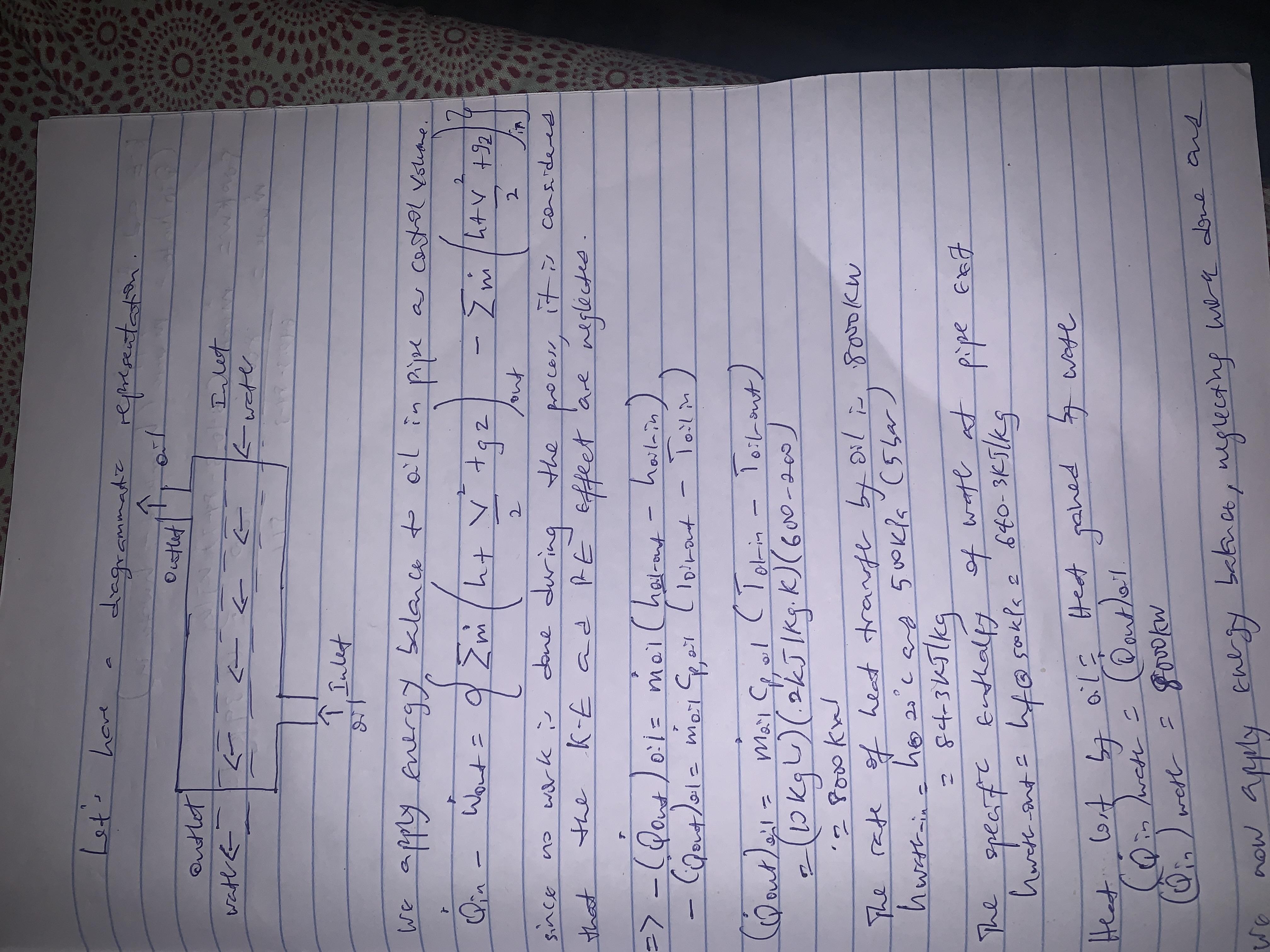
A closed system consisting of 4 lb of a gas undergoes a process during which the relation between pressure and volume is pVn 5 c
gayaneshka [121]

Answer:

V1=5<u>ft3</u>

<u>V2=2ft3</u>

n=1.377

Explanation:

PART A:

the volume of each state is obtained by multiplying the mass by the specific volume in each state

V=volume

v=especific volume

m=mass

V=mv

state 1

V1=m.v1

V1=4lb*1.25ft3/lb=5<u>ft3</u>

state 2

V2=m.v2

V2=4lb*0.5ft3/lb=  <u> 2ft3</u>

PART B:

since the PV ^ n is constant we can equal the equations of state 1 and state 2

P1V1^n=P2V2^n

P1/P2=(V2/V1)^n

ln(P1/P2)=n . ln (V2/V1)

n=ln(P1/P2)/ ln (V2/V1)

n=ln(15/53)/ ln (2/5)

n=1.377

3 0
2 years ago
A system consisting of 3 lb of water vapor in a piston–cylinder assembly, initially at 350°F and a volume of 71.7 ft3, is expand
Alla [95]

Answer:

isobaric expansion = 281.09 Btu

isothermal compression= 72 Btu

Explanation:

The first law of thermodynamics is:

Q_{AB}=W_{AB}+deltaU_{AB}

where:

Q=heat transferred

W= work

U=internal energy  

W_{AB}=P*(V_{B}-V_{A})

U_{AB}=n*C_{v}(T_{2}-T_{1})

P=pressure, V= volume, T= temperature, n =  moles, Cv= specific heat at constant volume.

In a isobaric process heat transferred is:

Q=P*(V_{B}-V_{A})+n*C_{v}(T_{2}-T_{1})

For an isothermal process (T2-T1 = 0) so

Q=P*(V_{B}-V_{A})= W_{AB}

From the data we know that the energy transferred to the system in the isothermal compression by work was 72 Btu that is the heat transferred to the system.

For the first process

Q=P*(V_{B}-V_{A})+n*C_{v}(T_{2}-T_{1})

we have to properties at the beginning of the process : temperature (350°F) and specific volume (V/mass)

specific-volume=\frac{71.7 ft^{3}}{3Lb}=23.9\frac{ft^{3}}{Lb}

we use this information in the appropriate unit to find the pressure in thermodynamic tables.

T1= 176°C

v1= 1.49 m^3/kg

P=1.37 bar

in the second state we have

P=1.37 bar =137000Pa

v_{2}=\frac{85.38ft^{3}}{3Lb}= 28.46\frac{ft^{3}}{Lb}

with thee properties we check in the thermodynamic tables

T2= 255°C

n=mass/Mw = 3Lb*\frac {1kg}{2.2Lb}*\frac{1000gr}{1kg}*\frac{1mol}{18gr}=75.75 mol

we usually find Cp on tables for water but from the Mayer relation we have:

C_{v}=C_{p}+R

Cp for water vapor is: 33.12 J/mol*K

R=8.314 J/mol*K

Cv= 41.434 J/mol*K

replacing in the equation for Q

Q=137000 Pa*(2.41m^{3}-2.030m^{3})+75.75mol*41.434\frac{ J}{mol*K}*(528.15-449.81 K)=296569J

296569J =281.09 Btu

5 0
2 years ago
Other questions:
  • Which of the two materials (brittle vs. ductile) usually obtains the highest ultimate strength and why?
    5·1 answer
  • If the electric field just outside a thin conducting sheet is equal to 1.5 N/C, determine the surface charge density on the cond
    9·1 answer
  • Current density is given in cylindrical coordinates as J = −106z1.5az A/m2 in the region 0 ≤ rho ≤ 20 µm; for rho ≥ 20 µm, J = 0
    13·1 answer
  • Air is compressed adiabatically from p1 1 bar, T1 300 K to p2 15 bar, v2 0.1227 m3 /kg. The air is then cooled at constant volum
    13·1 answer
  • Compute the strain-hardening exponent (n) for an alloy in which a true stress of 415 MPa produces a true strain of 0.10; assume
    10·1 answer
  • Hot combustion gases, modeled as air behaving as an ideal gas, enter a turbine at 10 bar, 1500 K and exit at 1.97 bar and 900 K.
    7·1 answer
  • Why is it that dislocations play an important role in controlling the mechanical properties of metallic materials, however, they
    10·1 answer
  • Milton has been tracking the migrating patterns of whales in the northwest Atlantic Ocean for five years. He knows where and whe
    5·2 answers
  • Mr. Ray deposited $200,000 in the Old and Third National Bank. If the bank pays 8% interest, how much will he have in the accoun
    10·2 answers
  • It has been stated that crime rates are impacted by ecological conditions. Which of the following
    13·1 answer
Add answer
Login
Not registered? Fast signup
Signup
Login Signup
Ask question!