answer.
Ask question
Login Signup
Ask question
All categories
  • English
  • Mathematics
  • Social Studies
  • Business
  • History
  • Health
  • Geography
  • Biology
  • Physics
  • Chemistry
  • Computers and Technology
  • Arts
  • World Languages
  • Spanish
  • French
  • German
  • Advanced Placement (AP)
  • SAT
  • Medicine
  • Law
  • Engineering
kirill [66]
2 years ago
13

Current density is given in cylindrical coordinates as J = −106z1.5az A/m2 in the region 0 ≤ rho ≤ 20 µm; for rho ≥ 20 µm, J = 0

. (a) Find the total current crossing the surface z = 0.1 m in the az direction. (b) If the charge velocity is 2 × 10⁶ m/s at z = 0.1 m, find rhoν there. (c) If the volume charge density at z = 0.15 m is −2000 C/m3, find the charge velocity there.
Engineering
1 answer:
Naily [24]2 years ago
8 0

Question:

Current density is given in cylindrical coordinates as J = −10^6z^1.5az A/m² in the region 0 ≤ ρ ≤ 20 µm; for ρ ≥ 20 µm, J = 0.

(a) Find the total current crossing the surface z = 0.1 m in the az direction.

(b) If the charge velocity is 2 × 10^6 m/s at z = 0.1 m, find ρν there.

(c) If the volume charge density at z = 0.15 m is −2000 C/m3, find the charge velocity there.

Answer:

a. -39.8μA

b. -15.81mC/m³

c. 29.05m/s

Explanation:

Given

Density = J = −10^6z^1.5az A/m²

Region: 0 ≤ ρ ≤ 20 µm

ρ ≥ 20 µm

J = 0.

a. Total current is calculated by.

J * ½((ρ1)² - (ρ0)²) * 2 π * φdza.

Where J = Density = -10^6 * z^1.5

ρ1 = Upper bound of ρ = 20

ρ0 = Lower bound of ρ = 0

π = 22/7

φdza = 10^-6

z = 0.1

Total current

= -10^6 * z^1.5 * ½(20² - 0²) * 2 * 22/7 * 10^-6

= 10^6 * 0.1^1.5 * ½(20² - 0²) * 2 * 22/7 * 10^-6

= −39.7543477278310

= -39.8μA

b. Calculating velocity charge density at (ρv)

Density (J) = ρv * V

Where J = Density = -10^6 * z^1.5

V = 2 * 10^6

z = 0.1

Substitute the above values

-10^6 * 0.1 ^1.5 = ρv * 2 * 10^6

ρv = (-10^6 * 0.1^1.5)/(2 * 10^6)

ρv = -0.1^1.5/(2)

ρv = -0.015811388300841

ρv = -0.01581 --------- Approximated

ρv = -15.81mC/m³

c. Calculating Velocity

Velocity = J/V

Where Velocity Charge Density = -2000 C/m3

Where J = -10^6 * z^1.5

z = 0.15

J = -10^6 * 0.15^1.5

J = -58094.75019311125

Velocity = -58094.75019311125/-2000

Velocity = 29.047375096555625m/s

Velocity = 29.05m/s

You might be interested in
Fix the code so the program will run correctly for MAXCHEESE values of 0 to 20 (inclusive). Note that the value of MAXCHEESE is
GarryVolchara [31]

Answer:

Code fixed below using Java

Explanation:

<u>Error.java </u>

import java.util.Random;

public class Error {

   public static void main(String[] args) {

       final int MAXCHEESE = 10;

       String[] names = new String[MAXCHEESE];

       double[] prices = new double[MAXCHEESE];

       double[] amounts = new double[MAXCHEESE];

       // Three Special Cheeses

       names[0] = "Humboldt Fog";

       prices[0] = 25.00;

       names[1] = "Red Hawk";

       prices[1] = 40.50;

       names[2] = "Teleme";

       prices[2] = 17.25;

       System.out.println("We sell " + MAXCHEESE + " kind of Cheese:");

       System.out.println(names[0] + ": $" + prices[0] + " per pound");

       System.out.println(names[1] + ": $" + prices[1] + " per pound");

       System.out.println(names[2] + ": $" + prices[2] + " per pound");

       Random ranGen = new Random(100);

       // error at initialising i

       // i should be from 0 to MAXCHEESE value

       for (int i = 0; i < MAXCHEESE; i++) {

           names[i] = "Cheese Type " + (char) ('A' + i);

           prices[i] = ranGen.nextInt(1000) / 100.0;

           amounts[i] = 0;

           System.out.println(names[i] + ": $" + prices[i] + " per pound");

       }        

   }

}

7 0
2 years ago
. A cylindrical metal specimen having an original diameter of 12.8 mm (0.505 in.) and gauge length of 50.80 mm (2.000 in.) is pu
kogti [31]

Answer:

% reduction in area==PR=0.734=73.4%

% elongation=EL=0.42=42%

Explanation:

given do=12.8 mm

df=6.60

Lf=72.4 mm

Lo=50.8 mm

% reduction in area=((\pi*(do/2)^2)-(\pi*(df/2)^2)))/\pi*(do/2)^2

substitute values

% reduction in area=73.4%

% elongation=EL=((Lf-Lo)/Lo))*100

% elongation=((72.4-50. 8)/50.8)*100=42%

6 0
2 years ago
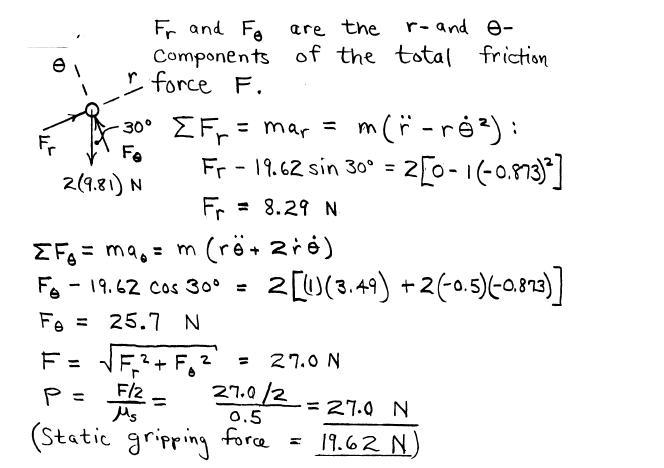
3/63 A 2‐kg sphere S is being moved in a vertical plane by a robotic arm. When the angle θ is 30°, the angular velocity of the a
miss Akunina [59]

Answer:

Ps=19.62N

Explanation:

The detailed explanation of answer is given in attached files.

5 0
2 years ago
. A piston-cylinder device whose piston is resting on top of a set of stops initially contains 0.5 kg of helium gas at 100 kPa a
Delvig [45]

Answer:

Qin = 1857 kJ

Explanation:

Given

m = 0.5 Kg

T₁ = 25°C = (25 + 273) K = 298 K

P₁ = 100 kPa

P₂ = 500 kPa

First, the temperature when the piston starts rising is determined from the ideal gas equations at the initial state and at that state:

T₂ = T₁*P₂/P₁

⇒  T₂ = 298 K*(500 kPa/100 kPa) = 1490 K

Until the piston starts rising no work is done so the heat transfer is the change in internal energy

Qin = ΔU = m*cv*(T₂-T₁)

⇒   Qin = 0.5*3.1156*(1490 - 298) kJ = 1857 kJ

8 0
2 years ago
It is said that Archimedes discovered his principle during a bath while thinking about how he could determine if King Hiero’s cr
arlik [135]

Answer: The crown is not made of pure gold.

Explanation:

Archimedes discovered that any solid, of any shape, when submerged in a liquid receives an upward force, equal to the weight of the volume of the liquid removed by the solid, which is equal to the solid volume.

So, if any body is weighed in air, the normal force will be equal to the gravity force (which we call weight) which can be expressed as follows:

Fg = m g = δ V g = 34.7 N

When submerged in water, the normal force is equal to the difference between the actual weight, and the upward force due to Archimedes' principle, called buoyant force, as follows:

Fn = Fg - Ep = δx. V. g - δH20 . V. g = 31.5 N

Dividing Fg between Fn, and simplifying common terms, we have:

δx / (δx - δh20) = 34.7 / 31.5 = 1.10

Solving for δx, we get the following value:

δx = 11,000 Kg/m3, less dense than pure gold, so we can conclude that the crown was not made of pure gold.

3 0
2 years ago
Other questions:
  • A long aluminum wire of diameter 3 mm is extruded at a temperature of 280°C. The wire is subjected to cross air flow at 20°C at
    9·1 answer
  • If the electric field just outside a thin conducting sheet is equal to 1.5 N/C, determine the surface charge density on the cond
    9·1 answer
  • A signalized intersection approach has an upgrade of 4%. The total width of the cross street at this intersection is 60 feet. Th
    15·1 answer
  • 1. A glass window of width W = 1 m and height H = 2 m is 5 mm thick and has a thermal conductivity of kg = 1.4 W/m*K. If the inn
    8·1 answer
  • A driver traveling at 65 mi/h rounds a curve on a level grade to see a truck overturned across the roadway at a distance of 350
    13·1 answer
  • An art collector is bidding on a statue that would complete a collection he is trying to assemble. The statue is being sold in a
    9·1 answer
  • A platinum resistance temperature sensor has a resistance of 120 Ω at 0℃ and forms one arm of a Wheatstone bridge. At this tempe
    12·1 answer
  • A piston-cylinder assembly contains 2 lb of air at a temperature of 540 °R and a pressure of 1 atm. The air compressed to a stat
    5·1 answer
  • The rectangular frame is composed of four perimeter two-force members and two cables AC and BD which are incapable of supporting
    9·1 answer
  • How does Accenture generate value for clients through Agile and DevOps?
    15·2 answers
Add answer
Login
Not registered? Fast signup
Signup
Login Signup
Ask question!