answer.
Ask question
Login Signup
Ask question
All categories
  • English
  • Mathematics
  • Social Studies
  • Business
  • History
  • Health
  • Geography
  • Biology
  • Physics
  • Chemistry
  • Computers and Technology
  • Arts
  • World Languages
  • Spanish
  • French
  • German
  • Advanced Placement (AP)
  • SAT
  • Medicine
  • Law
  • Engineering
eduard
2 years ago
9

The fatigue data for a brass alloy are given as follows: Stress Amplitude (MPa) Cycles to Failure 170 3.7 × 10⁴ 148 1.0 × 10⁵ 13

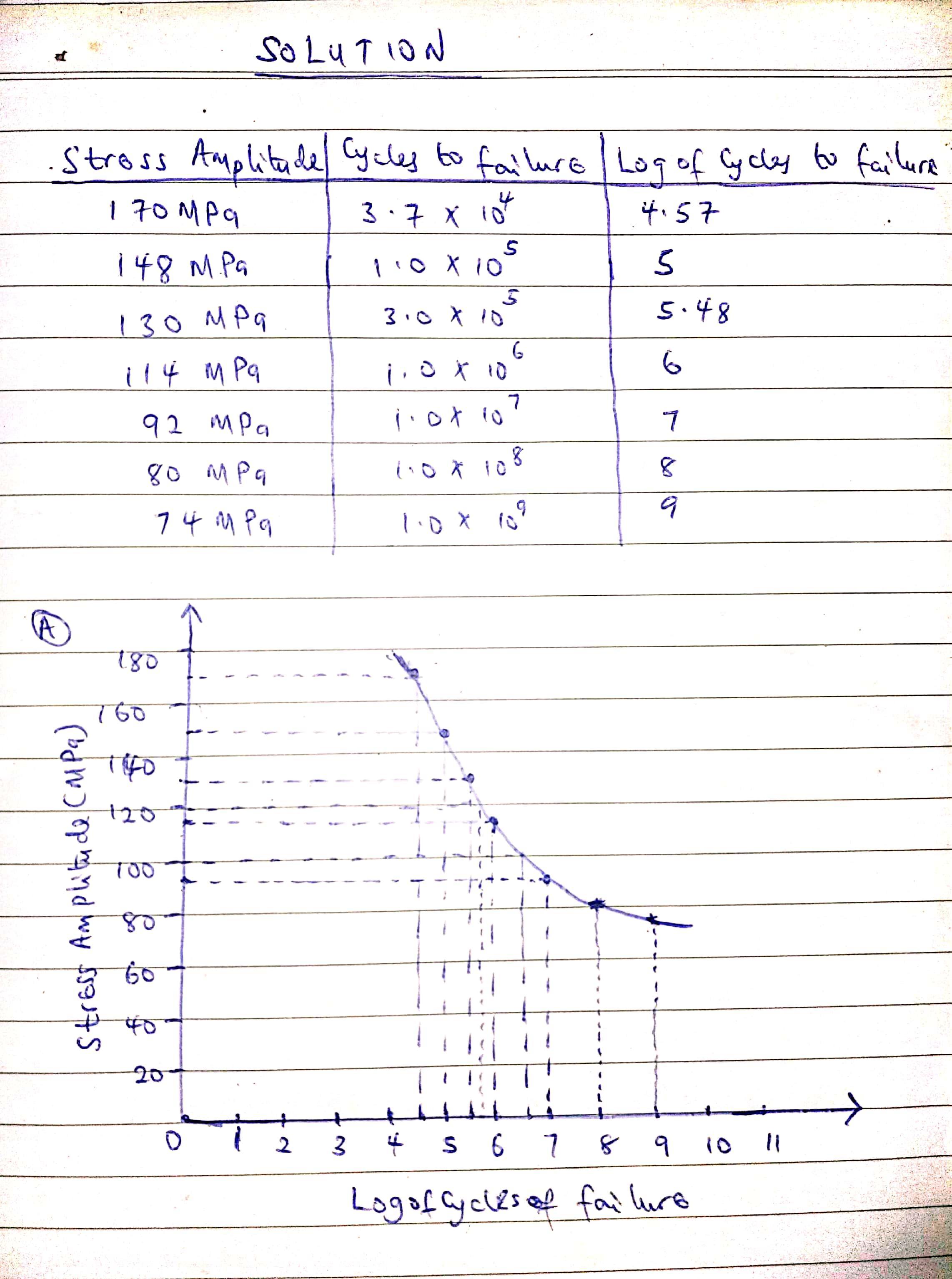
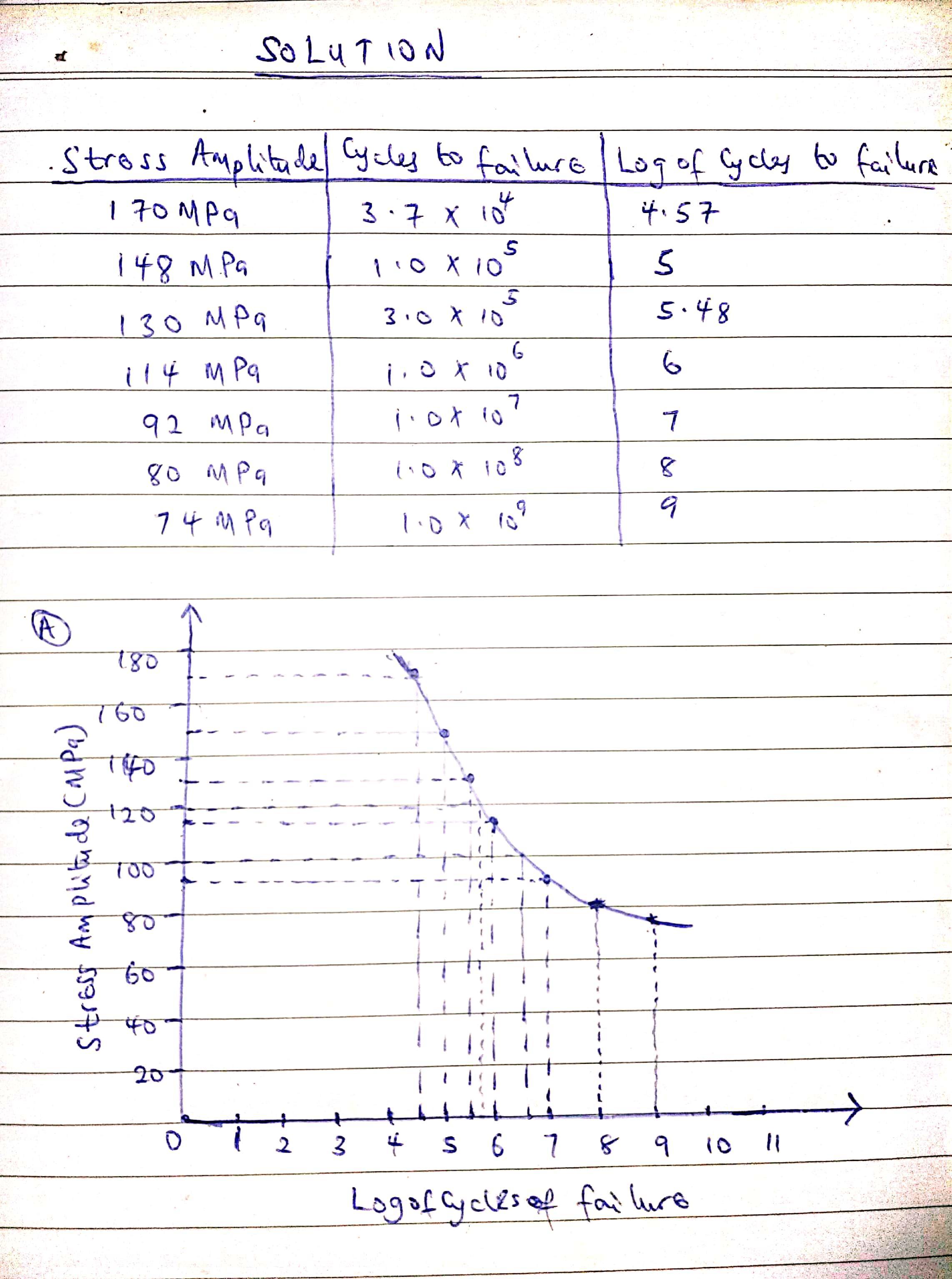
0 3.0 × 10⁵ 114 1.0 × 10⁶ 92 1.0 × 10⁷ 80 1.0 × 10⁸ 74 1.0 × 10⁹ i. Make an S–N plot (stress amplitude versus logarithm of cycles to failure) using these data. ii. Determine the fatigue strength at 4 × 10⁶ cycles. iii. Determine the fatigue life for 120 MPa.

Engineering
1 answer:
prohojiy [21]2 years ago
8 0

Answer:

i) S–N plot is attached

ii) fatigue strength = 100 MPa

iii) fatigue life = 5.62 x 10^(5) cycles

Explanation:

i) I have attached the S–N plot (stress amplitude versus logarithm of cycles to failure)

ii) The question says we should find the fatigue strength at 4 × 10^(6) cycles.

So let's find the log of this and trace it on the graph attached.

Log(4 × 10^(6)) = 6.6

From the graph attached, at log of cycle value of 6.6, the fatigue strength is approximately 100 MPa

iii) The question says we should find the fatigue life for 120 MPa.

Thus, from the graph, at stress amplitude of 120 MPa, the log of cycles is approximately 5.75.

Thus,the fatigue life will be the inverse log of 5.75.

Thus, fatigue life = 10^(5.75)

Fatigue life = 5.62 x 10^(5)

You might be interested in
A shaft consisting of a steel tube of 50-mm outer diameter is to transmit 100 kW of power while rotating at a frequency of 34 Hz
nikitadnepr [17]

Answer:

25 - \sqrt[4]{26.66*10^{-8} }  mm

Explanation:

Given data

steel tube : outer diameter = 50-mm

power transmitted = 100 KW

frequency(f) = 34 Hz

shearing stress ≤ 60 MPa

Determine tube thickness

firstly we calculate the ; power, angular velocity and torque of the tube

power = T(torque) * w (angular velocity)

angular velocity ( w ) = 2\pif = 2 * \pi * 34 = 213.71

Torque (T) = power / angular velocity = 100000 / 213.71 = 467.92 N.m/s

next we calculate the inner diameter  using the relation

  \frac{J}{c_{2}  } = \frac{T}{t_{max} }  = 467.92 / (60 * 10^6) =  7.8 * 10^-6 m^3

also

c2 = (50/2) = 25 mm

\frac{J}{c_{2} } = \frac{\pi }{2c_{2} } ( c^{4} _{2} - c^{4} _{1} ) =  \frac{\pi }{0.050} [ ( 0.025^{4} - c^{4} _{1}  ) ]

therefore; 0.025^4 - c^{4} _{1} = 0.050 / \pi (7.8 *10^-6)

c^{4} _{1} = 39.06 * 10 ^-8 - ( 1.59*10^-2 * 7.8*10^-6)

    39.06 * 10^-8 - 12.402 * 10^-8 =26.66 *10^-8

c_{1} = \sqrt[4]{26.66 * 10^{-8} }  =

THE TUBE THICKNESS

c_{2} - c_{1} = 25 - \sqrt[4]{26.66*10^{-8} }  mm

4 0
2 years ago
An electric field is expressed in rectangular coordinates by E = 6x2ax + 6y ay +4az V/m.Find:a) VMN if point M and N are specifi
Fittoniya [83]

Answer:

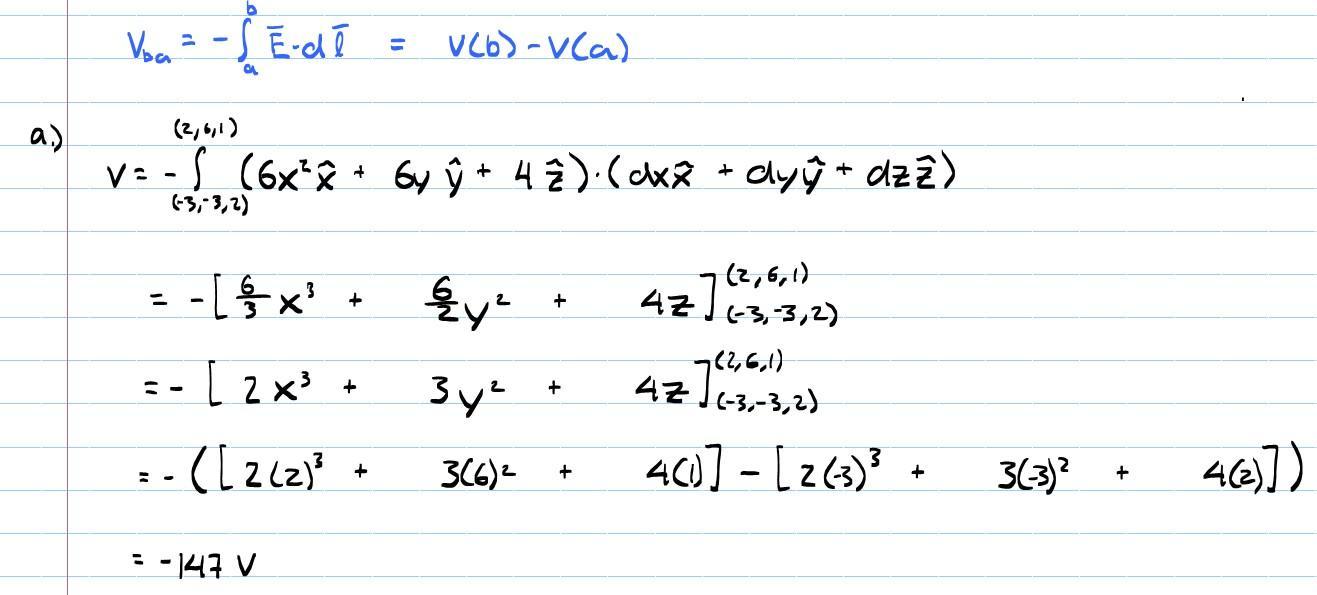
a.) -147V

b.) -120V

c.) 51V

Explanation:

a.) Equation for potential difference is the integral of the electrical field from a to b for the voltage V_ba = V(b)-V(a).

b.) The problem becomes easier to solve if you draw out the circuit. Since potential at Q is 0, then Q is at ground. So voltage across V_MQ is the same as potential at V_M.

c.) Same process as part b. Draw out the circuit and you'll see that the potential a point V_N is the same as the voltage across V_NP added with the 2V from the other box.

Honestly, these things take practice to get used to. It's really hard to explain this.

3 0
2 years ago
Annealing is a process by which steel is reheated and then cooled to make it less brittle. Consider the reheat stage for a 100-m
kodGreya [7K]

Complete question is;

Annealing is a process by which steel is reheated and then cooled to make it less brittle. Consider the reheat stage for a 100 mm thick plate (ρ = 7830 kg/m3, Cp = 550 J/kg K, k = 48 W/m K). The plate initially is at 200 °C and is to be heated to a minimum temperature of 550 °C. Heating is effected in a gas-fired furnace where the products of combustion at T∞ = 800 °C maintain a convection heat transfer coefficient of h = 250 W/m.K on both surfaces of the plate. How long should the plate be left in the furnace?

Answer:

860 seconds

Explanation:

We are given;

Initial Temperature; Ti = 200 °C

Minimum Temperature; T_i = 550 °C

T∞ = 800 °C

convection coefficient; h = 250 W/m².K

ρ = 7830 kg/m³

Cp = 550 J/kg K

k = 48 W/m K

Plate thickness = 100mm

Thus,L = 100/2 = 50mm = 0.05 m

Let's find the biot number from the formula;

Bi = hL/K

Bi = (250 × 0.05)/48

Bi = 0.2604

Now, lowest temperature in the slab is given as;

θ_o = (T_o - T∞)/(T_i - T∞)

θ_o = (550 - 800)/(200 - 800)

θ_o = 0.4167

Now, from online tables calculation, we can find the root of the biot number.

Thus, root of the biot number Bi = 0.2604 is;

ζ1 = 0.488 rad

Also, C1 is gotten as 1.0396

Now,formula for thermal diffusivity is;

α = k/ρc

α = 48/(7830 × 550)

α = 1.115 × 10^(-5) m²/s

Also, from online tables, f(ζ1) = 0.401

Thus, we can find the time the plate should the plate be left in the furnace from;

-(ζ1)²(αt/L²) = In 0.401

-(ζ1)²(αt/L²) = -0.9138

t = (-0.9138 × 0.05²)/-(0.488² × 1.115 × 10^(-5))

t ≈ 860 s
8 0
2 years ago
The force exerted on a bridge pier in a river is to be tested in a 1:10 scale model using water as the working fluid. In the pro
Len [333]

Answer:

Force on the prototype is 5000 N

Solution:

As per the question:

Depth of water, x = 2.0 m

Flow velocity, v' = 1.5 m/s

Width of the river, w = 20 m

Force on the bridge pier model, F' = 5 N

Pressure, Ratio = Ratio of scale length

Scale = 1:10

Now,

\frac{P'}{P} = \frac{x}{w} = \frac{2.0}{20}

where

P' = pressure on model

P = pressure on prototype

\frac{\frac{F'}{A'}}{\frac{F}{A}} = \frac{1}{10}

where

F' = Force on model

F = Force on prototype

A' = Area of model

A = Area of prototype

Now:

\frac{F'}{F}.\frac{A}{A'} = \frac{1}{10}

\frac{5}{F}.\frac{1}{\frac{1}{10}}.\frac{1}{\frac{1}{10}} = \frac{1}{10}

F = 5000 N

3 0
2 years ago
Determine the deflection at the center of the beam. Express your answer in terms of some or all of the variables LLL, EEE, III,
Rom4ik [11]

Answer:

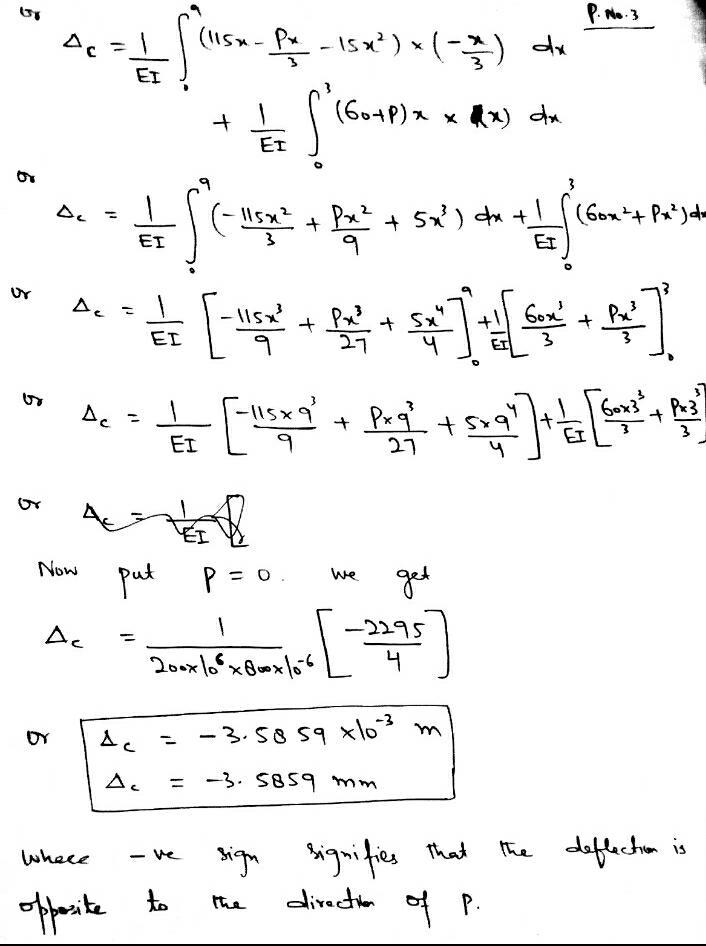
See explanations for step by step procedures to get answer.

Explanation:

Given that;

Determine the deflection at the center of the beam. Express your answer in terms of some or all of the variables LLL, EEE, III, and M0M0M_0. Enter positive value if the deflection is upward and negative value if the deflection is downward.

4 0
2 years ago
Other questions:
  • a. Replacing standard incandescent lightbulbs with energy-efficient compact fluorescent lightbulbs can save a lot of energy. Cal
    9·1 answer
  • Pipe (2) is supported by a pin at bracket C and by tie rod (1). The structure supports a load P at pin B. Tie rod (1) has a diam
    15·1 answer
  • Carbon dioxide gas enters a pipe at 3 MPa and 500 K at a rate of 2 kg/s. CO2 is cooled at constant pressure as it flows in the p
    10·1 answer
  • Define a function pyramid_volume with parameters base_length, base_width, and pyramid_height, that returns the volume of a pyram
    10·1 answer
  • Two physical properties that have a major influence on the cracking of workpieces, tools, or dies during thermal cycling are the
    13·1 answer
  • Sea water with a density of 1025 kg/m3 flows steadily through a pump at 0.21 m3 /s. The pump inlet is 0.25 m in diameter. At the
    8·1 answer
  • A 2-m3 rigid tank initially contains air at 100 kPa and 22oC. The tank is connected to a supply line through a valve. Air is flo
    9·1 answer
  • Q4. What happen when a steady potential is connected across the end points of the [3] conductor? Illustrate with an example.
    12·1 answer
  • Anytime scaffolds are assembled or __________, a competent person must oversee the operation.
    15·2 answers
  • How does Accenture generate value for clients through Agile and DevOps?
    15·2 answers
Add answer
Login
Not registered? Fast signup
Signup
Login Signup
Ask question!