answer.
Ask question
Login Signup
Ask question
All categories
  • English
  • Mathematics
  • Social Studies
  • Business
  • History
  • Health
  • Geography
  • Biology
  • Physics
  • Chemistry
  • Computers and Technology
  • Arts
  • World Languages
  • Spanish
  • French
  • German
  • Advanced Placement (AP)
  • SAT
  • Medicine
  • Law
  • Engineering
svp [43]
2 years ago
6

A pitfall cited in Section 1.10 is expecting to improve the overall performance of a computer by improving only one aspect of th

e computer. Consider a computer running a program that requires 250 s, with 70 s spent executing FP instructions, 85 s executed L/S instructions and 40 s spent executing branch instructions
(5 min, sec 1.10)By how much is the total time reduced if the time for FP operations is reduced by 20%?


(5 min, sec 1.10) By how much is the time for INT operations reduced if the total time is reduced by 20%?
(5 min, sec 1.10) Can the total time be reduced by 20% by reducing only the time for branch instructions?
Engineering
1 answer:
Oxana [17]2 years ago
8 0

Answer:

a) For this case the new time to run the FP operation would be reduced 20% so that means 100-20% =80% from the original time

(1-0.2)*70 s =56s

The reduction on this case is 70-56 s=14s

And since the new total time would be given by 250-14=236 s

b) For this case the total time is reduced 20%  so that means that the new total time would be (1-0.2)=0.8 times the original total time (1-0.2) *250s =200 s

The original time for INT operations is calculated as:

250 = 70+85+40 +t_{INT}

t_{INT}=55s

For this part the only time that was changed is assumed the INT operations so then:

200 = 70+85+40 \Delta t_{INT}

And then: \Delta t_{INT}= 200-70-85-40=5 s

c) A reduction of the total time implies that the total time would be 205 s from the results above. And the time for FP is 70, for L/S is 85 and for INT operations is 55 s, so then if we add 70+85+55=210s, we see that 210>205 so then we cannot reduce the total time 20% just reducing the branch intructions.

Explanation:

From the info given we know that a computer running a program that requires 250 s, with 70 s spent executing FP instructions, 85 s executed L/S instructions and 40 s spent executing branch instructions.

Part 1

For this case the new time to run the FP operation would be reduced 20% so that means 100-20% =80% from the original time

(1-0.2)*70 s =56s

The reduction on this case is 70-56 s=14s

And since the new total time would be given by 250-14=236 s

Part 2

For this case the total time is reduced 20%  so that means that the new total time would be (1-0.2)=0.8 times the original total time (1-0.2) *250s =200 s

The original time for INT operations is calculated as:

250 = 70+85+40 +t_{INT}

t_{INT}=55s

For this part the only time that was changed is assumed the INT operations so then:

200 = 70+85+40 \Delta t_{INT}

And then: \Delta t_{INT}= 200-70-85-40=5 s

And we can quantify the decrease using the relative change:

\% Change = \frac{5s}{55 s} *100 = 9.09\% of reduction

Part 3

A reduction of the total time implies that the total time would be 205 s from the results above. And the time for FP is 70, for L/S is 85 and for INT operations is 55 s, so then if we add 70+85+55=210s, we see that 210>205 so then we cannot reduce the total time 20% just reducing the branch intructions.


You might be interested in
Universal Containers has a junction object called "Job Production Facility". With 2 master-detail relationships to the Job and P
alexdok [17]

Answer:

C. The user will not be able to see the junction object records or the field values.

Explanation:

For the profile of the user to give access permission such as create and read to the job without granting access permission to the production facility object, the value of the field or records of the junction object will not be seen by the user. This is one of the necessary criteria or principle for the universal container with a junction object.

3 0
2 years ago
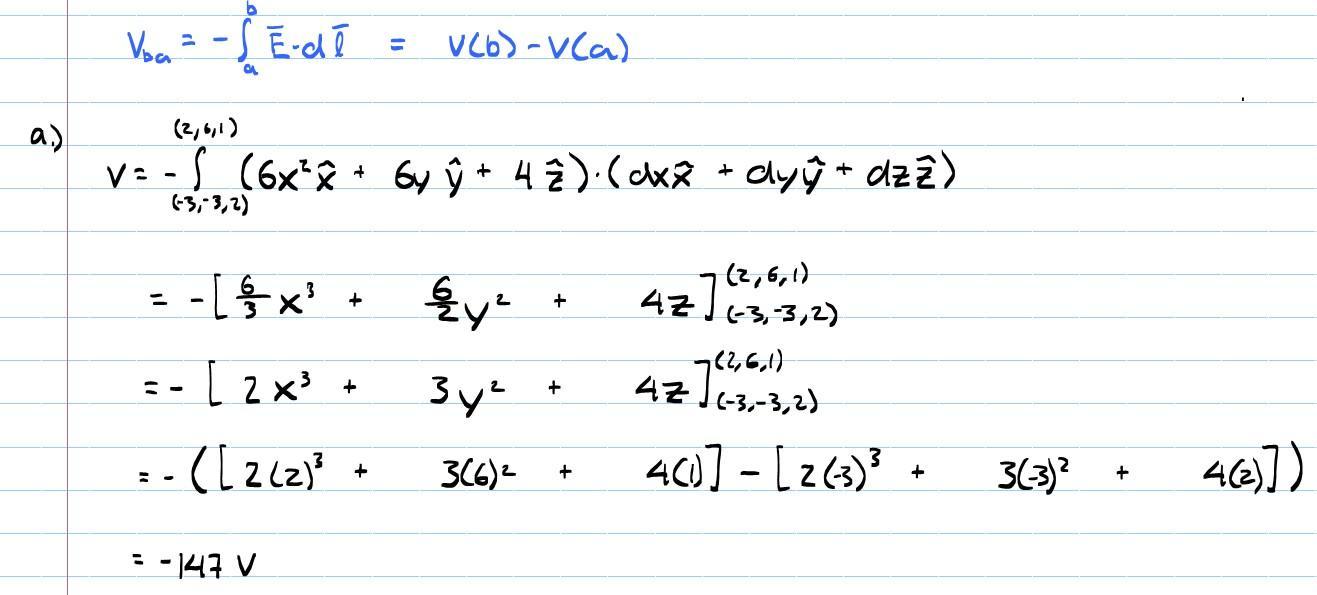
An electric field is expressed in rectangular coordinates by E = 6x2ax + 6y ay +4az V/m.Find:a) VMN if point M and N are specifi
Fittoniya [83]

Answer:

a.) -147V

b.) -120V

c.) 51V

Explanation:

a.) Equation for potential difference is the integral of the electrical field from a to b for the voltage V_ba = V(b)-V(a).

b.) The problem becomes easier to solve if you draw out the circuit. Since potential at Q is 0, then Q is at ground. So voltage across V_MQ is the same as potential at V_M.

c.) Same process as part b. Draw out the circuit and you'll see that the potential a point V_N is the same as the voltage across V_NP added with the 2V from the other box.

Honestly, these things take practice to get used to. It's really hard to explain this.

3 0
2 years ago
referring to either the CMS file or code book index, what is the cross reference for reduction of a dislocation?
Oksi-84 [34.3K]

Answer:

reposition

Explanation:

if you go to your icd 10 pcs index located on page 1 then  look up reduction the subterm is of a dislocation which leads you to the answer reposition

4 0
2 years ago
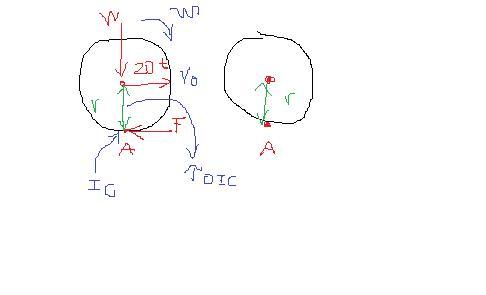
The 30-kg gear is subjected to a force of P=(20t)N where t is in seconds. Determine the angular velocity of the gear at t=4s sta
tatyana61 [14]

Answer:

\omega =\frac{24}{1.14375}=20.983\frac{rad}{s}

Explanation:

Previous concepts

Angular momentum. If we consider a particle of mass m, with velocity v, moving under the influence of a force F. The angular  momentum about point O is defined as the “moment” of the particle’s linear momentum, L, about O. And the correct formula is:

H_o =r x mv=rxL

Applying Newton’s second law to the right hand side of the above equation, we have that r ×ma = r ×F =

MO, where MO is the moment of the force F about point O. The equation expressing the rate of change  of angular momentum is this one:

MO = H˙ O

Principle of Angular Impulse and Momentum

The equation MO = H˙ O gives us the instantaneous relation between the moment and the time rate of change of angular  momentum. Imagine now that the force considered acts on a particle between time t1 and time t2. The equation MO = H˙ O can then be integrated in time to obtain this:

\int_{t_1}^{t_2}M_O dt = \int_{t_1}^{t_2}H_O dt=H_0t2 -H_0t1

Solution to the problem

For this case we can use the principle of angular impulse and momentum that states "The mass moment of inertia of a gear about its mass center is I_o =mK^2_o =30kg(0.125m)^2 =0.46875 kgm^2".

If we analyze the staritning point we see that the initial velocity can be founded like this:

v_o =\omega r_{OIC}=\omega (0.15m)

And if we look the figure attached we can use the point A as a reference to calculate the angular impulse and momentum equation, like this:

H_Ai +\sum \int_{t_i}^{t_f} M_A dt =H_Af

0+\sum \int_{0}^{4} 20t (0.15m) dt =0.46875 \omega + 30kg[\omega(0.15m)](0.15m)

And if we integrate the left part and we simplify the right part we have

1.5(4^2)-1.5(0^2) = 0.46875\omega +0.675\omega=1.14375\omega

And if we solve for \omega we got:

\omega =\frac{24}{1.14375}=20.983\frac{rad}{s}

8 0
2 years ago
A thermal energy storage unit consists of a large rectangular channel, which is well insulated on its outer surface and encloses
yaroslaw [1]

Answer:

the temperature of the aluminum at this time is 456.25° C

Explanation:

Given that:

width w of the aluminium slab = 0.05 m

the initial temperature T_1 = 25° C

T{\infty} =600^0C

h = 100 W/m²

The properties of Aluminium at temperature of 600° C by considering the conditions for which the storage unit is charged; we have ;

density ρ = 2702 kg/m³

thermal conductivity k = 231 W/m.K

Specific heat c = 1033 J/Kg.K

Let's first find the Biot Number Bi which can be expressed by the equation:

Bi = \dfrac{hL_c}{k} \\ \\ Bi = \dfrac{h \dfrac{w}{2}}{k}

Bi = \dfrac{hL_c}{k} \\ \\ Bi = \dfrac{100 \times \dfrac{0.05}{2}}{231}

Bi = \dfrac{2.5}{231}

Bi = 0.0108

The time constant value \tau_t is :

\tau_t = \dfrac{pL_cc}{h} \\ \\ \tau_t = \dfrac{p \dfrac{w}{2}c}{h}

\tau_t = \dfrac{2702* \dfrac{0.05}{2}*1033}{100}

\tau_t = \dfrac{2702* 0.025*1033}{100}

\tau_t = 697.79

Considering Lumped capacitance analysis since value for Bi is less than 1

Then;

Q= (pVc)\theta_1 [1-e^{\dfrac {-t}{ \tau_1}}]

where;

Q = -\Delta E _{st} which correlates with the change in the internal energy of the solid.

So;

Q= (pVc)\theta_1 [1-e^{\dfrac {-t}{ \tau_1}}]= -\Delta E _{st}

The maximum value for the change in the internal energy of the solid  is :

(pVc)\theta_1 = -\Delta E _{st}max

By equating the two previous equation together ; we have:

\dfrac{-\Delta E _{st}}{\Delta E _{st}{max}}= \dfrac{  (pVc)\theta_1 [1-e^{\dfrac {-t}{ \tau_1}}]} { (pVc)\theta_1}

Similarly; we need to understand that the ratio of the energy storage to the maximum possible energy storage = 0.75

Thus;

0.75=  [1-e^{\dfrac {-t}{ \tau_1}}]}

So;

0.75=  [1-e^{\dfrac {-t}{ 697.79}}]}

1-0.75=  [e^{\dfrac {-t}{ 697.79}}]}

0.25 =  e^{\dfrac {-t}{ 697.79}}

In(0.25) =  {\dfrac {-t}{ 697.79}}

-1.386294361= \dfrac{-t}{697.79}

t = 1.386294361 × 697.79

t = 967.34 s

Finally; the temperature of Aluminium is determined as follows;

\dfrac{T - T _{\infty}}{T_1-T_{\infty}}= e ^ {\dfrac{-t}{\tau_t}}

\dfrac{T - 600}{25-600}= e ^ {\dfrac{-967.34}{697.79}

\dfrac{T - 600}{25-600}= 0.25

\dfrac{T - 600}{-575}= 0.25

T - 600 = -575 × 0.25

T - 600 = -143.75

T = -143.75 + 600

T = 456.25° C

Hence; the temperature of the aluminum at this time is 456.25° C

3 0
2 years ago
Other questions:
  • 3. (20 points) Suppose we wish to search a linked list of length n, where each element contains a key k along with a hash value
    7·1 answer
  • Which of the following is correct regarding the principal stresses and maximum in-plane shear stresses? a. Principal stresses ca
    14·1 answer
  • An excavation is at risk for cave-in and water accumulation because of the excess soil that has accumulated. What type of excava
    12·1 answer
  • A fireboat is to fight fires at coastal areas by drawing seawater with a density of 1030 kg/m through a 20-cm-diameter pipe at a
    13·1 answer
  • Python Homework
    12·1 answer
  • Two airstreams are mixed steadily and adiabatically. The first stream enters at 35°C and 30 percent relative humidity at a rate
    6·1 answer
  • A shaft consisting of a steel tube of 50-mm outer diameter is to transmit 100 kW of power while rotating at a frequency of 34 Hz
    7·1 answer
  • The total floor area of a building, including below-grade space but excluding unenclosed areas, measured from the exterior of th
    8·1 answer
  • NEEDS TO BE IN PYTHON:ISBN-13 is a new standard for indentifying books. It uses 13 digits d1d2d3d4d5d6d7d8d910d11d12d13 . The la
    15·1 answer
  • What are practical considerations you might encounter when you increase the moment of inertia (I) while keeping the cross-sectio
    13·1 answer
Add answer
Login
Not registered? Fast signup
Signup
Login Signup
Ask question!