answer.
Ask question
Login Signup
Ask question
All categories
  • English
  • Mathematics
  • Social Studies
  • Business
  • History
  • Health
  • Geography
  • Biology
  • Physics
  • Chemistry
  • Computers and Technology
  • Arts
  • World Languages
  • Spanish
  • French
  • German
  • Advanced Placement (AP)
  • SAT
  • Medicine
  • Law
  • Engineering
amid [387]
2 years ago
6

What properties should the head of a carpenter’s hammer possess? How would you manufacture a hammer head?

Engineering
1 answer:
BabaBlast [244]2 years ago
5 0

Properties of Carpenter's hammer possess

Explanation:

1.The head of a carpenter's hammer should possess the impact resistance, so that the chips do not peel off the striking face while working.

2.The hammer head should also be very hard, so that it does not deform while driving or eradicate any nails in wood.

3.Carpenter's hammer is used to impact smaller areas of an object.It can drive nails in the wood,can crush  the rock and shape the metal.It is not suitable for heavy work.

How hammer head is manufactured :

1.Hammer head is produced by metal forging process.

2.In this process metal is heated and this molten metal is placed in the cavities said to be dies.

3.One die is fixed and another die is movable.Ram forces the two dies under the forces which gives the metal desired shape.

4.The third process is repeated for several times.

You might be interested in
Small droplets of carbon tetrachloride at 68 °F are formed with a spray nozzle. If the average diameter of the droplets is 200 u
Licemer1 [7]

Answer:

the difference in pressure between the inside and outside of the droplets is 538 Pa

Explanation:

given data

temperature = 68 °F

average diameter = 200 µm

to find out

what is the difference in pressure between the inside and outside of the droplets

solution

we know here surface tension of carbon tetra chloride at 68 °F is get from table 1.6 physical properties of liquid that is

σ = 2.69 × 10^{-2} N/m

so average radius = \frac{diameter}{2} =  100 µm = 100 ×10^{-6} m

now here we know relation between pressure difference and surface tension

so we can derive difference pressure as

2π×σ×r = Δp×π×r²    .....................1

here r is radius and  Δp pressure difference and σ surface tension

Δp = \frac{2 \sigma }{r}    

put here value

Δp = \frac{2*2.69*10^{-2}}{100*10^{-6}}  

Δp = 538

so the difference in pressure between the inside and outside of the droplets is 538 Pa

7 0
2 years ago
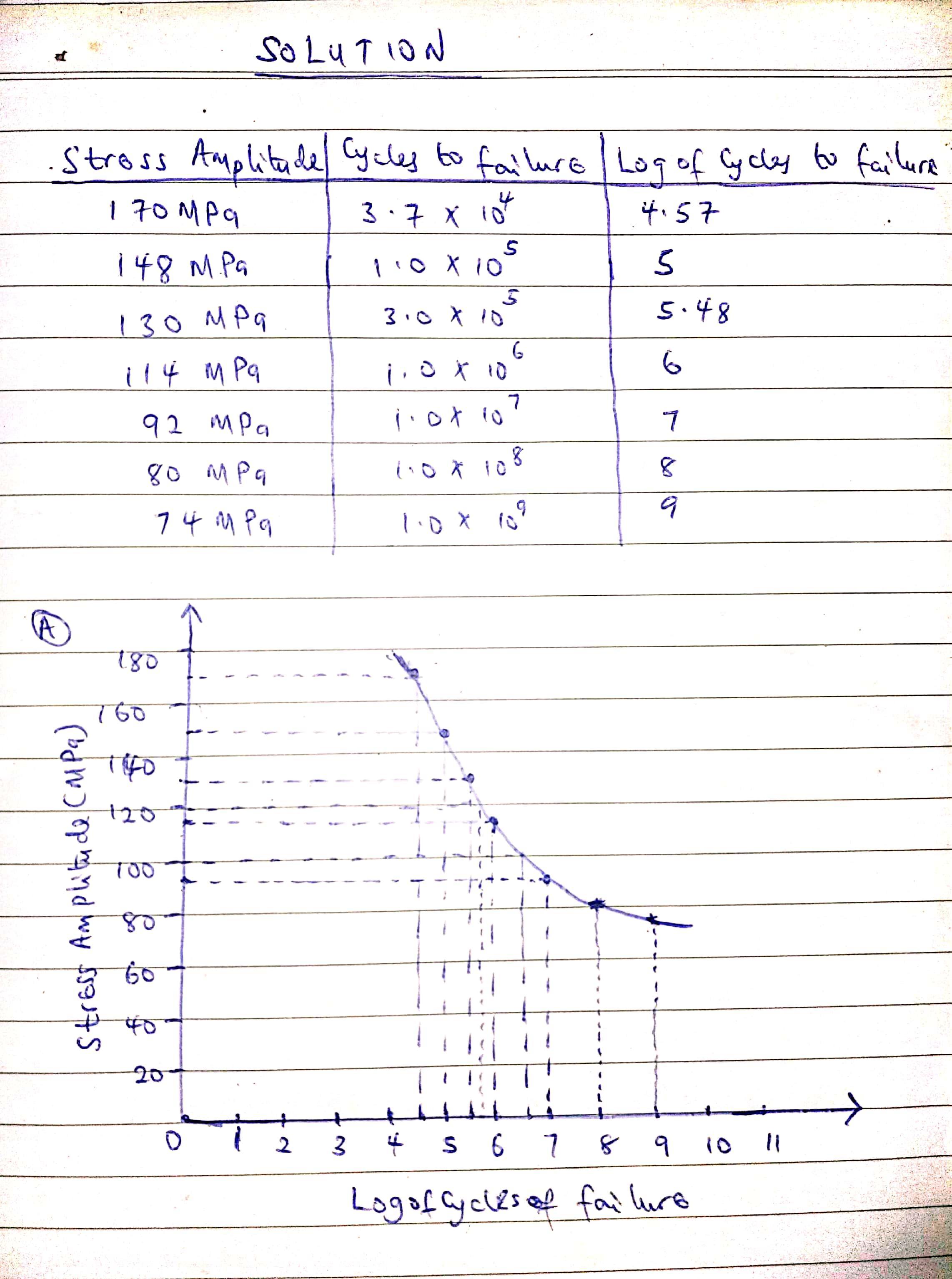
The fatigue data for a brass alloy are given as follows: Stress Amplitude (MPa) Cycles to Failure 170 3.7 × 10⁴ 148 1.0 × 10⁵ 13
prohojiy [21]

Answer:

i) S–N plot is attached

ii) fatigue strength = 100 MPa

iii) fatigue life = 5.62 x 10^(5) cycles

Explanation:

i) I have attached the S–N plot (stress amplitude versus logarithm of cycles to failure)

ii) The question says we should find the fatigue strength at 4 × 10^(6) cycles.

So let's find the log of this and trace it on the graph attached.

Log(4 × 10^(6)) = 6.6

From the graph attached, at log of cycle value of 6.6, the fatigue strength is approximately 100 MPa

iii) The question says we should find the fatigue life for 120 MPa.

Thus, from the graph, at stress amplitude of 120 MPa, the log of cycles is approximately 5.75.

Thus,the fatigue life will be the inverse log of 5.75.

Thus, fatigue life = 10^(5.75)

Fatigue life = 5.62 x 10^(5)

8 0
2 years ago
4. Water vapor enters a turbine operating at steady state at 1000oF, 220 lbf/in2 , with a volumetric flow rate of 25 ft3/s, and
hodyreva [135]
Yes i is the time of the day you get to frost the moon and back and then you can come over and then go to hang out with me me and then go to hang out
6 0
2 years ago
Consider insulation on a circular pipe For the same thickness and type of insulation, the thermal resistance of the insulation i
leonid [27]

Answer:

b). The same for all pipes independent of the diameter

Explanation:

We know,

R_{conduction}=\frac{ln(\frac{r_{2}}{r_{1}})}{2\pi LK}

R_{convection}=\frac{1}{h(2\pi r_{2}L)}

From the above formulas we can conclude that the thermal resistance of a substance mainly depends upon heat transfer coefficient,whereas radius has negligible effects on heat transfer coefficient.

We also know,

Factors on which thermal resistance of insulation depends are :

1. Thickness of the insulation

2. Thermal conductivity of the insulating material.

Therefore from above observation we can conclude that the thermal resistance of the insulation is same for all pipes independent of diameter.

5 0
2 years ago
Six years ago, an 80-kW diesel electric set cost $160,000. The cost index for this class of equipment six years ago was 187 and
exis [7]

Answer:

new boiler total cost = $229706.825

new boiler total cost = $127512

Explanation:

given data

power p1 = 80 kW

cost C = $160000

cost index CI 1 = 187

cost index CI 2= 194

cost capacity factor f = 0.6

power p2 = 120 kW

current cost = $18000

to find out

total cost and cost of 40 kW

solution

we consider here CN cost for new boiler and CO cost for old boiler

and x is capacity of new boiler

first we find old boiler current cost that is

current cost CO = C × \frac{CI 1 }{CI 2 }   .............1

put here value

current cost = 160000 × \frac{194 }{187 }

new current cost = $165989.304

and

use here power sizing technique for 124 kW

CN/CO = (\frac{p2}{p1} )^{f}    ...............2

put here value and find CN

CN/CO = (\frac{p2}{p1} )^{f}  

CN / 165989.304 = (\frac{120}{80} )^{0.6}  

CN = 211706.825

so new cost = $211706.825

so

total cost for new boiler is

total cost = new cost + current cost

total cost = 211706.825 + 18000

new boiler total cost = $229706.825

and

for 40 kW new cost will be

use equation 2

CN/CO = (\frac{p2}{p1} )^{f}

CN / 165989.304 = (\frac{40}{80} )^{0.6}  

CN = 109512

so new cost is $109512

so

total cost for new boiler is

total cost = new cost + current cost

total cost = 109512 + 18000

new boiler total cost = $127512

7 0
2 years ago
Other questions:
  • 5. A typical paper clip weighs 0.59 g and consists of BCC iron. Calculate (a) the number of
    5·1 answer
  • An excavation is at risk for cave-in and water accumulation because of the excess soil that has accumulated. What type of excava
    12·1 answer
  • Why is it that dislocations play an important role in controlling the mechanical properties of metallic materials, however, they
    10·1 answer
  • Reconsider Couette flow between two parallel plates as derived in class, but with the top plate moving with a known velocity +i
    13·1 answer
  • Consider water at 27°C in parallel flow over an isothermal, 1‐m‐long flat plate with a velocity of 2 m/s. a) Plot the variation
    15·1 answer
  • A piston-cylinder assembly contains 2 lb of air at a temperature of 540 °R and a pressure of 1 atm. The air compressed to a stat
    5·1 answer
  • The total floor area of a building, including below-grade space but excluding unenclosed areas, measured from the exterior of th
    8·1 answer
  • The u velocity component of a steady, two-dimensional, incompressible flow field is u = 3 ax 2 - 2 bxy, where a and b are consta
    6·1 answer
  • Air ows steadily in a thermally insulated pipe with a constant diameter of 6.35 cm, and an average friction factor of 0.005. At
    5·1 answer
  • A rectangular channel 3.0 m wide has a flow rate of 5.0 m3/s with a normal depth of 0.50 m. The flow then encounters a dam that
    9·1 answer
Add answer
Login
Not registered? Fast signup
Signup
Login Signup
Ask question!