answer.
Ask question
Login Signup
Ask question
All categories
  • English
  • Mathematics
  • Social Studies
  • Business
  • History
  • Health
  • Geography
  • Biology
  • Physics
  • Chemistry
  • Computers and Technology
  • Arts
  • World Languages
  • Spanish
  • French
  • German
  • Advanced Placement (AP)
  • SAT
  • Medicine
  • Law
  • Engineering
valentinak56 [21]
2 years ago
13

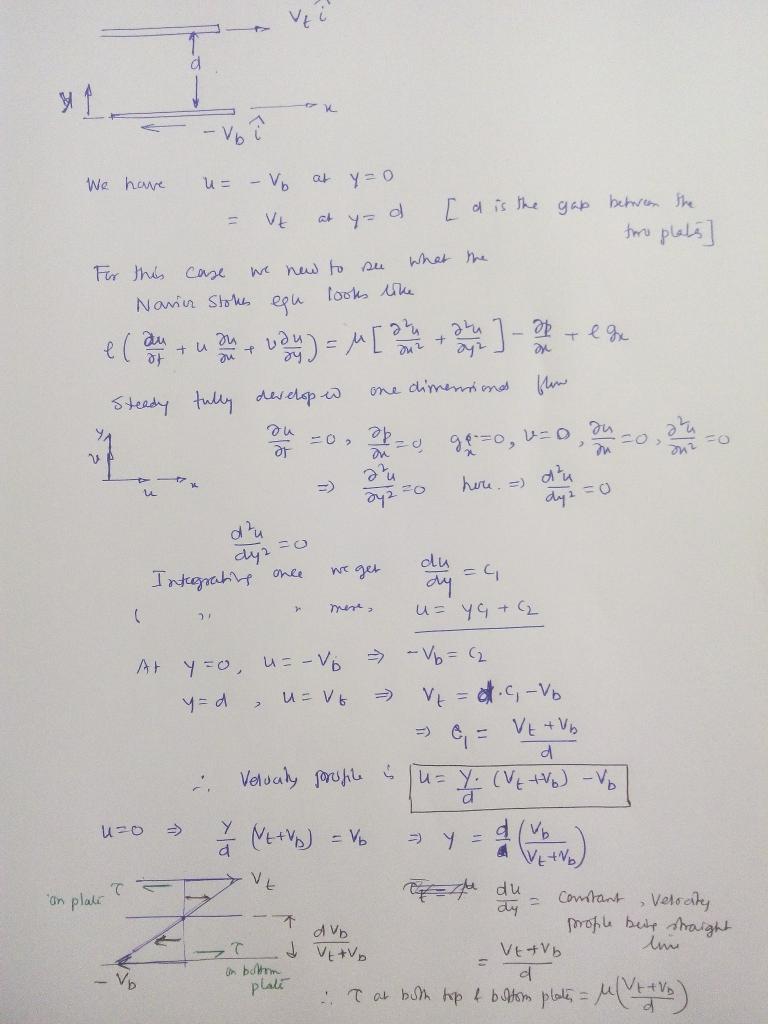
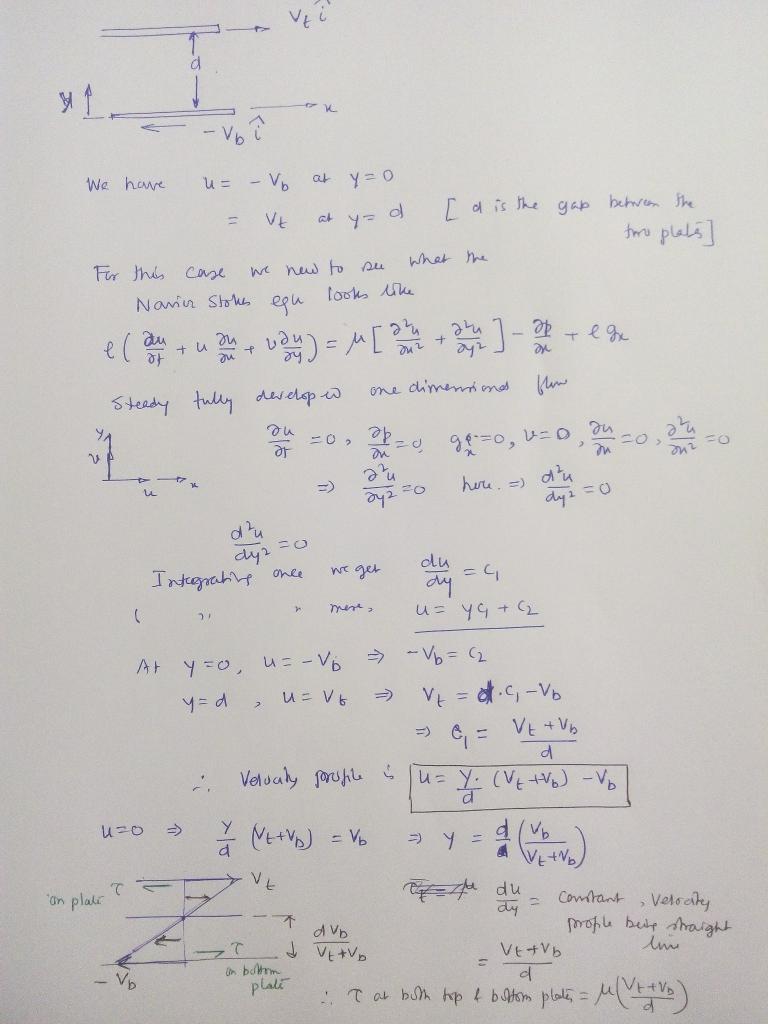
Reconsider Couette flow between two parallel plates as derived in class, but with the top plate moving with a known velocity +i

and the bottom plate is moving with a known velocity of-Vi,i. Derive the velocity field in the fluid layer.
Calculate the shear stress vector that the fluid exerts onto the top and bottom plates. Assume steady flow, incompressible, 2D, fully developed, no pressure gradient in the x direction. Fluid density and viscosity can also be treated as known.

Engineering
1 answer:
Sloan [31]2 years ago
6 0

Answer:

Go through the solution attached. It is very detailed.

Explanation:

You might be interested in
1. A glass window of width W = 1 m and height H = 2 m is 5 mm thick and has a thermal conductivity of kg = 1.4 W/m*K. If the inn
emmasim [6.3K]

Answer:

1. \dot Q=19600\ W

2. \dot Q=120\ W

Explanation:

1.

Given:

  • height of the window pane, h=2\ m
  • width of the window pane, w=1\ m
  • thickness of the pane, t=5\ mm= 0.005\ m
  • thermal conductivity of the glass pane, k_g=1.4\ W.m^{-1}.K^{-1}
  • temperature of the inner surface, T_i=15^{\circ}C
  • temperature of the outer surface, T_o=-20^{\circ}C

<u>According to the Fourier's law the rate of heat transfer is given as:</u>

\dot Q=k_g.A.\frac{dT}{dx}

here:

A = area through which the heat transfer occurs = 2\times 1=2\ m^2

dT = temperature difference across the thickness of the surface = 35^{\circ}C

dx = t = thickness normal to the surface = 0.005\ m

\dot Q=1.4\times 2\times \frac{35}{0.005}

\dot Q=19600\ W

2.

  • air spacing between two glass panes, dx=0.01\ m
  • area of each glass pane, A=2\times 1=2\ m^2
  • thermal conductivity of air, k_a=0.024\ W.m^{-1}.K^{-1}
  • temperature difference between the surfaces, dT=25^{\circ}C

<u>Assuming layered transfer of heat through the air and the air between the glasses is always still:</u>

\dot Q=k_a.A.\frac{dT}{dx}

\dot Q=0.024\times 2\times \frac{25}{0.01}

\dot Q=120\ W

5 0
2 years ago
Six years ago, an 80-kW diesel electric set cost $160,000. The cost index for this class of equipment six years ago was 187 and
exis [7]

Answer:

new boiler total cost = $229706.825

new boiler total cost = $127512

Explanation:

given data

power p1 = 80 kW

cost C = $160000

cost index CI 1 = 187

cost index CI 2= 194

cost capacity factor f = 0.6

power p2 = 120 kW

current cost = $18000

to find out

total cost and cost of 40 kW

solution

we consider here CN cost for new boiler and CO cost for old boiler

and x is capacity of new boiler

first we find old boiler current cost that is

current cost CO = C × \frac{CI 1 }{CI 2 }   .............1

put here value

current cost = 160000 × \frac{194 }{187 }

new current cost = $165989.304

and

use here power sizing technique for 124 kW

CN/CO = (\frac{p2}{p1} )^{f}    ...............2

put here value and find CN

CN/CO = (\frac{p2}{p1} )^{f}  

CN / 165989.304 = (\frac{120}{80} )^{0.6}  

CN = 211706.825

so new cost = $211706.825

so

total cost for new boiler is

total cost = new cost + current cost

total cost = 211706.825 + 18000

new boiler total cost = $229706.825

and

for 40 kW new cost will be

use equation 2

CN/CO = (\frac{p2}{p1} )^{f}

CN / 165989.304 = (\frac{40}{80} )^{0.6}  

CN = 109512

so new cost is $109512

so

total cost for new boiler is

total cost = new cost + current cost

total cost = 109512 + 18000

new boiler total cost = $127512

7 0
2 years ago
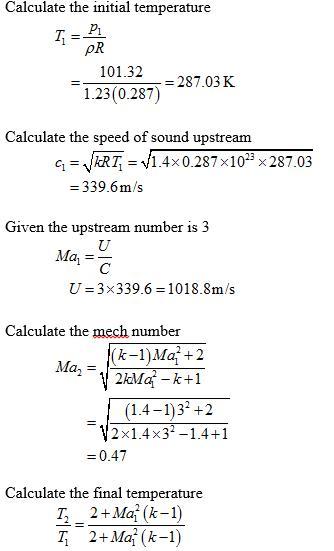
Consider a normal shock wave in air. The upstream conditions are given by M1=3, p1 = 1 atm, and r1 = 1.23 kg/m3. Calculate the d
mart [117]

Answer and Explanation:

The answer is attached below

7 0
2 years ago
The ingredient weights for making 1 yd (cyd) of concrete by assuming aggregates in SSD state are given below. The volume of air
Pachacha [2.7K]

Answer:

Explanation:

Ans) Given batch weight of each component :

Cement = 700 lb

Water = 315 lb

Coarse aggregate = 1575 lb

Fine aggregate = 1100 lb

Part 1) Amount of water = 328.5 lb

Amount of water is needed to be increased if the aggregates has absorption capacity, To maintain constant water cement ratio, the mixing water is increased because some of the water is absorbed by aggregates.

Amount of water absorbed = 328.5 lb - 315 lb = 13.5 lb

Total amount of aggregates = 1575 + 1100 = 2675 lb

=> % Absorption capacity = 13.5 x 100 / 2675 = 0.5 %

Hence, new amount of Coarse aggregate = (1 - 0.005) x 1575 lb = 1567.125 lb

New amount of fine aggregate = (1 - 0.005) x 1100 = 1094.5 lb

Since, water cement ratio is maintained constant , amount of cement remains unchanged

=> Volume of water = 328.5 / 62.4 = 5.26 ft3

=> Volume of cement = 700 / (3.15 x 62.4) = 3.56 ft3

=> Volume of coarse aggregate = 1567.125 / (2.4 x 62.4) = 10.46 ft3

=> Volume of fine aggregate = 1100 / (2.4 x 62.4) = 7.34 ft3

Volume of air = 2% = 0.02 x 27 = 0.54 ft3

Total concrete volume = 5.26 + 3.56 + 10.46 + 7.34 + 0.54 \approx 27 ft3 = 1 yd3

Hence, calculated amount of each component is correct

Part 2) We know, minus sign indicated that the aggregate will absorb some moisture from concrete, hence mixing water amount needed to be corrected .

=> Amount of water absorbed by coarse aggregate = 0.01 x 1567.125 lb = 15.67 lb

=> Amount of water absorbed by fine aggregate = 0.02 x 1094.50 lb = 21.89 lb

Total amount of water absorbed = 15.67 + 21.89 = 37.56 lb

To maintain same water cement ratio, amount of mixing water is needed to be increased

=> Corrected amount of mixing water = 328.5 lb + 37.56 lb = 366 lb

=> Corrected amount of coarse aggregate = (1 - 0.01) x 1567.125 = 1551.45 lb

=> Corrected amount of fine aggregate = (1 - 0.02) x 1094.5 = 1072.6 lb

Part 3) We know,

Unit weight = Sum of weight of each material / Total volume

=> Sum of weight = 366 + 700 + 1551.45 + 1072.6 = 3690.05 lb

Total volume = 1 yd3 or 27 ft3

=> Expected Unit Weight = 3690.05 lb / 27 ft3 = 136.67 lb/ft3

Also, Concrete Yield = Weight of all components / Unit weight of concrete

=> Yield = 3690.05 / 136.67 = 27 ft3 or 1 yd3
4 0
2 years ago
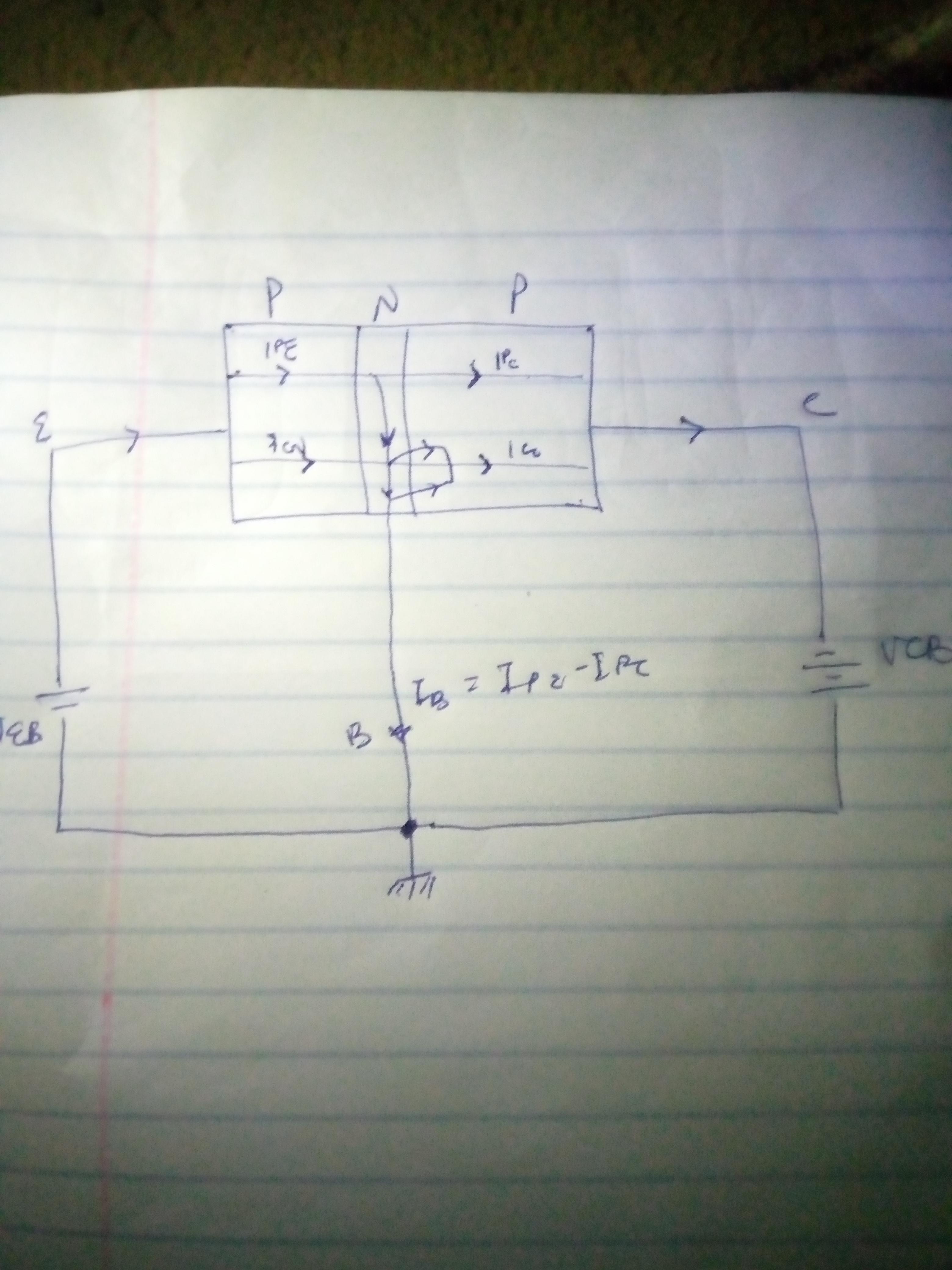
For a p-n-p BJT with NE 7 NB 7 NC, show the dominant current components, with proper arrows, for directions in the normal active
Sonja [21]

Answer:

=> base transport factor = 0.98.

=> emitter injection efficiency = 0.99.

=> common-base current gain = 0.97.

=> common-emitter current gain = 32.34.

=> ICBO = 1 × 10^-6 A.

=> base transit time = 0.325.

=> lifetime = 1.875.

Explanation:

(Kindly check the attachment for the diagram showing the dominant current components, with proper arrows, for directions in the normal active mode).

The following parameters or data are given for a p-n-p BJT with NE 7 NB 7 NC and they are: IEp = 10 mA, IEn = 100 mA, ICp = 9.8 mA, and ICn = 1 mA.

(1). The base transport factor = ICp/IEp=9.8/10 =  0.98.

(2). emitter injection efficiency =IEp/ IEp + ICn = 10/10 + 0.1 =  0.99.

(3).common-base current gain = 0.98 × 0.99 = 0.9702.

(4).common-emitter current gain =0.97 / 1- 0.97  = 32.34.

(5). Icbo = Ico = 1 × 10^-6 A.

(6). base transit time = 1248 × 10^-2 × (1.38× 10^-23/1.603 × 10^-19). = 0.325.

(7).lifetime;

= > 2 = √0.325 + √ lifetime.

= Lifetime = 2.875.

6 0
2 years ago
Other questions:
  • The hot water needs of an office are met by heating tab water by a heat pump from 16 C to 50 C at an average rate of 0.2 kg/min.
    5·1 answer
  • ) A shaft encoder is to be used with a 50 mm radius tracking wheel to monitor linear displacement. If the encoder produces 256 p
    15·1 answer
  • Air whose density is 0.082 lbm/ft3 enters the duct of an air-conditioning system at a volume flow rate of 450 ft3/min. If the di
    8·2 answers
  • 15. A cold-chamber die-casting machine operates automatically, supported by two industrial robots.The machine produces two zinc
    9·2 answers
  • With thermodynamics, one cannot determine ________.
    14·1 answer
  • Q5. A hypothetical metal alloy has a grain diameter of 2.4 x 10⁻² mm. After a heat treatment at 575°C for 500 min, the grain dia
    7·1 answer
  • Technician A says that TSBs are typically updates to the owner's manual. Technician B says that TSBs are generally
    11·1 answer
  • 2.24 Carbon dioxide (CO2) gas in a piston-cylinder assembly undergoes three processes in series that begin and end at the same s
    6·1 answer
  • According to the EWR specifications, ___ is responsible for picking up and disposing of debris or rubbish from
    15·1 answer
  • Find the velocity and rate of flow of water through a rectangular channel of 6m wide and 3m deep when it's running full. The cha
    13·1 answer
Add answer
Login
Not registered? Fast signup
Signup
Login Signup
Ask question!