answer.
Ask question
Login Signup
Ask question
All categories
  • English
  • Mathematics
  • Social Studies
  • Business
  • History
  • Health
  • Geography
  • Biology
  • Physics
  • Chemistry
  • Computers and Technology
  • Arts
  • World Languages
  • Spanish
  • French
  • German
  • Advanced Placement (AP)
  • SAT
  • Medicine
  • Law
  • Engineering
Alenkinab [10]
2 years ago
8

The ingredient weights for making 1 yd (cyd) of concrete by assuming aggregates in SSD state are given below. The volume of air

is 2% of the total concrete volume. Coarse Aggregates: 1,575 lb; Fine Aggregates: 1,100 lb; Cement: 700 lb; Water: 315 lb Given, the BSGssp of both coarse and fine aggregates is 2.4, specific gravity of cement is 3.15 and the density of water is 62.4 lb/ft?. 1 yd = 3 ft. Part 1: After performing a trial batch, it is determined that we need to increase the mix water content from 315 lb to 328.5 lb to correct the slump. For the same ingredients, recalculate all the ingredient weights in SSD state to achieve the concrete with the same compressive strength. Assume the same volume of air. If you state in your solution that the weight of a particular ingredient remains the same before and after the mix redesign, clearly state the reason behind your assumption for full credit. Note: You do NOT need any mix design table for solving this problem. Part 2: If the moisture content of coarse aggregates is -1% (note the minus sign) and the moisture content of fine aggregates is -2% (note the minus sign), determine the batch weights (also called stockpile or stock weights) of all ingredients for the redesigned concrete of Part 1. Part 3: Determine the expected unit weight and yield of the redesigned concrete of Part 1.
Engineering
1 answer:
Pachacha [2.7K]2 years ago
4 0

Answer:

Explanation:

Ans) Given batch weight of each component :

Cement = 700 lb

Water = 315 lb

Coarse aggregate = 1575 lb

Fine aggregate = 1100 lb

Part 1) Amount of water = 328.5 lb

Amount of water is needed to be increased if the aggregates has absorption capacity, To maintain constant water cement ratio, the mixing water is increased because some of the water is absorbed by aggregates.

Amount of water absorbed = 328.5 lb - 315 lb = 13.5 lb

Total amount of aggregates = 1575 + 1100 = 2675 lb

=> % Absorption capacity = 13.5 x 100 / 2675 = 0.5 %

Hence, new amount of Coarse aggregate = (1 - 0.005) x 1575 lb = 1567.125 lb

New amount of fine aggregate = (1 - 0.005) x 1100 = 1094.5 lb

Since, water cement ratio is maintained constant , amount of cement remains unchanged

=> Volume of water = 328.5 / 62.4 = 5.26 ft3

=> Volume of cement = 700 / (3.15 x 62.4) = 3.56 ft3

=> Volume of coarse aggregate = 1567.125 / (2.4 x 62.4) = 10.46 ft3

=> Volume of fine aggregate = 1100 / (2.4 x 62.4) = 7.34 ft3

Volume of air = 2% = 0.02 x 27 = 0.54 ft3

Total concrete volume = 5.26 + 3.56 + 10.46 + 7.34 + 0.54 \approx 27 ft3 = 1 yd3

Hence, calculated amount of each component is correct

Part 2) We know, minus sign indicated that the aggregate will absorb some moisture from concrete, hence mixing water amount needed to be corrected .

=> Amount of water absorbed by coarse aggregate = 0.01 x 1567.125 lb = 15.67 lb

=> Amount of water absorbed by fine aggregate = 0.02 x 1094.50 lb = 21.89 lb

Total amount of water absorbed = 15.67 + 21.89 = 37.56 lb

To maintain same water cement ratio, amount of mixing water is needed to be increased

=> Corrected amount of mixing water = 328.5 lb + 37.56 lb = 366 lb

=> Corrected amount of coarse aggregate = (1 - 0.01) x 1567.125 = 1551.45 lb

=> Corrected amount of fine aggregate = (1 - 0.02) x 1094.5 = 1072.6 lb

Part 3) We know,

Unit weight = Sum of weight of each material / Total volume

=> Sum of weight = 366 + 700 + 1551.45 + 1072.6 = 3690.05 lb

Total volume = 1 yd3 or 27 ft3

=> Expected Unit Weight = 3690.05 lb / 27 ft3 = 136.67 lb/ft3

Also, Concrete Yield = Weight of all components / Unit weight of concrete

=> Yield = 3690.05 / 136.67 = 27 ft3 or 1 yd3

You might be interested in
Water at 200C flows through a pipe of 10 mm diameter pipe at 1 m/s. Is the flow Turbulent ? a. Yes b. No
Degger [83]

Answer:

Yes, the flow is turbulent.

Explanation:

Reynolds number gives the nature of flow. If he Reynolds number is less than 2000 then the flow is laminar else turbulent.

Given:

Diameter of pipe is 10mm.

Velocity of the pipe is 1m/s.

Temperature of water is 200°C.

The kinematic viscosity at temperature 200°C is 1.557\times10^{-7}m2/s.

Calculation:

Step1

Expression for Reynolds number is given as follows:

Re=\frac{vd}{\nu}

Here, v is velocity, \nu is kinematic viscosity, d is diameter and Re is Reynolds number.

Substitute the values in the above equation as follows:

Re=\frac{vd}{\nu}

Re=\frac{1\times(10mm)(\frac{1m}{1000mm})}{1.557\times10^{-7}}

Re=64226.07579

Thus, the Reynolds number is 64226.07579. This is greater than 2000.

Hence, the given flow is turbulent flow.

5 0
2 years ago
Radioactive wastes are temporarily stored in a spherical container, the center of which is buried a distance of 10 m below the e
puteri [66]

Given:

outer radius, R' = 10 m

inner diameter, d = 2 m

inner radius, R = \frac{d}{2} = 1 m

surface temperature, T' = 20^{\circ}C

Thermal conductivity of soil, K = 0.52 W/mK

Solution:

To calculate the thermal temperature of conductor, T, we know amount of heat, Q is given by :

Q =  \frac{T - T'}{\frac{R' - R}{4\pi KRR'}}

500 =  (T - 20)\frac{4\pi \times0.52\times 1\times 10}{10 - 1}

T = 68.86 +20 = 88.865^{\circ}C  

Therefore, outside surface temperature is 88.865^{\circ}C  

4 0
2 years ago
A railcar with an overall mass of 78,000 kg traveling with a speed vi is approaching a barrier equipped with a bumper consisting
sergij07 [2.7K]

Answer:

v₀ = 2,562 m / s  = 9.2 km/h

Explanation:

To solve this problem let's use Newton's second law

              F = m a = m dv / dt = m dv / dx dx / dt = m dv / dx v

              F dx = m v dv

We replace and integrate

            -β ∫ x³ dx = m ∫ v dv

            β x⁴/ 4 = m v² / 2

We evaluate between the lower (initial) integration limits v = v₀, x = 0 and upper limit v = 0 x = x_max

        -β (0- x_max⁴) / 4 = ½ m (v₀²2 - 0)

         x_max⁴ = 2 m /β   v₀²


Let's look for the speed that the train can have for maximum compression

         x_max = 20 cm = 0.20 m


         v₀ =√(β/2m)   x_max²

Let's calculate

          v₀ = √(640 106/2 7.8 104)    0.20²

          v₀ = 64.05  0.04

          v₀ = 2,562 m / s

          v₀ = 2,562 m / s (1lm / 1000m) (3600s / 1h)

          v₀ = 9.2 km / h

5 0
2 years ago
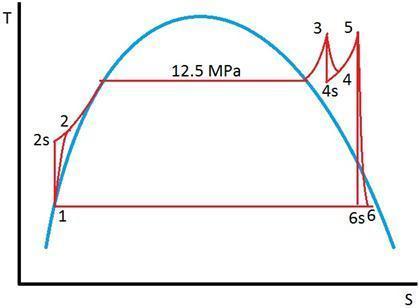
A steam power plant operates on the reheat Rankine cycle. Steam enters the highpressure turbine at 12.5 MPa and 550°C at a rate
gayaneshka [121]

Answer:

A) condenser pressure = 9.73 kPa,

B) 10242 kw

C) 36.9%

Explanation:

given data

entrance pressure of steam = 12.5 MPa

temperature of steam = 550⁰c

flow rate of steam = 7.7 kg/s

outer pressure = 2 MPa

reheated steam temperature = 450⁰c

isentropic efficiency of turbine( nt ) = 85% = 0.85

isentropic efficiency of pump = 90% = 0.90

From steam tables

at 12.5 MPa and 550⁰c ; h3 = 3476.5 kJ/kg,  S3 = 6.6317 kJ/kgK

also for an Isentropic expansion

S4s = S3 .

therefore when S4s = 6.6317 kJ/kg and P4 = 2 MPa

h4s = 2948.1 kJ/kg

nt = 0.85

nt (0.85) = \frac{h3-h4}{h3-h4s} = \frac{3476.5 - h4}{3476.5 - 2948.1}

making h4 subject of the equation

h4 = 3476.5 - 0.85 (3476.5 - 2948.1)

h4 = 3027.3 kj/kg

at P5 = 2 MPa and T5 = 450⁰c

h5 = 3358.2 kj/kg,  s5 = 7.2815 kj/kgk

at P6 , x6 = 0.95  and s5 = s6

using nt = 0.85 we can calculate for h6 and h6s

from the chart attached below we can see that

p6 = 9.73 kPa, h6 = 2463.3 kj/kg

B) the net power output

solution is attached below

c) thermal efficiency

thermal efficiency = 1 - \frac{qout}{qin} = 1 - ( 2273.7/ 3603.8) = 36.9% ≈ 37%

8 0
2 years ago
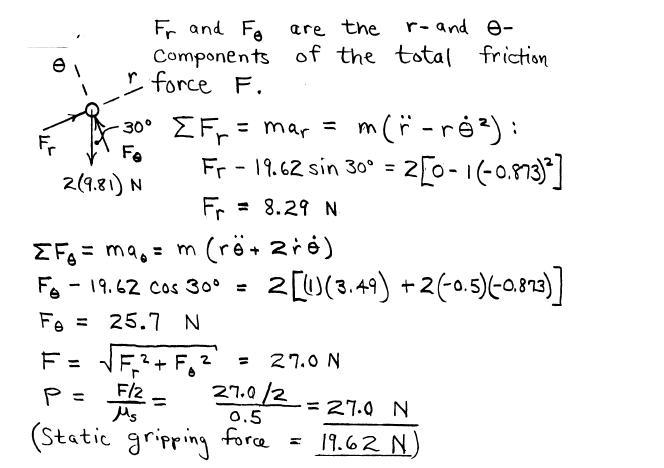
3/63 A 2‐kg sphere S is being moved in a vertical plane by a robotic arm. When the angle θ is 30°, the angular velocity of the a
miss Akunina [59]

Answer:

Ps=19.62N

Explanation:

The detailed explanation of answer is given in attached files.

5 0
2 years ago
Other questions:
  • 1. Which type of sketch most accurately represents what the finished product will look like?
    11·1 answer
  • A 0.9% solution of NaCl is considered isotonic to mammalian cells. what molar concentration is this?
    10·1 answer
  • ) A shaft encoder is to be used with a 50 mm radius tracking wheel to monitor linear displacement. If the encoder produces 256 p
    15·1 answer
  • Two physical properties that have a major influence on the cracking of workpieces, tools, or dies during thermal cycling are the
    13·1 answer
  • Check the answer that best describes the relationship between f(x) and x. (For example if f(x) is Θ(x) check that as your answer
    12·1 answer
  • The atomic radii of a divalent cation and a monovalent anion are 0.77 nm and 0.136 nm, respectively.1- Calculate the force of at
    11·1 answer
  • The rigid beam is supported by a pin at C and an A992 steel guy wire AB of length 6 ft. If the wire has a diameter of 0.2 in., d
    14·1 answer
  • Find the largest number. The process of finding the maximum value (i.e., the largest of a group of values) is used frequently in
    6·1 answer
  • According to the EWR specifications, ___ is responsible for picking up and disposing of debris or rubbish from
    15·1 answer
  • Who can work on a fixed ladder that extends more than 24 feet?
    11·1 answer
Add answer
Login
Not registered? Fast signup
Signup
Login Signup
Ask question!